

The Paradigm Shift: From Human-Triage to Machine-Speed Mitigation
For years, the cybersecurity industry has operated under a fundamental imbalance: attacks move at machine speed, while defense operates at human speed. Even the most advanced Security Operations Centers (SOCs) relying on modern Security Information and Event Management (SIEM) and Security Orchestration, Automation, and Response (SOAR) platforms remain bottlenecked by human triaging. When an alert fires, a human analyst must still validate the threat, investigate its blast radius, and manually execute a playbook. This reactive posture is no longer viable in an era of automated, multi-stage exploits that can compromise an entire cloud tenant in minutes.
Microsoft’s announcement of Project Perception and the release of the MAI-Cyber-1-Flash model mark a major architectural milestone in resolving this imbalance. Rather than using artificial intelligence merely to summarize alerts, draft email notifications, or write basic KQL queries, this paradigm shift introduces closed-loop, multi-agent autonomous mitigation. By combining specialized, low-latency models with a structured multi-agent orchestration pattern, these technologies aim to move security from passive observation to autonomous, self-correcting action.
In my analysis of these developments, I see both immense promise and significant engineering challenges. Moving to autonomous mitigation requires a complete rethinking of trust boundaries, state management, and model routing.
Architectural Dissection of Project Perception's Tri-Agent Loop
At the core of Project Perception lies a tri-agent architecture designed to prevent the single-point-of-failure risks inherent in single-agent systems. When a single LLM agent is tasked with detecting, validating, and mitigating a threat, it is highly susceptible to confirmation bias and runaway execution loops. If the agent hallucinates a threat, it may execute destructive mitigation actions to "fix" a non-existent problem, resulting in self-inflicted denial-of-service attacks.
To mitigate this, Project Perception structures autonomous action around three distinct, specialized agent roles operating in a continuous, adversarial, and cooperative feedback loop: the Red Agent, the Blue Agent, and the Green Agent. This division of labor mirrors classic security operations but automates the interactions at millisecond scale.
The Red Agent (Offensive Validation)
When a telemetry source flags a potential anomaly, the Red Agent is activated. Its sole objective is to validate the vulnerability or active exploit. Instead of relying on static signatures, the Red Agent acts as an autonomous penetration tester. It dynamically generates safe, non-destructive payloads or queries to probe the target system and confirm if the reported vulnerability is genuinely exploitable or if an active intrusion path exists. For example, if an alert indicates a potential SQL injection vulnerability on an internal endpoint, the Red Agent will formulate benign SQL queries designed to test for input sanitization without exfiltrating data or damaging the database. By verifying the exploitability of an alert before triggering defensive actions, the Red Agent filters out false positives that would otherwise trigger disruptive mitigations.
The Blue Agent (Defensive Containment)
Once the Red Agent confirms a threat, the Blue Agent takes over. Its primary responsibility is containment and isolation. The Blue Agent analyzes the active telemetry, maps the blast radius, and formulates a mitigation strategy. This might involve dynamically generating a network isolation policy, revoking a compromised IAM token, or spinning down a compromised container. The Blue Agent does not execute these actions blindly; it translates its strategy into structured, declarative configurations (such as Kubernetes NetworkPolicies, AWS Security Groups, or Azure NSGs) and submits them to the execution queue. It must operate under strict constraints, ensuring that its proposed actions are minimal, targeted, and directly mapped to the identified threat vector.
The Green Agent (Operational Safety and Policy Enforcement)
The Green Agent acts as the safety valve and compliance engine of the loop. It represents the interests of platform engineering and business continuity. Before any action proposed by the Blue Agent is executed, the Green Agent evaluates the proposed mitigation against operational safety policies, service-level objectives (SLOs), and dependency graphs. For example, if the Blue Agent proposes isolating a database container, the Green Agent evaluates whether that database is a critical dependency for other production services. If the mitigation violates safety thresholds, the Green Agent rejects the action and forces the Blue Agent to calculate an alternative, less disruptive containment strategy (such as rate-limiting or rotating credentials instead of full isolation).
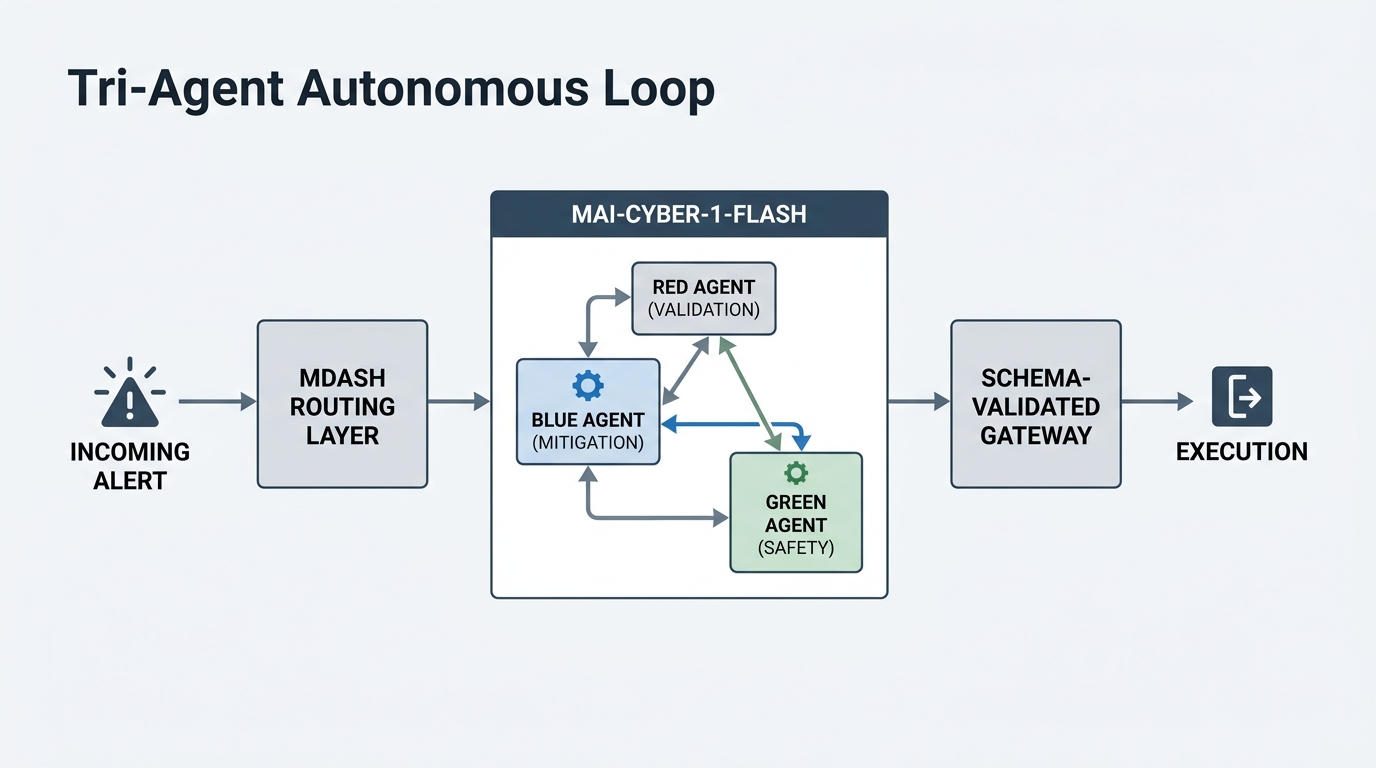
This tri-agent loop creates a self-balancing system. The adversarial tension between the Red Agent's validation, the Blue Agent's containment drive, and the Green Agent's safety constraints ensures that autonomous actions are both necessary and operationally safe. In my view, this separation of concerns is the only viable way to deploy autonomous agents in production environments without risking widespread operational downtime.
Deep Dive into MAI-Cyber-1-Flash and the MDASH Routing Pattern
Executing multi-agent loops in production requires a highly optimized model strategy. Standard frontier models, such as GPT-4o, are too slow and prohibitively expensive to run continuously across millions of security events. A typical security pipeline processes tens of thousands of events per second; routing all of these through a massive, general-purpose LLM would result in astronomical API bills and latency profiles that defeat the purpose of real-time mitigation.
This is where MAI-Cyber-1-Flash and the MDASH (Model-Driven Agent Security Handler) routing pattern become critical. MAI-Cyber-1-Flash is a specialized, high-throughput, low-latency model fine-tuned specifically on security ontologies, threat intelligence feeds, system call patterns, and network traffic logs.
MDASH acts as the intelligent traffic controller for this model ecosystem. It is a routing layer that evaluates incoming security tasks and dynamically assigns them to the most cost-effective and performant model capable of handling the task. The routing decision is based on three primary vectors: task complexity, latency budget, and required context window.
To understand how MDASH optimizes operations, consider the following routing tiers:
Tier 1: High-Volume Parsing and Filtering (Edge Routing) Incoming raw log streams and low-level alerts are routed to highly distilled, edge-optimized models or deterministic regex engines. No LLMs are invoked at this stage. This filters out 99% of background noise and ensures that downstream models are not overwhelmed by trivial telemetry.
Tier 2: Rapid Triaging and Schema Generation (MAI-Cyber-1-Flash) When an alert requires semantic understanding—such as analyzing a suspicious PowerShell script or parsing an unusual sequence of API calls—MDASH routes the task to MAI-Cyber-1-Flash. Because the model is small and specialized, it returns structured JSON outputs within milliseconds, allowing the Blue Agent to quickly formulate containment strategies.
Tier 3: Complex Threat Hunting and Root Cause Analysis (Frontier Models) If the threat is identified as a novel, multi-stage Advanced Persistent Threat (APT) spanning multiple cloud environments, MAI-Cyber-1-Flash may flag the task as highly complex. MDASH then escalates the context to a larger frontier model (such as GPT-4o or a specialized deep-reasoning model) to perform deep semantic analysis, cross-correlate disparate data sources, and generate a long-term remediation plan.
By leveraging this tiered routing, MDASH dramatically reduces the cost of autonomous security. I recommend implementing MDASH as a middleware layer in your security pipeline, ensuring that your expensive frontier model tokens are reserved strictly for high-cognitive-load reasoning tasks, while MAI-Cyber-1-Flash handles the high-velocity mitigation loops.
Engineering State Management and Cryptographic Trust Boundaries
Translating the theoretical tri-agent loop into a production-grade system requires solving two hard engineering problems: state management across asynchronous agent runs, and the enforcement of absolute trust boundaries.
Agents cannot be allowed to run statelessly. If an agent loop fails mid-execution or if a network partition occurs, the system must be able to reconstruct the exact state of the investigation and the mitigations already applied. I recommend utilizing a durable execution engine (such as Temporal) or a highly available, distributed state store (such as Redis) to maintain a centralized "Security Context Object" for every active incident. This object must track the lifecycle of the incident, including the initial alert telemetry, the Red Agent's validation results, the Blue Agent's proposed mitigations, the Green Agent's safety evaluations, and the execution status of the final payload.
Furthermore, you must never give an LLM agent raw shell access or unrestricted API keys to your cloud infrastructure. Agents must operate within a strict sandbox, interacting with your environment exclusively through a well-defined, schema-validated API gateway. The agent outputs a structured JSON payload describing its intended action; your gateway validates this payload against an OpenAPI schema, checks the agent's cryptographic signature, and executes the action using pre-authorized, least-privilege service accounts.
To prevent prompt injection attacks from hijacking your autonomous loop, I advise implementing cryptographic attestation. Every agent in the loop must sign its outputs using a dedicated Key Management Service (KMS) key. The execution gateway must verify these signatures before performing any action. If a malicious payload attempts to inject commands into a log file to trick the Blue Agent into deleting a database, the execution gateway will catch the unauthorized action because it will fail to match the expected schema or lack the necessary cryptographic attestation from the Green Agent.
Production-Grade Implementation of MDASH and Schema Validation
Below is a practical Python implementation of an MDASH-style routing and validation engine. This code demonstrates how to ingest an alert, route it to the appropriate model tier (simulating MAI-Cyber-1-Flash for standard threats), validate the agent's proposed mitigation against an explicit schema, and enforce a safety check before execution. This pattern ensures that even if the model generates an unexpected payload, the execution gateway catches it before it can cause operational damage.
import json
import os
from typing import Dict, Any
from pydantic import BaseModel, Field, ValidationError

# Define the expected schema for the Blue Agent's mitigation action
class MitigationAction(BaseModel):
    action_type: str = Field(..., description="The type of mitigation, e.g., 'isolate_host', 'revoke_token'")
    target_identifier: str = Field(..., description="The unique ID of the target resource")
    rationale: str = Field(..., description="The reasoning behind this mitigation action")
    risk_score: int = Field(..., ge=1, le=10, description="The operational risk score of the action")

class MDASHRouter:
    def __init__(self):
        # In a production system, these would point to actual model endpoints
        self.flash_model_endpoint = "https://api.microsoft.com/v1/mai-cyber-1-flash"
        self.frontier_model_endpoint = "https://api.microsoft.com/v1/gpt-4o"

def route_and_triage_alert(self, alert: Dict[str, Any]) -> str:
        """
        Evaluates the complexity of the incoming alert and routes to the correct model tier.
        """
        severity = alert.get("severity", "low").lower()
        contains_custom_code = alert.get("contains_custom_code", False)

# MDASH Routing Logic
        if severity == "critical" and contains_custom_code:
            print("[MDASH] Escalating complex threat to Frontier Model.")
            return self.frontier_model_endpoint
        else:
            print("[MDASH] Routing standard security alert to MAI-Cyber-1-Flash.")
            return self.flash_model_endpoint

class AutonomousSecurityCoordinator:
    def __init__(self, router: MDASHRouter):
        self.router = router
        # Define safety thresholds representing the Green Agent's policy engine
        self.max_allowable_risk = 7

def process_incident(self, alert: Dict[str, Any]) -> Dict[str, Any]:
        # 1. Route the alert using the MDASH pattern
        target_endpoint = self.router.route_and_triage_alert(alert)

        # 2. Simulate the model's structured JSON output (the Blue Agent's proposal)
        # In production, this JSON is returned by calling the target_endpoint with the alert context
        simulated_model_output = {
            "action_type": "isolate_host",
            "target_identifier": alert.get("resource_id", "unknown"),
            "rationale": "Host is communicating with known C2 IP address. Isolation required to prevent lateral movement.",
            "risk_score": 5
        }

# 3. Enforce strict schema validation on the agent's output
        try:
            validated_action = MitigationAction(**simulated_model_output)
            print(f"[Schema Validation] Passed. Action: {validated_action.action_type} on {validated_action.target_identifier}")
        except ValidationError as e:
            print(f"[Schema Validation] Failed! Agent output violated schema: {e}")
            return {"status": "rejected", "reason": "Schema validation failure"}

# 4. Green Agent Safety Check: Validate against operational risk threshold
        if validated_action.risk_score > self.max_allowable_risk:
            print(f"[Green Agent] REJECTED: Risk score {validated_action.risk_score} exceeds threshold of {self.max_allowable_risk}.")
            return {"status": "rejected", "reason": "Operational risk threshold exceeded"}

        # 5. Execute the mitigation via a secure API gateway (simulated)
        print(f"[Execution Gateway] Executing {validated_action.action_type} on target {validated_action.target_identifier}...")
        return {"status": "executed", "action": validated_action.action_type, "target": validated_action.target_identifier}

# Example Usage
if __name__ == "__main__":
    router = MDASHRouter()
    coordinator = AutonomousSecurityCoordinator(router)

# Test Case 1: Standard high-velocity alert
    standard_alert = {
        "id": "evt_10293",
        "severity": "high",
        "resource_id": "i-09f823bc81a",
        "contains_custom_code": False
    }
    print("--- Processing Standard Alert ---")
    result_1 = coordinator.process_incident(standard_alert)
    print(f"Result: {result_1}\n")

# Test Case 2: Complex critical alert requiring escalation
    complex_alert = {
        "id": "evt_10294",
        "severity": "critical",
        "resource_id": "lambda-auth-processor",
        "contains_custom_code": True
    }
    print("--- Processing Complex Alert ---")
    result_2 = coordinator.process_incident(complex_alert)
    print(f"Result: {result_2}")
This implementation highlights the necessity of deterministic validation. The validation step is entirely deterministic, providing a hard boundary around the non-deterministic nature of LLM outputs. I recommend integrating this validation logic directly into your CI/CD pipelines and runtime execution environments to ensure that no unvalidated agent actions can ever reach production systems.
Operational Realities: Human-in-the-Loop (HITL) and Deterministic Fallbacks
As you begin planning your migration toward autonomous security, you must accept that autonomy is not an all-or-nothing proposition. Attempting to deploy fully autonomous mitigation on day one is a recipe for operational disaster. Instead, you must implement a progressive trust model that transitions from human-in-the-loop (HITL) to human-on-the-loop (HOTL), and finally to full autonomy for specific, well-defined scenarios.
I recommend establishing a "Trust Tiering" framework for your security playbooks. Low-risk actions, such as isolating a single developer workstation, rotating a leaked API key on a non-production service, or blocking an IP address on an edge firewall, can be fully automated immediately. High-risk actions, such as modifying core database access controls, isolating production Kubernetes nodes, or revoking root-level IAM credentials, must require explicit human approval via a ChatOps interface (such as Slack or Microsoft Teams) before execution.
Additionally, your system must feature deterministic fallbacks. If an agent fails to reach a consensus, if the model times out, or if the state store becomes unavailable, the system must fail safely. This means falling back to traditional, deterministic SOAR playbooks or alerting a human engineer immediately. The autonomous loop should enhance your existing security controls, not replace them entirely. If the Green Agent detects that the Blue Agent's proposed action has a high risk score but the Red Agent insists the threat is critical, the system should automatically escalate the incident to a human analyst with all the gathered context, rather than stalling or executing a risky mitigation.
To help you evaluate your organization's readiness for autonomous mitigation, I have compiled a checklist of core operational guardrails that must be implemented before moving any agentic security workflows into production:
| Operational Guardrail | Technical Implementation | Objective |
|---|---|---|
| Cryptographic Attestation | Sign all agent-generated payloads with a dedicated KMS key. | Prevents prompt injection attacks from executing unauthorized actions directly on your API gateway. |
By systematically addressing each of these guardrails, you can build a resilient, self-defending infrastructure that dramatically reduces your Mean Time to Remediation (MTTR) while maintaining strict control over your system's operational stability.
Conclusion
The launch of Project Perception and MAI-Cyber-1-Flash represents a watershed moment in the evolution of cybersecurity. By moving beyond passive alert generation and embracing multi-agent autonomous loops, a viable path toward neutralizing threats at machine speed is established. However, the success of this paradigm shift depends entirely on the rigor of our engineering implementations.
As you begin designing your autonomous security roadmap, do not get caught up in the hype of fully autonomous, self-healing enterprises. Focus on the fundamentals: establish clear trust boundaries, implement the MDASH routing pattern to optimize latency and cost, enforce strict schema validation on all agent outputs, and maintain a robust human-in-the-loop safety valve. By taking a disciplined, phased approach to agentic automation, you can transform your security operations from a reactive bottleneck into a proactive, resilient, and self-defending system.