

The Architectural Shift: Moving Memory Safety to the Compiler
For over fifteen years, GPU programming has been defined by a Faustian bargain. To extract maximum throughput from massively parallel hardware, developers have tolerated an environment where a single misplaced pointer, out-of-bounds shared memory write, or subtle warp-level race condition can silently corrupt data or crash an entire cluster with imprecise hardware exceptions. In my experience auditing high-performance AI inference engines and custom simulation pipelines, debugging these issues is one of the most expensive engineering bottlenecks. Because GPU kernels execute asynchronously and at massive scale, reproducing a race condition or pinpointing a memory corruption event requires specialized, slow tooling like CUDA-MEMCHECK or Compute Sanitizer, which introduce massive runtime overhead.
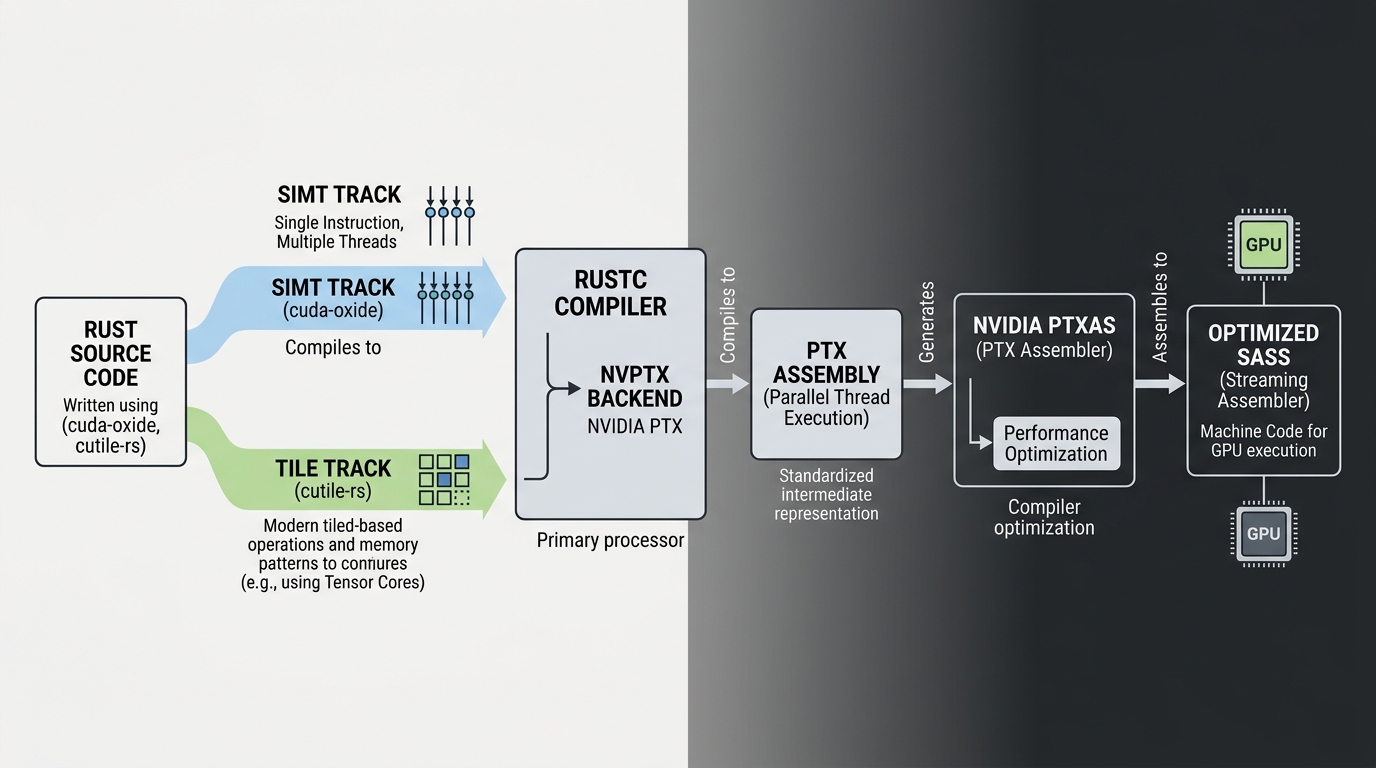
NVIDIA's introduction of CUDA Rust represents a structural shift in how we architect GPU software. By standardizing compile-time-safe GPU kernels through two distinct tracks—cuda-oxide for Single Instruction, Multiple Thread (SIMT) programming and cutile-rs for tile-based programming—NVIDIA is attempting to bring the safety guarantees of systems-level Rust directly to the GPU. This is not merely a cosmetic wrapper over CUDA C++; it is a fundamental re-engineering of the GPU programming model that leverages Rust’s type system, ownership model, and lifetime tracking to eliminate entire classes of runtime GPU bugs at compile time.
In this analysis, I evaluate the architectural mechanics of this new software stack, examine how cuda-oxide and cutile-rs enforce safety without sacrificing bare-metal performance, and provide my perspective on how engineering leaders should plan for this transition in their production pipelines.
To understand why CUDA Rust is a major milestone, we must first examine the architectural limitations of traditional CUDA C++. In a standard GPU execution model, thousands of threads run concurrently across multiple Streaming Multiprocessors (SMs). These threads organize into cooperative groups called warps (32 threads) and thread blocks (or Cooperative Thread Arrays, CTAs). They share several distinct memory spaces: global memory (high-latency, off-chip), shared memory (low-latency, on-chip scratchpad shared within a thread block), and local registers.
In C++, managing these memory spaces is entirely manual and highly error-prone. For instance, if thread A writes to a shared memory address while thread B reads from it without an explicit block-level synchronization barrier (__syncthreads()), a data race is introduced. If a thread calculates an out-of-bounds index for a shared memory array, it can overwrite data belonging to another thread block, leading to catastrophic, non-deterministic failures. The C++ compiler has no semantic understanding of these GPU-specific memory boundaries or execution barriers; it simply emits Parallel Thread Execution (PTX) assembly and trusts the developer to get the synchronization right.
CUDA Rust changes this paradigm by encoding the physical constraints of GPU execution directly into Rust's type system. The core compiler, rustc, coupled with the nvptx64-nvidia-cuda target triple, translates Rust’s strict safety invariants into PTX.
NVIDIA has split this effort into two highly specialized tracks to address different levels of abstraction:
cuda-oxide(SIMT Track): This track preserves the traditional thread-centric programming model of CUDA. Code is written from the perspective of a single thread, but the API uses Rust's borrow checker to enforce memory boundaries, validate pointer lifetimes across different memory spaces (global vs. shared vs. local), and prevent data races.cutile-rs(Tile Track): This track abandons thread-level indexing entirely in favor of a higher-level, structural abstraction. It models operations as transformations on multi-dimensional data "tiles" (e.g., $16 \times 16$ or $64 \times 64$ matrices). It is designed to target hardware-accelerated Tensor Cores and asynchronous copy engines directly, validating tile shapes, alignments, and memory layouts at compile time.
By splitting the stack this way, NVIDIA allows developers to choose between granular, low-level control (cuda-oxide) and highly optimized, mathematically structured tensor operations (cutile-rs). Both tracks share a common goal: ensuring that if a GPU kernel compiles, it is guaranteed to be free of memory safety violations and data races.
Deep Dive: cuda-oxide and SIMT Memory Safety
The fundamental challenge of writing a safe SIMT kernel in Rust is reconciling the language's single-ownership model with the reality of thousands of threads concurrently accessing shared memory. In Rust, multiple mutable references to the same memory location cannot exist simultaneously. Yet, in a GPU kernel, that is precisely what happens when multiple threads write to a shared memory buffer.
cuda-oxide resolves this tension through a combination of zero-cost wrapper types, explicit address space qualifiers, and compile-time barrier tracking. It introduces distinct type wrappers for different memory spaces, such as GlobalSlice<T>, SharedSlice<T>, and LocalSlice<T>. These types are parameterized by lifetimes that are tied to the execution scope of the block or the grid.
To prevent data races in shared memory, cuda-oxide enforces a strict compile-time state machine for shared memory access. A mutable reference to a SharedSlice cannot be obtained unless it is proved to the compiler that a synchronization barrier has occurred. This is achieved through "barrier tokens" or state-tracking types. When a synchronization function is called, it consumes a token representing an un-synchronized state and returns a new token representing a synchronized state, which unlocks access to the underlying data.
Let us look at how this works in practice. Below is an implementation of a safe vector addition and shared-memory block reduction kernel using cuda-oxide paradigms. This code demonstrates how to safely initialize shared memory, perform cooperative indexing, and enforce synchronization boundaries at compile time.
use cuda_oxide::kernel::prelude::*;
use cuda_oxide::memory::{GlobalSlice, SharedSlice};

#[kernel]
pub fn block_reduction_kernel<const BLOCK_SIZE: usize>(
    input: GlobalSlice<f32>,
    output: GlobalSlice<f32>,
    shared_scratch: SharedSlice<f32>,
) {
    let thread_id = thread::id_x() as usize;
    let block_id = block::id_x() as usize;
    let global_id = block_id * BLOCK_SIZE + thread_id;

    let val = if global_id < input.len() {
        input[global_id]
    } else {
        0.0
    };

    // Partition the shared slice so each thread gets a unique, non-overlapping view
    let mut local_shared = shared_scratch.split_to_thread(thread_id);
    local_shared.write(val);

    // Synchronize all threads in the block before reading
    block::synchronize();

    let mut s = BLOCK_SIZE / 2;
    while s > 0 {
        if thread_id < s {
            let neighbor_val = shared_scratch.read(thread_id + s);
            let current_val = shared_scratch.read(thread_id);
            shared_scratch.write(thread_id, current_val + neighbor_val);
        }
        block::synchronize();
        s /= 2;
    }

    if thread_id == 0 {
        output[block_id] = shared_scratch.read(0);
    }
}
In this kernel, SharedSlice::split_to_thread is a critical abstraction. It takes a shared memory slice and partitions it such that each thread receives a unique, non-overlapping mutable sub-slice. Because these sub-slices do not overlap, the Rust borrow checker allows concurrent writes without violating the aliasing XOR mutability rule. If you attempt to access another thread's partition without proper synchronization or partitioning, the compiler rejects the code.
Furthermore, cuda-oxide maps these high-level abstractions directly to PTX instructions without introducing runtime overhead. The GlobalSlice and SharedSlice structs compile down to raw pointers, and indexing operations compile to direct hardware memory offsets. The safety checks are entirely static; they exist solely during compilation to guide the compiler's verification pass and are completely erased in the final binary.
Deep Dive: cutile-rs and Tile-Based Abstractions
While cuda-oxide makes SIMT programming safe, it still requires developers to think in terms of individual threads, block indexing, and manual synchronization. For deep learning and linear algebra, this is often the wrong level of abstraction. Modern GPUs are optimized for matrix operations, featuring specialized hardware like Tensor Cores that operate on entire matrices (tiles) rather than individual scalar values.
This is where cutile-rs comes in. Inspired by NVIDIA's CUTLASS C++ library, cutile-rs models GPU programming as a sequence of high-level operations on multi-dimensional tiles. Instead of writing loops over thread indices, you define the shapes of your input, output, and accumulator tiles, and let the library handle the mapping to hardware threads, warps, and Tensor Cores.
Shape and Layout Validation at Compile Time
One of the most common sources of bugs in high-performance matrix multiplication (GEMM) kernels is shape mismatch. If your input tile dimensions do not align with your accumulator tile dimensions, or if your memory layout (row-major vs. column-major) is incorrectly specified, the hardware will read the wrong memory addresses, leading to garbage outputs or memory access violations.
cutile-rs solves this by encoding tile shapes and layouts directly into the type system using Rust's const generics. A tile is defined not just by its data type, but by its geometry and memory layout:
// A 128x64 tile of f16 values stored in Row-Major layout
type InputTile = Tile<f16, Shape<128, 64>, RowMajor>;
When you perform an operation, such as a tile-level matrix multiplication, the compiler enforces mathematical compatibility at compile time. If you attempt to pass a matrix with mismatched dimensions, the compilation fails immediately with a clear type mismatch error. You do not have to wait for a runtime crash or spend hours debugging numerical divergence in your model outputs.
Eliminating Bank Conflicts and Optimizing Asynchronous Copies
Shared memory on NVIDIA GPUs is divided into 32 equally sized memory banks. If multiple threads within a warp access addresses that map to the same bank simultaneously, a "bank conflict" occurs, and the hardware must serialize the accesses, severely degrading performance. To avoid this, C++ developers must manually pad their shared memory arrays (e.g., allocating a $16 \times 17$ array instead of $16 \times 16$) to shift the memory alignment.
In cutile-rs, layout transformations and padding are handled automatically by the type system. When you define a shared memory tile layout, cutile-rs applies compile-time layout swizzling. The library calculates the optimal memory layout based on the target hardware architecture, ensuring that thread-to-bank mappings are conflict-free.
Additionally, cutile-rs deeply integrates with NVIDIA's asynchronous copy engines (cp.async). These engines allow the GPU to copy data directly from global memory to shared memory without involving the register file or using thread execution resources. cutile-rs exposes this via safe, asynchronous pipeline abstractions. You can queue a tile-level copy, perform computations on a previous tile, and synchronize the copy pipeline only when the data is strictly needed, maximizing instruction-level parallelism and hardware utilization.
Operational Realities, Toolchain Integration, and Trade-offs
Transitioning to CUDA Rust is not a friction-free decision. While the safety and architectural benefits are clear, engineering leaders must balance these advantages against the operational realities of adopting a relatively young ecosystem.
Toolchain Integration
To compile CUDA Rust, you rely on the standard rustc compiler utilizing the LLVM NVPTX backend to emit PTX code. This PTX is then compiled to machine-specific binary code (SASS) by NVIDIA's ptxas compiler.
This pipeline introduces a few operational challenges:
- Debugging Symbols: While Rust emits standard DWARF debugging symbols, translating them through the PTX assembly phase to GPU-compatible formats can sometimes result in a degraded debugging experience in tools like NVIDIA Nsight.
- Compilation Times: Rust's borrow checker and heavy use of const generics for tile layout calculations place a significant burden on the compiler. Compile times for large GPU codebases can be noticeably longer than their C++ equivalents.
- Ecosystem Interoperability: Most existing deep learning frameworks (such as PyTorch or TensorFlow) and inference engines (like TensorRT) are built around C++ APIs. Integrating CUDA Rust kernels requires writing foreign function interface (FFI) bindings. While tools like
bindgenmake this manageable, it adds an extra layer of build-system complexity.
Comparing the Paradigms
To help you evaluate where each tool fits within your infrastructure, I have compiled a comparative analysis of the three primary GPU programming paradigms available on NVIDIA hardware today:
| Feature / Dimension | Traditional CUDA C++ | cuda-oxide (SIMT Track) |
cutile-rs (Tile Track) |
|---|---|---|---|
| Primary Abstraction | Thread-level indexing (threadIdx, blockIdx) |
Safe thread-level indexing with lifetime tracking | Multi-dimensional data tiles and pipeline stages |
| Memory Safety | Manual (Developer-managed; prone to leaks and corruption) | Compile-time enforced (Via borrow checker and lifetime bounds) | Compile-time enforced (Via layout types and safe copy pipelines) |
| Race Condition Prevention | None (Requires manual synchronization and runtime debugging) | Compile-time enforced (Via barrier tokens and split slices) | Eliminated by design (Data is managed via structured tile operations) |
| Tensor Core Utilization | Manual (Requires complex, low-level WMMA C++ intrinsics) | Manual (Requires unsafe intrinsics or low-level wrappers) | Native and automatic (Optimized layouts map directly to Tensor Cores) |
| Shared Memory Bank Conflicts | Manual mitigation (Requires manual array padding and swizzling) | Manual mitigation (Enforced safely, but layout must be designed manually) | Automatic mitigation (Type-level layout swizzling prevents conflicts) |
| Compilation Overhead | Low to Moderate | Moderate | High (Heavy reliance on const generics and type-level arithmetic) |
| Target Use Case | Legacy codebases, custom non-standard hardware operations | Custom physical simulations, complex non-matrix algorithms | Deep learning operators, GEMM, convolution, transformer kernels |
Performance Overhead: The Zero-Cost Promise
One of the most common misconceptions about safety-focused languages is that they introduce runtime overhead. I want to be explicit here: CUDA Rust does not introduce runtime overhead compared to optimized C++.
Because Rust's safety checks are enforced entirely at compile time, the generated PTX assembly is structurally identical to—and in some cases, more optimized than—hand-written C++. The compiler uses the strict aliasing guarantees of Rust to perform aggressive instruction scheduling and register allocation that a C++ compiler, constrained by potential pointer aliasing, would have to avoid. The only runtime checks that might be introduced are bounds checks on array accesses, but these can be entirely optimized away by using compile-time sized slices (GlobalSlice<T, N>) or explicit iterator patterns.
Conclusion
NVIDIA's standardization of CUDA Rust through cuda-oxide and cutile-rs represents a maturing of GPU software engineering. We are finally moving away from the era where writing high-performance GPU kernels required accepting constant stability risks and grueling debugging cycles.
For engineering leaders architecting the next generation of AI inference engines, custom simulation platforms, or database accelerators, my recommendation is clear:
- Evaluate your workload characteristics: If your code is dominated by matrix multiplications, convolutions, and transformer blocks, start prototyping with
cutile-rs. The productivity gains from compile-time shape validation and automatic bank conflict resolution are immediate and substantial. - Isolate custom algorithms with
cuda-oxide: For highly custom, non-linear algorithms that do not map cleanly to tiles, usecuda-oxideto build safe SIMT kernels. This isolates your low-level memory management to safe, compiler-verified Rust code. - Adopt a hybrid integration strategy: Do not attempt to rewrite your entire GPU codebase overnight. Instead, compile your CUDA Rust kernels into static libraries (
.aor.lib) and link them into your existing C++ or PyTorch host applications using clean FFI boundaries.
By shifting the burden of safety from the developer's cognitive load to the compiler's static analysis, CUDA Rust allows us to build GPU-accelerated systems that are not only blazingly fast but also fundamentally robust.