

Introduction\n\nWhen Cloudflare launched D1, its serverless relational database built on SQLite, the primary architectural challenge was not simply executing SQL queries at the edge. The real bottleneck emerged in the control plane: managing the lifecycle, routing, provisioning, schema migrations, and state synchronization across millions of isolated, highly distributed database instances. As a developer platform scales from thousands of active databases to millions, treating database metadata and lifecycle management as an inline, synchronous operation degrades both latency and reliability.\n\nIn this article, I will analyze the architectural evolution required to scale a serverless SQLite platform like Cloudflare D1 to millions of databases. By examining the decoupling of the control plane from the data plane—specifically moving heavy lifecycle orchestration, replication tracking, and metadata coordination off the critical execution path—I will detail the concrete patterns, trade-offs, and implementation strategies necessary to build high-density, low-latency distributed database infrastructure.\n\n## The Anatomy of the Hot Path Bottleneck\n\nTo understand why a control plane must be decoupled, we must first map what happens during a naive database request cycle. In a tightly coupled architecture, every incoming SQL query triggers a series of synchronous control plane checks before the actual query engine can touch the underlying SQLite file:\n\n1. Tenant Identification & Routing: Resolving the database identifier to a physical host, storage bucket, or edge worker node.\n2. State & Authorization Verification: Validating tenant permissions, quota consumption, and database status (e.g., active, sleeping, migrating, or read-only).\n3. Instance Provisioning / Hydration: If the target database is cold, downloading or mounting the SQLite file from object storage into memory or local flash cache.\n4. Transaction & Replication Lock Checks: Verifying whether primary-replica synchronization or write-ahead log (WAL) shipping is currently blocking local execution.\n5. Data Plane Execution: Compiling and executing the SQL statement against the SQLite engine.\n\nWhen you scale this design to millions of databases, two structural problems emerge: control plane amplification and tail-latency cascading.\n\n\n[ Client Query ]\n │\n ▼\n┌─────────────────────────────────────────────────────────┐\n│ Naive Hot Path (Synchronous Bottleneck) │\n│ │\n│ 1. Auth & Quota Check ──► 2. Global Catalog Lookup │\n│ │ │\n│ 4. Local Disk Hydration ◄── 3. Storage Placement Engine│\n└─────────────────────────────────────────────────────────┘\n │\n ▼\n┌─────────────────────────────────────────────────────────┐\n│ Data Path Execution (SQLite Query Engine) │\n└─────────────────────────────────────────────────────────┘\n\n\nControl plane amplification occurs because control checks scale linearly with request volume, not database count. If a global metadata store (like a centralized key-value or relational metadata catalog) handles every routing and authorization check inline, that catalog becomes a single point of congestion. Tail-latency cascading happens when transient network blips or lock contention inside the control plane directly inflate p99 query latency for tenant reads and writes.\n\nMy recommendation for high-density database platforms is absolute: No external network round-trips to a centralized control plane catalog should occur on the read or write data path.\n\n## Decoupling Architecture: Moving Control Off the Hot Path\n\nDecoupling the control plane requires splitting your system into three distinct runtime layers: a Zero-I/O Data Plane, an Eventual-Consistency Metadata Cache Layer, and an Asynchronous Control Plane Orchestrator.\n\n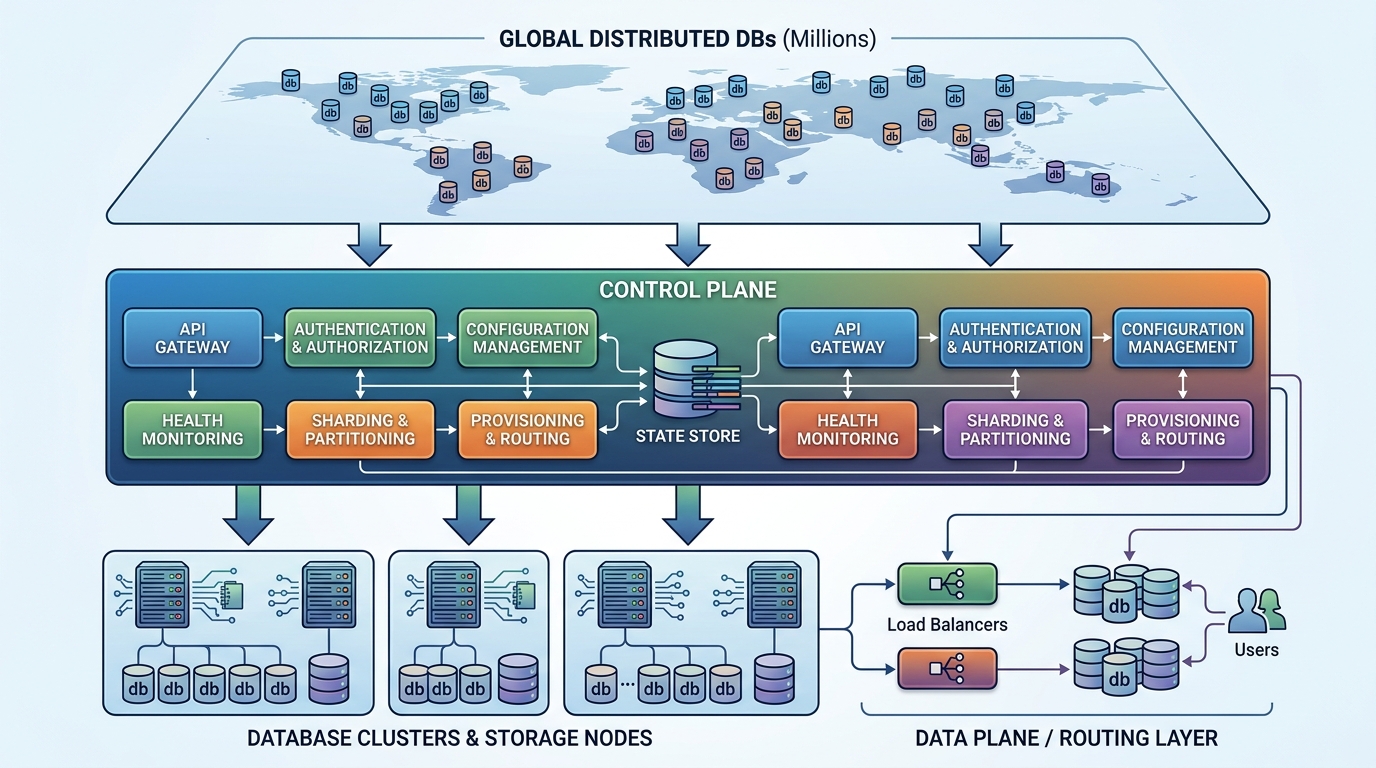 \n\n### 1. The Zero-I/O Data Plane\nThe data plane should assume that all necessary state for executing a query is already present locally or accessible via direct, zero-coordination memory mappings. The edge engine receives a self-contained token (such as a cryptographically signed JWT or an encrypted capability ticket) carrying the tenant identity, database version, and access scopes. The local node verifies this token statelessly using a cached public key. No control plane service is queried for authentication.\n\n### 2. Local State Caching with Optimistic Invalidation\nInstead of fetching database placement coordinates synchronously, edge nodes maintain a local, eventually consistent routing cache. When a database relocates or changes state (for instance, during a background compaction or region migration), the control plane broadcasts an asynchronous invalidation message across a pub/sub mesh. If an edge node routes a request using stale cache data, the data plane handles the failure gracefully via a local fallback path, updates its local cache, and retries.\n\n### 3. Asynchronous Replication and Snapshotting\nIn a serverless SQLite context, write operations append to a local write-ahead log (WAL). Rather than waiting for a centralized control plane to acknowledge snapshot persistence before returning to the caller, the write path commits locally and immediately returns. An independent background worker continuously streams WAL frames to durable object storage (such as Cloudflare R2 or S3) asynchronously.\n\nHere is how I structure the boundaries between these components:\n\n| Architectural Component | Responsibilities | Latency & Path Budget | Synchronization Strategy |\n| :--- | :--- | :--- | :--- |\n| Data Plane Engine | SQL parsing, VFS execution, local WAL append, token verification | < 1ms to 5ms (Hot Path) | Fully local, lock-free, zero network I/O |\n| Local VFS Cache | SQLite page block caching, NVMe page warming, snapshot downloading | 0ms (Hit) / 10-50ms (Miss) | LRU eviction, pre-signed object range requests |\n| Metadata Invalidation Mesh | Propagating topology changes, schema updates, quota status | 50ms - 500ms (Background) | Pub/Sub event bus (gRPC streaming / NATS) |\n| Control Plane Orchestrator | Database provisioning, global placement, cold storage compaction | Seconds to Minutes (Cold Path) | Asynchronous queue-driven state machines |\n\n## Implementing a Decoupled VFS for SQLite\n\nTo decouple storage management from the SQLite execution core, you must implement a custom SQLite Virtual File System (VFS). Standard SQLite performs POSIX file I/O operations (
read, write, fsync) directly against local disk storage. In a serverless environment with millions of databases, mounting millions of individual block storage volumes is impossible.\n\nA decoupled VFS intercepts these POSIX calls, operating over a combination of volatile memory, local NVMe page caches, and remote object stores without altering SQLite core engine logic.\n\nBelow is a conceptual Rust implementation of a decoupled SQLite VFS layer that handles asynchronous page fetching, local WAL caching, and off-path snapshot synchronization.\n\nuse std::fs::File;
use std::os::unix::fs::FileExt; use std::sync::Arc; use tokio::sync::mpsc;
/// Custom VFS state for a decoupled distributed SQLite instance. pub struct DecoupledVfs { db_id: String, local_cache: File, storage_client: RemoteStorageClient, wal_sender: mpsc::UnboundedSender, }
pub struct WalFrameMessage { pub db_id: String, pub frame_index: u64, pub data: Vec, }
#[derive(Clone)] pub struct RemoteStorageClient { // Client configuration for object store (e.g., Cloudflare R2 / AWS S3) }
impl DecoupledVfs { /// Read a page: First check local NVMe/Memory cache; if miss, fetch off path. pub fn read_page(&self, offset: u64, buffer: &mut [u8]) -> Result<(), String> { // Attempt local read from warm NVMe cache if let Ok(_) = self.local_cache.read_exact_at(buffer, offset) { return Ok(()); }
    // Cache Miss: Fetch page asynchronously from durable object store
    // Note: In production, this block is warmed off the hot path by prediction engines.
    let page_data = self.storage_client.fetch_page_sync(&self.db_id, offset, buffer.len())?;
    buffer.copy_from_slice(&page_data);

    // Write back to local cache for subsequent queries
    let _ = self.local_cache.write_all_at(&page_data, offset);
    Ok(())
}

/// Write WAL frame: Commit locally to NVMe immediately, offload remote upload to background task.
pub fn write_wal_frame(&self, frame_index: u64, data: &[u8]) -> Result<(), String> {
    let offset = frame_index * 4096;

    // 1. Synchronous write to local disk (Fast Hot Path)
    self.local_cache
        .write_all_at(data, offset)
        .map_err(|e| format!(