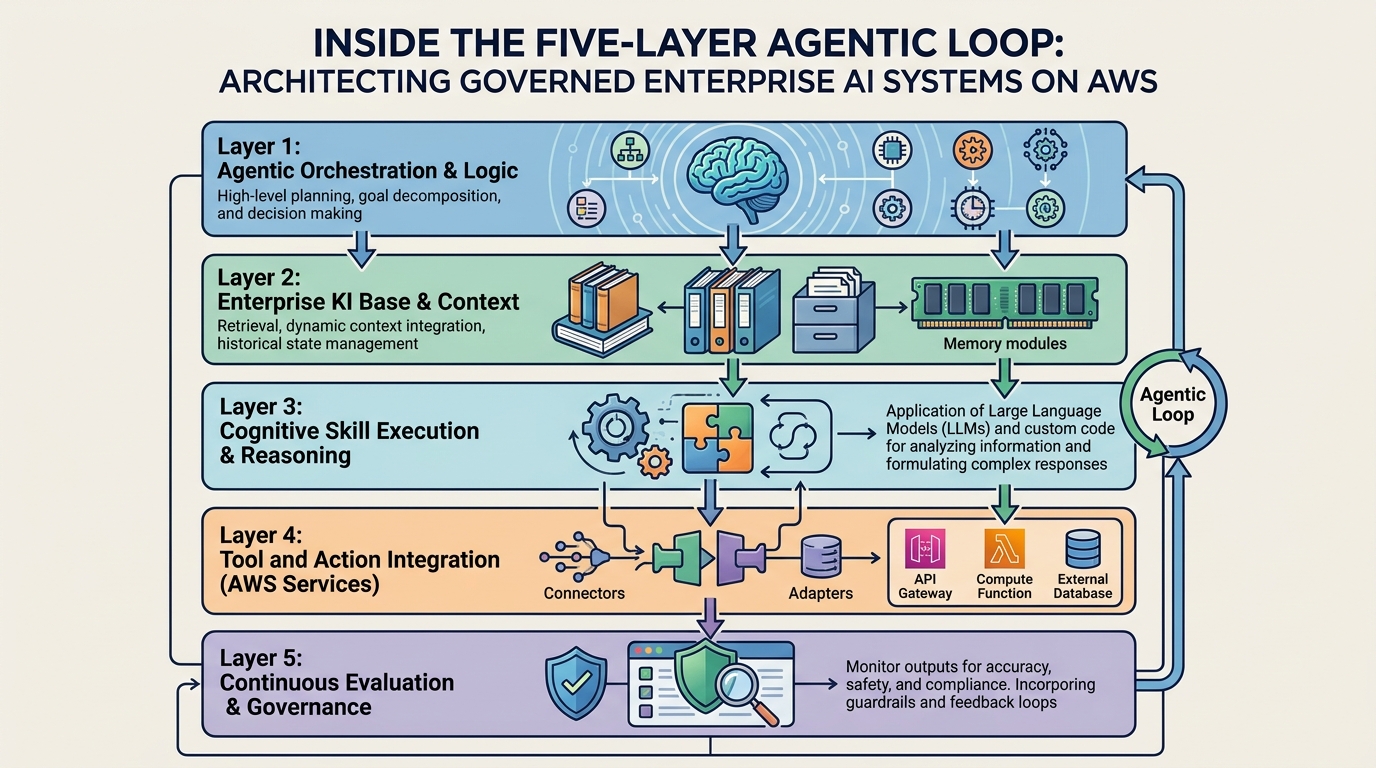
Introduction
When engineering teams move beyond simple single-turn Retrieval-Augmented Generation (RAG) and begin deploying autonomous AI agents into production, the primary challenge rapidly shifts from prompt engineering to system governance. Unconstrained agent loops can loop infinitely, incur runaway token costs, execute unauthorized state changes in downstream databases, and leak sensitive corporate data through unvalidated tool execution. Building a reliable enterprise agent requires treating the interaction not as a stochastic conversation, but as a multi-tiered execution pipeline where state transitions, action requests, and knowledge retrievals are strictly mediated.
In my work evaluating cloud-native architectures for enterprise workload automation, I consistently see teams struggle with the gap between probabilistic model outputs and deterministic enterprise requirements. To bridge this gap on Amazon Web Services (AWS), we must structure the system around a Five-Layer Agentic Loop. This architecture decouples reasoning, planning, memory, execution, and safety into distinct boundaries, enforcing fine-grained access control and real-time observability at every layer.
In this article, I analyze the mechanical detail of the Five-Layer Agentic Loop framework. I examine how to implement robust session isolation, restrict model actions using fine-grained authorization, and enforce strict execution guardrails on AWS using services like Amazon Bedrock, AWS Lambda, Amazon DynamoDB, and AWS Identity and Access Management (IAM).
The Anatomy of the Five-Layer Agentic Loop
To architect a predictable AI agent system, you must decouple the core execution lifecycle into explicit, functional tiers. The Five-Layer Agentic Loop achieves this by enforcing strict responsibility separation across the following layers:
- Interaction and Guardrail Layer: Serves as the entry and exit boundary. It handles input sanitation, token throttling, prompt injection mitigation, and output filtering before any inference or tool execution takes place.
- Reasoning and Perception Layer: Consists of the Foundation Model (FM) hosting environment (e.g., Amazon Bedrock). This layer consumes the contextual state, evaluates intent, and generates either a intermediate response or a structured action request (tool call).
- Planning and Orchestration Layer: The deterministic state machine that manages execution control flow. It parses model decisions, maintains the step count, evaluates loop termination criteria, and dispatches actions.
- Tool Execution and Integration Layer: The action runtime environment—typically hosted on AWS Lambda or Amazon ECS—where tools execute logic against downstream enterprise software (e.g., ERP, CRM, databases). This layer must never trust the model directly; it requires independent authorization validation.
- Memory and Context Layer: The state storage subsystem, divided into short-term session memory (conversational context and execution stack) and long-term enterprise knowledge (managed vector indexes, Knowledge Bases for Amazon Bedrock, or relational data).
+---------------------------------------------------------------------------------+
|                        1. INTERACTION & GUARDRAIL LAYER                         |
|   - Amazon API Gateway     - Bedrock Guardrails     - Input/Output Filtering    |
+---------------------------------------------------------------------------------+
                                        |
                                        v
+---------------------------------------------------------------------------------+
|                        3. PLANNING & ORCHESTRATION LAYER                        |
|   - Step Functions / Custom Runtime   - Loop Control   - Max Iteration Checks  |
+---------------------------------------------------------------------------------+
         |                                      ^                              |
         | (Inference Request)                  | (Tool Output)                |
         v                                      |                              |
+-------------------------------+      +----------------------------------+    |
| 2. REASONING & PERCEPTION     |      | 4. TOOL EXECUTION & INTEGRATION  |    |
| - Amazon Bedrock (FMs)        |      | - AWS Lambda Functions           |    |
| - Structured Tool Binding     |      | - Fine-Grained Authorization      |    |
+-------------------------------+      +----------------------------------+    |
         |                                      ^                              |
         +-------------------|------------------+                              |
                             v                                                 v
+---------------------------------------------------------------------------------+
|                           5. MEMORY & CONTEXT LAYER                             |
|   - DynamoDB Session State    - Bedrock Knowledge Bases (Vector Search)         |
+---------------------------------------------------------------------------------+
Without this clear operational boundary, developers risk embedding orchestration logic directly into prompt templates. When the orchestrator is embedded in the prompt, you lose the ability to deterministically intercept malformed calls, enforce dynamic access limits, or prevent expensive context expansion.
Deterministic State Management and Context Hydration
An agent loop operates continuously over sequence steps $t_0, t_1, \dots, t_n$. At every step $t_i$, the reasoning layer requires a hydrated context containing the initial system instructions, short-term message history, relevant enterprise documentation retrieved via RAG, and execution outputs from step $t_{i-1}$.
Managing this context requires balancing state preservation against token window constraints and cost limits. Relying on an unmanaged, monotonically growing history vector will eventually exceed model context limits or degrade model latency and reasoning accuracy.
To manage short-term session state effectively, I recommend using Amazon DynamoDB with a deterministic state schema. Each record stores session metadata, token usage metrics, an active iteration count, and an array of serialized messages.
When a user initiates an interaction, the Planning and Orchestration layer fetches the recent message trajectory from DynamoDB. Before issuing an inference API request to Amazon Bedrock, the orchestrator invokes the Memory Layer to query long-term knowledge sources, such as Amazon Bedrock Knowledge Bases. The context hydrator truncates or summarizes history items older than a configurable threshold, appends the vector search results as structured system context, and forwards the payload to the foundation model.
import json import boto3 from botocore.exceptions import ClientError
class ManagedAgentOrchestrator: def init(self, session_id: str, table_name: str, model_id: str): self.session_id = session_id self.table_name = table_name self.model_id = model_id self.dynamodb = boto3.resource('dynamodb') self.bedrock_runtime = boto3.client('bedrock-runtime') self.table = self.dynamodb.Table(self.table_name)
def load_session_state(self) -> dict:
    response = self.table.get_item(Key={'session_id': self.session_id})
    if 'Item' not in response:
        initial_state = {
            'session_id': self.session_id,
            'iteration_count': 0,
            'max_iterations': 5,
            'history': []
        }
        self.table.put_item(Item=initial_state)
        return initial_state
    return response['Item']

def update_session_history(self, history: list, iteration_count: int):
    self.table.update_item(
        Key={'session_id': self.session_id},
        UpdateExpression=