
The Mechanics of the "Last Mile" Bottleneck
Every seasoned engineering manager knows the unsettling quiet of a project that is "90% complete." On paper, the Jira board looks exemplary: epics are nearly green, velocity has remained stable for weeks, and the burn-down chart points toward a timely landing. Yet, weeks pass, and that final 10% refuses to resolve. The project enters a state of quantum superposition—simultaneously almost done and indefinitely delayed.
I have spent years analyzing why software teams struggle so acutely during this final mile. The root cause is rarely a lack of technical competence or raw effort. Instead, it is a failure to manage a fundamental structural and psychological shift. The skills, behaviors, and processes required to initiate a project and build its core features are diametrically opposed to those required to stabilize, polish, and ship it. While the first 90% of a project thrives on creative autonomy, parallel execution, and rapid feature accumulation, the final 10% demands hyper-discipline, radical scope reduction, collective swarming, and a tolerance for repetitive stabilization tasks.
When this transition is not explicitly managed, teams suffer from cognitive fatigue, stakeholder trust erodes, and scope creep quietly fills the vacuum left by ambiguous completion criteria. In this article, I present my operational playbook for navigating the psychological and structural shift of the final 10%, ensuring your team lands projects predictably without burning out.
To resolve the final 10% bottleneck, the systems dynamics at play must first be understood. Early in the lifecycle of a project, development occurs in parallel. Engineer A works on the database schema, Engineer B builds the API endpoints, and Engineer C designs the frontend components. Because these components are decoupled or mocked, progress feels rapid and linear.
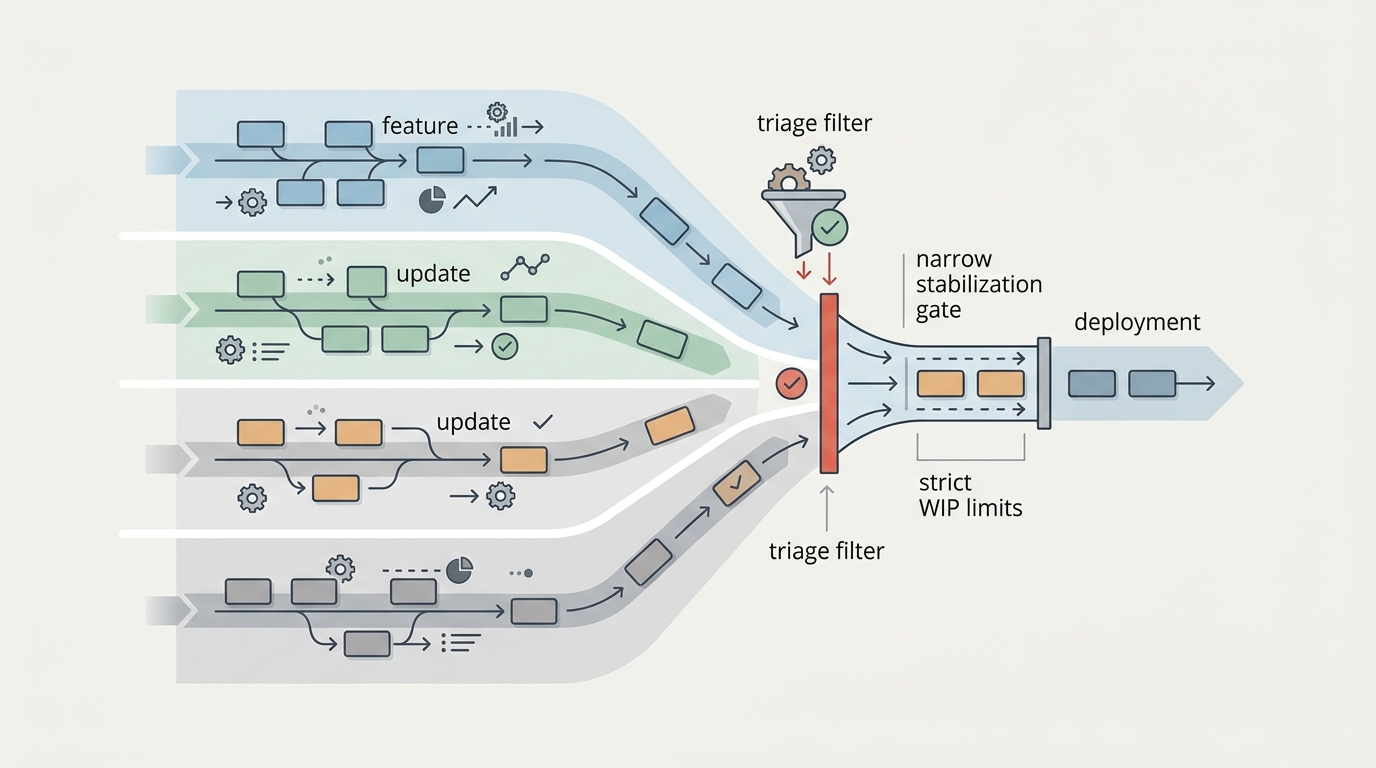
However, as the project nears completion, these parallel streams must converge. This convergence exposes integration debt—the hidden, compounding friction of mismatched assumptions, edge cases, performance bottlenecks, and race conditions that only manifest when the system is evaluated as a whole.
At this point, standard agile metrics like velocity become misleading. Velocity measures the rate of building, not the rate of stabilizing. If your team continues to pull new, minor features or low-priority polish items into the sprint, they create more integration debt faster than they can resolve existing bugs. This is a direct application of Little’s Law: as Work in Progress (WIP) increases, the cycle time to complete any individual task increases.
During this phase, the nature of the work changes. It shifts from high-agency creative building to low-agency bug hunting and configuration tuning. For many engineers, this transition feels like a loss of momentum. The dopamine loop of shipping a brand-new feature is replaced by the frustrating cycle of reproducing intermittent test failures or debugging environment-specific CORS issues. If you do not actively intervene to restructure the workflow, your team will naturally drift back toward building new things—under the guise of "nice-to-haves"—simply because it is more intellectually satisfying than fixing brittle integration tests.
Implementing Strict Late-Stage WIP Limits and Triage Protocols
My first step when a project enters the final 10% is to dismantle the standard sprint backlog and institute a strict stabilization protocol. The team must transition from parallel execution to a "swarming" model. This requires two concrete interventions: lowering your WIP limit to near-zero and establishing a ruthless triage framework.
1. The One-In, One-Out WIP Limit
If you have five engineers on a team, you cannot have five active work items during the final 10%. I recommend reducing your active WIP limit to a maximum of two concurrent items. When a critical bug or release blocker is identified, it becomes the immediate priority for the entire team. If Engineer A is blocked on a bug, Engineer B does not start a new task; instead, Engineer B pair-programs with Engineer A to unblock them, writes the integration test, or replicates the environment.
This feels highly inefficient to engineers accustomed to local optimization (keeping themselves busy). You must explain to them that you are optimizing for global throughput (shipping the project) rather than local utilization (keeping individual keyboards clacking).
2. The Cut/Defer/Fix Triage Matrix
During the final 10%, every bug, polish item, and minor feature request must be subjected to a rigorous triage process. I use a simple, three-tiered matrix to evaluate every single ticket remaining in the backlog. I run this triage meeting daily with my tech lead and product manager.
| Classification | Definition | Action | Example |
|---|---|---|---|
| Must-Have (Release Blocker) | The system is insecure, data corruption occurs, or the primary user flow is completely broken. | Fix immediately. Assign maximum resources. | Payment gateway fails when user clicks 'back' during processing. |
| Defer to v1.1 | The issue is valid and visible, but a reasonable workaround exists, or it affects a tiny fraction of users. | Move to a post-launch epic. Do not touch now. | Profile picture upload fails if the image is exactly 10MB. |
| Cut Entirely | The item is a "nice-to-have" polish, an edge-case optimization, or a feature that adds complexity without immediate value. | Delete or archive the ticket. | Adding a smooth fade-in animation to the dashboard widgets. |
By enforcing this matrix, you protect your team's cognitive bandwidth. You make it clear that the goal is not to deliver a perfect, flawless system—which is an illusion—but to deliver a stable, predictable system that meets the agreed-upon definition of done.
Managing the Psychological Shift: From Innovation to Discipline
Managing the technical backlog is only half the battle; the harder half is managing your team's psychological state. The end of a project is a period of high vulnerability. The excitement of the launch has worn off, the initial architectural vision has been compromised by real-world constraints, and the team is tired.
To combat this, I shift my management style from directional guidance to active facilitation and protection. I focus on three core psychological interventions:
Redefining "Progress"
When engineers are fixing bugs, they often feel like they are spinning their wheels. You must explicitly redefine what progress looks like. In the first 90% of a project, progress is adding lines of code and shipping features. In the final 10%, progress is deleting dead code, reducing the open bug count, and stabilizing build times. Celebrate a day where the team closed five bugs and wrote zero new features just as enthusiastically as you celebrated the initial prototype demo.
Shielding the Team from External Noise
As a project nears completion, stakeholders become anxious. They want updates, they want to demo early versions to clients, and they want to inject last-minute requirements because they finally see the product taking shape. This external noise is toxic to a team trying to focus on stabilization.
I establish a strict communication buffer. I tell my team: "Your job is to focus on the stabilization backlog. My job is to handle the stakeholders." I run interference, manage expectations, and block any external requests from reaching the engineers directly. If a stakeholder insists on a change, it goes through me and the product manager first, where it is almost always categorized as "Defer to v1.1."
Preventing the "Hero Culture" Trap
During the final mile, it is easy for a single senior engineer to step in, work 80-hour weeks, and single-handedly resolve all the remaining bugs. While this might get the project over the line, it is an organizational failure. It creates a single point of failure, burns out your best talent, and prevents the rest of the team from learning how to debug and stabilize the system. I actively discourage heroics. I ensure that bug-fixing duties are shared, that pairing is mandatory for complex issues, and that we maintain sustainable working hours. A project landed by an exhausted, resentful team is not a victory.
The Final 10% Delivery Playbook
To make these concepts actionable, I have developed a repeatable technical and operational playbook that I activate as soon as a project enters its final phase.
First, we freeze the main branch for new feature development. We create a dedicated release branch (e.g., release/v1.0) and apply strict branch protection rules. Only bug fixes targeting verified release blockers are permitted to merge into this branch.
To automate this enforcement and keep the team focused, I use a custom CI/CD gatekeeper script. This script runs on every pull request targeting the release branch, ensuring that no unauthorized files are modified and that every change is explicitly linked to an approved triage ticket. Here is an example of a validation script I run within our GitHub Actions workflow to enforce this discipline:
#!/usr/bin/env python3
import sys
import os
import re

def validate_release_pr():
    pr_title = os.getenv("GITHUB_HEAD_REF", "")
    target_branch = os.getenv("GITHUB_BASE_REF", "")

    if not target_branch.startswith("release/"):
        print("Not a release branch PR. Skipping strict validation.")
        sys.exit(0)

    print(f"Analyzing PR targeting release branch: {target_branch}")

    ticket_pattern = r"\[(FIX|BUG)-\d+\]"
    if not re.search(ticket_pattern, pr_title):
        print("ERROR: PR title must start with an approved ticket identifier, e.g., '[FIX-1234] Fix memory leak'.")
        sys.exit(1)

    forbidden_patterns = ["package-lock.json", "yarn.lock", "go.sum", "Dockerfile", "docker-compose.yml"]
    modified_files = os.getenv("MODIFIED_FILES", "").split(",")
    for file in modified_files:
        if any(forbidden in file for forbidden in forbidden_patterns):
            print(f"ERROR: Modifying dependency or infrastructure files ({file}) is blocked during stabilization.")
            sys.exit(1)

    print("PR validation passed. Ready for peer review.")
    sys.exit(0)

if __name__ == "__main__":
    validate_release_pr()
Beyond technical gates, you must establish a clear operational cadence. My playbook consists of the following steps:
- Declare the Shift: Hold an explicit kick-off meeting for the "Stabilization Phase." Tell the team: "We are now shifting from building to landing. Our metrics, processes, and daily schedules are changing as of today."
- Daily Standup Restructure: Stop asking "What did you do yesterday?" Instead, walk the board from right to left. Ask: "What is blocking this ticket from being closed forever?" and "Who can pair with the owner to get it merged today?"
- The "Definition of Done" Audit: Review your Definition of Done (DoD). Often, teams have a DoD that works for individual features but lacks system-level criteria. Ensure your stabilization DoD includes: zero high/medium security vulnerabilities, load testing validation under peak target volume, and successful automated rollback execution.
- The Post-Launch Decompression Buffer: Before the project even launches, schedule a mandatory 3-to-5-day "cool-down" period immediately following the release. Promise your team that during this buffer, there will be no roadmap deliverables, no feature building, and no high-pressure meetings. This gives them a psychological light at the end of the tunnel, allowing them to focus entirely on the hard work of landing the current project without worrying about the next mountain they have to climb.
Conclusion
Landing a project well is not a matter of luck, nor is it a matter of working harder in the final weeks. It is a predictable outcome of deliberate, structured management. By recognizing that the final 10% of a project requires an entirely different operational and psychological framework than the first 90%, you can guide your team through the transition with minimal friction.
Your role as an engineering manager during this critical phase is to act as a stabilizer. Reduce the team's WIP, implement a ruthless triage process, protect them from external distractions, and celebrate the quiet, disciplined work of fixing bugs and deleting code. When you master this shift, you will find that your projects do not just eventually ship—they land smoothly, predictably, and with your team's morale fully intact.