

The Systems Bottleneck of Agentic Alignment
The transition from static Reinforcement Learning from Human Feedback (RLHF) to active, agentic reinforcement learning (RL) represents a major shift in how large language models are aligned. In agentic RL, the language model does not merely output a single response to a prompt; it acts as an agent within an environment, executing multi-step reasoning, calling external APIs, running code in sandboxed environments, and dynamically reacting to environmental feedback.
While this agentic loop improves the model's problem-solving capabilities, it introduces a severe systems-engineering bottleneck. Traditional RL training pipelines are synchronous: the model generates a batch of rollouts, the environment executes those actions, rewards are calculated, and the model updates its weights. When your environment involves slow host-side operations—such as executing Python code, waiting for web page loads, or querying external databases—expensive Tensor Processing Units (TPUs) sit completely idle. This step-lock problem results in poor Model Flops Utilization (MFU), often dropping accelerator efficiency below 10%.
To solve this bottleneck, Google developed Tunix, a JAX-native library designed specifically for LLM post-training and high-throughput RL orchestration. I have analyzed how Tunix scales agentic RL by decoupling trajectory generation from policy optimization. In this article, I examine its asynchronous architecture, detail how it orchestrates TPU memory and JAX compilation under dynamic workloads, address the mathematical challenges of off-policy divergence, and provide a concrete implementation blueprint for engineering leaders looking to scale their agentic training pipelines.
The Architecture of Decoupled Trajectory Generation
In a standard synchronous actor-learner architecture, the training loop is bound by the slowest component. If an agent takes 5 seconds to execute a tool call and receive a response, the entire TPU cluster remains blocked during those 5 seconds. To achieve high throughput, this synchronous execution model must be broken. Tunix achieves this by completely decoupling the trajectory generation (the actors) from the policy optimization (the learner).
In the Tunix framework, actors and learners run as independent, asynchronous processes, often on heterogeneous hardware. The actors—which run the policy model to generate actions and interact with the environment—can be distributed across cheaper GPU instances or CPU pools optimized for network and I/O operations. The learner—which performs the computationally intensive forward and backward passes to update the model weights—runs continuously on a dedicated TPU Pod slice.
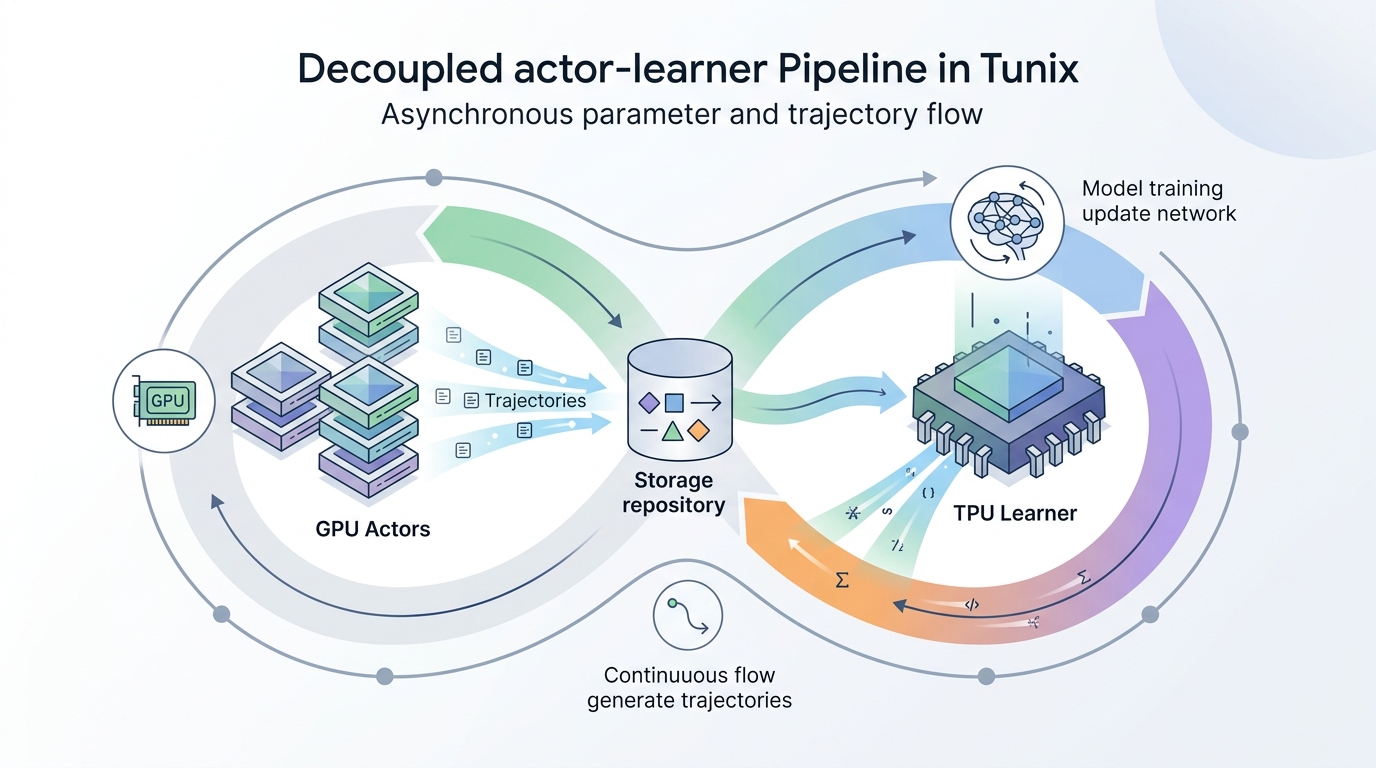
These two components communicate via a centralized, high-throughput trajectory buffer. The lifecycle of a trajectory in this decoupled architecture proceeds as follows:
- Asynchronous Rollout: The actor processes query the current policy parameters (periodically synced from the learner) to generate actions. They execute these actions in parallel environments, collect the transitions (state, action, log probabilities, reward, next state), and pack them into standardized trajectory tensors.
- Buffer Ingestion: These trajectories are streamed asynchronously into a distributed, in-memory replay buffer managed by Tunix. The buffer handles deduplication, sequence packing, and prioritization.
- Continuous Learning: Completely independent of the actor state, the TPU-based learner continuously pulls batches of trajectories from the buffer, performs gradient descent, and updates the global policy parameters.
- Parameter Synchronization: At regular, configurable intervals, the updated parameters are broadcast back to the actors.
By decoupling these loops, the learner never waits for environment steps. If the environment latency spikes, the learner continues to train on the buffered trajectories (within a safe staleness threshold), maintaining near-100% TPU utilization. Conversely, if the learner is faster than the actors, the actor pool can be scaled horizontally without modifying the learner code or changing the TPU cluster topology.
TPU Orchestration and JAX-Native Memory Management
Orchestrating this decoupled architecture in JAX requires overcoming several unique compiler and memory challenges. JAX relies on Ahead-Of-Time (AOT) compilation via XLA (Accelerated Linear Algebra). XLA compiles computation graphs based on static tensor shapes. However, agentic trajectories are inherently dynamic: one episode might terminate after two tool calls, while another might run for thirty steps.
If variable-length trajectories are fed directly into a JAX training loop, constant recompilations are triggered, neutralizing the performance benefits of accelerators. Tunix solves this by implementing strict sequence packing and bucketing strategies before data reaches the TPU High Bandwidth Memory (HBM).
Dynamic Sequence Packing and Bucketing
Instead of padding every trajectory to the maximum possible episode length—which wastes memory and compute on padding tokens—Tunix groups trajectories into buckets of similar lengths. It then packs multiple short trajectories into a single fixed-size sequence window (e.g., 4096 or 8192 tokens), utilizing attention masking to prevent cross-trajectory contamination. This ensures that the input shape remains constant, preventing XLA recompilation while maximizing the token density per batch.
Distributed Memory Layout and Sharding
To scale massive agentic models (e.g., 70B+ parameters), both the model weights and the incoming trajectory batches must be sharded across the TPU topology. Tunix leverages JAX's native jax.experimental.shard_map (ShardMap) and SPMD (Single Program, Multiple Data) partition specs to manage this memory layout.
I recommend a hybrid parallelization strategy when configuring Tunix for large-scale agentic RL:
- Tensor Parallelism (TP): Shard the model's attention heads and MLP layers across adjacent TPUs within a single node to minimize latency during the forward and backward passes.
- Pipeline Parallelism (PP): Partition the model layers across different TPU stages to accommodate models that exceed a single node's HBM capacity.
- Data Parallelism (DP): Shard the trajectory batch across different TPU nodes. Tunix's data loaders are designed to stream distinct chunks of the trajectory buffer directly to the corresponding DP shards, avoiding redundant host-to-device transfers.
This deliberate memory orchestration ensures that the high-throughput data stream coming from the asynchronous actors is ingested directly into the TPU's local HBM with minimal host-side overhead, keeping the tensor cores saturated.
Mitigating Off-Policy Divergence and Stale Gradients
While decoupling actors from the learner solves the throughput bottleneck, it introduces a fundamental algorithmic challenge: stale gradients. Because the actors run asynchronously and only sync parameters periodically, the policy used to generate a trajectory is often slightly older than the policy currently being updated on the learner.
If the policy updates too quickly, the trajectories in the buffer become highly off-policy. Standard on-policy RL algorithms like PPO (Proximal Policy Optimization) degrade rapidly under these conditions, leading to training instability, policy collapse, or divergence. To maintain mathematical correctness and training stability, Tunix integrates several mitigation mechanisms.
1. Importance Sampling Correction
To correct for the discrepancy between the behavior policy and the target policy, Tunix applies importance sampling ratios to the policy gradient loss. The standard objective is modified to include the importance ratio, which is computed as the ratio of the probability of the action under the current policy to the probability under the behavior policy. Tunix tracks the exact parameter version used to generate each trajectory and stores the action log-probabilities alongside the transition data. During the learner's forward pass, it computes the log-probabilities under the current parameters to calculate the ratio accurately.
2. Strict Staleness Bounds
To prevent the learner from training on completely obsolete data, Tunix implements a dynamic synchronization barrier. I configure this using a maximum staleness threshold. If the difference between the learner's current step and the step at which a trajectory was generated exceeds this threshold, the trajectory is discarded from the buffer. If the average staleness of the buffer exceeds a critical threshold, the learner throttles its execution until the actors catch up and populate the buffer with fresher trajectories.
3. Kullback-Leibler (KL) Divergence Constraints
In addition to clipping the importance ratio, Tunix enforces a KL divergence penalty between the current policy and the reference model (typically the initial SFT model) to prevent the policy from drifting too far during optimization. This is particularly crucial in agentic environments where a single bad update can cause the model to enter infinite loops or generate garbage tool calls, permanently damaging its ability to collect high-quality trajectories.
Implementation Blueprint: Configuring a Tunix Pipeline
To illustrate how these concepts translate into production code, let us walk through a practical JAX implementation using Tunix's architectural patterns. The following code block demonstrates how to set up an asynchronous trajectory buffer, define a sharded learner step using shard_map, and manage the asynchronous training loop.
import jax
import jax.numpy as jnp
from jax.experimental import shard_map
import optax

# Define our mesh topology (e.g., 8 TPUs configured for Data and Tensor Parallelism)
mesh = jax.sharding.Mesh(
    jax.devices(),
    ("data", "tensor")
)

# Define partition specifications for sharding
# Model weights are sharded across the tensor dimension; batch is sharded across data
weight_spec = jax.sharding.PartitionSpec(None, "tensor")
batch_spec = jax.sharding.PartitionSpec("data", None)

class TunixLearner:
    def __init__(self, model_apply_fn, optimizer, total_steps):
        self.model_apply_fn = model_apply_fn
        self.optimizer = optimizer
        self.total_steps = total_steps

    def loss_fn(self, params, batch, reference_log_probs):
        """Computes the clipped PPO loss with importance sampling correction."""
        # batch contains: states, actions, old_log_probs, advantages
        states, actions, old_log_probs, advantages = batch

        # Forward pass under current parameters
        current_logits = self.model_apply_fn(params, states)
        current_log_probs = jax.nn.log_softmax(current_logits)
        # Gather log probs for the taken actions
        current_action_log_probs = jnp.take_along_axis(
            current_log_probs,
            actions[:, :, None],
            axis=-1
        ).squeeze(-1)

        # Calculate importance sampling ratio
        ratio = jnp.exp(current_action_log_probs - old_log_probs)

        # Clipped surrogate objective
        clip_val = 0.2
        surr1 = ratio * advantages
        surr2 = jnp.clip(ratio, 1.0 - clip_val, 1.0 + clip_val) * advantages
        ppo_loss = -jnp.minimum(surr1, surr2).mean()

        # KL penalty against reference model to prevent policy drift
        kl_penalty = (current_action_log_probs - reference_log_probs).mean()
        total_loss = ppo_loss + 0.05 * kl_penalty

        return total_loss, ppo_loss

    @sharded_step
    def train_step(self, state, batch, reference_log_probs):
        """A compiled, sharded training step executed on the TPU cluster."""
        grad_fn = jax.value_and_grad(self.loss_fn, has_aux=True)
        (loss, ppo_loss), grads = grad_fn(state.params, batch, reference_log_probs)

        # Apply gradients using Optax
        updates, new_opt_state = self.optimizer.update(grads, state.opt_state, state.params)
        new_params = optax.apply_updates(state.params, updates)

        new_state = state.replace(
            params=new_params,
            opt_state=new_opt_state
        )
        return new_state, loss

# Helper decorator to apply ShardMap over the device mesh
def sharded_step(func):
    def wrapper(state, batch, reference_log_probs):
        # ShardMap allows us to write SPMD code as if we are writing for a single device,
        # while explicitly declaring how axes map to the hardware mesh.
        sharded_fn = shard_map.shard_map(
            func,
            mesh=mesh,
            in_specs=(weight_spec, batch_spec, batch_spec),
            out_specs=(weight_spec, None)
        )
        return sharded_fn(state, batch, reference_log_probs)
    return wrapper
This blueprint illustrates the simplicity of writing highly optimized, distributed RL code once you leverage Tunix's design principles. By mapping the batch dimension to the data axis of your mesh and using shard_map, you ensure that the TPU cluster processes incoming trajectories with maximum parallel efficiency, while keeping model weights synchronized across the tensor dimension.
Comparing Architectures: Synchronous vs. Decoupled RL
To help you evaluate whether migrating to a decoupled architecture like Tunix is appropriate for your engineering team, I have compiled a comparison of the operational trade-offs between synchronous and decoupled agentic RL systems.
| Architectural Metric | Synchronous RL (Standard Baseline) | Decoupled Asynchronous RL (Tunix) |
|---|---|---|
| TPU Model Flops Utilization (MFU) | Low (10% - 30% due to environment step-lock) | High (75% - 90% continuous computation) |
| Hardware Heterogeneity | Poor (Requires expensive accelerators to host environments) | Excellent (Actors run on cheap CPUs/GPUs; Learner on TPUs) |
| Scaling Characteristics | Bound by slowest environment step | Horizontally scalable actor pools |
| Algorithmic Complexity | Low (Strictly on-policy, simple math) | Medium-High (Requires importance sampling & staleness limits) |
| Memory Footprint | Low (No large trajectory buffer needed) | High (Requires large, high-throughput in-memory replay buffers) |
| Sensitivity to Network Latency | High (Any API or tool latency halts training) | Low (Buffered trajectories mask transient network spikes) |
Operational Next Steps
As LLMs transition from passive text generators to active agents, training infrastructure must evolve to handle the unique bottlenecks of interactive environments. Standard synchronous training pipelines are no longer viable; they waste precious accelerator cycles while waiting for host-side tool execution, sandboxed code compilation, and API responses.
Google's Tunix library solves this bottleneck by decoupling trajectory generation from policy optimization. By leveraging an asynchronous actor-learner architecture, implementing strict sequence packing to prevent XLA recompilation, and applying mathematically sound off-policy corrections, Tunix allows engineering teams to maximize their TPU investment and scale agentic RL to models with tens of billions of parameters.
If you are currently building or scaling an agentic LLM platform, my recommendation is clear: do not attempt to patch a standard synchronous RL pipeline to handle tool-use training. Instead, transition to a decoupled architecture. Begin by auditing your environment latency, establish a dedicated worker pool for asynchronous rollouts, and implement a robust trajectory buffer with strict staleness bounds. This structural investment will pay immediate dividends in training stability, developer velocity, and massive compute cost savings.