

The Mechanics of the Agent Loop: Why LLMs Need CPU Muscle
To understand why autonomous workloads are consuming massive amounts of CPU cycles, I look closely at the lifecycle of a single agentic step. Unlike a standard LLM call, which is a straightforward forward pass through a neural network, an agent operates within a continuous loop—often structured around the ReAct (Reasoning and Acting) paradigm.
This loop consists of several distinct phases, and with the exception of the raw token generation, almost every single phase is heavily CPU-bound.
1. Parsing, Validation, and Schema Enforcement
When an LLM decides to call a tool, it outputs a structured response, typically formatted as a JSON object or a Markdown block embedded within a text stream. Before any action can be taken, the application layer must parse this raw string, validate it against a target schema (such as a Pydantic model or a JSON Schema specification), and handle any syntax errors or incomplete generations.
At scale, parsing is surprisingly expensive. If your agent is processing multi-modal inputs, handling large system prompts, or receiving massive tool outputs, the CPU must spend significant cycles on string manipulation, regex matching, and memory allocation. When using standard Python-based parsers, this serialization and deserialization overhead scales non-linearly with the complexity of the agent's toolset.
2. State Management and Context Window Orchestration
Agents must maintain state across multiple turns. This requires the orchestration layer to constantly prune, summarize, and restructure the context window. To do this efficiently, the system must query vector databases, perform semantic search, execute reranking algorithms, and dynamically assemble the next prompt template.
While the vector database itself might run on separate infrastructure, the client-side orchestration, embedding generation coordination, and metadata filtering are executed entirely on the application CPU. If your agent framework uses naive in-memory state management, the CPU becomes a bottleneck as it constantly copies and manipulates large arrays of tokenized text.
3. Sandboxed Code Execution
Perhaps the most severe contributor to the CPU tax is the execution of agent-generated code. Advanced agents are frequently equipped with code interpreters, allowing them to write and execute Python, Bash, or SQL to solve complex analytical problems.
To run this untrusted, dynamically generated code safely, you cannot simply execute it on your host operating system. You must isolate it within a secure sandbox. Whether you use lightweight microVMs (such as AWS Firecracker), container runtimes with strict kernel isolation (like gVisor), or WebAssembly (Wasm) runtimes, the virtualization overhead is immense.
Every time an agent runs a generated script, the CPU must handle virtual machine startup, kernel initialization, process isolation, and eventual teardown. When hundreds of agents are executing multiple code blocks per minute, the host CPU is overwhelmed by context switching, system calls, and hypervisor management overhead.
4. The Network I/O and Protocol Translation Bottleneck
Agents rarely operate in a vacuum; they interact with external APIs, databases, and legacy enterprise systems. Each tool execution requires initiating network connections, negotiating TLS handshakes, serializing payloads into protocols like gRPC or HTTP/2, and parsing the returning data.
The CPU spending time in network I/O wait states is a classic software engineering problem, but in agentic workflows, this is compounded by the fact that the agent cannot proceed to the next reasoning step until the tool execution completes. This synchronous blocking behavior leads to highly inefficient CPU utilization patterns, where cores are either pinned at 100% during parsing and sandboxing or sitting completely idle while waiting for external network responses.
The Collapse of the GPU-to-CPU Provisioning Ratio
For years, cloud providers and infrastructure architects designed AI-optimized virtual machine instances based on a specific, highly optimized ratio of CPU cores to GPUs. For example, a standard high-end AI instance might pair eight NVIDIA H100 GPUs with 96 or 128 vCPUs.
This ratio was calculated under two primary assumptions:
- The CPU's primary job is to pipeline data to the GPU during training (e.g., loading images, tokenizing text datasets, and managing PCIe data transfers).
- During inference, the CPU merely acts as a lightweight API gateway, routing incoming HTTP requests to the GPU and returning the generated tokens to the client.
Autonomous agents have completely shattered these assumptions, creating a phenomenon I call "GPU Starvation via CPU Saturation."
Because the agent loop requires multiple sequential steps of reasoning (GPU) followed by tool execution (CPU), the workload is highly asynchronous and unbalanced. When the agent is executing a complex tool, running a sandboxed Python script, or parsing a massive API response, the GPU sits completely idle. Conversely, when the LLM is generating the next step, the CPU-bound tool execution environment is waiting.
This mismatch creates a severe utilization crisis. If you run your agent orchestration layer on the same virtual machine as your GPU inference engine, you will quickly find that your CPUs are pinned at 100% utilization while your incredibly expensive GPUs are running at less than 20% utilization.
To keep the GPUs fed, you might try to increase the concurrency of your agent loops on the machine. However, this immediately triggers severe CPU thrashing. The operating system spends more time managing thread context switches, handling page faults, and resolving lock contention than it does executing actual agent code.
In multi-tenant cloud environments, this sudden, massive demand for CPU cycles has caught hyper-scalers completely off guard. Standard hyper-scaler overcommit ratios—where providers sell more virtual CPU cores than physical cores exist on the host, assuming most workloads will be idle—are failing. Agentic workloads do not have the bursty, self-limiting traffic patterns of traditional web applications. They run sustained, high-intensity CPU loops, leading to severe noisy-neighbor issues and regional CPU capacity exhaustion.
Architectural Mitigations: Designing for CPU Efficiency
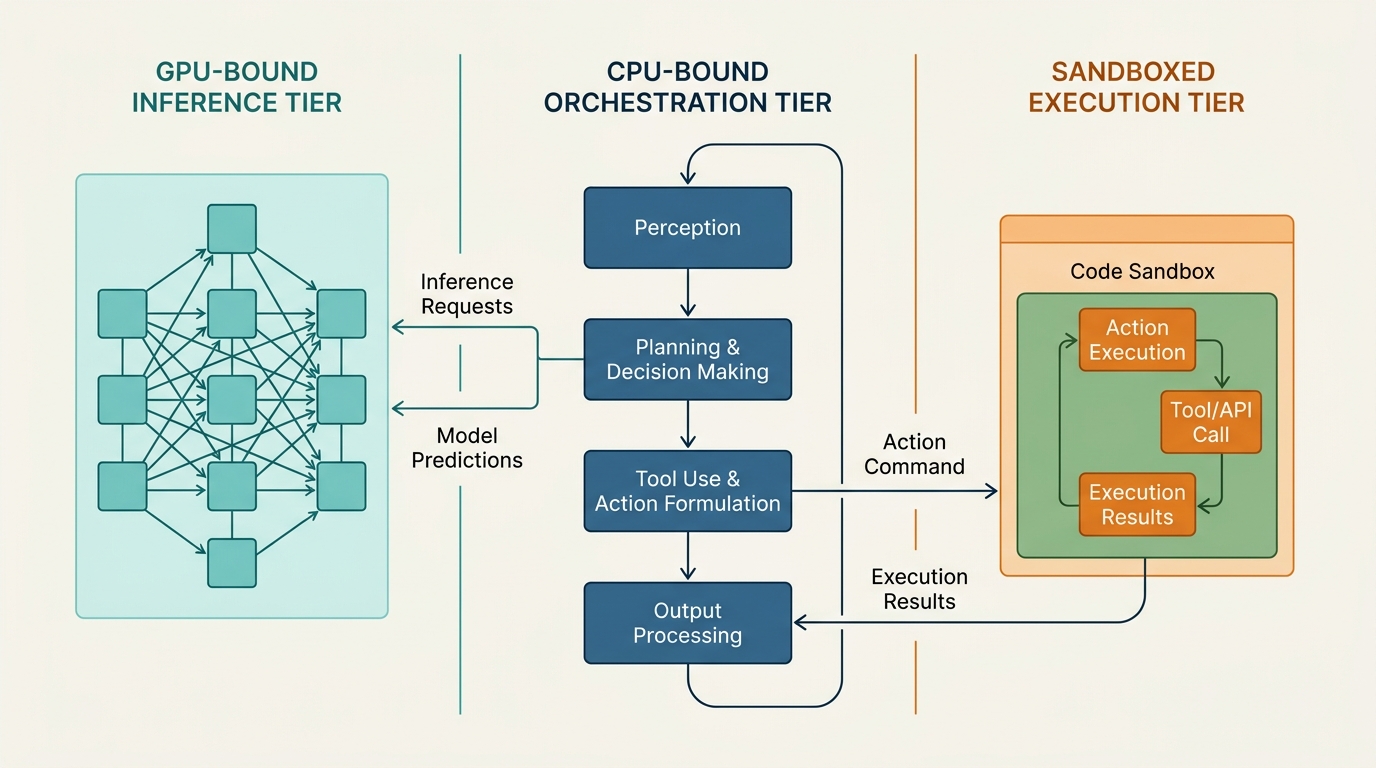
To survive the CPU tax and build scalable agentic platforms, you must abandon monolithic designs where orchestration, execution, and inference live on the same compute node. I recommend adopting a decoupled, event-driven architecture that separates these concerns into specialized execution tiers.
Decoupling Orchestration from Execution
Your first priority must be to isolate your GPU-bound inference from your CPU-bound agent logic. Run your LLMs on dedicated, auto-scaling GPU clusters (using serving frameworks like vLLM, TensorRT-LLM, or Hugging Face TGI) that are optimized purely for high-throughput token generation.
Your agent orchestration engine—the state machine, prompt builders, and parsing logic—should run on a separate tier of compute-optimized, high-core-density CPU instances (such as AWS Graviton c7g/c8g or Google Cloud c4 instances). This allows you to scale your CPU resources independently of your GPU resources, ensuring you only pay for expensive GPU silicon when it is actually generating tokens.
Optimizing the Sandboxing Layer
If your agents execute dynamic code, you must optimize your sandboxing strategy. Standard Docker containers do not provide sufficient security isolation for executing untrusted agent code, while full virtual machines are far too heavy and slow to spin up dynamically.
I recommend utilizing WebAssembly (Wasm) runtimes or highly optimized microVMs with pre-warmed pools. By maintaining a pool of running, paused microVMs (using a technology like AWS Firecracker with snapshotting), you can resume a sandbox in milliseconds rather than seconds, drastically reducing the CPU startup tax.
High-Performance Parsing and Serialization
Python is the de facto language of AI, but its native string handling and JSON parsing are notoriously slow. If your agent loop is processing megabytes of structured data per second, you should offload parsing to native compiled extensions.
Replacing standard Python json or pydantic parsing with high-performance Rust-backed libraries like orjson and pydantic-core can reduce parsing-related CPU overhead by up to 80%.
Here is an example of an optimized, asynchronous agent worker pattern designed to minimize CPU overhead by decoupling the orchestration loop, using fast serialization, and delegating tool execution to an isolated, non-blocking worker pool:
import asyncio
import orjson
from typing import Dict, Any
from concurrent.futures import ThreadPoolExecutor

# Use a dedicated thread pool for CPU-bound parsing and validation
# to avoid blocking the main event loop.
cpu_executor = ThreadPoolExecutor(max_workers=4)

class OptimizedAgentWorker:
    def __init__(self, tool_registry: Dict[str, Any]):
        self.tool_registry = tool_registry

    async def process_agent_step(self, raw_payload: bytes) -> bytes:
        """
        Processes a single step of the agent loop with minimal CPU overhead.
        """
        # 1. Fast, off-loop JSON deserialization using Rust-backed orjson
        loop = asyncio.get_running_loop()
        try:
            data = await loop.run_in_executor(
                cpu_executor,
                orjson.loads,
                raw_payload
            )
        except orjson.JSONDecodeError as e:
            return orjson.dumps({"status": "error", "message": "Invalid JSON payload"})

        # 2. Extract action and parameters
        action = data.get("action")
        params = data.get("parameters", {})

        if not action or action not in self.tool_registry:
            return orjson.dumps({"status": "error", "message": f"Unknown tool: {action}"})

        # 3. Execute tool asynchronously without blocking the main orchestrator
        try:
            tool_output = await self.execute_tool_async(action, params)
            response_payload = {"status": "success", "output": tool_output}
        except Exception as e:
            response_payload = {"status": "error", "message": str(e)}

        # 4. Fast serialization for the next step in the loop
        return await loop.run_in_executor(
            cpu_executor,
            orjson.dumps,
            response_payload
        )

    async def execute_tool_async(self, action: str, params: Dict[str, Any]) -> Any:
        """
        Delegates execution to the appropriate isolated environment.
        """
        tool = self.tool_registry[action]
        if asyncio.iscoroutinefunction(tool):
            return await tool(params)
        else:
            # Run synchronous/CPU-heavy tools in the thread pool
            return await asyncio.get_running_loop().run_in_executor(
                cpu_executor,
                tool,
                params
            )
Capacity Planning and Infrastructure Strategies
To successfully deploy autonomous agents in production, your infrastructure team must transition from reactive scaling to proactive capacity planning. You can no longer rely on simple CPU utilization metrics to trigger auto-scaling, as these metrics are often lagging indicators that fail to capture the micro-bursts of CPU activity inherent in agentic loops.
The Agent Compute Budgeting Framework
When planning your infrastructure, I recommend calculating your required CPU capacity using a structured budgeting framework. Instead of guessing, you can estimate your required vCPU cores using this formula:
$$\text{Required vCPUs} = \left( \frac{\text{Concurrent Agents} \times \text{Steps per Agent/Sec} \times \text{Avg. CPU Time per Step (ms)}}{1000} \right) \times \text{Safety Factor (1.5)}$$
Where:
- Concurrent Agents is the peak number of active agent sessions running simultaneously.
- Steps per Agent/Sec is the frequency with which your agents execute loops (typically 0.1 to 1.0 steps/sec depending on LLM latency).
- Avg. CPU Time per Step is the total time the CPU spends parsing, running sandboxes, and managing state per step (measured via profiling).
- Safety Factor accounts for virtualization overhead, OS context switching, and network queueing.
Evaluating Sandboxing Technologies
Choosing the right isolation barrier is critical to balancing security, latency, and CPU overhead. The table below outlines the trade-offs of the primary sandboxing technologies used in modern agent architectures:
| Sandboxing Technology | Startup Latency | CPU Overhead | Memory Footprint | Security Isolation | Best Use Case |
|---|---|---|---|---|---|
| Standard Docker Container | Low (100ms - 1s) | Low | Medium (~50MB) | Weak (Shared Kernel) | Trusted internal tools, data processing |
| gVisor (Runsc) | Medium (200ms - 1s) | Medium (Syscall filtering) | Medium (~80MB) | Strong (Intercepted Kernel) | Semi-trusted multi-tenant APIs |
| AWS Firecracker (MicroVM) | Medium (100ms - 500ms) | High (Virtualization tax) | High (~128MB+) | Excellent (Hardware Virtualization) | Untrusted user code execution |
| WebAssembly (Wasm) | Extremely Low (<5ms) | Extremely Low | Extremely Low (<10MB) | Strong (Sandboxed Runtime) | Lightweight, fast mathematical or text manipulation |
An Infrastructure Audit Checklist for Engineering Leaders
If you are currently running agentic workloads in production, or planning to deploy them shortly, I advise conducting an immediate infrastructure audit using the following checklist:
- Isolate the Orchestration Layer: Ensure your agent orchestration code (e.g., LangChain, LlamaIndex, or custom state machines) is running on a completely separate auto-scaling group from your LLM inference servers.
- Profile Your Serialization: Measure the percentage of CPU time spent on JSON parsing and validation. If it exceeds 15%, migrate your serialization layer to high-performance libraries like
orjsonor implement binary protocols like Protocol Buffers where appropriate. - Implement Pre-Warmed Sandbox Pools: If you use microVMs for code execution, implement a pre-warming and pooling mechanism to avoid paying the CPU initialization tax on every single agent step.
- Enforce Strict Timeout and Loop Limits: Prevent runaway agents from pinning CPU cores indefinitely by enforcing hard limits on the maximum number of iterations and execution time allowed per agent session.
- Configure CPU Limits in Container Orchestration: If running on Kubernetes, ensure you have set appropriate CPU requests and limits on your agent pods to prevent a single runaway agent loop from starving adjacent services on the same node.
Conclusion
The global cloud compute crisis has made one thing abundantly clear: the AI revolution is not just a GPU problem. As we transition from passive, chat-based assistants to active, autonomous agents, the bottleneck is shifting back to the CPU. The complex orchestration, parsing, and sandboxed execution required by these agentic loops have imposed a heavy "CPU tax" that traditional cloud architectures were never designed to handle.
By understanding the systems-level mechanics of the agent loop, recognizing the collapse of historical GPU-to-CPU provisioning ratios, and implementing decoupled, event-driven architectures, you can build platforms that are both highly performant and economically viable. The future of AI belongs to those who can orchestrate efficiently, not just compute intensely. My recommendation is to start auditing your CPU utilization patterns today, before the agent tax compromises your production stability and inflates your cloud bill.