
Introduction
For years, the software industry has been flooded with predictions about the automation of engineering roles. Yet, as generative AI and autonomous agent frameworks mature, the most profound disruption is occurring not in the code editor, but in the orchestration layer of software delivery. The narrative that artificial intelligence will outright replace project managers (PMs) is fundamentally naive. It assumes that project management is merely a collection of administrative tasks: updating tickets, generating Gantt charts, and badgering developers for status updates.
If your project managers spend their entire week acting as human routers of information, then yes, their current workflow is obsolete. However, true project leadership has never been about administrative bookkeeping. It is about managing risk, aligning diverse stakeholders, resolving systemic bottlenecks, and maintaining a clear path to business value amidst constant technical change.
I have observed that instead of replacing the project manager, AI is acting as a force multiplier that redefines the role. By delegating the friction-heavy, manual work of status aggregation and data synthesis to automated systems, engineering leaders can elevate PMs into strategic orchestrators. In this article, I will analyze the mechanics of this shift, outline how to transition from administrative tracking to agent orchestration, evaluate the collapse of legacy engineering metrics, and provide a practical framework for operationalizing AI-assisted delivery leadership.
The Shift from Administrative Tracking to Agent Orchestration
Traditional software delivery is plagued by administrative latency. A typical project manager spends a significant portion of their week performing manual synchronization tasks. They read through pull requests, parse Slack channels for architectural decisions, attend daily standups to extract status updates, and manually update state in tools like Jira or Linear. This manual pipeline is not only slow; it is highly prone to human error and cognitive bias. Engineers often overreport progress out of optimism, while PMs may misinterpret technical roadblocks due to a lack of domain-specific context.
AI-agent orchestration transforms this entire loop. Instead of relying on manual updates, specialized LLM-based agents can be deployed to continuously ingest telemetry from the entire engineering ecosystem. This includes Git commits, pull request discussions, CI/CD pipeline logs, Slack or Teams conversations, and architectural decision records (ADRs). By processing this unstructured stream of engineering activity, AI agents can construct a real-time, high-fidelity model of the project's actual state.
Consider the mechanics of an automated tracking loop. An agent can monitor a GitHub repository. When a pull request is opened, the agent analyzes the diff, maps it against the acceptance criteria of the corresponding Jira ticket, and automatically updates the ticket's status, subtasks, and technical documentation. If the agent detects that a pull request has been sitting idle for 24 hours with unresolved review comments, it can synthesize the blocking points and ping the relevant engineers with a precise summary of what is needed to move forward. This is not science fiction; it is a straightforward application of modern LLM APIs integrated with webhook-driven event architectures.
However, this shift introduces new technical challenges and limitations that I must caution you against. The most significant of these is context drift and hallucination. An AI agent analyzing a complex, multi-threaded Slack conversation about an architectural pivot might misunderstand the final decision, leading to incorrect ticket updates or false alerts. Furthermore, LLMs are constrained by context windows and token costs. Ingesting the entire commit history and chat logs of a large enterprise team daily is cost-prohibitive and technically inefficient.
To mitigate these limitations, you must design a system where the AI agent acts as a synthesizer and proposer, while the project manager serves as the high-context validator. The agent should not have unilateral authority to change critical project paths or rewrite roadmaps. Instead, it should present the PM with a curated dashboard of anomalies, risks, and proposed updates. I call this the "human-in-the-loop validation" pattern. By offloading the collection and synthesis of data to the agent, the PM is freed to focus exclusively on validating the insights and executing the necessary human interventions.
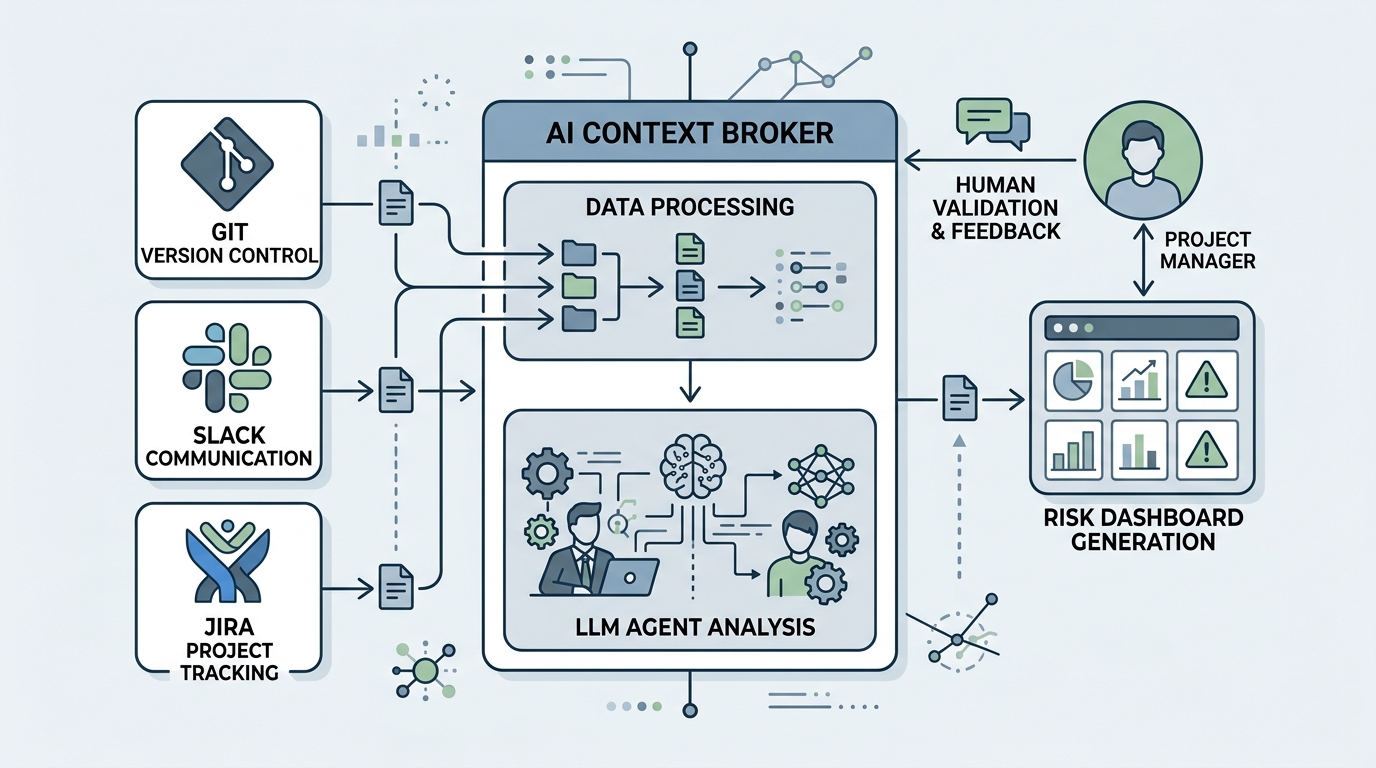
To scale this pattern across an engineering organization, a centralized data ingestion layer must be designed. This layer acts as a unified context broker, pulling data from your VCS, chat platforms, and issue trackers, normalizing it, and feeding it to specialized agent loops. The project manager interacts with this system through a unified control plane, validating proposed actions and focusing their energy where human intervention is uniquely required.
Redefining the Metrics: Moving Beyond Velocity and Burndown
The integration of AI into the software development lifecycle (SDLC) is also breaking our traditional metrics. For decades, engineering organizations have relied on metrics like story points completed per sprint (velocity), burndown charts, and lines of code written to measure productivity and project health. These metrics have always been flawed—they are easily gamed and prioritize output over outcome—but the rise of AI-assisted coding tools like GitHub Copilot, Cursor, and autonomous coding agents makes them completely obsolete.
When developers can use AI to generate hundreds of lines of boilerplate code in seconds, or when autonomous agents can draft entire feature branches, "lines of code" and "velocity" skyrocket without necessarily delivering any real business value. In fact, this explosion of AI-generated code often leads to an increase in technical debt, architectural fragmentation, and code review bottlenecks. If your project managers are still tracking success based on sprint velocity, they are optimizing for a metric that has been completely decoupled from actual progress.
I recommend that engineering leaders abandon these legacy output metrics and shift toward a combination of System Health Metrics and Outcome-Oriented Metrics. The project manager of the future must use AI to analyze qualitative, unstructured data to measure these new dimensions. The following table outlines this paradigm shift:
| Dimension | Legacy Metric (Output-Focused) | Modern Metric (Outcome & Health-Focused) | How AI Enables It |
|---|---|---|---|
| Delivery Speed | Sprint Velocity, Story Points | Lead Time to Value (LTV), Cycle Time | AI tracks the exact time from business requirement formulation to production deployment, flagging non-technical friction points. |
| Code Quality | Lines of Code, Commit Count | Change Failure Rate, Defect Density | AI monitors post-release telemetry and maps production incidents back to specific commits and PRs to identify systemic quality issues. |
| Team Cognitive Load | Hours Logged, Task Count | Cognitive Load Index, Context-Switching Frequency | AI analyzes Slack activity, calendar invites, and PR review loops to detect when engineers are spread too thin across disparate contexts. |
| Strategic Alignment | Feature Completion % | Feature Adoption, Business Value Realization | AI correlates product usage data and customer feedback with specific engineering initiatives to measure actual business impact. |
By focusing on these modern metrics, the project manager shifts their attention from "Are we writing code fast enough?" to "Are we delivering the right value with minimal friction?" AI makes this possible by processing the massive volume of qualitative data required to calculate these metrics—data that was previously too fragmented and unstructured for a human to analyze systematically.
Operationalizing the AI-Assisted PM Workflow
To move beyond theory, let us look at how you can build a practical, automated pipeline to assist your project managers. Below is a complete, syntactically valid Python script that demonstrates how to implement a risk-detection engine. This script ingests engineering telemetry—such as Git commit summaries, Slack channel logs, and Jira backlog states—and uses an LLM with structured outputs (via Pydantic) to generate a high-fidelity risk assessment and actionable mitigation steps.
import os
from typing import List, Literal
from pydantic import BaseModel, Field
from openai import OpenAI

# Define the structured schema for our project risk assessment
class RiskAssessment(BaseModel):
    risk_level: Literal["Low", "Medium", "High", "Critical"] = Field(
        ...,
        description="The overall assessed risk level of the project delivery."
    )
    identified_bottlenecks: List[str] = Field(
        ...,
        description="Specific engineering, communication, or architectural bottlenecks."
    )
    recommended_actions: List[str] = Field(
        ...,
        description="Actionable, concrete steps for the project manager to mitigate the risks."
    )
    confidence_score: float = Field(
        ...,
        description="The confidence score of the model's assessment, from 0.0 to 1.0."
    )

def analyze_project_telemetry(
    git_summary: str,
    slack_summary: str,
    jira_backlog_status: str
) -> RiskAssessment:
    """
    Analyzes engineering telemetry to identify delivery risks and generate
    actionable mitigation recommendations for the project manager.
    """
    # Initialize the client. Expects OPENAI_API_KEY to be set in the environment.
    client = OpenAI(api_key=os.environ.get("OPENAI_API_KEY"))

    prompt = f"""
    Analyze the following engineering team telemetry to identify delivery risks,
    bottlenecks, and concrete mitigation steps.

    Git Activity Summary:
    {git_summary}

    Slack Communication Summary:
    {slack_summary}

    Jira Backlog Status:
    {jira_backlog_status}
    """

    # Use the structured outputs API to guarantee the response matches our Pydantic model
    completion = client.beta.chat.completions.parse(
        model="gpt-4o-2024-08-06",
        messages=[
            {
                "role": "system",
                "content": "You are an expert technical project manager and systems engineer. Your job is to analyze team telemetry to find hidden risks, communication gaps, and architectural bottlenecks."
            },
            {
                "role": "user",
                "content": prompt
            }
        ],
        response_format=RiskAssessment,
    )

    return completion.choices[0].message.parsed

# Example execution
if __name__ == "__main__":
    # Sample telemetry data representing a common project bottleneck scenario
    git_data = """
    - 12 commits to branch 'feature/auth-overhaul' by developer_a.
    - 3 pull requests open for > 48 hours awaiting review from lead_architect.
    - Build failing on main branch due to dependency conflict in package.json.
    """

    slack_data = """
    - developer_a: 'I am waiting on lead_architect to approve the database schema changes before I can proceed.'
    - developer_b: 'Does anyone know if we are still supporting the legacy OAuth endpoint? The docs are conflicting.'
    - lead_architect: 'Out of office today attending the architecture summit.'
    """

    jira_data = """
    - Epic: Auth Overhaul (Target Date: Friday)
    - 4 In-Progress tasks, 2 Blocked tasks (waiting on external API credentials).
    - 0 QA tasks completed.
    """

    try:
        assessment = analyze_project_telemetry(git_data, slack_data, jira_data)
        print(f"Assessed Risk Level: {assessment.risk_level}")
        print(f"Confidence Score: {assessment.confidence_score}\n")
        print("Identified Bottlenecks:")
        for bottleneck in assessment.identified_bottlenecks:
            print(f"- {bottleneck}")
        print("\nRecommended Actions:")
        for action in assessment.recommended_actions:
            print(f"- {action}")
    except Exception as e:
        print(f"Error running risk assessment: {e}")
This script demonstrates how easily we can convert fragmented, noisy engineering telemetry into a highly structured, actionable risk report. By running this pipeline on a daily cron job, a project manager can start their day with a clear, prioritized list of where the team is blocked and what actions they need to take to unblock them. This completely bypasses the need for a 30-minute status meeting where developers repeat what they did yesterday.
The Human Core: Influence, Conflict Resolution, and Strategic Alignment
While the technical architecture of AI-agent orchestration is powerful, it highlights a fundamental truth: the most critical aspects of project management cannot be written in code or solved by an LLM. When we strip away the administrative overhead of status tracking, we are left with the true core of project leadership—a core that is entirely human.
An LLM can identify that a project is running behind schedule due to a dependency on another team. It can even draft a polite Slack message asking that team to prioritize the dependency. What it cannot do is build the relational trust required to get that team to actually do the work. It cannot sit down with a stubborn stakeholder who is demanding unrealistic features and negotiate a compromise that keeps the project on track without burning out the engineering team. It cannot resolve the interpersonal friction that arises when two senior engineers disagree on an architectural pattern.
Software delivery is a deeply human endeavor. It is driven by emotion, motivation, fear of failure, and organizational politics. Projects rarely fail because of a lack of tracking; they fail because of misaligned expectations, poor communication, and a lack of psychological safety. When engineers are afraid to deliver bad news, they hide it. An AI agent can only analyze the data that exists; it cannot analyze the conversations that aren't happening because people are afraid to have them.
This is where the redefined project manager excels. Released from the prison of updating Jira tickets, the modern PM becomes a facilitator of human alignment. They use the insights generated by AI as leverage to have deeper, more meaningful conversations.
For example, if the AI risk engine flags that a developer is experiencing high context-switching and cognitive load, the PM does not simply assign fewer tickets. They schedule a one-on-one conversation to understand the root cause. Is the developer struggling with a personal issue? Are they being pulled into unofficial support loops because of poor documentation? Is there a lack of clarity in the product requirements? These are human problems that require empathy, active listening, and creative problem-solving.
Furthermore, strategic alignment requires a level of business acumen and long-term vision that LLMs currently lack. An AI can optimize a schedule based on historical data, but it cannot make the strategic judgment call to launch a minimally viable product early to capture a sudden market window, even if it means taking on massive technical debt. That is a value judgment that requires weighing business survival against engineering excellence—a decision that must ultimately be made by a human leader.
Conclusion
AI is not going to replace project managers. However, project managers who refuse to adapt to AI will inevitably be replaced by those who do. The transition from administrative tracking to strategic orchestration is not a threat to the profession; it is an elevation of it. It rescues the role from the mundane, repetitive tasks that have historically given project management a reputation for bureaucratic overhead, allowing PMs to focus on what they do best: leading people, managing strategic risk, and driving business value.
To prepare your engineering organization for this shift, I recommend taking the following concrete actions:
- Audit your PMs' time allocation: Track how much time your project managers spend on manual data entry, status aggregation, and meeting coordination versus strategic planning, stakeholder alignment, and team coaching. Target the administrative tasks for immediate automation.
- Build a unified telemetry pipeline: Start integrating your engineering tools (GitHub, Slack, Jira) into a centralized data layer. This will serve as the foundation for deploying AI-agent orchestration loops.
- Upskill your PMs in data literacy and prompt engineering: Teach your project managers how to interact with AI systems, how to validate LLM outputs, and how to use data-driven insights to guide their human interventions.
- Shift your organizational metrics: Begin phasing out output-focused metrics like velocity and story points in favor of outcome-oriented and system health metrics that reflect the true state of your delivery pipeline.
By embracing this evolution, you will not only build a more efficient, high-performing engineering organization, but you will also create a culture where human leadership and machine intelligence work in tandem to deliver exceptional software.