
Introduction
Distributed computing frameworks have become the bedrock of modern artificial intelligence and machine learning pipelines. Among these, Ray—developed by Anyscale—has emerged as the de facto standard for scaling compute-intensive workloads, from distributed training of large language models to high-throughput reinforcement learning and real-time model serving. However, the rapid adoption of Ray has exposed a systemic architectural blind spot: the historical prioritization of raw performance and developer convenience over strict, zero-trust security boundaries.
This tension has culminated in active, real-world exploitation. The Cybersecurity and Infrastructure Security Agency (CISA) recently added CVE-2025-62593, a critical remote code injection vulnerability in Ray, to its Known Exploited Vulnerabilities (KEV) Catalog. This vulnerability allows unauthenticated attackers to execute arbitrary code across a Ray cluster, effectively turning high-performance computing environments into launchpads for lateral movement, intellectual property theft, and cryptojacking.
As a senior technology editor and systems architect, I have watched organizations repeatedly fall into the trap of deploying complex distributed systems using default, development-oriented configurations in production environments. In this article, I will analyze the architectural root causes of CVE-2025-62593, dissect the mechanics of the exploit, and provide concrete, production-grade mitigation strategies to secure your distributed AI infrastructure. This is not a theoretical exercise; if you run Ray in production, you must assume your environment is a target and take immediate, systematic action to isolate and protect your compute nodes.
Understanding the Ray Architecture and the Attack Surface
To understand why CVE-2025-62593 is so devastating, we must first examine the fundamental architecture of a Ray cluster. Ray is designed to abstract away the complexities of distributed systems, allowing developers to write Python code that runs seamlessly across thousands of CPU and GPU cores. To achieve this, Ray relies on a highly interconnected, multi-component topology.
At the core of any Ray cluster is the Head Node. The head node runs several critical control plane services:
- The Global Control Store (GCS): A key-value store (historically built on Redis, now a custom C++ service) that manages cluster metadata, actor registration, and object locations.
- The API Server / Job Submission Service: An HTTP endpoint (typically listening on port 8265) that allows developers to submit jobs, upload runtime environments, and monitor cluster state.
- The Ray Dashboard: A web-based user interface (also sharing port 8265) that visualizes resource utilization, logs, and active tasks.
- The Ray Client Server: An endpoint (typically on port 10001) that allows remote interactive Python sessions to connect directly to the cluster.
Surrounding the head node are Worker Nodes. Each worker node runs a local raylet process, which manages local scheduling, object stores (Plasma), and worker processes that execute the actual Python tasks.
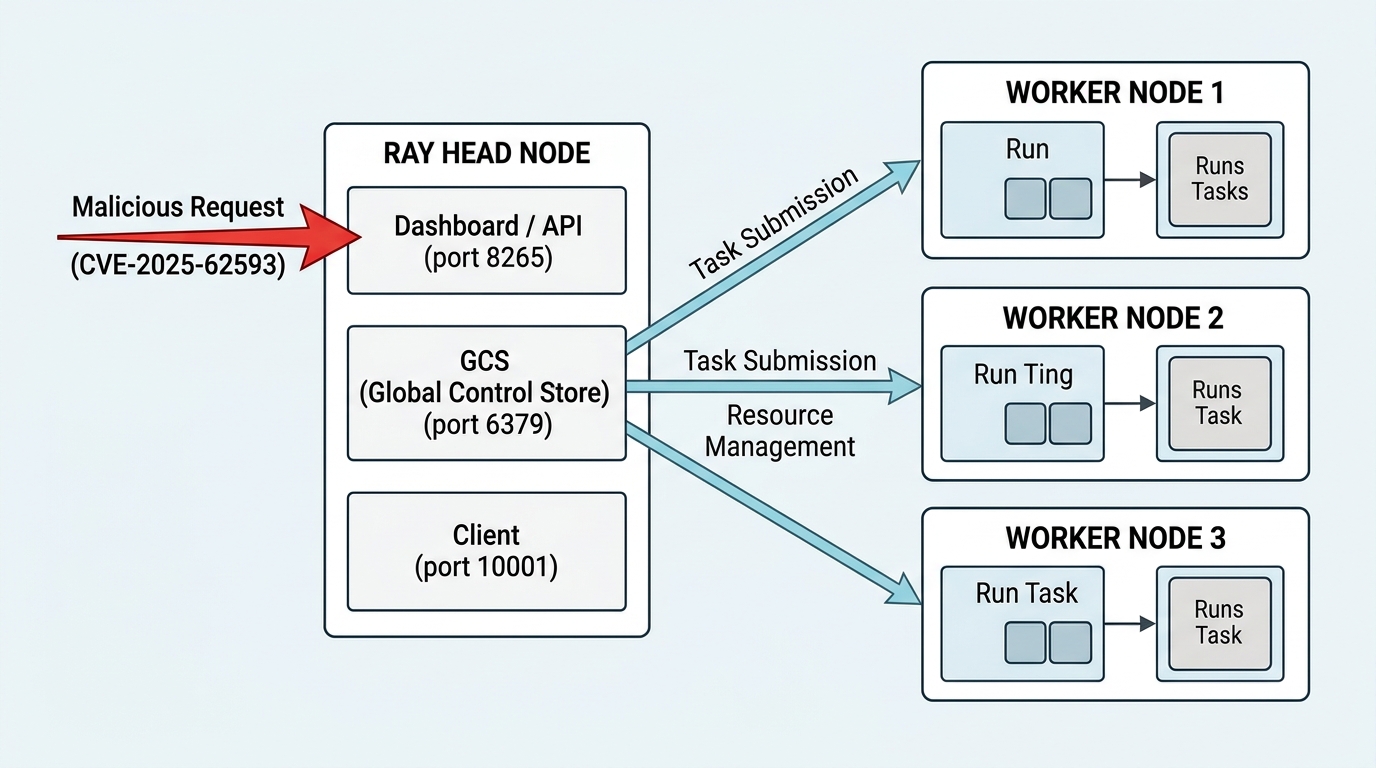
The architectural vulnerability of this design lies in its trust model. Ray was originally conceived for trusted, isolated academic or private network environments. By default, Ray assumes that any entity capable of communicating with the head node's ports is authorized to execute arbitrary code. There is no native, fine-grained role-based access control (RBAC) built into the core Ray protocol. If an attacker can reach the dashboard, the job submission API, or the GCS port, they can instruct the cluster to spawn tasks, download external packages, and run arbitrary shell commands with the privileges of the Ray process.
When organizations deploy Ray on cloud infrastructure (such as AWS, GCP, or Azure) or within Kubernetes clusters (using the KubeRay operator) without strict network isolation, they inadvertently expose these highly sensitive control plane ports to the public internet or compromised internal networks. This exposure is precisely what threat actors are targeting to exploit CVE-2025-62593.
Dissecting CVE-2025-62593: The Mechanics of the Injection
The CVE-2025-62593 vulnerability is fundamentally a failure of input validation and boundary enforcement within the Ray Dashboard and Job Submission APIs. Specifically, the vulnerability resides in how the Ray head node processes incoming requests to configure "runtime environments" (runtime_env).
In Ray, a runtime_env allows developers to dynamically specify dependencies—such as pip packages, environment variables, conda environments, or remote zip files—that must be installed on worker nodes before a job executes. This is a powerful feature for machine learning workflows, where different jobs may require conflicting versions of libraries.
However, the implementation of this feature failed to sanitize and validate the parameters passed within the API payload. When a client submits a job with a custom runtime_env, the head node parses the configuration and executes system-level commands to prepare the environment (for example, invoking pip install or extracting downloaded archives).
Because of CVE-2025-62593, an attacker can craft a malicious HTTP POST request to the /api/jobs/ or dashboard endpoints containing shell metacharacters or malicious payloads embedded within the runtime_env parameters. The head node executes these commands without sufficient sanitization, leading to arbitrary code execution.
Because the head node is responsible for orchestrating the entire cluster, once an attacker achieves code execution on the head node, they can easily propagate malicious payloads to all connected worker nodes. The attacker can leverage Ray's native task distribution mechanisms to execute commands across the entire GPU cluster, bypassing any endpoint detection and response (EDR) tools that are only monitoring edge servers.
This vulnerability is particularly insidious because it does not require authentication by default. If the Ray dashboard port (8265) is accessible, any external actor can send a single HTTP request to compromise the entire computing cluster. This has made Ray clusters prime targets for automated scanning and active exploitation by threat actors seeking massive computational resources for cryptomining or looking to exfiltrate proprietary training data and model weights.
Architectural Mitigation: Hardening Ray Clusters
Mitigating CVE-2025-62593 requires a multi-layered, zero-trust approach to systems architecture. You cannot rely solely on software patches; you must design your infrastructure under the assumption that the application layer may contain unpatched vulnerabilities.
I recommend implementing a strict defense-in-depth strategy consisting of network isolation, robust authentication, and runtime containment.
1. Network Isolation and Microsegmentation
The single most effective control is to ensure that no Ray control plane ports are accessible from outside your trusted network boundary. You must block all external access to ports 8265 (Dashboard/API), 10001 (Ray Client), and 6379 (GCS).
If you are running Ray on Kubernetes via the KubeRay operator, you should enforce strict NetworkPolicies to restrict ingress traffic to the head node. Below is a production-grade Kubernetes NetworkPolicy that restricts access to the Ray dashboard and API, allowing connections only from a designated ingress controller or a secure bastion host namespace:
apiVersion: networking.k8s.io/v1
kind: NetworkPolicy
metadata:
  name: restrict-ray-head-ingress
  namespace: ml-workloads
spec:
  podSelector:
    matchLabels:
      ray.io/node-type: head
  policyTypes:
  - Ingress
  ingress:
  - from:
    - namespaceSelector:
        matchLabels:
          kubernetes.io/metadata.name: ingress-nginx
    ports:
    - protocol: TCP
      port: 8265
  - from:
    - podSelector:
        matchLabels:
          ray.io/node-type: worker
    ports:
    - protocol: TCP
      port: 6379
    - protocol: TCP
      port: 10001
2. Implementing Authenticated Reverse Proxies
By default, the Ray Dashboard does not support authentication. To expose the dashboard to data scientists safely, you must place it behind an authenticating reverse proxy.
I advise deploying an OAuth2 Proxy or an ingress controller integrated with your identity provider (IdP) via OIDC (such as Okta, Azure AD, or Keycloak). The proxy intercepts all traffic to port 8265, validates the user's identity and group membership, and only forwards authenticated requests to the Ray head node.
Additionally, if you use the Ray Job CLI or Python SDK to submit jobs, you should configure mutual TLS (mTLS) across your cluster. Ray supports TLS encryption for all internal communication channels (gRPC, GCS, and object manager). You must generate secure certificates and configure the following environment variables on all nodes:
RAY_USE_TLS=1RAY_TLS_SERVER_CERTRAY_TLS_SERVER_KEYRAY_TLS_CACERT
3. Least Privilege and Container Hardening
Many organizations run Ray processes as the root user inside Docker containers. This is a dangerous anti-pattern. If an attacker exploits CVE-2025-62593, they immediately inherit root privileges, allowing them to escape the container, compromise the host operating system, and access cloud provider metadata services (which can leak IAM credentials).
To mitigate this risk, apply the following container hardening practices:
- Run as Non-Root: Configure your Dockerfiles and Kubernetes PodSecurityContexts to run the Ray process under a dedicated, non-privileged user (e.g., UID
1000). - Read-Only Root Filesystem: Mount the container's root filesystem as read-only, using dedicated, non-executable emptyDir volumes for Ray's temporary directories (
/tmp/ray). - Disable Privilege Escalation: Set
allowPrivilegeEscalation: falsein your Kubernetes security contexts. - Restrict Cloud Metadata Access: Block access to the cloud metadata service (e.g.,
169.254.169.254) using network policies or local iptables rules to prevent credential exfiltration.
Monitoring, Detection, and Incident Response
Even with robust preventative controls, you must establish continuous monitoring to detect potential exploitation attempts and post-compromise behavior.
Log Analysis and Anomalous API Activity
You should centralize and analyze logs from the Ray Dashboard and Job Submission service. Look for anomalous HTTP POST requests to /api/jobs/ or /api/packages/. Specifically, inspect the payload of these requests for:
- Unexpected shell commands, pipe characters (
|), semicolons (;), or backticks (`) within theruntime_envJSON structure. - Attempts to download files from untrusted external domains (e.g., using
curlorwgetinside a pip dependency specification). - Requests originating from unexpected IP addresses or outside your corporate VPN range.
Runtime Security and Process Monitoring
Because CVE-2025-62593 results in arbitrary code execution, the most reliable indicator of compromise (IoC) is anomalous process behavior on your compute nodes.
I recommend deploying eBPF-based runtime security tools, such as Cilium Tetragon or Falco, on your Kubernetes nodes. Configure rules to alert on suspicious child processes spawned by the Ray worker or head processes. For example, a Ray worker process (raylet or Python worker) should never spawn a shell (/bin/sh, /bin/bash), initiate outbound SSH connections, or execute cryptomining binaries.
| Detection Vector | Indicator of Compromise (IoC) | Recommended Action |
|---|---|---|
| Process Execution | raylet or python spawning sh, bash, curl, or wget |
Terminate the pod/node immediately; isolate the network segment. |
| Network Activity | Outbound connections from Ray nodes to public IPs on non-standard ports | Block outbound internet access at the firewall/NAT gateway level. |
| File System | Write operations to binary directories or unexpected execution of files in /tmp |
Implement read-only root filesystems and monitor /tmp mounts. |
| API Logs | High frequency of 4xx/5xx errors on /api/jobs/ with malformed JSON payloads |
Audit ingress controller logs and verify authentication token validity. |
If you detect an active compromise, execute your incident response playbook immediately:
- Isolate: Revoke the network security group rules or Kubernetes NetworkPolicies for the affected cluster to prevent lateral movement.
- Snapshot: Take a snapshot of the affected nodes' memory and persistent disks for forensic analysis.
- Terminate: Destroy the compromised Ray cluster. Because Ray workloads are typically stateless or checkpointed to external object storage (like S3), terminating and recreating the cluster from a clean, patched image is the fastest path to recovery.
- Rotate Credentials: Immediately rotate any cloud IAM keys, database credentials, or API tokens that were accessible to the compromised cluster.
Conclusion
CVE-2025-62593 is a stark reminder that the rapid pace of AI innovation must not outstrip foundational security engineering. Distributed computing frameworks like Ray are incredibly powerful, but their inherent design prioritizes compute efficiency over isolation. When these systems are deployed without rigorous architectural guardrails, they present a highly attractive target for sophisticated threat actors.
To secure your environment, you must move away from the assumption that internal networks are safe. Implement network microsegmentation, enforce strict authentication for all dashboard and API endpoints, run your workloads with the least privilege, and deploy runtime monitoring to catch anomalous behavior. By treating your distributed AI infrastructure with the same security rigor as your core transactional systems, you can leverage the full power of distributed machine learning without exposing your organization to catastrophic compromise.