

Introduction
For the past few years, the software industry has been operating in a state of collective suspension of disbelief. The rapid rise of large language models (LLMs) democratized access to cognitive automation, giving birth to a phenomenon often referred to as "vibe coding." This is a development pattern where engineers write natural language prompts, manually inspect a handful of outputs, declare the system "good enough," and push it to production. While vibe coding is an exceptional tool for rapid prototyping and proof-of-concept validation, it is a catastrophic strategy for building resilient, predictable, and scalable enterprise software.
As the initial hype around generative AI matures into a demand for measurable return on investment, engineering leaders are facing a stark reality: prototypes are easy, but production is incredibly hard. The non-deterministic nature of LLMs introduces a class of failure modes that traditional software testing frameworks are ill-equipped to handle. To bridge this gap, Andrew Ng and the team at DeepLearning.AI released the AI Engineering Skills Map. This framework serves as a timely intervention, formally decoupling ad-hoc prompting from the rigorous, multi-disciplinary practices required of a modern AI Engineer.
In my analysis of this framework, I see more than just a curriculum; I see a blueprint for the professionalization of AI application development. As engineering leaders, our primary challenge is no longer access to compute or models, but the systemic lack of engineering discipline applied to non-deterministic systems. In this article, I will dissect the core pillars of the AI Engineering Skills Map, analyze the architectural implications of moving from vibe coding to specification-driven development, and provide a concrete roadmap for operationalizing these standards within your engineering organization.
The Six Core Pillars of Modern AI Engineering
Andrew Ng’s framework breaks down the necessary competencies of an AI engineer into six distinct sub-skills. These skills move sequentially from basic model interaction to complex, multi-agent orchestration and production lifecycle management. Understanding the boundaries and technical depths of these pillars is essential for any leader looking to build a high-performing AI team.
1. Prompt Engineering and System Prompting
While often dismissed as a transient skill, prompt engineering at an engineering level is not about finding "magic words." It is about structured context window management, systematic prompt templating, and the implementation of robust system instructions. An AI engineer must understand how to enforce output formats (such as JSON or Protocol Buffers), manage token budgets, and mitigate prompt injection vulnerabilities. This pillar forms the baseline interface between deterministic code and non-deterministic models.
2. Retrieval-Augmented Generation (RAG)
Moving beyond static knowledge bases requires dynamic context injection. RAG has evolved from simple vector database lookups to complex, multi-stage retrieval pipelines. AI engineers must master document parsing, chunking strategies (such as semantic chunking or sliding windows), embedding model selection, vector indexing, and re-ranking algorithms. Furthermore, they must understand how to handle retrieval failures, such as when the retriever returns irrelevant context that poisons the generator's response.
3. Agentic Workflows and Tool Use
Single-turn prompt-and-response patterns are insufficient for complex tasks. Agentic workflows introduce loops, planning, and tool execution. An AI engineer must know how to equip an LLM with external APIs, database connectors, and computational tools. This requires designing robust state machines, handling tool execution errors gracefully, and implementing reflection loops where the model evaluates its own work before returning a result. The complexity here lies in managing state, latency, and cost as the agent iterates.
4. Fine-Tuning and Model Customization
When prompt engineering and RAG hit their limits regarding style, tone, domain-specific terminology, or task-specific performance, fine-tuning becomes necessary. This pillar requires a deep understanding of dataset curation, data synthesis, and training techniques like Low-Rank Adaptation (LoRA) and Parameter-Efficient Fine-Tuning (PEFT). An AI engineer must be able to evaluate whether a problem requires the retrieval of external facts (RAG) or the modification of the model's internal behavior (fine-tuning), and execute the latter without causing catastrophic forgetting.
5. Evaluation and Testing (EvalOps)
This is the most critical and frequently neglected pillar. Traditional unit tests cannot validate whether an LLM's response is "helpful," "accurate," or "safe." AI engineers must build systematic evaluation pipelines (Evals). This involves defining quantitative metrics (such as faithfulness, answer relevance, and toxicity), curating golden evaluation datasets, and implementing automated testing loops using LLM-as-a-judge patterns, heuristic checks, and semantic similarity evaluations.
6. Deployment, Monitoring, and LLMOps
Bringing an AI system to production requires the same operational rigor as traditional microservices, with added layers of complexity. This pillar encompasses model serving, caching strategies (such as semantic prompt caching to reduce latency and cost), rate limiting, fallback mechanisms, and continuous monitoring. Engineers must track operational metrics (latency, token throughput, cost) alongside alignment metrics (drift, hallucination rates, and user feedback loops).
Deconstructing the Vibe Coding Trap: Moving to Specification-Driven Development
To understand why Andrew Ng’s skills map is so vital, we must look at the mechanics of the "vibe coding" trap. In traditional software engineering, we write a specification, write code to meet that specification, and write deterministic unit tests to prove compliance. If the input is $X$, the output must be $Y$.
In AI engineering, we deal with probabilistic systems. The same input can yield slightly different outputs on subsequent runs. When developers engage in vibe coding, they iterate on a prompt until a few manual test cases look correct. This approach fails to account for regression. A change to a prompt that improves performance for Test Case A might silently break performance for Test Cases B through Z.
To escape this trap, I advocate for a transition to Specification-Driven AI Engineering. This paradigm shifts the focus from writing the "perfect prompt" to building a robust evaluation harness. Before writing a single line of a prompt or configuring a RAG pipeline, you must define the acceptance criteria programmatically.
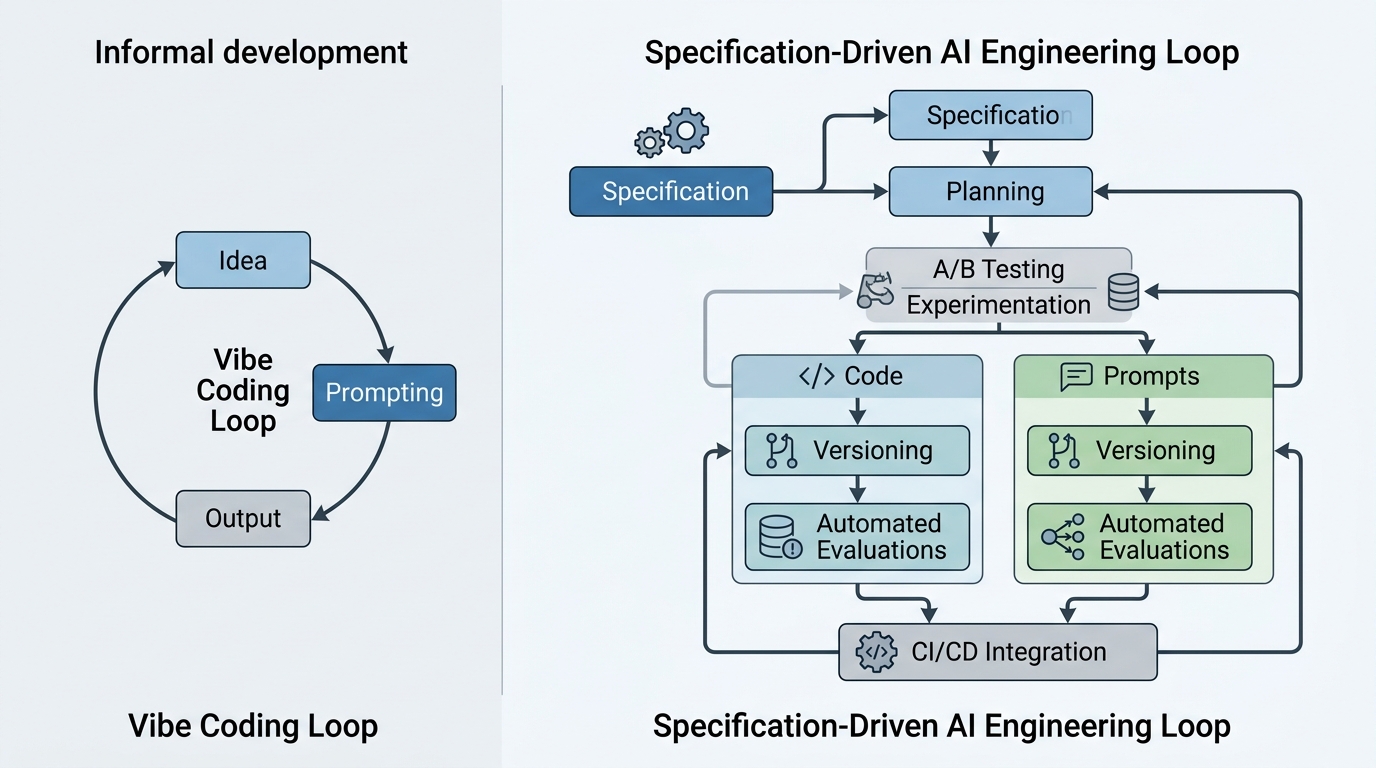
This transition requires a fundamental shift in how we structure our development lifecycle. Instead of treating the LLM as a black box that we coax into submission, we treat it as an untrusted third-party API that must be continuously validated against a strict set of assertions. The prompt becomes a configuration file, the RAG pipeline becomes a data ingestion pipeline, and the evaluation suite becomes our build pipeline. If a prompt change does not pass the automated evaluation suite, the build fails. This is how we bring engineering discipline to generative AI.
Implementing a Systematic Evaluation Framework
To illustrate what specification-driven development looks like in practice, let us examine a concrete implementation of an automated evaluation pipeline. The following Python code demonstrates how to move away from manual inspection by using Pydantic for schema enforcement and an automated assertion-based evaluation harness to programmatically score LLM outputs.
import os
from typing import List, Optional
from pydantic import BaseModel, Field, field_validator
from openai import OpenAI

# Define the expected structured output from our AI system
class CustomerSupportAction(BaseModel):
    category: str = Field(..., description="The classification of the user's issue.")
    urgency: str = Field(..., description="Must be one of: LOW, MEDIUM, HIGH, CRITICAL.")
    suggested_response: str = Field(..., description="The draft response to send to the customer.")
    requires_human_escalation: bool = Field(..., description="True if the issue requires human intervention.")

    @field_validator('urgency')
    @classmethod
    def validate_urgency(cls, v: str) -> str:
        allowed = {"LOW", "MEDIUM", "HIGH", "CRITICAL"}
        if v.upper() not in allowed:
            raise ValueError(f"Urgency must be one of {allowed}")
        return v.upper()

# Define our evaluation criteria and test cases
class EvalTestCase(BaseModel):
    user_input: str
    expected_category: str
    min_response_length: int
    must_contain_keywords: List[str]

# Sample golden dataset for evaluation
GOLDEN_DATASET = [
    EvalTestCase(
        user_input="I need a refund for my subscription billed yesterday. I cancelled last week.",
        expected_category="Billing",
        min_response_length=50,
        must_contain_keywords=["refund", "subscription", "sorry"]
    ),
    EvalTestCase(
        user_input="My account is locked and I cannot access my dashboard. This is urgent.",
        expected_category="Security",
        min_response_length=40,
        must_contain_keywords=["access", "security", "help"]
    )
]

class AIApp:
    def __init__(self):
        # Initialize client using standard environment variables
        self.client = OpenAI(api_key=os.getenv("OPENAI_API_KEY", "mock-key"))

    def process_request(self, user_input: str) -> CustomerSupportAction:
        # System prompt enforcing strict formatting and behavioral guardrails
        system_prompt = (
            "You are an elite customer support triage system. "
            "Analyze the user input and output a valid JSON object matching the requested schema."
        )

        # Utilizing Structured Outputs feature to guarantee schema adherence
        completion = self.client.beta.chat.completions.parse(
            model="gpt-4o-mini",
            messages=[
                {"role": "system", "content": system_prompt},
                {"role": "user", "content": user_input}
            ],
            response_format=CustomerSupportAction,
            temperature=0.0 # Zero temperature for deterministic behavior
        )
        return completion.choices[0].message.parsed

def run_evaluations(app: AIApp, dataset: List[EvalTestCase]) -> bool:
    all_passed = True
    print("Starting automated evaluation suite...\n")

    for i, test_case in enumerate(dataset):
        print(f"Running Test Case {i+1}...")
        try:
            result = app.process_request(test_case.user_input)

            # Assertion 1: Category Matching
            category_match = result.category.lower() == test_case.expected_category.lower()

            # Assertion 2: Response Length Check
            length_ok = len(result.suggested_response) >= test_case.min_response_length

            # Assertion 3: Keyword Inclusion
            keywords_present = all(kw.lower() in result.suggested_response.lower() for kw in test_case.must_contain_keywords)

            # Assertion 4: Logical consistency (e.g., Security issues must be escalated)
            escalation_ok = True
            if result.category.lower() == "security" and not result.requires_human_escalation:
                escalation_ok = False

            test_passed = category_match and length_ok and keywords_present and escalation_ok

            if test_passed:
                print(f"  Result: PASSED")
            else:
                print(f"  Result: FAILED")
                print(f"    Category Match: {category_match} (Got: '{result.category}', Expected: '{test_case.expected_category}')")
                print(f"    Length OK: {length_ok} (Got: {len(result.suggested_response)} chars, Min: {test_case.min_response_length})")
                print(f"    Keywords Present: {keywords_present} (Expected: {test_case.must_contain_keywords})")
                print(f"    Escalation Logic OK: {escalation_ok}")
                all_passed = False

        except Exception as e:
            print(f"  Result: ERROR - {str(e)}")
            all_passed = False

        print("-" * 40)

    return all_passed

if __name__ == "__main__":
    # Execution entry point for CI/CD integration
    app = AIApp()
    success = run_evaluations(app, GOLDEN_DATASET)
    if not success:
        print("Evaluation suite failed. Block deployment.")
        exit(1)
    else:
        print("All evaluations passed. Safe to deploy.")
        exit(0)
This script demonstrates several critical shifts away from vibe coding:
- Schema Enforcement: By using Pydantic and OpenAI's structured outputs, we eliminate the risk of the model returning malformed JSON. The output structure is guaranteed at the API level.
- Deterministic Validation: Instead of looking at the output and saying "that looks good," we run programmatic assertions on category matching, response length, keyword presence, and business logic consistency (e.g., security issues must be escalated).
- CI/CD Readiness: The script exits with a non-zero status code if any evaluation fails. This allows you to integrate this evaluation directly into your GitHub Actions or GitLab CI/CD pipelines, preventing broken prompts from ever reaching production.
Operationalizing the Skills Map: A Guide for Engineering Leaders
As an engineering leader, your job is to translate Andrew Ng’s skills map into organizational capability. You cannot simply hire six different specialists for every AI project; instead, you must upskill your existing software engineers to think like AI engineers.
I recommend structuring this transition around a clear operational checklist. The table below outlines the practical steps you must take to transition your team from ad-hoc prototyping to systematic, specification-driven AI engineering.
| Phase | Current Vibe Coding Practice | Target Production Standard | Actionable Next Step for Leaders |
|---|---|---|---|
| 1. Prompting | Developers write prompts in the UI playground and copy-paste them into code. | Prompts are version-controlled, templated, and decoupled from application logic. | Move all prompts into dedicated YAML or JSON configuration files in your git repository. |
| 2. Retrieval | Simple vector search using default chunking and a single embedding model. | Multi-stage retrieval with semantic chunking, metadata filtering, and re-ranking. | Audit your current RAG retrieval accuracy. Implement a re-ranking step (e.g., Cohere or BGE-Reranker) to improve relevance. |
| 3. Evaluation | Manual "spot-checking" of 5-10 outputs by the developer before deployment. | Automated evaluation suites run against a golden dataset of at least 100 diverse test cases. | Mandate that no AI feature can be merged without an accompanying evaluation dataset and assertion script. |
| 4. Monitoring | Checking application logs occasionally for errors or user complaints. | Real-time tracking of token usage, latency, cost, semantic drift, and negative user feedback. | Integrate dedicated LLM monitoring tools (such as LangSmith, Phoenix, or Arize) into your staging environment. |
| 5. Team Skills | Relying on a single "AI enthusiast" who understands prompt tricks. | Cross-functional team where backend engineers understand context windows, token limits, and Evals. | Conduct structured internal workshops focusing on LLM APIs, structured outputs, and automated evaluation patterns. |
The Hiring and Upskilling Strategy
When building out your team, do not make the mistake of looking exclusively for PhDs in Machine Learning. The skills required to build AI-powered applications are fundamentally different from the skills required to train foundational models. You do not need researchers who can derive backpropagation from scratch; you need systems engineers who understand latency, API design, caching, state management, and testing.
My recommendation is to take your strongest backend engineers—those who are obsessed with performance, API design, and testing—and upskill them on the nuances of probabilistic systems. Teach them how to manage context windows, how to design robust RAG retrieval pipelines, and how to write automated evaluations. This approach is far more scalable and successful than trying to teach a machine learning researcher how to build production-grade enterprise software.
Conclusion
Andrew Ng’s AI Engineering Skills Map arrives at a critical juncture in the evolution of software engineering. It draws a clear, uncompromising line between the hobbyist who can write a clever prompt and the professional engineer who can build a reliable, cost-effective, and scalable AI system. Vibe coding was a necessary phase to explore the boundaries of what is possible with generative AI, but it has reached its logical limit.
As engineering leaders, our responsibility is to establish the standards, tooling, and culture necessary to build dependable systems. By embracing specification-driven development, implementing automated evaluation pipelines, and systematically upskilling our teams across the six core pillars of AI engineering, we can transition our organizations out of the experimental sandbox and into the era of robust, production-grade AI systems. The tools are ready, the framework is clear, and the path forward is ours to execute.