

The Economic Realignment of Software Production
The economics of enterprise software engineering are undergoing a structural realignment. For decades, the primary constraint on software delivery was the capacity to write code. Organizations scaled their engineering teams linearly with business demand, treating code production as the primary bottleneck. Today, the widespread adoption of generative AI and autonomous agents has inverted this dynamic. The marginal cost of code generation is rapidly approaching zero, yet the cost of verification, integration, and long-term architectural maintenance is climbing exponentially.
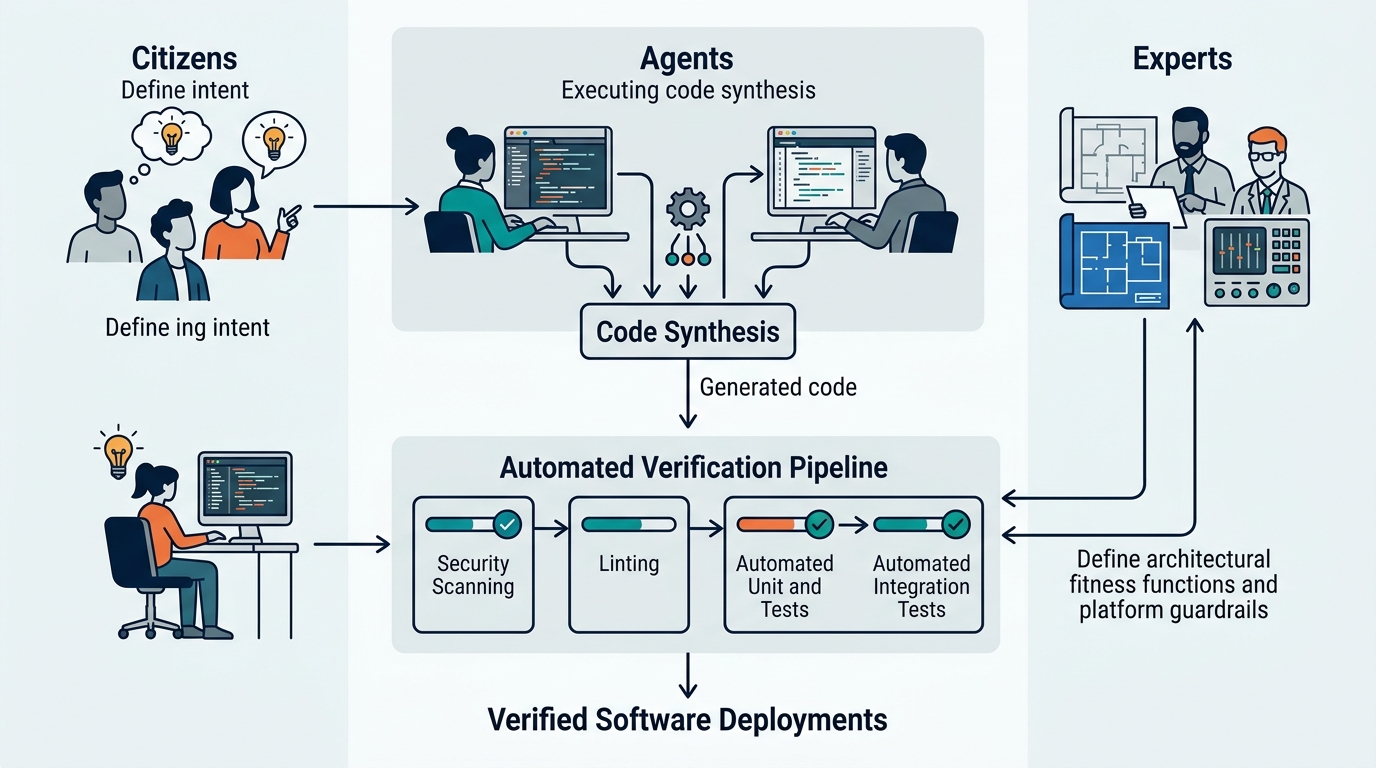
This shift demands a fundamental reorganization of how we build, run, and govern software systems. We are transitioning from a model where human developers write every line of code to a three-tier operating model: Citizens Build, Agents Execute, and Experts Govern. This paradigm redefines the roles of business stakeholders, autonomous tooling, and senior engineers.
To understand why the traditional software engineering lifecycle is failing under the weight of AI-assisted development, I must examine the underlying economics of code. When code generation becomes cheap and instantaneous, we encounter Jevons Paradox: an increase in the efficiency of producing a resource (code) leads to an increase in its overall consumption.
+-----------------------------------------------------------------+
|                       JEVONS PARADOX IN SOFTWARE                |
|                                                                 |
|  [ Lower Cost of Code ] ---> [ Exponential Volume of Code ]     |
|                                          |                      |
|                                          v                      |
|  [ Crisis of Verification ] <--- [ Higher Cognitive Load ]      |
+-----------------------------------------------------------------+
When business units and developers can generate thousands of lines of code with a single prompt, the volume of software increases dramatically. However, this code is not self-maintaining. Every line of code generated—whether by a human or a Large Language Model (LLM)—represents a liability. It must be compiled, tested, deployed, monitored, secured, and eventually refactored.
This creates a severe imbalance in the software production function. I break this down into three distinct phases:
- The Generation Phase (Near-Zero Cost): LLMs and specialized agents can write boilerplate, generate unit tests, translate languages, and draft entire microservices in seconds.
- The Verification Phase (High Cost): Determining whether the generated code is secure, architecturally sound, performant, and aligned with business logic still requires rigorous analysis.
- The Maintenance Phase (Compounding Cost): As the codebase grows, the cognitive load required to understand the interactions between components increases non-linearly. If agentic code is allowed to bypass strict architectural boundaries, the system quickly degrades into an unmanageable "big ball of mud."
If you do not adapt your organizational structure to this reality, your engineering department will become a bottleneck of manual code reviews. Senior engineers will spend their entire day reading, debugging, and rejecting low-quality, agent-generated pull requests. To avoid this, I recommend decoupling code production from code verification through a structured, three-tier operating model.
The Three-Tier Operating Model: Citizens, Agents, and Experts
The "Citizens, Agents, Experts" framework redistributes responsibilities across the enterprise to leverage the strengths of both human intelligence and machine scale. It establishes clear boundaries between intent definition, execution, and systemic governance.
1. Citizens: Defining Intent and Domain Boundaries
In this model, "Citizens" are business analysts, product managers, domain experts, and non-technical stakeholders. Historically, these individuals had to translate their requirements into documents, hand them off to product owners, who then translated them into tickets for developers to write code. This multi-step translation pipeline is incredibly lossy.
With agentic interfaces, Citizens can directly build and orchestrate lightweight applications, workflows, and data pipelines using natural language and low-code abstraction layers. They do not write production-grade infrastructure code. Instead, they define the intent and the domain rules. Their role shifts from passive consumers of software to active creators of local automation, operating within sandboxed environments provided by the platform team.
To prevent this from devolving into the "shadow IT" crises of the past, these sandboxes must be strictly bounded. Citizens operate within runtime environments where data access is governed by fine-grained API gateways, and deployment targets are restricted to internal, non-critical environments. If a Citizen-built application proves its value and needs to scale, it is handed over to the automated agent pipeline for hardening.
2. Agents: Autonomous Execution and Code Synthesis
Agents are the workhorses of the new software lifecycle. They are not merely autocomplete tools; they are autonomous execution units capable of goal-directed behavior. When a Citizen or an Expert defines a goal, the agent plans the execution steps, writes the necessary code, runs local tests, refactors legacy structures, and packages the application.
Agents excel at tasks with high repeatability and clear evaluation metrics, such as:
- Migrating a service from an older framework version to a newer one.
- Writing boilerplate integration code between two well-defined APIs.
- Generating comprehensive unit test suites based on code coverage gaps.
- Automating routine database migrations and schema updates.
However, agents lack systemic context. They do not understand the long-term business strategy, the subtle security implications of a specific architectural pattern, or the organizational cost of introducing a new third-party dependency. They execute locally but cannot govern globally.
3. Experts: Architectural Governance and Platform Engineering
Experts are your senior software engineers, principal architects, and security specialists. In the traditional model, these highly skilled individuals spent a significant portion of their day writing routine feature code. In the new model, I advise redirecting their hands-on coding time toward high-leverage activities: platform engineering, architectural design, and automated governance.
Experts do not review every line of agent-generated code manually. Instead, they design the guardrails, write the automated fitness functions, build the platform APIs that agents consume, and govern the entire system. They focus on the how of the system's architecture, ensuring that the platform is robust enough to allow Citizens and Agents to build safely.
Architectural Governance and the Verification Bottleneck
To make this three-tier model viable, you must solve the verification bottleneck. If human experts have to manually approve every pull request generated by an agent, the system collapses. The solution is to shift from human-centric governance to automated, code-defined governance.
This requires treating your architecture as a verifiable set of constraints. You must define your architectural rules in code, allowing your CI/CD pipelines to automatically reject agentic output that violates these rules. This is where architectural fitness functions become critical.
An architectural fitness function is an objective integrity assessment of some architectural characteristic. By implementing these functions directly into your build pipelines, you can ensure that agents operate within strict boundaries without requiring manual human intervention for every change.
The Verification Pipeline
When an agent generates code, it must pass through a multi-layered verification pipeline before it can be merged into the main branch or deployed to production:
| Verification Layer | Responsibility | Tooling / Approach |
|---|---|---|
| Syntactic & Static Analysis | Ensures code quality, formatting, and basic security hygiene. | Linters, SAST tools (SonarQube, Semgrep), dependency checkers. |
| Functional Verification | Validates that the generated code actually solves the business problem. | Automated unit tests, integration tests, and behavior-driven development (BDD) assertions. |
| Architectural Fitness | Enforces structural boundaries, dependency rules, and design patterns. | Custom AST parsers, ArchUnit, NetArchTest, or custom policy engines (OPA). |
| Operational & Cost Guardrails | Prevents runaway resource consumption or insecure deployment configurations. | Infrastructure-as-Code (IaC) scanners, policy-as-code (Terraform Sentinel, Kubeval). |
If a pull request generated by an agent fails any of these automated checks, the pipeline rejects the change and feeds the error log directly back to the agent. The agent then attempts to self-correct and resubmit the code. The human expert is only alerted if the agent fails to resolve the violation after a predetermined number of iterations, or if the change requires a fundamental modification of the architectural policy itself.
Implementing the Expert Governance Framework
To transition your organization to this model, you must equip your experts with the tools to write architectural policies as code. Below, I have provided a practical implementation of an architectural fitness function written in Python.
This script acts as a governance gate in a CI/CD pipeline. It parses the codebase using the Abstract Syntax Tree (AST) module to enforce strict architectural boundaries. Specifically, it ensures that code generated by agents in the "presentation" layer does not bypass the "domain" layer to query the database directly, and that no unauthorized external libraries are imported.
import ast
import os
import sys
from typing import List, Set

class ArchitecturalGovernanceVerifier(ast.NodeVisitor):
    def __init__(self, file_path: str, allowed_external_imports: Set[str]):
        self.file_path = file_path
        self.allowed_external_imports = allowed_external_imports
        self.violations: List[str] = []
        self.current_module = self._get_module_name(file_path)

def _get_module_name(self, file_path: str) -> str:
        parts = os.path.normpath(file_path).split(os.sep)
        return parts[0] if parts else ""

def visit_Import(self, node: ast.Import):
        for alias in node.names:
            self._verify_import(alias.name, node.lineno)
        self.generic_visit(node)

def visit_ImportFrom(self, node: ast.ImportFrom):
        if node.module:
            self._verify_import(node.module, node.lineno)
        self.generic_visit(node)

def _verify_import(self, module_name: str, line_number: int):
        # Rule 1: Presentation layer cannot import infrastructure/database modules directly
        if self.current_module == "presentation":
            if "infrastructure" in module_name or "database" in module_name:
                self.violations.append(
                    f"[LAYER VIOLATION] Line {line_number}: Presentation layer in '{self.file_path}' "
                    f"is forbidden from directly importing database/infrastructure module '{module_name}'."
                )

        # Rule 2: Prevent agents from introducing unapproved external dependencies
        if not module_name.startswith("app") and not module_name.startswith("."):
            root_package = module_name.split(".")[0]
            if root_package not in self.allowed_external_imports:
                self.violations.append(
                    f"[DEPENDENCY VIOLATION] Line {line_number}: Unauthorized external import '{root_package}' "
                    f"detected in '{self.file_path}'."
                )

def run_governance_checks(target_directory: str) -> bool:
    allowed_imports = {"os", "sys", "typing", "json", "pydantic", "fastapi"}
    has_failures = False

return not has_failures

if __name__ == "__main__":
    target_dir = sys.argv[1] if len(sys.argv) > 1 else "./src"
    success = run_governance_checks(target_dir)
    if not success:
        print("\nArchitectural governance checks FAILED. Agentic changes rejected.", file=sys.stderr)
        sys.exit(1)
    print("\nArchitectural governance checks PASSED.")
    sys.exit(0)
Operational Trade-offs and Limitations
While the three-tier model offers a path to scale software engineering without a linear increase in headcount, it introduces distinct operational trade-offs and risks that you must manage actively.
The Self-Correction Loop Failure Mode
When an agent fails an automated architectural check, the pipeline feeds the error back to the agent for self-correction. In my experience, agents can easily fall into infinite loops or "hallucination traps" when trying to resolve complex architectural violations. For example, an agent trying to bypass a dependency restriction might repeatedly rewrite imports in slightly different but equally invalid ways, consuming significant LLM token budgets without resolving the root issue.
To mitigate this, you must implement strict execution limits on the self-correction loop. I recommend capping the agent's self-correction attempts at three iterations. If the agent cannot resolve the violation within three attempts, the pipeline must halt, reject the pull request, and flag the issue for human intervention. This prevents runaway API costs and alerts experts to systemic issues in either the agent's prompt context or the architectural rules themselves.
The Uncanny Valley of Semi-Automated Code Reviews
As agents generate more code, human engineers can easily fall into a state of cognitive fatigue. When reviewing pull requests that are 90% correct, humans tend to overlook subtle logical flaws, security vulnerabilities, or edge cases. This "uncanny valley" of code quality is highly dangerous; it allows complex, hard-to-detect bugs to slip into production under the guise of clean, syntactically correct code.
To combat this, you must shift your verification strategy away from manual code reviews entirely for agent-generated code. If a piece of code is generated by an agent, it must be verified by automated tests and fitness functions, not by a human staring at a diff. The human expert's role is to review and approve the tests and the policies, not the generated implementation details.
Compute and API Cost Escalation
Running continuous, agentic development pipelines is computationally expensive. The cost of querying LLM APIs, running continuous integration suites for every minor agent iteration, and executing static analysis tools can quickly surpass the cost savings of reduced human developer time.
I advise monitoring your token consumption and CI runner usage closely. To optimize costs, you should run lightweight, local static analysis and AST checks before invoking expensive LLM-based verification or running full integration test suites. This tiered verification approach ensures that obvious syntax or architectural violations are caught early and cheaply.
Step-by-Step Migration Blueprint
Transitioning your engineering organization to this model requires a structured, phased approach. I recommend a 180-day migration plan to safely transition your teams and systems.
Phase 1: Establish the Baseline (Days 1–60)
Your immediate priority is to assess your current codebase's governability. You cannot automate the governance of a system that is highly coupled and lacks clear boundaries.
- Action 1: Identify your critical architectural boundaries. Map out the dependencies between your presentation, application, domain, and infrastructure layers.
- Action 2: Write your first automated fitness functions. Use the Python AST script provided above as a starting template, or adopt tools like ArchUnit for JVM-based systems or NetArchTest for .NET.
- Action 3: Establish baseline metrics for your CI/CD pipelines, including build times, test coverage, and the frequency of architectural violations.
Phase 2: Sandbox and Automate (Days 61–120)
Once you have established your baseline governance rules, you can begin introducing autonomous agents and citizen developers into controlled environments.
- Action 1: Create isolated sandbox environments for your Citizen developers. Set up API gateways with strict rate-limiting and read-only access to production data.
- Action 2: Deploy autonomous agents to handle routine, low-risk tasks, such as dependency upgrades, boilerplate generation, and unit test expansion.
- Action 3: Integrate your architectural fitness functions directly into your CI/CD pipelines. Configure the pipelines to automatically reject agentic pull requests that violate your defined boundaries.
Phase 3: Scale and Refine (Days 121–180)
In the final phase, you scale the model across the enterprise and shift your senior engineering talent into full-time platform and governance roles.
- Action 1: Transition your senior engineers out of routine feature development and into dedicated Platform Engineering and Architecture teams.
- Action 2: Implement the self-correction loop with strict iteration caps to allow agents to resolve their own architectural violations without human intervention.
- Action 3: Continuously audit and refine your architectural policies based on pipeline failure rates and system performance. Treat your governance rules as living code that evolves alongside your business needs.
Conclusion
The shift in enterprise software economics is not a temporary trend; it is a permanent structural realignment. As the cost of code generation drops, the value of software engineering shifts from the act of writing code to the act of designing, organizing, and verifying systems.
To succeed in this new landscape, you must move away from manual code reviews and linear scaling models. By adopting the three-tier model of Citizens Build, Agents Execute, and Experts Govern, you can unleash the productivity of business stakeholders and autonomous agents while maintaining strict control over your system's integrity.
Your next step is to assess your current codebase's governability. Start by identifying your critical architectural boundaries and writing your first automated fitness functions. Shift your senior engineers' focus from writing routine features to building the platform guardrails that will allow your organization to scale safely in the age of autonomous software execution.