

Introduction
For years, engineering leaders have treated software delivery tools as passive repositories of record. We configured Jira workflows, defined transition rules, and expected human developers, product managers, and site reliability engineers to manually update ticket states. However, the Summer 2026 Atlassian release—highlighted by the general availability of Request Resolver and a fundamental restructuring of Jira's underlying workspace architecture—signals a permanent shift. Jira is transitioning from a static tracker into an active, collaborative execution space shared equally by human engineers and autonomous AI agents.
This evolution is not merely about adding conversational shortcuts or basic auto-triage capabilities. It represents a structural standardization of how software development workspaces handle human-agent co-production. As engineering organizations increasingly deploy specialized AI agents to write code, run regression tests, monitor CI/CD pipelines, and resolve service requests, the primary bottleneck has shifted from agent capability to agent coordination. Without standardized workspaces, AI agents operate in isolated silos, generating fragmented context, violating security boundaries, and creating coordination overhead that negates their productivity gains.
In my analysis of these updates, I see a clear imperative for engineering leaders: you must redesign your delivery pipelines and issue tracking schemas to accommodate this new class of digital team members. In this article, I will dissect the technical architecture of Atlassian's human-agent workspace model, evaluate the mechanics of the Request Resolver engine, outline the implementation of robust agent-to-human handoff protocols, and provide a concrete framework for monitoring and governing these hybrid workflows.
The Architecture of Human-Agent Co-Production
To understand the significance of the Summer 2026 release, we must first examine the architectural shift in how Jira represents work. Historically, an issue was a discrete unit of human labor. In the new paradigm, an issue is a shared state machine and context window. Both human operators and AI agents read from and write to this state machine, requiring strict concurrency controls, deterministic state transitions, and structured data schemas.
Atlassian’s approach centers on standardizing the workspace so that agents do not simply interact with Jira via generic, high-privilege API keys. Instead, they operate within defined execution boundaries. The general availability of Request Resolver demonstrates this architecture in action. Request Resolver is not an external chatbot bolted onto Jira Service Management; it is an orchestrator embedded directly into the Jira platform's issue-tracking core. It ingests incoming unstructured requests, maps them against organizational knowledge graphs, determines intent, and either executes resolution steps autonomously or structures the issue for a human engineer.
This co-production model relies on three architectural pillars:
- Unified Context Windows: AI agents require more than just the text of a description field. They need historical ticket resolution paths, linked Confluence documentation, active repository states, and deployment logs. The standardized workspace aggregates these disparate data sources into a unified context layer that is programmatically accessible to the agent at the moment of issue creation.
- Deterministic State Machine Transitions: To prevent agents from entering infinite loops or executing unauthorized actions, Jira’s workflow engine now enforces strict state transition validation. Every action an agent takes must conform to a schema-validated transition path, treating the agent as a non-interactive system user with highly scoped, role-based access control (RBAC).
- Bidirectional Event Streams: The interaction between humans and agents is asynchronous. When an agent updates a code branch or runs a diagnostic script, the results are streamed back into the Jira issue in real-time, triggering webhooks that update the human-facing UI without requiring page refreshes or manual polling.
By formalizing these pillars, Atlassian has created an environment where agents can perform complex, multi-step operations—such as triaging a production incident, identifying the offending commit, and drafting a hotfix—while keeping human engineers fully informed and in control of the final deployment step.
Standardizing the Workspace: Schema, State, and Context
Integrating AI agents into your engineering workflows requires a systematic overhaul of your Jira project schemas. If you attempt to point an LLM-based agent at a legacy, unstandardized Jira project filled with free-form text fields and ambiguous workflow statuses, the agent will fail. It will misinterpret requirements, write incorrect data to custom fields, and fail to transition tickets correctly.
I recommend standardizing your workspaces around a strict, machine-readable schema. This involves three core modifications to your Jira configuration:
1. Explicit State Machine Definition
Your Jira workflows must be designed as explicit state machines with zero ambiguity. Avoid generic statuses like "In Progress" if that status can mean a human is writing code, an agent is running tests, or a deployment is pending. Instead, split your workflow into highly granular, deterministic states that clearly demarcate ownership. For example, implement distinct states such as Pending Agent Triage, Agent Executing, Pending Human Review, and Verification Failed.
2. Structured Custom Fields for Agent Metadata
To track agent performance, cost, and decision-making pathways, you must introduce structured custom fields dedicated to agent metadata. These fields should not be editable by general human users. They serve as the audit trail and telemetry log for your automated systems. Key fields should include:
- Agent ID: A unique identifier for the specific agent or LLM run executing the task.
- Confidence Score: A float value (0.0 to 1.0) indicating the agent's self-assessed certainty in its proposed resolution or analysis.
- Execution Payload: A hidden, structured JSON field containing the exact parameters, API calls, and prompt versions used by the agent during its run.
- Handoff Reason: A standardized dropdown field populated when an agent escalates a ticket to a human, detailing why autonomous resolution failed (e.g., "Insufficient Context," "Security Policy Violation," "Low Confidence").
3. Context Boundaries and Knowledge Graph Integration
An agent is only as effective as the context it can access. Through the integration of Request Resolver and Atlassian’s broader intelligence framework, Jira issues now act as nodes within a larger organizational knowledge graph. When configuring your workspace, you must explicitly define the context boundaries. This means linking your Jira projects to specific, curated Confluence spaces, API documentation repositories, and runbooks. You must actively prune outdated documentation; otherwise, agents will retrieve stale information and apply incorrect resolution steps to active incidents.
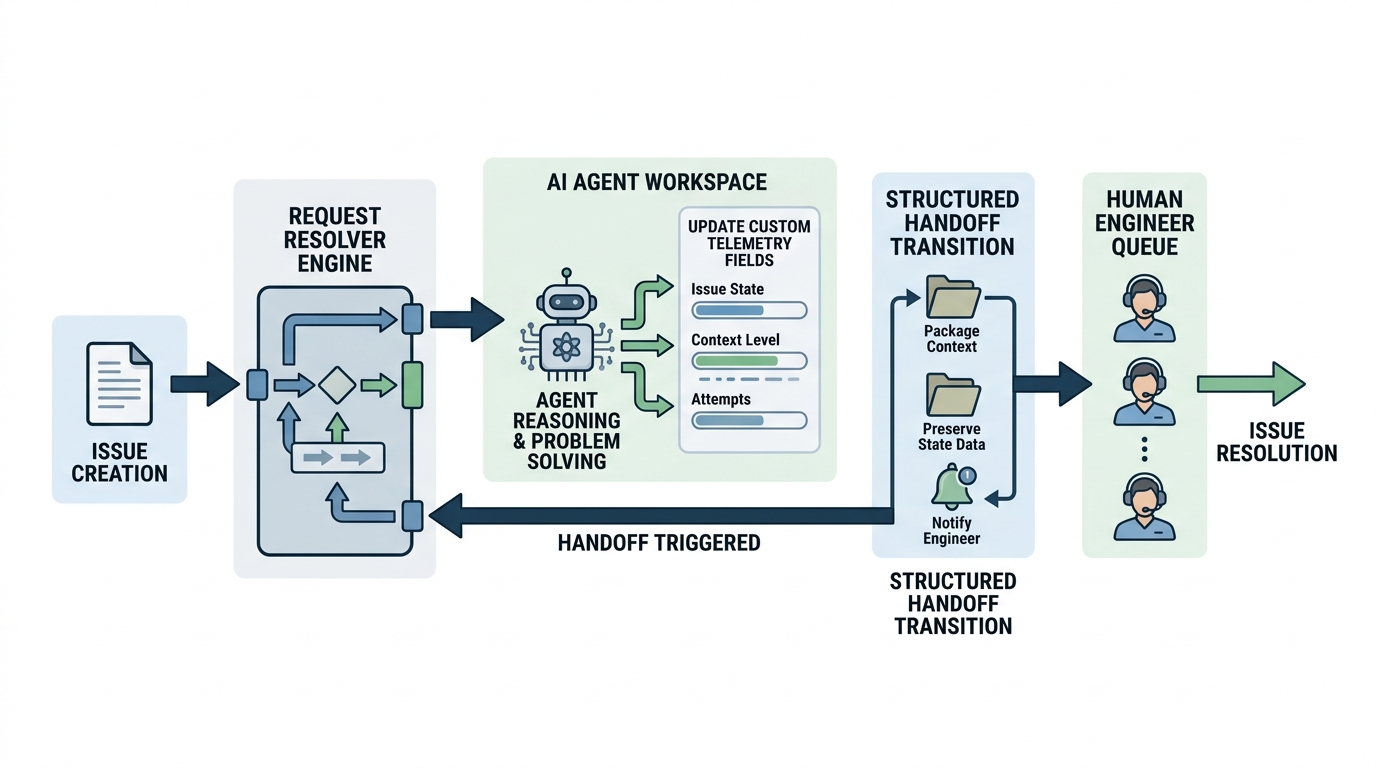
Implementing the Agent-to-Human Handoff Workflow
The most critical point in any human-agent collaboration model is the handoff. When an agent encounters an edge case, falls below a defined confidence threshold, or attempts an action that requires human authorization (such as merging code to production or modifying infrastructure), it must gracefully hand off the execution context to a human engineer.
This handoff must be seamless. The human engineer should not have to dig through raw log files or prompt histories to understand what the agent did. The agent must present a clean, structured summary of its actions, its current findings, and the precise block or decision point that triggered the escalation.
To implement this, I recommend utilizing Jira's automation engine combined with webhooks to orchestrate the state transitions and payload deliveries. Below is an example of a syntactically valid Jira Automation webhook payload designed to transition an issue from an agent-controlled state to a human-controlled state when an exception occurs or when human approval is required.
{
  "update": {
    "comment": [
      {
        "add": {
          "body": "### 🤖 Agent Handoff Summary\n\n**Status:** Escalated to Human Engineering\n**Reason:** Confidence score fell below threshold during automated database migration dry-run.\n\n#### Actions Taken:\n1. Parsed migration script `V4__add_user_indices.sql`.\n2. Executed dry-run on staging environment.\n3. Detected potential table lock on high-traffic table `users` (estimated lock duration: > 4.5 seconds).\n\n#### Block Point:\n* **Policy Violation:** Automated migrations causing locks exceeding 2.0 seconds require manual DBA approval.\n\n#### Next Steps for Human Operator:\n* Review the migration script.\n* Schedule execution during a maintenance window or optimize the index creation to run concurrently.\n\n*Telemetry ID: `run_98234_db_mig`*"
        }
      }
    ]
  },
  "transition": {
    "id": "101"
  },
  "fields": {
    "customfield_10042": "Low Confidence - Policy Limit",
    "customfield_10043": 0.42,
    "priority": {
      "id": "2"
    }
  }
}
This payload performs three vital tasks:
- Injects Structured Context: It writes a highly readable Markdown comment to the issue, outlining exactly what the agent did, why it stopped, and what the human needs to do next. This eliminates the "context switch tax" for the receiving engineer.
- Executes State Transition: It transitions the issue status (using transition ID
101, which maps toPending Human Review) to ensure the ticket leaves the agent's queue and enters the human team's active sprint or triage board. - Updates Telemetry Fields: It updates the custom fields for handoff reason (
customfield_10042) and confidence score (customfield_10043), allowing engineering leadership to run analytical reports on why agents are failing to complete tasks autonomously.
Operational Guardrails, Performance, and Metrics
Deploying autonomous agents into your Jira workspaces without strict operational guardrails is a recipe for system instability, runaway API costs, and developer frustration. As an engineering leader, you must establish clear boundaries and monitor key performance indicators (KPIs) to ensure your human-agent collaboration model is delivering tangible business value.
Establishing Operational Guardrails
First, you must enforce rate limiting and loop detection. An LLM agent stuck in an infinite loop can easily generate thousands of Jira comments, transition tickets back and forth rapidly, and exhaust your API quotas within minutes. I advise setting up hard limits on the number of automated updates allowed per ticket within a given timeframe (e.g., a maximum of 5 agent-initiated transitions or 10 agent comments per hour per issue).
Second, implement strict permission boundaries. AI agents should never share human user accounts. Every agent must have its own dedicated service account with the absolute minimum permissions required to perform its specific role. If an agent is designed to triage tickets, it should not have permissions to delete issues, modify project configurations, or access sensitive HR-related service desks.
Third, establish a human-in-the-loop (HITL) policy for high-risk actions. Any action that alters production infrastructure, modifies billing configurations, or communicates directly with external customers must require explicit human approval before execution. The agent can draft the response or prepare the terraform plan, but a human must click the "Approve" button within Jira.
Monitoring Performance and Success Metrics
To evaluate the efficacy of your human-agent workspaces, you should track a specific set of metrics. The table below outlines the key indicators I recommend monitoring, along with their target thresholds and the underlying operational significance of each.
| Metric Name | Definition | Target Threshold | Operational Significance |
|---|---|---|---|
| Autonomous Resolution Rate (ARR) | Percentage of issues resolved completely by agents without human intervention. | 35% - 50% (for Tier 1 support/triage) | Measures the direct reduction of low-complexity toil on your engineering team. |
| Mean Time to Handoff (MTTH) | The average time elapsed from issue creation to the agent executing a handoff to a human. | < 3 minutes | Ensures agents do not waste time attempting to solve problems they are unequipped to handle. |
| Handoff Accuracy Rate (HAR) | Percentage of handoffs where the human engineer agreed that the escalation was necessary and the context provided was sufficient. | > 90% | Evaluates the quality of the agent's context summaries and prevents "alert fatigue" among engineers. |
| Agent Execution Cost per Issue | The total API and token cost incurred by the agent's LLM calls to resolve or triage a single issue. | < $0.50 per ticket | Monitors financial sustainability and prevents runaway operational costs associated with complex reasoning models. |
| Workflow Transition Velocity | The speed at which an issue moves through agent-controlled states compared to human-controlled states. | 10x speedup over human baseline | Validates that automated agents are speeding up the delivery pipeline and reducing lead time. |
By systematically tracking these metrics, you can identify which agents are performing optimally, which workflows require refinement, and where your documentation or knowledge base has gaps that are preventing successful autonomous resolutions.
Conclusion
The Summer 2026 Atlassian release is a watershed moment for engineering organizations. By standardizing workspaces for human-agent collaboration, Jira has evolved from a simple tracking tool into an active, multi-agent orchestration platform. This transition offers a profound opportunity to eliminate developer toil, accelerate incident response, and streamline software delivery.
However, realizing these benefits requires deliberate, disciplined engineering leadership. You cannot simply turn on these AI features and hope for the best. You must actively restructure your Jira schemas to support machine-readable data, implement deterministic state machines, design robust agent-to-human handoff protocols, and establish strict operational guardrails to govern agent behavior.
Your immediate next steps are clear. First, audit your current Jira workflows and identify a high-volume, low-complexity process—such as Tier 1 service desk triage or automated dependency updates—to serve as your pilot human-agent workspace. Second, configure the necessary custom fields for agent telemetry and implement the handoff webhook pattern detailed above. Finally, establish your baseline metrics and continuously refine your agent prompts and organizational knowledge bases. The future of software engineering is collaborative, and the organizations that master the integration of human and machine intelligence within a standardized workspace will be the ones that outpace the competition.