

The Anatomy of YAML Ambiguity: Why Traditional Parsing Fails
To understand why KYAML is necessary, we must first dissect the failure modes of traditional YAML parsing in Kubernetes. The core issue lies in the YAML 1.1 specification, which contains aggressive implicit typing rules. When a parser encounters an unquoted string, it attempts to resolve its type based on a series of regular expressions.
Consider the following common scenarios where traditional parsing introduces silent, catastrophic failures:
1. The "Norway Problem" and Boolean Coercion
In YAML 1.1, the values y, Y, yes, Yes, YES, n, N, no, No, NO, true, false, on, and off are all resolved as booleans. If an application configuration map requires a two-letter country code, a configuration like country: NO is parsed not as the string "NO", but as the boolean false. When this manifest is round-tripped through JSON to be sent to the Kubernetes API server, the API server receives a boolean where it expects a string, leading to a schema validation rejection or, worse, an application-level logical failure if the schema is loosely typed.
2. Octal Integer Coercion
In YAML 1.1, any integer with a leading zero is parsed as an octal number. For example, a port configuration defined as port: 0123 is parsed as octal 123, which evaluates to decimal 83. If a platform engineer defines a container port this way, the application will bind to port 83 instead of 123. This can lead to silent deployment failures where the container starts successfully but health checks fail because they are targeting the wrong port.
3. Destructive JSON Round-Tripping
Because Kubernetes controllers and client-side tools are primarily written in Go, they historically relied on the following pipeline to manipulate manifests programmatically:
- Read the YAML manifest from disk.
- Convert the YAML to JSON using a library like
ghodss/yaml. - Unmarshal the JSON into a Go struct (e.g.,
v1.Deployment) or a genericmap[string]interface{}. - Perform the mutation (e.g., updating an image tag).
- Marshal the struct back to JSON.
- Convert the JSON back to YAML.
- Write the YAML back to disk or apply it to the cluster.
This pipeline is highly destructive. Because JSON does not support comments, every inline comment, warning, and documentation block in the original YAML file is permanently deleted. Furthermore, because Go maps do not preserve key insertion order, the resulting YAML file has its fields reordered. In a GitOps workflow managed by tools like ArgoCD or Flux, this results in massive, unreadable git diffs that obscure the actual semantic changes made by the developer or automated tool.
KYAML’s Architecture: AST-Preserving and Type-Safe Manifest Manipulation
KYAML fundamentally changes how Kubernetes manifests are parsed and manipulated by moving away from the JSON round-trip model. Instead, KYAML operates directly on the YAML Abstract Syntax Tree (AST). It treats a YAML document as a tree of nodes, where each node retains its exact formatting, comments, line numbers, and column positions.
At the core of KYAML is the RNode (Resource Node) structure, which wraps the underlying YAML AST node. When you manipulate a manifest using KYAML, you do not deserialize the document into a Go struct. Instead, you navigate and mutate the AST directly. If you update the value of an image tag, KYAML locates the specific node in the AST, updates its scalar value, and writes the tree back to disk. Because the rest of the tree remains untouched, all comments, field orderings, and whitespace formatting are perfectly preserved.
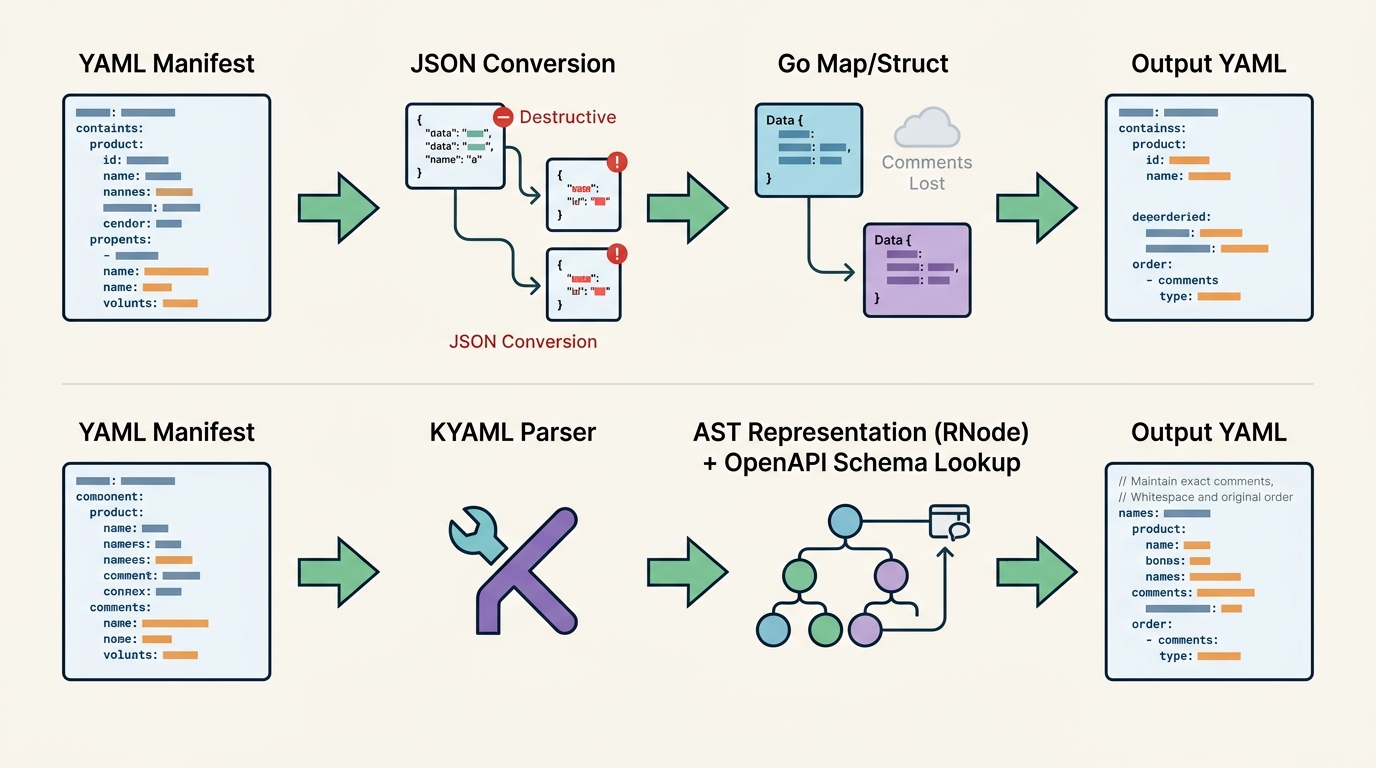
To prevent the implicit type coercions described earlier, KYAML integrates directly with Kubernetes OpenAPI schemas. Instead of guessing the type of a node based on regular expressions (as standard YAML parsers do), KYAML looks up the field’s path in the OpenAPI schema of the corresponding Kubernetes resource.
If the schema states that a field is a string, KYAML treats the value as a string, even if it looks like a boolean (NO), an octal integer (0123), or a float (3.10). This schema-driven parsing ensures that the data sent to the API server matches the exact structural expectations of the resource definition, eliminating client-side parsing drift.
Key Architectural Components of KYAML
yaml.Node: The underlying AST node representation (derived from the maintainedgopkg.in/yaml.v3parser), which stores token-level metadata including comments (head, line, and foot), style flags (literal, folded, double-quoted), and positional data.RNode: The Kubernetes-specific wrapper that provides high-level traversal and mutation methods (e.g.,Field(),GetMapFields(),Pipe()) tailored for resource manifests.- OpenAPI Schema Store: A local or embedded registry of Kubernetes resource schemas that KYAML queries to resolve type ambiguities during AST traversal.
- Filters: Reusable, pipeline-oriented mutation functions that conform to the
yaml.Filterinterface, allowing developers to chain complex transformations (like namespace injection or image tagging) cleanly.
Architectural and Operational Implications for Platform Teams
The graduation of KYAML to stable in v1.37 has immediate, practical benefits for platform engineering teams. It directly addresses the operational friction points of managing large-scale, automated GitOps pipelines.
1. Eliminating Git Diff Noise in GitOps Pipelines
In a mature GitOps environment, automated tools frequently modify manifests. For example, a CI/CD pipeline might run a script to update the image tag of a deployment after a successful build, or a dependency bot might bump a version number in a Helm value file.
When these tools use traditional parsers, the resulting pull request often contains hundreds of lines of changes due to field reordering and comment deletion, making manual code review nearly impossible. By adopting KYAML-based tools, platform teams ensure that pull requests contain only the exact semantic change (e.g., a single-line diff updating the image tag), preserving the readability of the git history and reducing review overhead.
2. Safeguarding Custom Resource Definitions (CRDs)
Custom Resources are highly susceptible to parsing errors because their schemas are defined dynamically. If an operator developer defines a CRD with a field that expects a string, but a user provides a value that a traditional YAML parser interprets as a number or boolean, the operator may crash or behave unpredictably when attempting to reconcile the resource. KYAML’s schema-aware parsing acts as a defensive barrier, ensuring that client-side tools validate and format Custom Resources correctly before they are submitted to the cluster.
3. Standardizing Client-Side Tooling
With KYAML reaching stability, it becomes the standard foundation for Kubernetes client-side utilities. Tools like kubectl (specifically kubectl kustomize and various subcommands), kustomize itself, and third-party configuration management tools can now share a unified, reliable parsing engine. This reduces the behavioral discrepancies where a manifest behaves differently when applied via kubectl apply versus when processed by a local linting or templating tool.
To highlight the differences between these parsing methodologies, I have compiled a comparison of standard Go-YAML parsing, JSON round-tripping, and KYAML:
| Capability | Standard Go-YAML (v2/v3) | JSON Round-Tripping | KYAML (Kubernetes v1.37+) |
|---|---|---|---|
| Comment Preservation | Partial (v3 only, highly fragile) | Completely Lost | Fully Preserved (AST-level) |
| Key Ordering | Lost (alphabetized or randomized) | Lost | Fully Preserved (original order) |
| Type Coercion Safety | Poor (relies on YAML 1.1 specs) | Poor (coerced during JSON phase) | High (enforced via OpenAPI schemas) |
| OpenAPI Integration | None | None | Native (schema-driven parsing) |
| Memory/CPU Overhead | Low | Moderate | Moderate (due to AST maintenance) |
| Suitability for GitOps | Low | Unusable | High (ideal for automated PRs) |
Migration and Implementation: Adopting KYAML in Custom Tooling
If you are building internal platform tooling, CLI utilities, or custom operators that programmatically read, modify, and write Kubernetes manifests, you should migrate from standard YAML parsers or JSON round-tripping to KYAML.
Below, I have provided a complete, syntactically valid Go implementation demonstrating how to use the stable KYAML library to programmatically update a container image tag in a Deployment manifest. This example demonstrates how KYAML targets a specific field in the AST, modifies it, and writes the output back while preserving all original comments and formatting.
package main

import (
	"bytes"
	"fmt"
	"os"

	"sigs.k8s.io/kustomize/kyaml/filesys"
	"sigs.k8s.io/kustomize/kyaml/kio"
	"sigs.k8s.io/kustomize/kyaml/yaml"
)

func main() {
	// Simulate an incoming Kubernetes manifest with inline comments and specific formatting.
	inputManifest := []byte(`apiVersion: apps/v1
kind: Deployment
metadata:
  name: payment-gateway
  namespace: production # Critical: Do not deploy to staging
spec:
  replicas: 3
  template:
    spec:
      containers:
      - name: gateway-container
        # Ensure this image is scanned before promotion
        image: internal-registry.net/payment/gateway:v1.2.0
        ports:
        - containerPort: 8080
`)

	// Initialize the KYAML node reader
	reader := &kio.ByteReader{
		Reader: bytes.NewReader(inputManifest),
	}

	// Read the manifest into an RNode slice
	nodes, err := reader.Read()
	if err != nil {
		fmt.Fprintf(os.Stderr, "Failed to parse manifest: %v\n", err)
		os.Exit(1)
	}

	newImageURL := "internal-registry.net/payment/gateway:v1.3.0-RC1"

	// Iterate through the nodes (typically one per YAML document)
	for _, node := range nodes {
		// Navigate the AST to locate the container image field.
		// We use a path lookup to locate: spec.template.spec.containers
		containers, err := node.Pipe(yaml.Lookup("spec", "template", "spec", "containers"))
		if err != nil {
			fmt.Fprintf(os.Stderr, "Failed to locate containers block: %v\n", err)
			continue
		}

		if containers == nil {
			continue
		}

		// Iterate over the list of containers
		containerElements, err := containers.Elements()
		if err != nil {
			fmt.Fprintf(os.Stderr, "Failed to parse container elements: %v\n", err)
			continue
		}

		for _, container := range containerElements {
			nameNode, err := container.Pipe(yaml.Get("name"))
			if err != nil {
				continue
			}

			// Target only the container named "gateway-container"
			nameVal, _ := nameNode.String()
			if yaml.GetValue(nameVal) == "gateway-container" {
				// Update the image field value directly in the AST
				err = container.PipeE(
					yaml.SetField("image", yaml.NewScalarRNode(newImageURL)),
				)
				if err != nil {
					fmt.Fprintf(os.Stderr, "Failed to update image field: %v\n", err)
					os.Exit(1)
				}
			}
		}
	}

	// Write the mutated AST back to a buffer
	var outputBuffer bytes.Buffer
	writer := &kio.ByteWriter{
		Writer:           &outputBuffer,
		KeepReaderAnnotations: true,
	}

	err = writer.Write(nodes)
	if err != nil {
		fmt.Fprintf(os.Stderr, "Failed to write manifest: %v\n", err)
		os.Exit(1)
	}

	// Output the result
	fmt.Println("Mutated Manifest:")
	fmt.Println(outputBuffer.String())
}
Key Takeaways from the Implementation
- AST-Level Mutation: The
yaml.SetFieldoperation does not rewrite the entire document. It targets the exact scalar value node associated with theimagekey. - Comment Preservation: The output manifest retains the inline comments
# Critical: Do not deploy to stagingand# Ensure this image is scanned before promotionin their exact original locations. Under a traditional JSON round-trip parser, both comments would have been permanently deleted. - Formatting Retention: The spacing, indentation, and key ordering of the original document are preserved exactly, preventing arbitrary git diffs when this change is committed to a repository.
Conclusion
The graduation of KYAML to stable in Kubernetes v1.37 represents a quiet but profound victory for platform engineering. By replacing destructive, heuristic-based parsing with a deterministic, AST-preserving, and schema-aware model, KYAML eliminates the silent parsing failures that have plagued Kubernetes operators and platform teams for years.
If you are currently managing Kubernetes infrastructure, I recommend taking the following actions:
- Audit Your GitOps Tooling: Ensure that your custom scripts, image updaters, and CI/CD pipelines are not utilizing destructive JSON-to-YAML conversion libraries. Transition them to use KYAML-based utilities or Kustomize plugins.
- Standardize CLI Tools: Upgrade your administrative workstations and CI runners to Kubernetes v1.37+ to ensure that
kubectland associated tools leverage the stable, non-destructive KYAML engine natively. - Enforce Schema Validation: Leverage KYAML’s OpenAPI integration in your local validation pipelines to catch type coercion issues (such as unquoted port numbers or boolean-like strings) before they are committed to your git repositories.
By constraining the inherent ambiguity of YAML, KYAML provides the structural predictability required to run mission-critical, automated infrastructure at scale.