

The Architectural Shift: Why Standard API Gateways Fail at AI Workloads
As enterprise adoption of large language models (LLMs) transitions from isolated proof-of-concepts to production-grade agentic workflows, platform engineers face a stark realization: traditional API gateways are fundamentally unequipped to handle the unique operational, security, and semantic requirements of generative AI. Standard HTTP gateways excel at routing, rate-limiting based on IP or client keys, and processing flat JSON payloads. They do not, however, understand token consumption, prompt injection risks, semantic caching, model fallbacks, or the emerging Model Context Protocol (MCP) that connects agents to data sources and tools.
In response to these challenges, Microsoft recently introduced a dedicated AI Gateway tier for Azure API Management (APIM). This architectural addition positions APIM not merely as a proxy, but as a specialized governance, security, and routing layer designed specifically for LLMs and MCP-enabled tools.
To understand the necessity of a dedicated AI Gateway tier, I must first examine the structural differences between traditional REST/gRPC traffic and LLM API interactions. Standard API gateways operate on a request-response model where payload sizes are predictable, latency is measured in milliseconds, and rate limits are calculated in requests per second (RPS).
AI workloads break these paradigms in several critical ways:
The Token-Based Consumption Model: Traditional gateways rate-limit by request count. In contrast, LLM providers charge and limit usage based on tokens (both input and output). A single request containing a massive system prompt or a retrieved document can consume tens of thousands of tokens, while another request consumes only a dozen. Standard gateways cannot parse incoming prompts or stream chunked responses in real time to count and enforce Token-per-Minute (TPM) or Request-per-Minute (RPM) limits across multiple backend endpoints.
Stateful, Long-Running, and Streaming Connections: LLM interactions often rely on Server-Sent Events (SSE) for streaming responses to minimize perceived latency. Traditional gateways often struggle with long-lived streaming connections, failing to apply middle-of-stream policy evaluations or dynamic routing if a connection degrades mid-response.
Semantic and Context-Aware Routing: Standard gateways route traffic based on static HTTP headers, methods, or URI paths. AI routing, however, must be dynamic and semantic. For example, a gateway might need to route a query to a lightweight model (like GPT-4o-mini) if the prompt complexity is low, or escalate it to a frontier model (like GPT-4o or o1) if the prompt requires complex reasoning. It must also handle fallback routing when a specific model endpoint encounters a 429 (Too Many Requests) or a content filter trigger.
The Rise of Agentic Tooling (MCP): The rapid adoption of the Model Context Protocol (MCP)—an open standard designed to connect AI models to data sources, local contexts, and execution environments—creates a new vector of security and governance vulnerability. Traditional gateways have no native understanding of MCP schemas, meaning they cannot inspect, sanitize, or authorize the tools and resources an LLM attempts to invoke on behalf of a user.
By splitting the gateway architecture and introducing a dedicated AI Gateway tier, Azure APIM addresses these limitations. It introduces deep packet inspection of model payloads, native token-tracking state machines, and built-in support for orchestrating MCP tool calls securely at the platform boundary.
Inside the Dedicated AI Gateway Tier: Topology and Core Capabilities
The dedicated AI Gateway tier in Azure API Management is engineered as a high-throughput, low-latency proxy optimized for processing unstructured and semi-structured LLM payloads. Rather than forcing platform teams to write complex, custom Lua scripts or WebAssembly (Wasm) plugins to parse JSON bodies, the AI Gateway tier integrates these capabilities directly into its core engine.
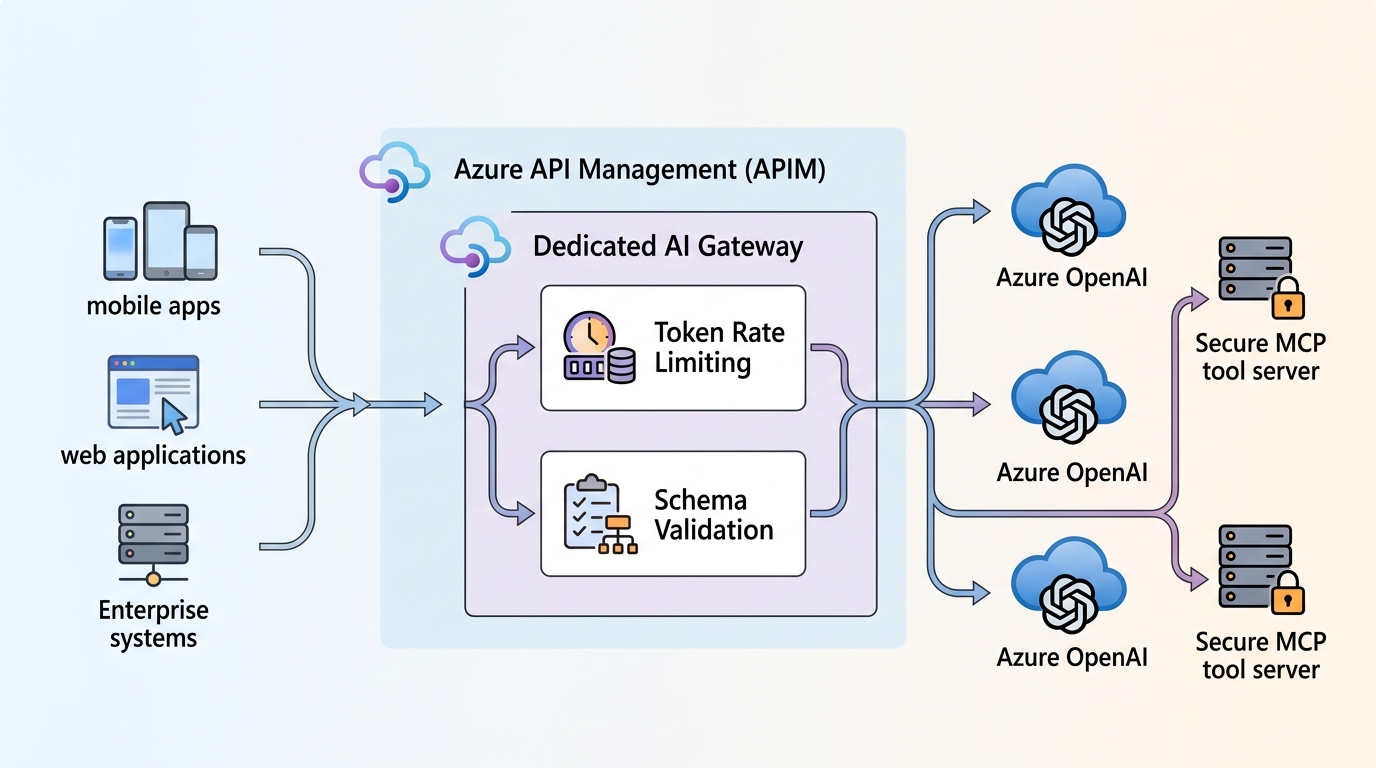
Architectural Topology
At its core, the dedicated AI Gateway tier sits between your internal application consumers (such as chat UIs, agentic frameworks, and microservices) and your backend model providers (including Azure OpenAI, OpenAI, Anthropic, Hugging Face, and self-hosted models on Azure Kubernetes Service).
I divide the gateway architecture into three distinct planes:
- The Control Plane: Managed via the Azure Resource Manager (ARM), this plane handles the provisioning, configuration, and deployment of APIs, policies, and backend definitions. It is where platform engineers define model routing groups, rate-limiting tiers, and security boundaries.
- The Dedicated AI Gateway Runtime (Data Plane): A highly optimized, containerized runtime deployed across Azure availability zones. This runtime intercepts incoming HTTP requests, decodes model-specific payloads, tracks token usage in an in-memory distributed cache, evaluates security policies, and manages streaming connections.
- The Governance and Observability Plane: This plane integrates natively with Azure Monitor, Application Insights, and log analytics workspaces. It extracts semantic metadata from requests—such as prompt tokens, completion tokens, model names, user identifiers, and tool invocation schemas—without violating data privacy boundaries or storing sensitive payload content unless explicitly configured.
Core Capabilities of the Dedicated Tier
This dedicated tier introduces several capabilities that are fundamentally missing from standard APIM tiers:
- Native Token Rate Limiting (TPM/RPM): The gateway parses incoming prompt payloads and outgoing completion streams to calculate exact token usage. It maintains a highly accurate, distributed token bucket algorithm that prevents backend model exhaustion and ensures fair-use allocation across different internal teams.
- Multi-Provider Load Balancing and Circuit Breaking: You can define a logical pool of model backends (e.g., combining Azure OpenAI instances in East US, Sweden Central, and West US). The gateway automatically load-balances traffic across these backends based on latency, availability, and remaining token capacity. If a backend returns a 5xx error or a 429, the gateway instantly trips a circuit breaker and reroutes the request to an active backend without exposing the failure to the client application.
- Semantic Caching: To reduce latency and API costs, the gateway can interface with an external cache (such as Azure Cache for Redis Enterprise) to perform semantic caching. Instead of requiring an exact string match on the prompt, the gateway uses an embedding model to determine if a semantically similar query has been answered recently, returning the cached response if it falls within a configurable similarity threshold.
Implementing Model Context Protocol (MCP) Governance and Tool Routing
One of the most significant advancements in this dedicated AI Gateway tier is its native integration with the Model Context Protocol (MCP). As agentic architectures mature, LLMs are increasingly granted the ability to call external tools—such as database query engines, file systems, web search APIs, and internal line-of-business applications.
Without a centralized gateway, each agent must establish direct, unmonitored connections to these tools. This creates massive security risks: an LLM, manipulated by a prompt injection attack, could be coerced into executing unauthorized database writes or exfiltrating sensitive files.
The Gateway as an MCP Proxy
By routing all MCP traffic through the Dedicated AI Gateway, you establish a centralized governance tier. The gateway acts as a secure intermediary between the LLM (or the agent framework orchestrating the LLM) and the MCP servers hosting the tools.
When an agent requests a list of available tools, or attempts to execute a tool call, the request passes through the gateway. This allows you to enforce several critical security controls:
- Tool Discovery Filtering: You can restrict which tools are visible to specific agents. For example, an agent running in a public-facing customer service portal can be restricted from discovering or invoking administrative database tools, even if those tools are hosted on the same backend MCP server.
- Schema Validation and Sanitization: The gateway inspects the JSON-RPC payloads of MCP tool executions. It validates that the arguments passed by the LLM conform strictly to the JSON schema defined by the tool, blocking malformed or malicious inputs before they reach your internal systems.
- Credential Mapping and Token Exchange: Instead of distributing sensitive database credentials or API keys to individual agent applications, the gateway manages these credentials securely. When an agent requests a tool execution, the gateway intercepts the request, injects the necessary authorization tokens or connection strings from Azure Key Vault, and forwards the request to the secure backend tool.
Step-by-Step Implementation Blueprint for MCP Governance
To implement this architecture, you must configure the AI Gateway to recognize your MCP servers as distinct backends and apply schema-validation policies.
First, define your MCP servers within the APIM control plane. These can be hosted as containerized microservices on Azure Container Apps or AKS. Next, define an API schema that represents the standard MCP JSON-RPC interface (/tools/list, /tools/call, etc.).
Once the endpoints are defined, you apply policies to govern the interactions. For example, you can inspect the method parameter of an incoming MCP request. If the method is tools/call, the gateway parses the name of the tool being invoked. If the tool name matches a restricted list (such as execute_sql or delete_record), the gateway evaluates the caller's OAuth2 token claims to ensure they have administrative privileges before permitting the execution.
Operationalizing Policy-Driven AI Routing, Rate Limiting, and Failover
To demonstrate the practical application of the dedicated AI Gateway tier, I present a concrete implementation of an APIM policy. The following XML configuration showcases how to establish a resilient, token-aware routing architecture with automated failover and rate limiting across multiple Azure OpenAI backends.
This policy performs the following operations:
- It intercepts the incoming request and evaluates the client's subscription tier.
- It applies a strict Token-per-Minute (TPM) limit using the native
azure-openai-token-limitpolicy. - It attempts to route the request to a primary Azure OpenAI backend.
- If the primary backend returns a 429 or 503, it catches the error, marks the backend as temporarily degraded, and seamlessly retries the request against a secondary, geo-redundant backend.
<policies>
<inbound>
<base />
<set-variable name="clientId" value="@(context.Request.Headers.GetValueOrDefault("X-Client-Id", "default-anonymous"))" />
<azure-openai-token-limit
counter-key="@((string)context.Variables["clientId"])"
tokens-per-minute="200000"
estimate-prompt-tokens="true"
remaining-tokens-variable-name="remainingTokens"
retry-after-variable-name="tokenRetryAfter" />
<set-backend-service backend-id="openai-primary-eastus" />
</inbound>
<backend>
<retry condition="@(context.Response != null && (context.Response.StatusCode == 429 || context.Response.StatusCode >= 500))"
count="3"
interval="1"
first-fast-retry="true">
<choose>
<when condition="@(context.Response != null && (context.Response.StatusCode == 429 || context.Response.StatusCode >= 500))">
<trace source="AI-Gateway-Routing" severity="warning">
<message>Primary backend failed or rate-limited. Failing over to secondary backend.</message>
<metadata name="FailedBackend" value="openai-primary-eastus" />
<metadata name="StatusCode" value="@(context.Response.StatusCode.ToString())" />
</trace>
<set-backend-service backend-id="openai-secondary-swedencentral" />
</when>
</choose>
<forward-request timeout="30" buffer-request-body="true" />
</retry>
</backend>
<outbound>
<base />
<set-header name="X-RateLimit-Remaining-Tokens" exists-action="override">
<value>@(((int)context.Variables.GetValueOrDefault("remainingTokens", 0)).ToString())</value>
</set-header>
</outbound>
<on-error>
<base />
<choose>
<when condition="@(context.Response?.StatusCode == 429)">
<set-status code="429" reason="Too Many Requests" />
<set-header name="Retry-After" exists-action="override">
<value>@(((int)context.Variables.GetValueOrDefault("tokenRetryAfter", 10)).ToString())</value>
</set-header>
<set-body>{
"error": {
"code": "TokenLimitExceeded",
"message": "The AI Gateway has rate-limited this request due to token quota exhaustion. Please retry later."
}
}</set-body>
</when>
</choose>
</on-error>
</policies>
Key Implementation Considerations
When deploying this policy configuration in a production environment, you must account for several operational realities:
- Request Body Buffering: In the
<forward-request>tag, settingbuffer-request-body="true"is necessary when implementing retry logic. This ensures that if the primary backend fails after the request body has been sent, the gateway still has the payload cached in memory to forward to the secondary backend. However, this increases memory consumption on the gateway instances. For exceptionally large prompts (e.g., multi-megabyte document uploads), you must monitor gateway memory utilization closely. - Token Estimation Accuracy: The
estimate-prompt-tokens="true"attribute allows the gateway to estimate token usage before sending the request to the backend. While highly optimized, estimation algorithms can occasionally differ slightly from the actual token count calculated by the model provider's tokenizer. I recommend configuring a safety buffer (e.g., setting your gateway limit to 90% of your actual backend provider contract limit) to absorb these minor discrepancies. - Streaming Responses: When clients request streamed completions (
stream: true), the gateway processes chunks on the fly. Theazure-openai-token-limitpolicy dynamically updates the token bucket as chunks are received from the backend, ensuring that even long-running streaming responses are accurately accounted for in your rate-limiting metrics.
Operational Checklist for Production Deployment
To ensure a successful rollout of the Dedicated AI Gateway tier, I recommend executing the following checklist during your architecture and deployment phases:
| Phase | Action Item | Technical Objective | Verification Method |
|---|---|---|---|
| Network Security | Establish Private Endpoints | Ensure all traffic between your apps, APIM, and model backends travels over the Azure private backbone. | Verify that public network access is disabled on Azure OpenAI and APIM backend settings. |
| Identity & Access | Implement Managed Identities | Eliminate hardcoded API keys by using system-assigned managed identities for APIM to authenticate against backends. | Audit Azure RBAC roles; ensure APIM has "Cognitive Services User" permissions. |
| Model Governance | Define Fallback Topologies | Group models into logical backends with defined priority levels to handle regional outages or localized rate limits. | Simulate a 429 error on the primary backend and verify seamless routing to the secondary. |
| MCP Security | Enforce Tool Schema Validation | Bind strict JSON schema validation policies to all outgoing MCP tool execution endpoints. | Send a malformed tool argument payload and verify that the gateway blocks it with a 400 Bad Request. |
| Observability | Configure Semantic Logging | Export token usage, model latency, and client identifiers to Azure Log Analytics without logging sensitive PII. | Review Kusto (KQL) queries in Log Analytics to confirm token metrics are populated without raw prompt text. |
Conclusion
As generative AI architectures evolve from simple chat interfaces to complex, autonomous agentic systems, the infrastructure supporting them must evolve accordingly. Treating LLMs and MCP servers as standard HTTP endpoints is a recipe for operational instability, security vulnerabilities, and unpredictable costs.
The dedicated AI Gateway tier in Azure API Management represents a significant step forward in platform engineering for AI. By moving token calculation, semantic routing, multi-backend failover, and MCP tool governance into a dedicated, optimized gateway runtime, you decouple application logic from operational governance.
My recommendation for engineering leaders is clear: if you are running multi-model applications or deploying agentic workflows in production, you should begin migrating these workloads to a dedicated AI gateway architecture. Start by centralizing your model endpoints behind APIM, implementing token-based rate limiting to protect your budgets, and establishing strict schema validation policies over your MCP tool integrations. This foundational architecture will ensure your AI initiatives remain secure, resilient, and highly observable as they scale.