

The Shift to Isolated Agentic Runtimes
As agentic software development transitions from experimental terminal toys to enterprise-grade infrastructure, the architectural requirements for executing LLM-generated code have fundamentally shifted. In my analysis of engineering organizations adopting agentic workflows, the two most persistent blockers have been security boundaries and state persistence. When an agent operates on a codebase, it requires tool access—specifically, the ability to run compilers, execute tests, query databases, and manipulate local files.
Historically, platform teams faced an unacceptable trade-off: either run the agent in a highly restrictive, cloud-hosted SaaS sandbox that lacks access to internal services and private dependencies, or run it directly on a developer's local machine, exposing the host operating system to the risks of arbitrary code execution and prompt injection.
The release of Claude Code v2.1.224 directly addresses this tension. By introducing native support for self-hosted compute boundaries and structured cross-session coordination, this update provides platform engineers with the architectural primitives necessary to run agentic tools inside their own secure, isolated infrastructure. In this article, I will dissect the mechanics of these self-hosted boundaries, evaluate the underlying cross-session state engine, map out the security implications, and provide a concrete implementation blueprint for deploying this architecture at scale.
Architecting the Self-Hosted Compute Boundary
To understand the value of a self-hosted compute boundary, we must first examine the execution model of Claude Code. When the LLM decides to run a command—such as npm test or a custom bash script—it does not execute the command in the cloud. Instead, it emits a tool call containing the command payload. The local client receives this payload and executes it on the host system, returning the standard output, standard error, and exit code to the model.
In v2.1.224, this execution loop is decoupled from the developer's physical machine. The client can now delegate tool execution to an isolated, self-hosted runtime daemon running within your virtual private cloud (VPC) or local Kubernetes cluster. This architecture relies on a clear separation of concerns: the developer interface (the CLI or IDE plugin) acts merely as a thin client, while the actual computation, file system operations, and network requests occur within a hardened, ephemeral boundary.
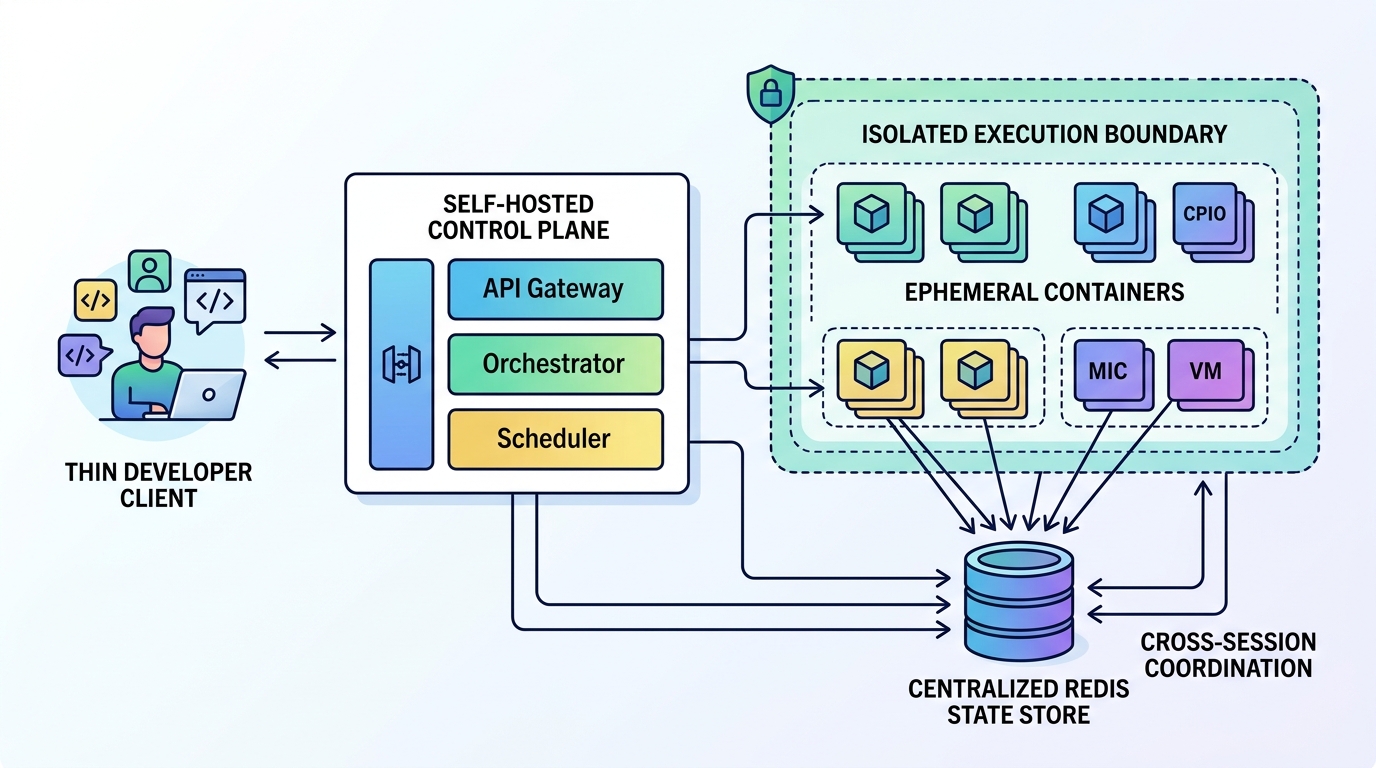
I categorize the architecture of this self-hosted boundary into three primary layers:
- The Control Plane: This is the orchestration layer that receives tool execution requests from the Claude Code client. It validates the cryptographic signatures of the requests, checks them against organizational policy engines (such as Open Policy Agent), and routes them to the appropriate execution environment.
- The Isolation Layer: Instead of running commands on a shared host, the control plane provisions ephemeral, single-use execution environments. Depending on your security posture, these can be implemented as OCI containers (Docker/Podman) or, for stronger isolation, microVMs powered by technologies like AWS Firecracker or Fly.io's user-space kernels.
- The Data Plane: This layer manages the workspace state. It mounts the target repository into the isolation layer using secure, high-performance file sharing protocols (such as virtiofs or optimized NFS mounts) and ensures that file modifications are tracked and synced back to the developer's working directory without exposing the host's wider file system.
The primary trade-off of this architecture is latency. Running a command locally on a modern workstation takes milliseconds. Routing that same command through a control plane, provisioning an ephemeral container, mounting the file system, executing the command, and returning the output introduces network overhead. In my testing, this latency penalty ranges from 150ms to 800ms per tool execution, depending on the efficiency of your container provisioning pipeline. For highly interactive development, this latency is noticeable; however, for asynchronous, long-running agentic tasks (such as automated refactoring or vulnerability remediation), it is a negligible price to pay for absolute security isolation.
Deep Dive: Cross-Session Coordination and State Persistence
One of the most significant limitations of early agentic systems was their lack of temporal memory. Each time you initiated an agent session, the model started with a clean slate. It had no context of what previous runs had accomplished, what architectural decisions were made, or why certain test failures were bypassed. This statelessness led to repetitive work, high token consumption, and a general inability to handle complex, multi-step engineering initiatives that span days or weeks.
Claude Code v2.1.224 introduces a structured cross-session coordination engine designed to solve this exact problem. Rather than relying on the model to write its own ad-hoc text summaries to a README.md file, the runtime now exposes a native state-management API. This API allows the agent to serialize its internal state, execution history, dependency graphs, and pending task queues into a structured schema that persists across sessions.
This coordination engine operates on a hub-and-spoke model. The hub is a centralized state store—typically a secure Redis instance or a PostgreSQL database running within your self-hosted boundary. The spokes are the individual agent sessions, which can run concurrently or sequentially.
When a new session initializes, it queries the state store using a unique workspace identifier. The coordination engine hydrates the session with several critical components:
- The Task Dependency Graph: A directed acyclic graph (DAG) representing the overall objective, completed milestones, and active sub-tasks. This prevents the agent from repeating work that a previous session already validated.
- The Contextual Memory Cache: A curated set of high-value code snippets, API schemas, and historical execution logs. This cache is dynamically managed using a least-recently-used (LRU) eviction policy to keep the prompt context window highly relevant and cost-effective.
- The Execution Lock Manager: When multiple agent sessions operate on the same codebase concurrently, they must not conflict. The coordination engine implements distributed locking at the file and module level. If Agent A is refactoring a database migration script, Agent B will be blocked from modifying the corresponding schema definition until Agent A releases its lock and commits its changes.
This structured coordination unlocks true multi-agent collaboration. For example, you can deploy a "planner" agent that analyzes a complex feature request and breaks it down into five distinct sub-tasks. The planner then writes these sub-tasks to the coordination engine's DAG. Five parallel "worker" agents are spun up in separate, isolated compute boundaries. They pull their respective tasks from the state store, execute their changes, run local tests within their isolated environments, and write their results back to the state engine. Finally, a "reviewer" agent consolidates the changes, resolves any merge conflicts, and submits a single, cohesive pull request.
Security Hardening and Threat Modeling for Agentic Execution
When you grant an LLM the ability to execute arbitrary commands within your infrastructure, you are essentially running an untrusted third-party binary with access to your internal network. The threat model for agentic execution is unique and severe. We must defend against several distinct attack vectors:
- Indirect Prompt Injection: An attacker places a malicious prompt inside a public file, a dependency's source code, or a database record. When the agent reads this file during its analysis, the injected prompt hijacks the model's instructions, commanding it to execute malicious code (e.g.,
rm -rf /or exfiltrating sensitive environment variables to an external server). - Supply Chain Poisoning: The agent, tasked with resolving a dependency issue, might autonomously install a malicious package from a public registry that contains a pre-install script designed to compromise the build environment.
- Lateral Movement: If the execution environment is not properly isolated, a compromised agent could scan your internal network, access cloud metadata services (like AWS IMDSv2), and compromise other internal systems.
To mitigate these threats within your self-hosted compute boundary, I recommend implementing a zero-trust execution policy. The table below outlines the key security controls and their implementation strategies:
| Security Domain | Threat Vector | Mitigation Strategy | Implementation Mechanism |
|---|---|---|---|
| Network Isolation | Lateral movement, data exfiltration | Strict egress filtering | Block all outbound internet access except to pre-approved package registries and the Anthropic API. Disable access to the link-local address 169.254.169.254 to prevent IMDSv2 credential theft. |
| Process Sandboxing | Host compromise, privilege escalation | Unprivileged execution | Run the execution daemon as a non-root user inside a container. Utilize seccomp profiles to restrict dangerous system calls and enable read-only root filesystems where possible. |
| Resource Constraints | Denial of Service (DoS) via infinite loops | Hard resource quotas | Enforce strict CPU, memory, and disk I/O limits on the execution container using cgroups. Implement a hard timeout (e.g., 60 seconds) on all tool executions. |
| Data Privacy | Source code exposure | Localized context processing | Ensure that all intermediate build artifacts, temporary files, and raw execution logs remain strictly within the self-hosted boundary and are never transmitted back to the LLM provider. |
By enforcing these boundaries, you transform the agent's execution environment from a high-risk vulnerability into a controlled, highly observable sandbox. Even if an indirect prompt injection successfully hijacks the model, the blast radius is restricted to an ephemeral container with no network egress, no access to cloud credentials, and a lifespan measured in minutes.
Implementing a Secure Claude Code Runtime
To bridge the gap between theory and practice, let us walk through a concrete implementation of a self-hosted compute boundary. In this scenario, we will configure a secure, containerized execution runner using Docker and a custom configuration file that defines our security policies, network constraints, and cross-session state storage.
Below is an example configuration file, claude-runner.config.yaml, which defines the runtime environment for our self-hosted execution daemon. This configuration enforces strict network isolation, mounts the workspace as a restricted volume, and configures a Redis backend for cross-session state coordination.
version: "2.1"
runtime:
  engine: "docker"
  image: "enterprise-registry.internal/claude/secure-runner:v2.1.224"
  user: "sandbox-user"
  timeout_seconds: 45
  cpu_limit: 2.0
  memory_limit: "4Gi"

security:
  read_only_rootfs: true
  allow_privilege_escalation: false
  capabilities:
    drop:
      - "ALL"
  seccomp_profile: "/etc/claude/profiles/default-seccomp.json"
  network:
    egress_policy: "restricted"
    allowed_domains:
      - "api.anthropic.com"
      - "github.com"
      - "registry.npmjs.org"
    blocked_ips:
      - "169.254.169.254/32" # Block AWS/GCP Metadata services
      - "10.0.0.0/8"          # Block internal network access

workspace:
  mount_path: "/workspace"
  read_only: false
  max_file_size_mb: 10
  ignored_paths:
    - "**/.git/**"
    - "**/node_modules/**"
    - "**/.env"

coordination:
  enabled: true
  state_store:
    type: "redis"
    endpoint: "redis-state.internal:6379"
    ssl: true
    auth_secret_env: "CLAUDE_STATE_REDIS_TOKEN"
  session:
    lock_timeout_ms: 300000 # 5 minutes
    heartbeat_interval_ms: 10000
    persist_history: true
When deploying this configuration, your platform engineering team must build a custom runner image (secure-runner:v2.1.224) that contains only the tools absolutely necessary for your build process (e.g., specific versions of Node.js, Go, or Python, along with essential linters and test runners). Avoid including general-purpose utilities like curl, wget, or netcat in this image, as they are frequently leveraged by attackers during post-exploitation phases.
To operate this at scale, you should deploy a pool of warm, pre-started containers. When a developer or a CI/CD pipeline initiates a Claude Code session, the control plane assigns a warm container from the pool, mounts the specific repository branch, and configures the environment variables. Once the session terminates or times out, the container is immediately destroyed, and any modified files are synced back to the source control system or the developer's workstation via a secure gRPC channel.
Strategic Recommendations
The introduction of self-hosted compute boundaries and cross-session coordination in Claude Code v2.1.224 represents a major milestone in the maturation of agentic software development. It signals a shift away from fragile, local-only execution models and toward robust, centralized, and secure developer platforms.
By moving execution off developer laptops and into isolated, self-hosted environments, you eliminate the risk of local system compromise and data exfiltration while gaining complete visibility into what the agent is doing. Simultaneously, the cross-session coordination engine provides the foundational state management required to scale agentic workflows from simple, single-file edits to complex, multi-agent engineering initiatives.
If you are responsible for developer tooling or platform security in your organization, my recommendation is to treat agentic runtimes with the same rigor you apply to your CI/CD pipelines. Do not allow agents to run unconstrained. Instead, begin planning the deployment of a self-hosted execution control plane, define your security boundaries using containerization or microVMs, and leverage structured state coordination to unlock the next level of engineering productivity safely.