Introduction
For over two decades, the software-as-a-service (SaaS) playbook has remained remarkably consistent: raise venture capital, hire a multi-disciplinary engineering team, build a minimum viable product (MVP) over six to twelve months, and scale the organization to support continuous feature delivery. This model, while highly successful, has created a massive, capital-intensive industry. Large SaaS incumbents are often weighed down by organizational complexity, legacy technical debt, and the sheer overhead of maintaining massive codebases and engineering teams.
However, we are witnessing the beginning of a structural shift in how software is conceptualized, built, and brought to market. The emergence of AI-native venture studios—exemplified by Inevitable AI Group's recent $6 million funding round—signals a fundamental departure from traditional software engineering economics. Rather than relying on large human development teams to build and maintain software, these studios are leveraging autonomous AI agent networks to generate, validate, and deploy highly agile, targeted SaaS alternatives at a fraction of the traditional cost and time.
As an engineering leader, I find this transition both inevitable and highly disruptive. It forces us to re-examine the core tenets of software project management, team topology, and product lifecycle dynamics. In this article, I will analyze the underlying architecture of agentic product engineering, explore how autonomous workflows redefine the software delivery pipeline, evaluate the economic realities of this new paradigm, and provide a pragmatic framework for managing the risks associated with AI-generated codebases.
The Architecture of Agentic Product Engineering
To understand the viability of AI-native SaaS, we must first look past the simplistic view of LLMs as mere autocomplete tools. Writing code line-by-line via conversational prompts is not scalable for complex systems. Instead, AI-native venture studios rely on a Multi-Agent System (MAS) architecture. In this setup, specialized, autonomous agents collaborate within a structured, stateful environment to execute complex engineering tasks.
Unlike a human engineering team where communication overhead scales quadratically with team size, an agentic architecture scales through structured message passing, deterministic state machines, and automated validation loops. The system decomposes a high-level product requirement into discrete, executable tasks, routing them to specialized agents designed for specific domains: product specification, database schema design, backend API implementation, frontend UI generation, and automated testing.
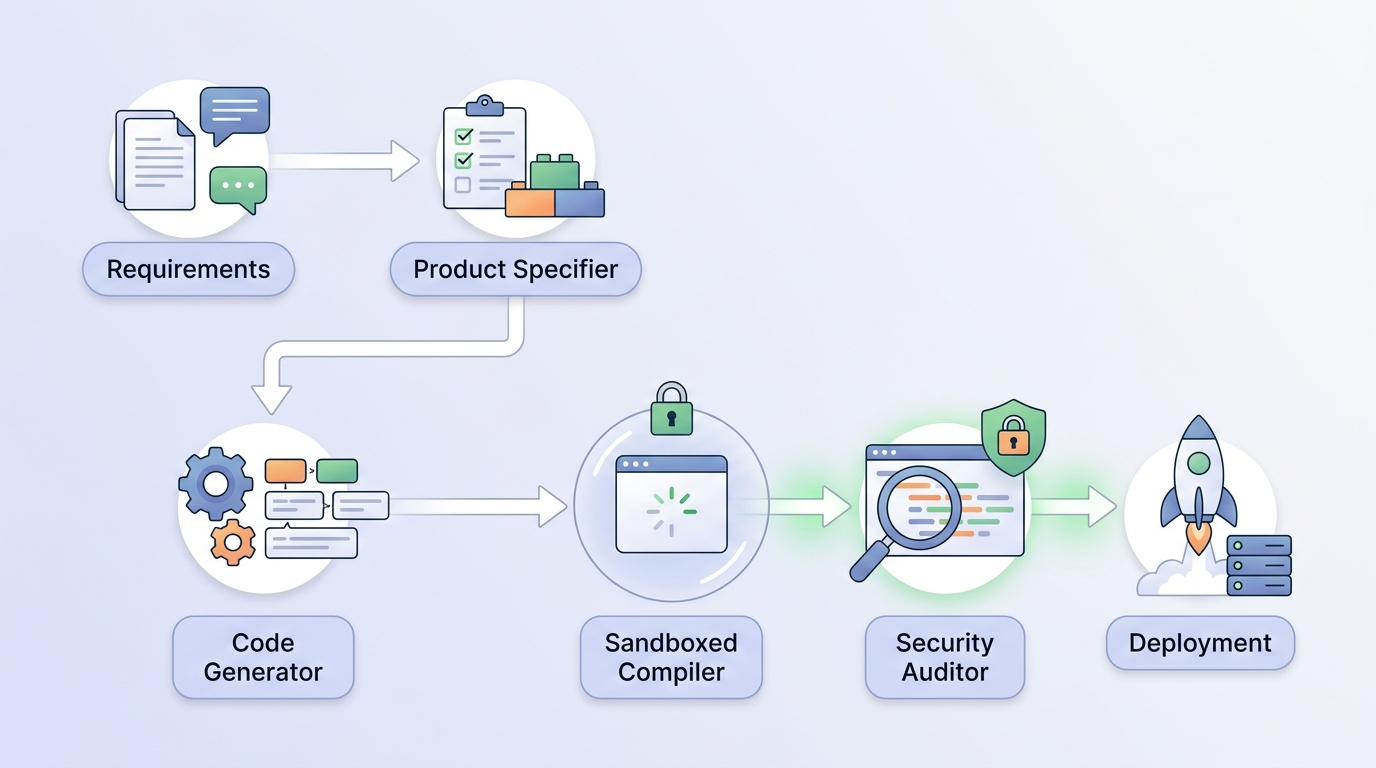
To illustrate how these systems function, consider a typical agentic code-generation pipeline. The process does not rely on a single, massive prompt. Instead, it uses a compiler-driven feedback loop. The code generation agent writes code, which is immediately passed to a syntax validation and compilation agent. If compilation fails, the compiler's error logs are fed back to the generation agent as a prompt correction, allowing the system to self-correct in a sandboxed execution environment before any human reviews the output.
Below is a conceptual declarative configuration schema for an agentic orchestration pipeline. This YAML-based specification demonstrates how an engineering leader might define the roles, constraints, and validation gates for a multi-agent system tasked with generating a micro-SaaS feature:
version: "1.0"
pipeline:
  name: "MicroSaaS_Feature_Generator"
  agents:
    - id: "product_architect"
      role: "Specifier"
      model: "gpt-4o"
      system_prompt: "Translate user requirements into strict OpenAPI 3.0 specs and DB schemas."
      validation_rules:
        - "schema_must_be_valid_json"

    - id: "backend_engineer"
      role: "Coder"
      model: "claude-3-5-sonnet"
      system_prompt: "Generate clean, modular Go code matching the provided OpenAPI specification."
      dependencies:
        - "product_architect"

    - id: "compiler_validator"
      role: "Validator"
      runtime: "golang:1.21-alpine"
      command: "go test ./... && go build -o main ."
      max_retries: 5

    - id: "security_auditor"
      role: "SecOps"
      tools:
        - "gosec"
        - "semgrep"
      remediation_loop:
        target_agent: "backend_engineer"

  routing:
    sequence:
      - "product_architect"
      - "backend_engineer"
      - "compiler_validator"
      - "security_auditor"
In this architecture, the "compiler_validator" and "security_auditor" act as non-negotiable gates. If the code generated by the "backend_engineer" fails to compile or violates a security rule (such as SQL injection vulnerability detected by Semgrep), the system automatically routes the code, along with the error logs, back to the generator. This closed-loop execution is what enables autonomous systems to produce functional, syntactically correct code without constant human intervention.
Redefining the Software Lifecycle: From Sprints to Continuous Generation
In a traditional software organization, project management is dominated by Agile ceremonies: sprint planning, daily standups, backlog grooming, and retrospectives. These ceremonies exist primarily to coordinate human effort, manage communication overhead, and align individual developers with business goals.
When the primary "developers" are autonomous agents, the software lifecycle undergoes a radical transformation. Sprints, which typically run in two-week cycles, are replaced by continuous, real-time generation and deployment. The bottleneck shifts from "how fast can we write the code" to "how accurately can we define the system's constraints and validate its outputs."
This shift redefines the role of the human engineer. I argue that the engineering leader of tomorrow is not a manager of people, but an architect of systems and a curator of constraints. Instead of writing code, human engineers focus on three primary activities:
- Policy and Constraint Definition: Setting the architectural boundaries, security policies, and performance budgets that the agentic system must respect.
- Domain Validation: Ensuring that the generated software actually solves the business problem. While an AI agent can verify that a piece of code compiles and passes its unit tests, it cannot intuitively understand if the user experience is delightful or if the business logic aligns with complex regulatory requirements.
- Orchestration Engineering: Designing, monitoring, and optimizing the agentic pipelines themselves—tuning prompts, adjusting agent topologies, and managing the cost and latency of underlying LLM APIs.
This transition is not without its challenges. One of the most significant hurdles is managing technical debt and code drift. In a traditional codebase, refactoring is a deliberate, human-led process. In an AI-generated codebase, there is a risk that the system will continuously patch existing code with ad-hoc solutions, leading to a highly fragmented and unmaintainable architecture. To prevent this, the orchestration pipeline must include dedicated "refactoring agents" that periodically analyze the entire AST (Abstract Syntax Tree) of the codebase, ensuring adherence to clean-code principles, design patterns, and modularity standards.
The Economic and Operational Reality of AI-Native SaaS
The economic thesis behind AI-native venture studios like Inevitable AI Group is compelling: by reducing the marginal cost of software development to near zero, they can build and run highly profitable SaaS alternatives that target niche markets or offer hyper-focused, lightweight versions of bloated enterprise tools.
To understand this disruption, we must analyze the cost structures of traditional SaaS versus AI-native SaaS. In a traditional SaaS company, the largest operating expense (OpEx) is payroll—specifically, the salaries of software engineers, product managers, QA testers, and DevOps engineers. In contrast, the primary development cost for an AI-native studio is compute and API tokens.
Let us look at a comparative breakdown of these two models across key operational dimensions:
| Operational Dimension | Traditional SaaS Development | AI-Native Studio Development |
|---|---|---|
| Time-to-Market (MVP) | 3 to 9 months | 2 to 5 days |
| Primary Cost Driver | Human salaries, benefits, and equity | API tokens, compute, and orchestration infrastructure |
| Team Size (per Product) | 5 to 15 cross-functional professionals | 1 to 2 human operators (orchestrators) |
| Maintenance & Scaling | Continuous manual sprints, high legacy debt | Automated refactoring, on-demand code regeneration |
| Feature Adaptability | Slow, constrained by developer bandwidth | Rapid, driven by real-time user feedback loops |
| Capital Efficiency | High capital requirement ($1M+ seed rounds) | Extremely capital efficient ($50K-$100K per launch) |
This economic asymmetry allows AI-native studios to pursue a "portfolio" strategy. Instead of betting the entire company on a single, massive SaaS platform, a studio can launch dozens of highly specialized micro-SaaS products. If a product fails to find product-market fit within a few weeks, it can be decommissioned or pivoted with minimal financial loss. If it succeeds, it can be scaled using automated infrastructure pipelines.
This model poses a direct threat to established SaaS incumbents. Many enterprise software platforms are filled with "feature bloat"—complex, rarely used features that exist only to justify enterprise pricing tiers. An AI-native studio can identify these specific, high-value workflows, generate a clean, fast, single-purpose alternative, and offer it at a fraction of the incumbent's price.
Mitigating Risk: Security, Governance, and Maintainability
While the speed and cost advantages of AI-native software development are undeniable, engineering leaders must approach this paradigm with a healthy dose of skepticism. The use of LLMs to generate production-grade software introduces unique risks that must be systematically mitigated.
1. The Vulnerability of Auto-Generated Code
LLMs are trained on vast corpora of public code, which inevitably contain security vulnerabilities, outdated libraries, and poor coding practices. If left unchecked, an autonomous agent will happily generate code containing SQL injections, cross-site scripting (XSS) vulnerabilities, or insecure dependency configurations.
To mitigate this, the engineering pipeline must enforce strict, automated security gates. Every block of generated code must pass through static application security testing (SAST) tools, software composition analysis (SCA) scanners, and dynamic application security testing (DAST) environments before deployment. These tools must be integrated directly into the agentic feedback loop, allowing the system to self-heal when vulnerabilities are detected.
2. Intellectual Property and Licensing Risks
Another critical concern is the provenance of the generated code. There is an ongoing legal debate regarding the copyrightability of AI-generated code and the potential for LLMs to emit copyrighted code fragments from their training data (e.g., GPL-licensed code ending up in a proprietary commercial product).
I recommend implementing strict code-provenance filters. Tools that scan generated code against public repositories for exact matches should be integrated into the CI/CD pipeline. Furthermore, studios should prioritize models trained on permissively licensed codebases or utilize private, fine-tuned models where the training data is fully audited and controlled.
3. The Challenge of "Black Box" Codebases
When code is generated at scale by autonomous agents, there is a risk that the resulting codebase becomes a "black box" that no single human fully understands. If a critical production outage occurs, diagnosing and fixing the issue can be incredibly difficult if the system's architecture is overly complex or poorly documented.
To prevent this, the generation pipeline must enforce a strict documentation policy. Every generated function, API endpoint, and database migration must be accompanied by comprehensive, auto-generated documentation, including architecture decision records (ADRs) and visual sequence diagrams. More importantly, the system must maintain a high level of modularity, ensuring that components are loosely coupled and can be easily isolated, tested, or completely regenerated if necessary.
Conclusion
The rise of AI-native venture studios, backed by early-stage funding rounds like Inevitable AI Group's $6 million injection, is not a passing trend. It represents a fundamental evolution in how software is engineered, managed, and commercialized. By shifting the unit economics of software development from human labor to compute, these studios are paving the way for a highly agile, fragmented, and competitive SaaS landscape.
For engineering leaders, the lessons are clear. We must move beyond the role of traditional project managers overseeing human-centric sprints. We must begin building the skills required to design, orchestrate, and govern multi-agent engineering pipelines. The organizations that successfully transition to this agentic paradigm will enjoy unprecedented speed-to-market and capital efficiency, while those that cling to traditional, headcount-heavy development models risk being outpaced by leaner, faster, and more adaptable AI-native competitors.
My recommendation is to start small: identify a non-critical internal tool or a minor product feature, design a simple multi-agent generation pipeline with strict validation gates, and observe how your team's role shifts from writing code to curating constraints. The future of software engineering is being written now, and it is autonomous.