
The Architectural Vulnerability of Business Intelligence Layers
As a senior technology editor and systems architect, I have long observed a recurring structural vulnerability in modern data platform designs: the tools deployed to democratize data access are inherently the most attractive targets for adversaries. Business intelligence (BI) platforms sit at a highly sensitive architectural junction. They bridge isolated, secure database networks with user-facing web interfaces. When a zero-day vulnerability emerges in this layer, the blast radius is rarely confined to the application container itself.
A critical SQL injection (SQLi) vulnerability in Metabase has been observed undergoing active exploitation in the wild. This vulnerability bypasses standard input validation mechanisms, allowing unauthenticated remote attackers to execute arbitrary SQL commands against the underlying application database. In specific configurations, this access can be escalated to achieve remote code execution (RCE) on the hosting infrastructure. The exploit has compromised both self-hosted instances and cloud-managed environments, highlighting systemic risks in how organizational data layers are isolated, credentialed, and monitored.
In this analysis, I will deconstruct the technical mechanics of this Metabase SQL injection vulnerability. I will analyze how the exploit bypasses application-level sanitization, trace the flow of an attack from the initial HTTP request to database compromise, and provide concrete, actionable detection and remediation strategies that you can implement immediately to protect your infrastructure.
Anatomy of the Metabase SQL Injection Vulnerability
To understand why this vulnerability is so devastating, you must look at how Metabase handles database connections, query generation, and API routing. Metabase is built primarily in Clojure and runs on the Java Virtual Machine (JVM). It acts as an abstraction layer, translating user-defined GUI filters and questions into optimized SQL queries compatible with various database engines, such as PostgreSQL, MySQL, Redshift, and BigQuery.
At the core of the vulnerability is a failure in how Metabase processes specific unauthenticated API endpoints—specifically those associated with setup tokens, public dashboards, or embedded resource rendering. In a secure architecture, any parameter passed from an untrusted client to a database engine must be strictly parameterized using prepared statements. However, in this specific exploit vector, certain parameters passed to internal helper functions bypassed the parameterization engine.
The Failure of Parameterization in Clojure and HoneySQL
In typical Metabase operations, when a query is executed or a dashboard filter is applied, Metabase uses HoneySQL—a Clojure library that represents SQL queries as data structures—to programmatically construct queries. These data structures are then compiled into SQL strings with corresponding parameter placeholders. The Java Database Connectivity (JDBC) driver executes these queries as prepared statements. This design prevents SQL injection because the database engine treats user input strictly as data, never as executable code.
However, the vulnerability lies in an edge case where Metabase dynamically constructs SQL schema metadata queries or configuration lookups. When an unauthenticated user interacts with specific endpoints, the application attempts to resolve database-specific metadata, such as table schemas, field types, or localization settings. During this resolution process, the application constructs a dynamic SQL string by concatenating user-controlled parameters instead of compiling them through HoneySQL's parameterized compiler.
Because this dynamic construction occurs within internal utility libraries rather than the primary query-building engine, it bypassed the standard security controls and input sanitization filters. An attacker can inject SQL syntax into these parameters, escaping the intended query context and executing arbitrary commands with the privileges of the Metabase database connection user.
Database-Specific Implications and RCE Escalation
Because Metabase supports dozens of database backends, the ultimate impact of the SQL injection depends heavily on the database engine hosting the Metabase application database (typically PostgreSQL or H2/MySQL) and the target data warehouses connected to it.
If the Metabase application database (the metadata store) is compromised, the attacker gains access to:
- Database Credentials: Decryption keys or plaintext credentials for all connected data warehouses.
- Session Tokens: Active user session tokens, allowing the attacker to impersonate administrators.
- Saved Queries and Cache: Sensitive business data cached within the Metabase application database.
If the connected database engine allows system-level interactions, the attacker can escalate the SQL injection into full Remote Code Execution (RCE) on the underlying operating system or container host. For example, in PostgreSQL, if the database user has sufficient privileges, functions like COPY ... FROM PROGRAM can be abused to run arbitrary shell commands. In MySQL, configurations allowing LOAD DATA INFILE can be leveraged to read local system files and exfiltrate them via the SQL injection channel.
Attack Vectors and Exploitation in the Wild
Active exploitation campaigns observed in the wild indicate that attackers are scanning the public internet for exposed Metabase instances. The attack pattern is highly automated, utilizing multi-stage payloads designed to first probe for vulnerability and then execute secondary payloads.
The Exploitation Flow
- Reconnaissance and Fingerprinting: Attackers scan for the Metabase web interface. They identify vulnerable instances by querying public endpoints such as
/api/healthor/api/session/propertiesto extract version information and verify if the instance is unpatched. - The Payload Delivery: The attacker sends a crafted HTTP POST or GET request to a vulnerable endpoint, such as endpoints handling public sharing tokens or setup configurations. The payload contains malicious SQL syntax embedded within a JSON parameter.
- Query Execution: The Metabase backend parses the JSON payload, extracts the tainted parameter, and concatenates it into a metadata query. The database engine executes the injected SQL commands.
- Privilege Escalation & Exfiltration: The injected SQL typically performs one of two actions: it either exfiltrates the database credentials stored in the
metabase_databasetable or attempts to write a malicious web shell to the local disk if the database and Metabase run on the same host.
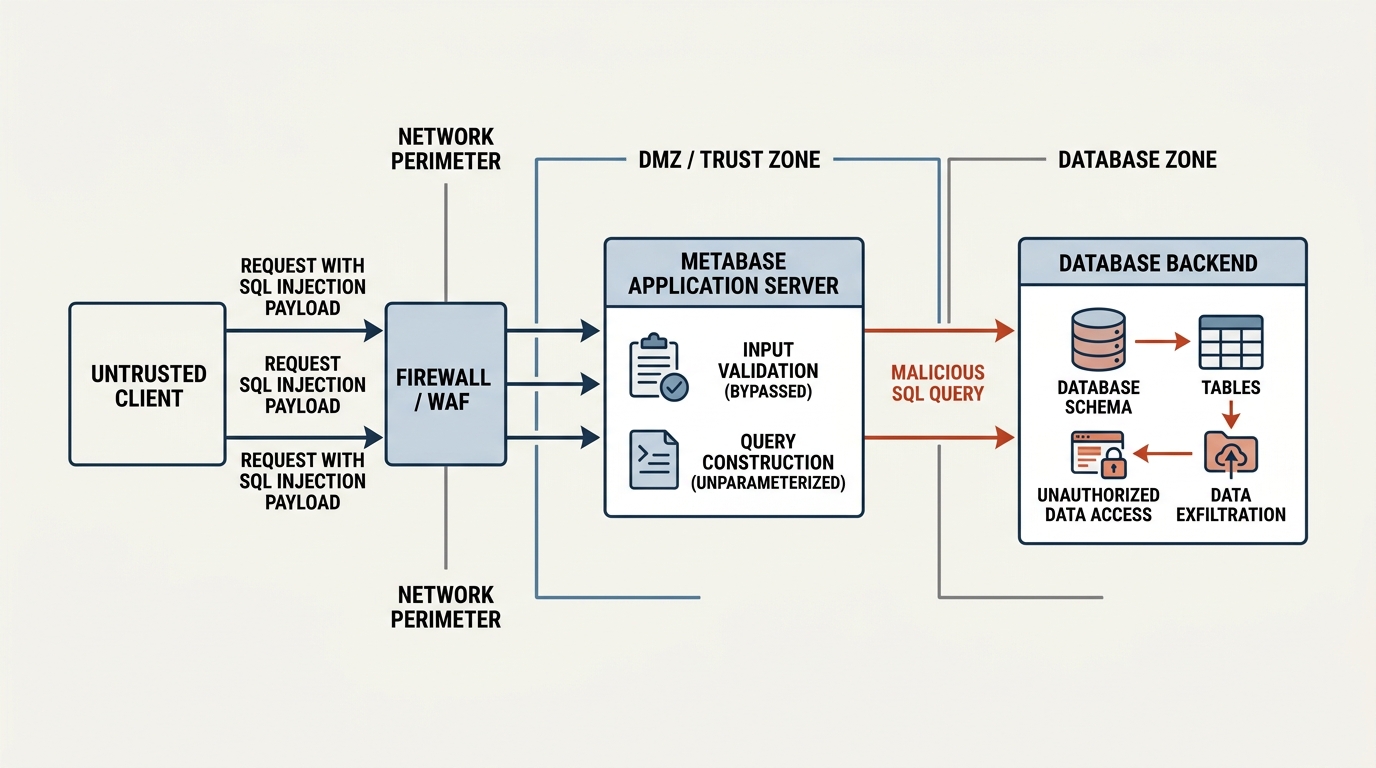
This architectural diagram illustrates the trust boundaries and the flow of the exploit from the untrusted client through the Metabase application layer to the database backend.
The Role of Setup Tokens and Public Endpoints
Historically, Metabase has faced vulnerabilities related to the setup phase, such as CVE-2023-38646, which involved the abuse of setup tokens. In this current exploit vector, a similar pattern is observed where endpoints that are supposed to be restricted or only accessible during initial setup are exposed to unauthenticated users.
If an organization leaves its Metabase instance exposed to the internet without a reverse proxy enforcing authentication at the perimeter, these endpoints are directly reachable. Even if you have configured Single Sign-On (SSO) or multi-factor authentication (MFA) within Metabase, the vulnerable API routes are processed before the authentication middleware enforces session validation. This is why standard application-level access controls fail to prevent this attack.
Detection, Forensic Analysis, and Blast Radius Mitigation
If you are running Metabase in your environment, you must assume you are targeted. Detecting whether you have been compromised requires a multi-layered forensic approach across application logs, database query logs, and network traffic.
1. Application Log Analysis
Your first line of defense is analyzing your Metabase container or application logs. Look for unusual stack traces, particularly those originating from Clojure's JDBC wrappers or database driver errors. When an attacker attempts to inject SQL, they often make syntax errors during their initial probing phase. This results in database driver exceptions logged by Metabase.
Search your logs for the following indicators:
org.postgresql.util.PSQLExceptionor equivalent driver errors containing unexpected SQL syntax, such as mismatched quotes, unexpectedUNION,SELECT, or system function calls likepg_sleep.- Requests to
/api/endpoints that return a500 Internal Server Errorwith large payload sizes or unusual parameter keys. - Log entries indicating changes to database connection configurations that you did not authorize.
2. Database Query Log Auditing
Because the SQL injection executes directly on the database, your database engine's query logs are the source of truth. If you have query logging enabled (e.g., log_statement = 'all' in PostgreSQL), audit your logs for queries executing against the Metabase metadata tables.
Specifically, look for queries targeting the metabase_database table, which holds the encrypted credentials for your data warehouses. Attackers will attempt to read the details column of this table, which contains the connection strings, usernames, and passwords.
Here is an example of what a suspicious query pattern might look like in your PostgreSQL logs:
-- Example of an injected query attempting to exfiltrate database credentials
SELECT details FROM metabase_database WHERE id = 1; -- UNION SELECT pg_read_file('/etc/passwd');
-- Or attempts to trigger out-of-band DNS requests (OOB-DNS) to verify vulnerability
SELECT * FROM metabase_database WHERE name = 'test' OR (SELECT pg_sleep(10));
If you see unexpected pg_sleep() calls, attempts to read system files, or queries accessing the metabase_database table from unusual application threads, this is a strong indicator of compromise.
3. Assessing the Blast Radius
If you find evidence of exploitation, you must immediately assess the blast radius. I recommend asking the following critical questions:
- What database user does Metabase use? If Metabase connects to its application database as
superuserordb_owner, the attacker has full control over the database server, including the ability to read, write, and delete all data, and potentially access the underlying host OS. - What data warehouses are connected? Metabase decrypts connection credentials on demand. If the attacker compromised the Metabase application database, they likely extracted the credentials for all connected data sources. This means your production databases, data lakes, and data warehouses (Snowflake, BigQuery, Redshift) must be considered compromised.
- Is Metabase running in a container? If Metabase is containerized, check if the container is running as
rootor has sensitive host directories mounted. An attacker achieving RCE can easily escape a misconfigured container to compromise the host node.
Comprehensive Remediation and Hardening Playbook
To secure your environment against this zero-day and prevent future attacks of this nature, you must execute a comprehensive hardening playbook. Do not rely solely on patching; you must implement defense-in-depth.
Immediate Remediation Steps
- Isolate the Instance: Immediately pull your Metabase instances behind a VPN, zero-trust network access (ZTNA) gateway, or IP access control list (ACL). No Metabase instance should be directly accessible from the public internet.
- Apply the Official Patch: Metabase has released emergency patches to address this vulnerability. Identify your deployment type and update your container images or jar files to the latest patched version immediately.
- Rotate All Credentials: If you suspect or confirm exploitation, you must rotate:
- The Metabase application database password.
- All credentials for connected data warehouses and databases.
- The Metabase Secret Key (used to encrypt database credentials in the metadata store).
- All user session tokens and API keys.
Hardening Checklist
I have compiled the following checklist to help you audit and harden your Metabase deployment:
| Hardening Area | Action Item | Implementation Details |
|---|---|---|
| Network Security | Restrict Ingress | Block all public internet access to Metabase. Force users through a corporate VPN, Cloudflare Access, or Tailscale. |
Implementing Network-Level Egress Filtering
One of the most effective ways to neutralize the impact of an SQL injection or RCE vulnerability is strict egress filtering. When an attacker gains the ability to execute commands, their first step is almost always to download a secondary payload (such as a reverse shell or mining script) or to exfiltrate data to an attacker-controlled server.
If your Metabase container is hosted in Kubernetes, you can enforce this using a NetworkPolicy. Below is an example of a Kubernetes NetworkPolicy that restricts a Metabase deployment's egress traffic to only allow DNS resolution and connections to a specific PostgreSQL database, blocking all other outbound internet traffic.
apiVersion: networking.k8s.io/v1
kind: NetworkPolicy
metadata:
  name: metabase-egress-restriction
  namespace: analytics
spec:
  podSelector:
    matchLabels:
      app: metabase
  policyTypes:
  - Egress
  egress:
  # Allow DNS resolution
  - to:
    - namespaceSelector: {}
      podSelector:
        matchLabels:
          k8s-app: kube-dns
    ports:
    - protocol: UDP
      port: 53
  # Allow connection to the local PostgreSQL application database
  - to:
    - podSelector:
        matchLabels:
          app: metabase-db
    ports:
    - protocol: TCP
      port: 5432
  # Allow connections to your specific cloud data warehouse (e.g., Snowflake)
  # Replace with your specific IP ranges or external services
  - to:
    - ipBlock:
        cidr: 209.115.181.0/24
    ports:
    - protocol: TCP
      port: 443
By applying this policy, even if an attacker successfully exploits an SQL injection and achieves code execution within the Metabase container, they will be unable to establish a reverse shell back to their command-and-control (C2) server or download malicious tools from the internet.
Operational Trade-offs and Limitations of Remediation
When implementing these security controls, you must balance protection with operational overhead. Restricting network access and enforcing strict egress filtering introduces several trade-offs that engineering leaders must manage.
1. The Impact of Ingress Restrictions on Embedded Analytics
Many organizations use Metabase to embed dashboards directly into their customer-facing SaaS applications. If you completely isolate Metabase behind a corporate VPN or IP access control list, these embedded dashboards will break for external users.
To mitigate this, I recommend separating your Metabase deployment into two distinct environments:
- Internal BI Instance: This instance contains all raw data connections, ad-hoc querying capabilities, and administrative controls. It must be strictly isolated behind a zero-trust network gateway.
- External Embedded Instance: This instance is dedicated solely to serving public or signed embedded dashboards. It can remain accessible to the internet but must connect to a highly restricted, read-only replica of your database containing only non-sensitive, anonymized data. This ensures that even if the external instance is compromised, the blast radius is strictly limited to public data.
2. Performance Overhead of Database Query Logging
Enabling full query logging (log_statement = 'all') on your Metabase application database is essential for forensic visibility, but it introduces non-trivial performance and storage overhead. In high-concurrency environments where hundreds of users are actively running queries, logging every single SQL statement can lead to disk I/O bottlenecks and rapid storage consumption.
To manage this trade-off, I recommend implementing selective logging. Instead of logging all statements globally, you can configure your database to log only connections and queries originating from the specific database user assigned to Metabase. Additionally, ensure that your log rotation and retention policies are configured to automatically archive older logs to low-cost object storage, preventing disk exhaustion on your primary database server.
3. Maintenance Overhead of Egress Network Policies
Implementing strict egress filtering via Kubernetes NetworkPolicies or cloud security groups is a highly effective defense, but it increases maintenance complexity. Cloud data warehouses like Snowflake, BigQuery, and Redshift frequently update their IP address ranges. If your egress policy relies on static IP blocks, your Metabase instance may suddenly lose connectivity to your data warehouse when these IPs change.
To address this limitation, I recommend using DNS-based egress controls rather than static IP blocks. Tools like Cilium (using CiliumNetworkPolicies) or service meshes like Istio allow you to define egress rules based on fully qualified domain names (FQDNs) rather than IP addresses. This allows you to restrict egress traffic to *.snowflakecomputing.com or *.amazonaws.com dynamically, ensuring continuous connectivity without compromising security.
Long-Term Security Posture for BI Platforms
This Metabase vulnerability highlights a broader industry challenge: BI and data visualization tools are often treated as secondary administrative applications rather than critical production infrastructure. Because these platforms hold the credentials to your most valuable data assets, they must be secured with the same level of rigor as your primary customer-facing APIs.
Moving forward, I recommend adopting a zero-trust architecture for all data access tools. This involves:
- Decoupling Credentials: Never store master database credentials within your BI platform. Use dynamic, short-lived credentials managed by secrets managers like HashiCorp Vault or AWS Secrets Manager.
- Continuous Auditing: Implement automated configuration drift detection to ensure that public sharing settings, setup endpoints, and user permissions are continuously audited and aligned with your security policies.
- Network Segmentation: Treat your BI platform as an untrusted zone. Even if it resides within your internal network, segment it from your primary production databases and enforce strict, authenticated API gateways for all communication.
By implementing these architectural safeguards, you can protect your organization against both known vulnerabilities and the zero-days of tomorrow.