

The Connection Explosion: Why Direct Client-to-Storage Topologies Fail at Scale
In large-scale distributed systems, the architectural boundary between application clients and storage backends is a frequent battleground for reliability, performance, and operational sanity. For years, the prevailing wisdom in high-performance engineering favored direct client-to-node topologies. By embedding routing logic, shard maps, and state tracking directly into client libraries, systems could bypass intermediate hops, minimizing latency and maximizing raw throughput.
However, as infrastructure scales from thousands of client instances to millions, this decentralized model begins to fracture under its own weight. At Meta, this inflection point manifested within the ecosystem surrounding ZippyDB—a highly durable, distributed key-value store built on top of RocksDB and Paxos. As the microservices fleet grew, the direct-client model introduced severe operational pain points: catastrophic connection churn, unsustainable memory consumption on storage nodes, and configuration drift that led to cascading routing errors.
To resolve these systemic bottlenecks, Meta engineered and deployed ZGateway, a specialized proxy layer positioned between application clients and ZippyDB clusters. In this article, I analyze the architectural transition from direct-client routing to proxy-based traffic management. I dissect the underlying mechanics of connection explosion, examine the internal architecture of ZGateway, evaluate how it resolves fleet-wide configuration drift, and discuss the inevitable operational trade-offs—such as latency overhead and failure mode shifts—that you must navigate when implementing a proxy layer in your own high-throughput storage architectures.
To understand why a proxy layer like ZGateway becomes necessary, we must first analyze the mathematical and physical limits of direct-client connection topologies. In a classic direct-client architecture, every client instance running in the application fleet must be capable of talking to any storage shard in the database cluster.
If you have $M$ client containers (or threads) and $N$ database storage nodes, the theoretical upper bound of concurrent connections is $O(M \times N)$. In a microservices-driven infrastructure, $M$ is not a static or small number; it represents tens of thousands of ephemeral containers constantly scaling up, scaling down, restarting, and executing periodic batch jobs. As $M$ scales into the hundreds of thousands, the connection footprint on the storage nodes ($N$) scales quadratically.
This connection explosion degrades storage node performance in several critical ways:
- Memory Overhead of Connection State: Each established TCP connection consumes kernel memory for read and write buffers (typically 4KB to 64KB per buffer, depending on OS tuning). When TLS is layered on top, the user-space memory footprint of connection state, session caches, and cryptographic buffers can easily exceed several megabytes per connection. Multiplying this by 50,000 concurrent clients per storage node results in tens of gigabytes of RAM wasted purely on maintaining idle connection state, directly starving the database's page cache and block cache (e.g., RocksDB memtables and block caches).
- CPU Overhead from Context Switching and Epoll Churn: Operating system kernels manage active connections using event loops like
epollin Linux. As the number of file descriptors monitored by the kernel grows, the overhead of context switching, handling interrupt requests (IRQs) from network interface cards (NICs), and traversing active file descriptor lists increases. The CPU spends more time managing network multiplexing than executing database reads and writes. - TCP Handshake and TLS Negotiation Latency: Because storage nodes cannot support an infinite number of concurrent connections, they must aggressively reap idle connections. When clients experience bursty traffic, they must constantly re-establish connections. This triggers a cycle of TCP three-way handshakes and TLS cryptographic negotiations (often requiring multiple round-trips and intensive CPU-bound asymmetric cryptography), which injects massive latency spikes (p99 and p99.9) into application requests.
By inserting ZGateway as an intermediary, we decouple the client scaling factor ($M$) from the storage node scaling factor ($N$). The proxy acts as a connection consolidator, terminating the highly dynamic, short-lived client connections at the proxy boundary and maintaining a stable, pre-warmed, and highly optimized pool of persistent connections to the backend storage nodes.
Inside the ZGateway Architecture: Decoupling Clients from Storage Nodes
ZGateway is designed as a high-performance, asynchronous, non-blocking Layer 7 proxy. To achieve the throughput required to sit in front of a primary key-value store like ZippyDB, its internal architecture must minimize memory allocations, avoid lock contention, and maximize CPU cache locality.
At its core, ZGateway utilizes an event-driven, thread-per-core execution model, typically built on top of modern asynchronous network frameworks (such as C++ Folly or Seastar). The proxy assigns a dedicated event loop (epoll or io_uring) to each physical CPU core. When a client connects, the connection is assigned to a specific thread's event loop for its entire lifecycle. This eliminates cross-thread synchronization and cache-line bouncing for connection state management.
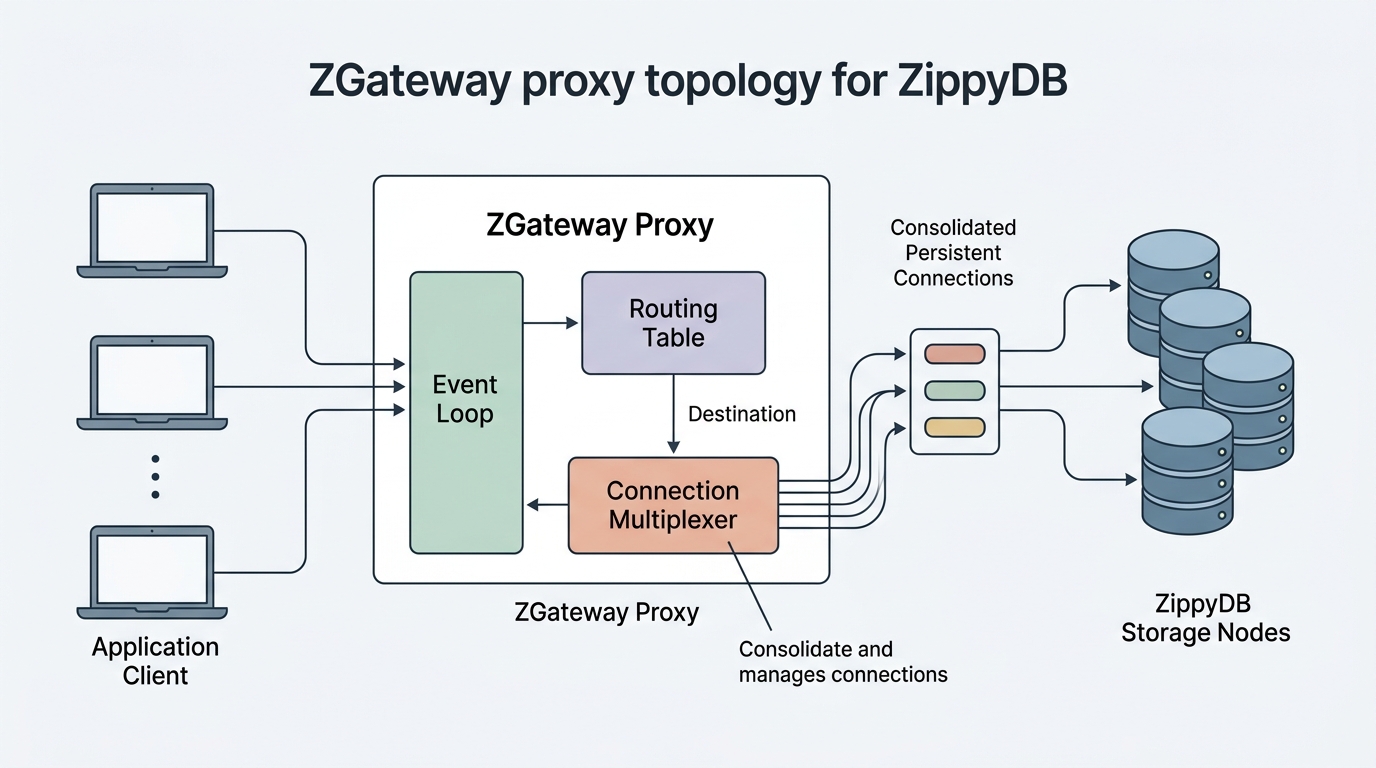
To bridge the gap between clients and backend storage nodes, ZGateway implements a highly structured connection pooling and multiplexing engine. Let us examine how requests are handled internally:
- Downstream Connection Management: Downstream (client-to-proxy) connections are accepted and terminated by ZGateway. These connections use a lightweight, frame-based protocol over TCP or TLS. ZGateway reads raw byte streams, parses the protocol headers to extract routing keys, and constructs a lightweight request metadata object.
- Upstream Connection Pooling: Upstream (proxy-to-storage) connections are pre-allocated and pooled. Instead of mapping one client connection to one backend connection, ZGateway multiplexes requests from thousands of downstream clients over a small, fixed set of persistent TCP connections to each ZippyDB storage node.
- Request Multiplexing and Pipelining: To prevent head-of-line blocking on the upstream connections, ZGateway assigns a unique sequence identifier (Request ID) to each multiplexed request. It writes requests sequentially to the upstream socket without waiting for the previous request's response. When the storage node returns responses out-of-order, ZGateway uses the Request ID to correlate the response with the correct downstream client connection and routes it back accordingly.
The following C++ conceptual outline demonstrates the core event loop and multiplexing flow within a ZGateway worker thread:
#include <unordered_map>
#include <string>
#include <memory>
#include <iostream>

struct ClientRequest {
    uint64_t client_conn_id;
    uint64_t request_id;
    std::string key;
    std::string payload;
};

struct BackendResponse {
    uint64_t request_id;
    std::string value;
    bool success;
};

class ZGatewayWorker {
private:
    std::unordered_map<uint64_t, uint64_t> pending_requests_;
    uint64_t next_upstream_req_id_ = 0;

public:
    void on_client_read(uint64_t client_id, const std::string& raw_buffer) {
        ClientRequest req = parse_frame(raw_buffer);
        req.client_conn_id = client_id;

        uint64_t upstream_id = ++next_upstream_req_id_;
        pending_requests_[upstream_id] = req.client_conn_id;

        std::string target_node = route_request(req.key);
        forward_to_backend(target_node, upstream_id, req.payload);
    }

    void on_backend_read(const BackendResponse& resp) {
        auto it = pending_requests_.find(resp.request_id);
        if (it != pending_requests_.end()) {
            uint64_t client_id = it->second;
            pending_requests_.erase(it);
            write_to_client(client_id, resp.value);
        } else {
            log_error("Orphaned response received for ID: " + std::to_string(resp.request_id));
        }
    }

private:
    ClientRequest parse_frame(const std::string& buf) { return ClientRequest(); }
    std::string route_request(const std::string& key) { return "node_shard_01"; }
    void forward_to_backend(const std::string& node, uint64_t id, const std::string& data) {}
    void write_to_client(uint64_t client_id, const std::string& val) {}
    void log_error(const std::string& msg) {}
};
Through this architecture, ZGateway reduces the connection count on ZippyDB storage nodes by several orders of magnitude. A storage node that previously struggled under 80,000 direct client connections now interacts with a highly stable pool of only a few hundred connections originating from the ZGateway proxy fleet.
Solving the Fleet Configuration Drift and Routing Challenge
In a distributed, sharded database like ZippyDB, data is partitioned into logical shards, and each shard is assigned to a specific replica set (typically consisting of a Paxos leader and multiple followers). Because data placement is dynamic—due to shard splits, rebalancing, node failures, and administrative migrations—the system must maintain a global "routing table" or "shard map" that maps keys to the physical IP addresses of the primary and secondary nodes.
In the legacy direct-client model, every single application client instance had to maintain its own local copy of this routing table. This introduced severe operational challenges at scale:
- Massive Configuration Drift: Distributing routing table updates to hundreds of thousands of clients is a slow, asynchronous process. Even with optimized pub-sub systems or ZooKeeper/Consul-style configuration trees, there is always a propagation delay. At any given moment, a significant percentage of the client fleet is running with stale routing tables.
- Routing Errors and Retry Storms: When a client with a stale routing table attempts to write to a shard that has migrated to a new Paxos leader, the target node rejects the write with a "Not Leader" error. The client must then invalidate its local cache, fetch the updated routing table, and retry the request. When a large-scale shard migration occurs, thousands of clients simultaneously hit this failure path, triggering a massive retry storm that can overwhelm both the configuration service and the storage nodes.
- High Memory Footprint of Shard Maps: As the database cluster grows to millions of shards, the size of the routing table itself becomes non-trivial (often hundreds of megabytes). Forcing every lightweight client container to load and parse this massive map consumes valuable memory that could otherwise be allocated to application logic.
ZGateway elegantly solves this problem by centralizing the routing logic and shard map management within the proxy tier. Instead of distributing routing updates to millions of clients, the configuration service only needs to push updates to a relatively small, dedicated fleet of ZGateway proxy instances. Because the proxy fleet is highly concentrated, configuration updates propagate in milliseconds rather than minutes.
When a shard migration occurs, only the ZGateway instances need to update their internal routing tables. If a ZGateway instance does hit a transient "Not Leader" error during a migration window, it handles the retry and redirection internally and transparently. The client remains completely oblivious to the migration, experiencing only a minor, sub-millisecond blip in latency rather than a hard connection failure or an application-level exception.
Operational Trade-offs, Latency Overhead, and Mitigation Strategies
While introducing a proxy layer solves connection exhaustion and configuration drift, it is not a silver bullet. In systems engineering, every architectural benefit comes with a corresponding cost. As a technology leader, you must carefully evaluate these trade-offs before committing to a proxy-based topology.
1. The Latency Tax and CPU Overhead
Adding ZGateway introduces an extra network hop and serialization/deserialization cycle into the critical path of every single database request. In a direct-client model, a read request takes $T_{network} + T_{storage}$. With a proxy, it takes $T_{network1} + T_{proxy_processing} + T_{network2} + T_{storage}$.
To mitigate this latency tax, I recommend implementing several optimization strategies:
- Zero-Copy Parsing: The proxy should not fully deserialize the request payload. It only needs to parse the outer protocol envelope to extract the routing key and request metadata. The actual value payload should be passed through using zero-copy techniques (such as
spliceorsendfilesystem calls, or custom buffer chains like Folly'sIOBuf) directly from the downstream socket to the upstream socket. - Colocated Deployment and Network Topology Awareness: Deploy ZGateway instances in the same physical racks or availability zones as the application clients they serve. This keeps the first network hop ($T_{network1}$) within sub-millisecond, low-latency local switching domains.
- Asynchronous Pipelining: Ensure the proxy does not block threads waiting for storage responses. By using asynchronous, event-driven I/O, a single proxy core can process hundreds of thousands of concurrent requests without context-switching overhead.
2. Single Point of Failure and Blast Radius Management
By placing a proxy tier in front of your database, you introduce a new potential single point of failure. If a ZGateway instance crashes or becomes unresponsive, all clients routing through that instance lose access to the database.
To manage this risk, you must design for high availability and strict isolation:
- Anycast Routing and Load Balancing: Deploy ZGateway behind a layer of hardware or software load balancers (such as Maglev or IPVS) using Layer 4 Anycast. If a ZGateway node fails, the load balancer immediately withdraws its route, redirecting client traffic to healthy proxy instances within milliseconds.
- Graceful Degradation and Failover: Implement strict health-checking endpoints on ZGateway. If a proxy detects that its connection pool to a critical ZippyDB shard is failing, it should report itself as unhealthy to the load balancer, allowing traffic to drain gracefully before the backend is completely cut off.
3. Comparing the Architectures
To help you evaluate whether a proxy layer is appropriate for your specific infrastructure scale, I have compiled a comparative analysis of the two architectural paradigms:
| Architectural Dimension | Direct Client-to-Storage | Proxy-Based (ZGateway) |
|---|---|---|
| Connection Scaling | $O(M \times N)$ (Quadratic, unsustainable at scale) | $O(M + N)$ (Linear, highly stable) |
| Network Latency | Minimal (Direct path, no intermediate hops) | Incremental overhead (Extra hop, typically < 1ms) |
| Configuration Convergence | Slow, asynchronous (High risk of fleet-wide drift) | Near-instantaneous (Centralized update path) |
| Client Complexity | High (Fat client libraries, routing, retry logic) | Extremely low (Thin, simple protocol clients) |
| Storage Node Resource Usage | High CPU/Memory overhead from connection state | Low, predictable resource usage (Fixed connection pool) |
| Operational Blast Radius | Isolated to individual client instances | High (Proxy failure affects all downstream clients) |
Conclusion
The transition from a direct-client topology to the ZGateway proxy architecture represents a classic evolution in distributed systems design: trading a minor latency penalty for massive gains in scalability, predictability, and operational simplicity. By decoupling client connection lifecycles from storage node resources and centralizing dynamic routing configurations, ZGateway resolves the structural bottlenecks that inevitably emerge when microservices scale to millions of instances.
If your organization is experiencing rising p99 latencies, connection-related memory pressure on database nodes, or frequent routing errors during shard migrations, it is time to move away from "fat" client libraries. Designing a lightweight, high-performance proxy layer like ZGateway is a proven, production-grade strategy to future-proof your storage infrastructure and ensure your database nodes spend their precious CPU cycles executing queries rather than managing network state.