
The Collapse of the Unified Engineering Manager Role
The traditional role of the first-line Engineering Manager (EM)—historically a hybrid of people management, project delivery, and technical architecture—is breaking under the weight of its own contradictions. As autonomous, multi-agent systems evolve from simple autocomplete extensions into systems capable of executing complex refactors, managing database migrations, and deploying microservices, the operational bottleneck shifts. The bottleneck is no longer writing code; it is the orchestration, verification, and structural integrity of that code.
When your contributors are a mix of three human engineers and twenty autonomous agents running parallel workflows 24/7, the traditional EM playbook becomes obsolete. You can no longer run standard stand-ups, manually assign tickets, or perform casual code reviews. This operational shift forces a permanent bifurcation of first-line engineering leadership. In my judgment, the role is splitting into two distinct, highly specialized career paths: the AI Manager (AIM), who focuses on agent orchestration, compute budgets, and operational delivery, and the Technical Staff (TS), who focuses on deep system architecture, security boundaries, and domain-model guardrails. Engineering leaders who fail to intentionally split these responsibilities will see their delivery pipelines collapse under the weight of agent-generated technical debt.
The Bifurcation of First-Line Engineering Leadership
To understand why this split is inevitable, we must look at how agentic software engineering alters the velocity and volume of code production. In a traditional team, a manager oversees five to eight human engineers. The team's output is limited by human typing speed, cognitive load, and collaboration overhead.
When agents are introduced as primary contributors, the dynamics change. An agent does not sleep, does not experience context-switching fatigue, and can generate hundreds of lines of syntactically correct but architecturally suspect code in seconds. If a single manager attempts to maintain human career development, unblock business requirements, manage the compute budgets of agent fleets, and review thousands of lines of agent-generated code for architectural compliance, they will fail.
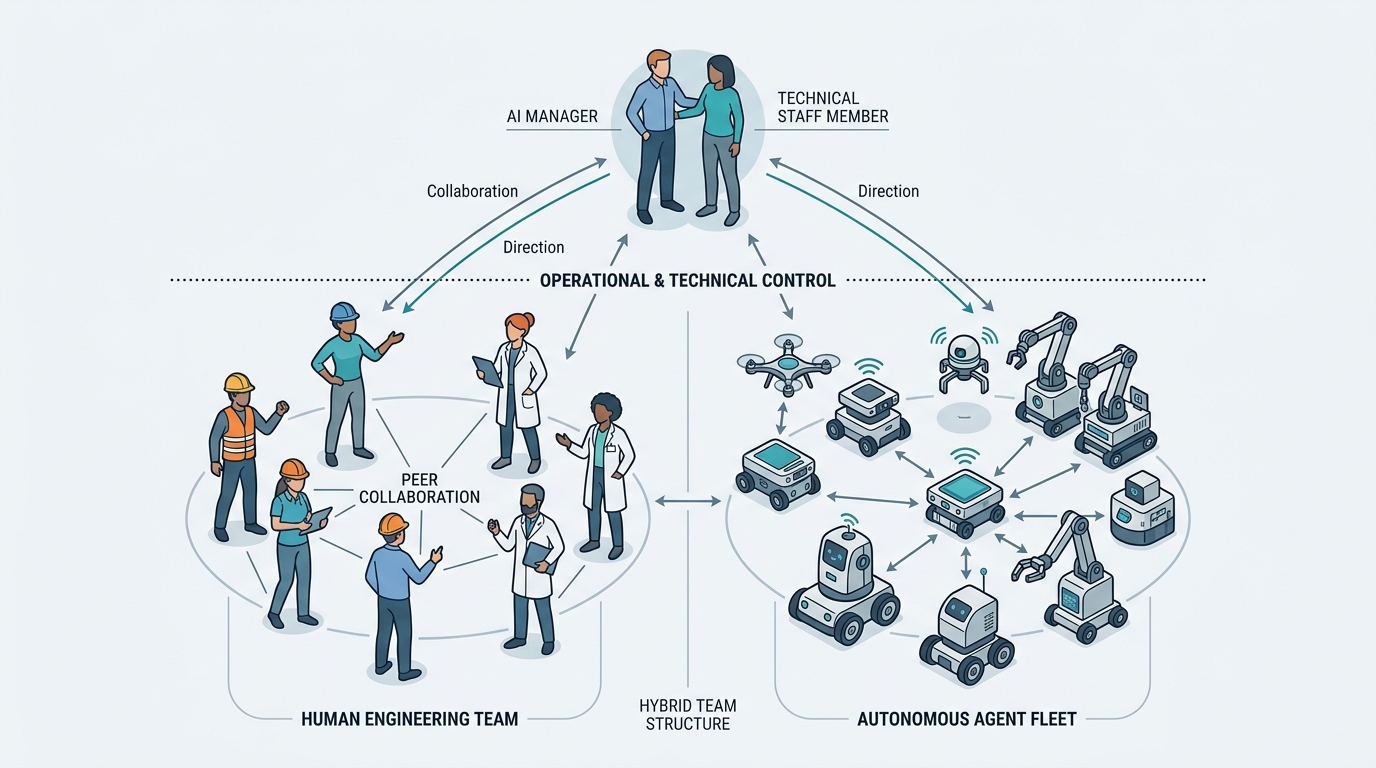
This failure mode manifests in two ways. Either the manager focuses on the people and the business, allowing the agents to turn the codebase into an unmaintainable, spaghetti-like mess of decoupled microservices, or the manager dives deep into code verification, neglecting the human team members and business stakeholders. To prevent this, organizations must divide these responsibilities into two roles:
- The AI Manager (AIM): This is an operational and organizational leadership role. The AIM treats agents as a digital workforce and humans as high-leverage directors of that workforce. Their primary responsibility is maximizing the throughput and efficiency of the hybrid team while managing the human talent, career paths, and business alignment.
- The Technical Staff (TS): This is a hands-on, highly technical role. The TS does not manage people. Instead, they design the architectural sandbox, write the system-level guardrails, and define the interface contracts within which the agents operate. They are the ultimate arbiters of code quality, system resilience, and security.
This is not simply a rebranding of the old EM vs. Tech Lead distinction. The scale of automation requires fundamentally different skills and tools for both paths.
The AI Manager: Orchestrating Agentic Workforces
If you choose the AI Manager path, your primary objective shifts from managing human tasks to orchestrating agentic workflows. You are no longer asking "Who is working on this ticket?" but rather "Which agent topology, system prompt, and context window configuration will solve this class of problems most cost-effectively?"
Agent Topology and Orchestration
An AI Manager must understand how to structure agent networks. Instead of relying on a single, monolithic LLM to write code, you will deploy specialized agent swarms. For example, a standard feature-delivery pipeline might consist of a Planner Agent, a Coder Agent, a Security Scanner Agent, and a Test-Generation Agent. I recommend establishing clear operational SLAs for these agent networks. You must monitor their execution paths and intervene when an agent enters a "looping" state—where it repeatedly attempts and fails to solve the same unit test, draining your API budget.
Compute and Token Budgeting
The engineering budget is no longer just about headcount; it is heavily weighted toward compute and token allocation. As an AIM, you are responsible for the Return on Investment (ROI) of your digital workforce. You must analyze metrics such as:
- Cost per Resolved Issue (CRI): The total API and infrastructure cost required for an agent to successfully close a ticket.
- Token Efficiency: The ratio of useful code generated to the number of input/output tokens consumed.
- Agent-to-Human Escalation Rate: How often an agent must hand off a task to a human engineer because it has hit a cognitive or context boundary.
Human-in-the-Loop (HITL) Management
Your human engineers are your most valuable and expensive assets. The AIM ensures that humans are not wasted on repetitive coding tasks. Instead, humans are positioned at critical leverage points: defining product requirements, reviewing high-level system designs, and acting as the final approval gate (Human-in-the-Loop) for agent deployments. You must manage the psychological shift for your human engineers, helping them transition from "code writers" to "system directors."
The Technical Staff: Deep System Architecture and Guardrails
For those who choose the Technical Staff path, the focus is entirely on technical governance and risk mitigation. When agents can write code instantly, the primary risk is no longer delivery delay; it is architectural drift, security vulnerabilities, and systemic fragility. As a TS, your job is to build the machine that builds the software. You do this by establishing strict, automated guardrails and designing highly decoupled, modular architectures that limit the blast radius of agent errors.
Designing the Sandbox
Agents perform poorly in highly coupled, monolithic codebases because the context window required to understand the system is too large. The TS must design systems using clean domain boundaries, strict API contracts, and event-driven architectures. By decoupling services, you allow agents to work within a highly localized context, drastically improving their success rate and reducing token consumption.
Automated Guardrails and Policy as Code
You cannot manually review every line of code generated by twenty parallel agents. The TS must implement automated verification pipelines. This involves writing Policy as Code (using tools like Open Policy Agent or custom static analysis suites) to enforce architectural constraints before an agent's pull request can even be considered for human review.
Here is an example of a declarative guardrail configuration that a Technical Staff member might write to restrict agent capabilities during a deployment pipeline:
# agent-guardrail-policy.yaml
version: "2027.1"
metadata:
  name: agent-deployment-constraints
  target: autonomous-coding-agents

constraints:
  network_access:
    allowed_domains:
      - "github.com"
      - "api.openai.com"
      - "internal-npm-registry.local"
    block_all_other_egress: true

  file_system:
    writable_paths:
      - "/workspace/src"
      - "/workspace/tests"
    read_only_paths:
      - "/workspace/config/secrets"
      - "/workspace/.github/workflows"

  execution_limits:
    max_consecutive_failures: 5
    max_token_spend_per_task: 15.00
    require_human_approval_for:
      - "database-migration"
      - "dependency-upgrade"
      - "iam-policy-change"

verification:
  required_coverage_delta: "+2.0%"
  static_analysis_severity_threshold: "medium"
This configuration ensures that an autonomous agent cannot access sensitive configuration directories, cannot run up infinite API bills, and cannot modify critical CI/CD pipelines without human intervention. Writing and maintaining these guardrails is the core engineering work of the Technical Staff.
Operationalizing the Split: Team Topologies and Transition Playbooks
Transitioning your organization to this bifurcated model requires deliberate structural changes. You cannot simply change job titles overnight; you must redesign how work flows through your teams.
The Modern Engineering Unit
I recommend structuring your engineering units around a 1:1 partnership between an AI Manager and a Technical Staff member. Together, they lead a hybrid unit consisting of a small group of human engineers and a dynamic fleet of specialized agents.
| Operational Dimension | AI Manager (AIM) | Technical Staff (TS) |
|---|---|---|
| Primary Focus | Delivery velocity, team health, resource allocation, and business alignment. | System architecture, code quality, security boundaries, and technical guardrails. |
| Key Metrics | Sprint velocity, token ROI, human retention, and SLA compliance. | System uptime, test coverage, architectural drift index, and vulnerability count. |
| Daily Activities | Managing human career paths, optimizing agent topologies, and budgeting compute costs. | Writing system blueprints, configuring static analysis tools, and reviewing complex PRs. |
| Interface with Agents | Configures agent workflows, assigns tasks, and monitors operational budgets. | Writes agent system prompts, defines APIs, and builds verification test suites. |
Transition Playbook for Engineering Leaders
If you are currently running a traditional engineering organization, I recommend taking the following immediate steps to prepare for this split:
- Audit Your Current EM Skillsets: Identify which of your current managers lean toward organizational dynamics and operational efficiency, and which lean toward deep technical problem-solving. Begin steering them toward their respective paths.
- Decouple People Management from Technical Oversight: Formally remove the requirement for your technical leaders to conduct career performance reviews, and remove the requirement for your people managers to approve complex architectural changes.
- Implement Agent Budgeting Infrastructure: Before deploying autonomous agents at scale, set up billing alerts, token limits, and execution tracking at the team level. Treat agent compute costs as a first-class operational metric.
- Establish "Architecture as Code": Begin codifying your architectural rules into automated linters, static analysis tools, and CI/CD gates. If a rule cannot be checked automatically, an agent will break it.
Conclusion
The split of first-line engineering management is not a temporary trend; it is a structural adjustment to the reality of agentic software development. Trying to maintain the traditional, unified EM role in this environment is a recipe for organizational burnout and technical chaos. By separating operational orchestration from technical governance, you allow both human managers and technical experts to operate at their highest leverage. As you plan your organization's roadmap, I recommend evaluating your leadership structure and actively guiding your teams toward this bifurcated model. The efficiency of your engineering engine depends on it.