

Introduction
As engineering leaders, our daily operational routine is often dictated by the tension between rapid feature delivery and immediate risk mitigation. When a critical Cybersecurity and Infrastructure Security Agency (CISA) advisory coincides with major updates to developer platform APIs, the challenge is not just reading the alerts, but translating them into immediate, actionable engineering tasks.
I have spent years managing systems where a single unpatched vulnerability or an insecure API default could compromise an entire production cluster. In this briefing, I will analyze a critical vulnerability class highlighted in recent security advisories—specifically focusing on remote code execution (RCE) vectors in edge infrastructure—and pair it with modern API design principles from recent developer platform updates. My goal is to provide you with a pragmatic blueprint for hardening your ingress points and securing your deployment pipelines.
Deciphering the CISA Advisory: Threat Vector Analysis
Recent CISA advisories highlight a persistent trend: threat actors are bypassing traditional network perimeters by targeting vulnerabilities in edge devices, reverse proxies, and API gateways. Specifically, we are seeing a rise in path-traversal vulnerabilities combined with unsafe deserialization in management interfaces.
When an attacker exploits a path-traversal vulnerability (such as ../ sequences) in an edge proxy, they can read arbitrary configuration files containing sensitive credentials, API keys, or private certificates. If that same edge device exposes an administrative endpoint that unsafely deserializes untrusted input, the attacker can escalate this read access to full remote code execution.
To mitigate this, I recommend a multi-layered defense strategy. You cannot rely solely on the vendor's patch cycle. You must implement active request validation at your outer firewall layer and enforce strict input sanitization.
Key Mitigation Steps:
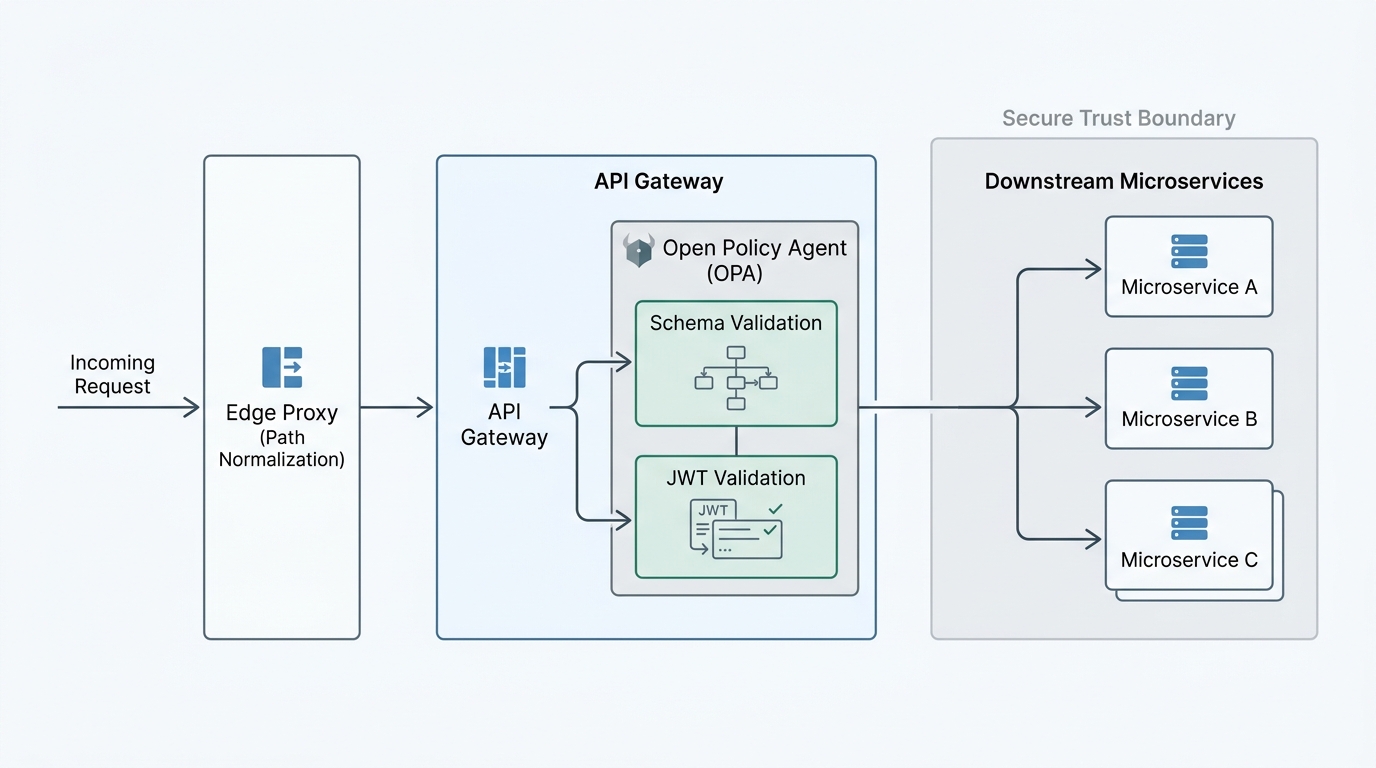
- Normalize URI Paths: Ensure your edge proxies (e.g., Nginx, Envoy, or HAProxy) are configured to strictly normalize incoming URI paths before processing routing rules. This prevents double-encoding attacks (e.g.,
%252e%252e%252f) from bypassing path-matching filters. - Isolate Management Interfaces: Management and administrative interfaces must never be exposed to the public internet. Bind these services to internal loopback addresses or access them exclusively through a secure, authenticated VPN/overlay network.
- Implement Strict Payload Validation: For APIs processing structured data (JSON or Protocol Buffers), enforce schema validation at the gateway level before the payload reaches downstream microservices.
Hardening the API Gateway: Lessons from Modern Developer Frameworks
In parallel with securing our infrastructure against external threats, we must align our internal development practices with modern platform standards. Recent updates from major developer ecosystems, including Google's developer initiatives, emphasize the transition toward strongly-typed, contract-first API development.
By leveraging Protocol Buffers (gRPC) or OpenAPI schemas as the single source of truth, we eliminate a broad class of injection and deserialization vulnerabilities. When your API contract is explicitly defined, the runtime environment can automatically reject malformed requests that do not conform to the schema.
Let's look at how we can implement a declarative validation policy at the API gateway level using Open Policy Agent (OPA) and Rego. This policy ensures that incoming requests to sensitive endpoints contain the required authorization claims and conform to safe path structures.
package api.authz

default allow = false

# Helper to split the path into segments
path_segments := split(input.path, "/")

# Allow request only if it meets security criteria
allow {
    # Ensure the path does not contain directory traversal sequences
    not has_traversal_sequence(path_segments)

    # Validate JWT token presence and claims
    input.headers["authorization"] != ""
    token := substring(input.headers["authorization"], 7, -1) # Strip "Bearer "
    io.jwt.decode(token, [header, payload, signature])
    payload.role == "admin"
}

# Detect path traversal patterns
has_traversal_sequence(segments) {
    segments[_] == ".."
}
has_traversal_sequence(segments) {
    segments[_] == "."
}
This Rego policy provides a declarative, testable way to enforce security controls at the gateway. By decoupling authorization and validation logic from your core application code, you ensure consistent enforcement across all microservices.
Implementing a Zero-Trust Configuration Pipeline
Securing the runtime environment is only half the battle. If your configuration pipeline is vulnerable, an attacker can manipulate your deployment manifests to bypass runtime controls. I advocate for a "Zero-Trust Configuration" model, where every change to your infrastructure, routing rules, or security policies is cryptographically signed and verified before deployment.
This approach requires integrating policy-as-code checks directly into your CI/CD pipelines. When a developer submits a pull request to modify an API route, an automated runner must validate the changes against your organization's security baseline.
| Operational Phase | Security Control | Tooling / Implementation |
|---|---|---|
| Development | Static Application Security Testing (SAST) | Semgrep, Snyk (detect unsafe deserialization in code) |
| CI/CD Pipeline | Policy-as-Code Validation | Conftest, OPA (validate Kubernetes manifests and API schemas) |
| Deployment | Admission Control | Kyverno, OPA Gatekeeper (block unsigned or non-compliant images) |
| Runtime | eBPF-based Observability | Cilium Tetragon (monitor system calls for unexpected process execution) |
By implementing this pipeline, you shift security left, catching misconfigurations before they reach your production cluster. If a vulnerability is disclosed in an upstream dependency, your CI/CD pipeline can automatically scan container registries to identify and flag affected deployments.
Conclusion
Managing modern technology operations requires a continuous loop of ingestion, analysis, and execution. When CISA issues an advisory, my immediate response is to verify our edge configurations and path-normalization rules. When platform providers release new API standards, I look for opportunities to enforce stronger contracts and reduce our attack surface.
I recommend taking three immediate actions today:
- Audit your edge proxies: Verify that path normalization is enabled and that double-encoded URI paths are rejected at your ingress.
- Review your API schemas: Transition away from loose JSON parsing toward strict schema validation using OpenAPI or Protocol Buffers.
- Automate policy enforcement: Integrate a policy-as-code tool like OPA into your deployment pipeline to prevent insecure configurations from ever reaching production.