
Scaling LLM Inference via P2P: A Deep Dive into Mesh LLM and the Iroh Networking Layer
Running large language models (LLMs) with hundreds of billions of parameters has historically been the exclusive domain of enterprise data centers equipped with high-bandwidth, interconnected accelerator clusters—such as NVIDIA HGX H100 nodes linked via InfiniBand or NVLink. For engineering teams, researchers, and home-lab practitioners, the hardware barrier to running models like Llama-3-70B or larger 235B mixtures-of-experts (MoEs) is often insurmountable on a single workstation due to VRAM limitations.
Mesh LLM addresses this challenge by introducing a peer-to-peer (P2P) distributed inference framework built on top of the iroh networking layer. By partitioning model weights across a decentralized network of consumer-grade hardware—including Macs with Apple Silicon, consumer NVIDIA RTX GPUs, and commodity CPUs—Mesh LLM enables the execution of massive models that exceed the memory capacity of any individual node. However, moving from tightly coupled, low-latency data center fabrics to loosely coupled, heterogeneous P2P networks introduces significant engineering trade-offs.
The Architecture of P2P Distributed Inference
Unlike data-parallel inference—where the entire model is replicated across multiple nodes to handle higher request concurrency—Mesh LLM relies on model parallelism (specifically pipeline parallelism) to split a single model across multiple physical devices.
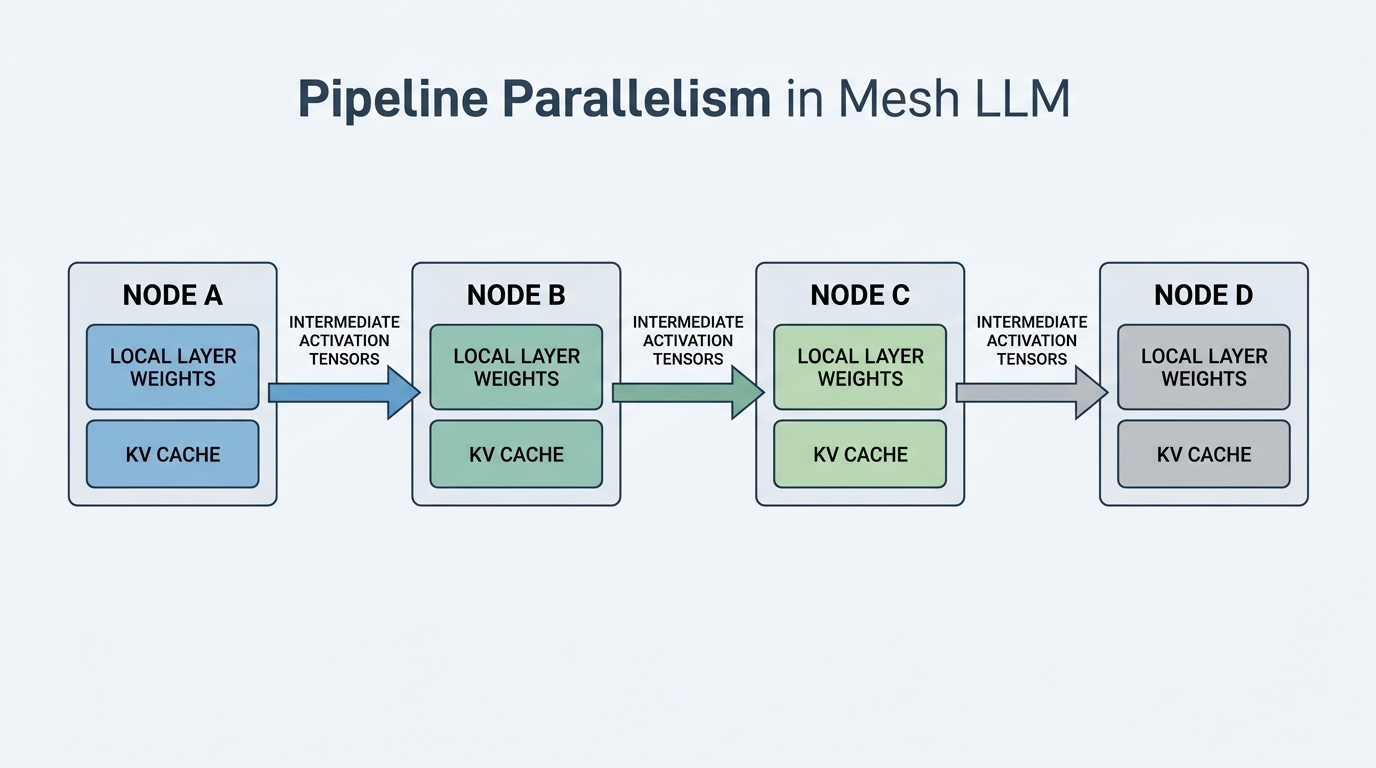
In a typical Mesh LLM deployment, a massive model is divided into sequential stages or layer groups:
- Layer Grouping: A model with 80 layers is split across four nodes. Node A hosts layers 1–20, Node B hosts layers 21–40, Node C hosts layers 41–60, and Node D hosts layers 61–80.
- Sequential Execution: During the forward pass of the prefill or decode phase, Node A processes the initial input embeddings through its local layers, then transmits the resulting intermediate activations (tensors) to Node B. Node B processes them and forwards its output to Node C, and so on.
- KV Cache Management: Each node maintains the Key-Value (KV) cache only for its assigned layers. This drastically reduces the memory footprint per node, as the KV cache for long context windows can consume gigabytes of VRAM.
While pipeline parallelism is highly memory-efficient, it suffers from the "bubble effect," where downstream nodes sit idle waiting for upstream nodes to finish processing their chunk of the layer stack. To mitigate this, Mesh LLM implements micro-batching and speculative execution strategies, allowing nodes to pipeline multiple generation requests concurrently.
Under the Hood: The Iroh Networking Layer
Traditional distributed computing frameworks (such as PyTorch's torch.distributed or MPI) assume a highly stable, low-latency, and fully routed network topology. They typically require static IP addresses, open ports, and manual firewall configurations. In a consumer or home-lab environment, these assumptions break down due to symmetric NATs, dynamic IPs, and unpredictable residential firewalls.
Mesh LLM solves this by building directly on iroh, a modern, lightweight networking stack designed for P2P applications. Written in Rust, iroh excels at establishing direct connections between nodes under challenging network conditions.
iroh utilizes a combination of technologies to ensure reliable, high-throughput communication between inference nodes:
- Hole Punching:
irohuses STUN (Session Traversal Utilities for NAT) to discover public-facing IP addresses and ports, attempting to establish direct UDP-based connections between peers behind NATs. - DERP (Designated Echo Relay Packets): When direct hole punching fails (for example, when both nodes are behind strict symmetric enterprise NATs),
irohseamlessly falls back to routing traffic through encrypted relay servers (DERP). This guarantees connectivity, albeit at the cost of higher latency and reduced bandwidth. - QUIC Protocol: All transport in
irohis built on QUIC (via thequinnimplementation). QUIC provides encrypted-by-default, multiplexed streams over UDP. This is critical for Mesh LLM, as it allows a single connection between two nodes to handle multiple parallel tensor transfers without head-of-line blocking. - Public Key Addressing: Nodes in an
irohnetwork are identified by their public keys (Node IDs) rather than IP addresses. This means that if a node's IP address changes (e.g., due to a Wi-Fi handoff or DHCP lease renewal), the connection is automatically migrated without tearing down the active inference session.
The following Rust code demonstrates how a Mesh LLM node initializes an iroh endpoint, establishes a connection to a peer, and prepares to stream intermediate activation tensors:
use iroh::{Endpoint, SecretKey};
use tokio::io::AsyncWriteExt;
use std::error::Error;

#[tokio::main]
async fn main() -> Result<(), Box<dyn Error>> {
    // Generate or load a persistent cryptographic identity for this node
    let secret_key = SecretKey::generate();

    // Bind the iroh endpoint to a local UDP port
    let endpoint = Endpoint::builder()
        .secret_key(secret_key)
        .bind()
        .await?;

    println!("Mesh LLM Node initialized. Node ID: {}", endpoint.node_id());

    // Connect to a peer node using its public key (Node ID)
    let peer_node_id = "abc123xyz...".parse()?;
    let connection = endpoint.connect(peer_node_id, b"mesh-llm-v1").await?;

    // Open a unidirectional stream to transmit activation tensors
    let mut send_stream = connection.open_uni().await?;

    // Example: Serialized tensor data representing intermediate layer activations
    let activation_tensor_bytes = vec![0u8; 4096];
    send_stream.write_all(&activation_tensor_bytes).await?;
    send_stream.finish().await?;

    println!("Successfully transmitted activation tensor to peer.");
    Ok(())
}
Performance Trade-offs: Latency, Bandwidth, and Model Partitioning
While the prospect of running a 235B model across four consumer-grade machines is compelling, practitioners must understand the severe performance bottlenecks inherent to P2P distributed inference.
In a dedicated data center, nodes are connected via InfiniBand offering bandwidths of 400 Gbps (50 GB/s) or higher, with sub-microsecond latencies. In contrast, a home lab or distributed P2P network relies on consumer broadband or local Wi-Fi/Ethernet, which typically caps out at 1 Gbps to 10 Gbps (125 MB/s to 1.25 GB/s) with latencies ranging from 1 to 50 milliseconds.
The Communication Bottleneck
During LLM generation (the decoding phase), the model generates tokens one by one. For each token generated, the intermediate activations must traverse the entire pipeline from the first node to the last.
If we assume a hidden size of 8,192 and a batch size of 1, using FP16 precision, the activation tensor size passed between pipeline stages is:
$$\text{Size} = 1 \times 8,192 \times 2 \text{ bytes} = 16,384 \text{ bytes} \ (16 \text{ KB})$$
While 16 KB is trivial to transmit even over slow connections, the primary bottleneck during the decoding phase is network latency rather than bandwidth. If the round-trip time (RTT) between Node A and Node B is 10 ms, the network overhead alone introduces a hard ceiling on generation speed:
$$\text{Max Speed} \approx \frac{1}{\text{Number of Hops} \times \text{Latency per Hop}}$$
If a model is split across 4 nodes sequentially (3 hops) with a 10 ms latency per hop, the network overhead adds 30 ms per token, limiting the absolute maximum generation speed to ~33 tokens per second, completely ignoring the actual computation time on the GPUs.
Conversely, during the prefill phase (processing the input prompt), the activation tensors are much larger because they scale with the prompt length. For a prompt of 2,048 tokens:
$$\text{Size} = 2,048 \times 8,192 \times 2 \text{ bytes} = 33,554,432 \text{ bytes} \ (33.5 \text{ MB})$$
Transmitting 33.5 MB over a 1 Gbps (125 MB/s) network takes approximately 268 ms per hop. In this scenario, network bandwidth becomes the primary bottleneck.
Comparison: Centralized vs. P2P Distributed Inference
| Metric / Dimension | Centralized Data Center (e.g., 8x H100) | P2P Distributed (Mesh LLM over Iroh) |
|---|---|---|
| Interconnect Bandwidth | 400 Gbps - 3.2 Tbps (InfiniBand/NVLink) | 100 Mbps - 10 Gbps (Residential/LAN) |
| Interconnect Latency | < 2 microseconds | 1 ms (LAN) to 50+ ms (WAN/Relay) |
| Hardware Homogeneity | Identical GPUs, CPUs, and memory | Heterogeneous (Apple Silicon, RTX, CPUs) |
| Fault Tolerance | Low (relies on orchestration like Kubernetes) | High (dynamic routing and node re-pooling) |
| Capital Expense (CapEx) | Extremely High ($250k+) | Low (repurposes existing hardware) |
Operational Deployment and Security Considerations
Deploying Mesh LLM in a production or semi-production environment requires addressing several operational challenges, specifically regarding node heterogeneity, fault tolerance, and security.
Handling Heterogeneous Hardware
In a P2P network, nodes will inevitably have different compute capabilities. A node running an Apple M3 Max with 128GB of unified memory will process its layers significantly faster than an older node running an NVIDIA RTX 3060 with 12GB of VRAM.
If layers are distributed evenly, the faster nodes will spend most of their time idling, waiting for the slowest node to complete its forward pass. To optimize throughput, Mesh LLM implementations must perform dynamic load balancing, assigning a larger number of layers to high-compute, high-bandwidth nodes, and fewer layers to slower nodes.
Fault Tolerance and Dynamic Re-pooling
Unlike data centers where node failures are rare and treated as system anomalies, P2P networks must treat node departures (churn) as a normal, expected event. A user might close their laptop, or a residential internet connection might drop.
Mesh LLM leverages iroh's gossip protocols to maintain a real-time map of active peers. If a node hosting layers 21–40 suddenly drops offline:
- The coordinator or adjacent nodes detect the timeout.
- The network initiates a re-pooling sequence.
- A standby node with sufficient VRAM is selected to load layers 21–40 from a decentralized cache or local disk.
- If no single node can take the load, the remaining nodes dynamically re-partition the model layers, sacrificing performance (or context length) to keep the inference service online.
Security and Privacy in P2P Inference
Using P2P networks for LLM inference introduces unique security vectors that do not exist in centralized environments:
- Data Confidentiality: Because intermediate activations are sent over the public internet, they must be encrypted.
irohhandles this natively by encrypting all traffic using TLS 1.3/QUIC. However, the host running a specific layer segment still has access to the raw activations passing through it. In a public or untrusted mesh, a malicious node operator could theoretically reconstruct parts of the prompt or generated text by analyzing the activation tensors. - Model Weight Integrity: Nodes must trust that the weights they are loading have not been tampered with. Mesh LLM mitigates this by verifying the cryptographic hashes of model shards against a signed manifest before loading them into memory.
- Sybil Attacks: A malicious actor could join the mesh with multiple virtual nodes to disrupt inference, return garbage tensors, or attempt to harvest activation data. Implementing strict authorization tokens or relying on closed, private
irohnamespaces is highly recommended for sensitive deployments.
Next Steps for Engineering Leaders
Mesh LLM, powered by the iroh networking layer, represents a significant step forward for decentralized AI computing. By abstracting away the complexities of NAT traversal, dynamic IP addressing, and secure peer discovery, it democratizes access to massive models that were previously restricted to high-end enterprise infrastructure.
However, the laws of physics dictate that P2P networks cannot match the raw throughput of dedicated data centers. The latency overhead of residential networks makes Mesh LLM less suitable for real-time, high-concurrency conversational applications. Instead, its sweet spot lies in asynchronous batch processing, offline research, and cost-effective home-lab deployments where memory capacity is the primary constraint and latency is a secondary concern.
For engineering leaders looking to leverage this technology, the immediate next steps are to evaluate the latency profiles of your target node topologies, establish private iroh namespaces to secure data transmission, and implement strict hardware-aware layer partitioning to maximize the efficiency of your distributed mesh.