
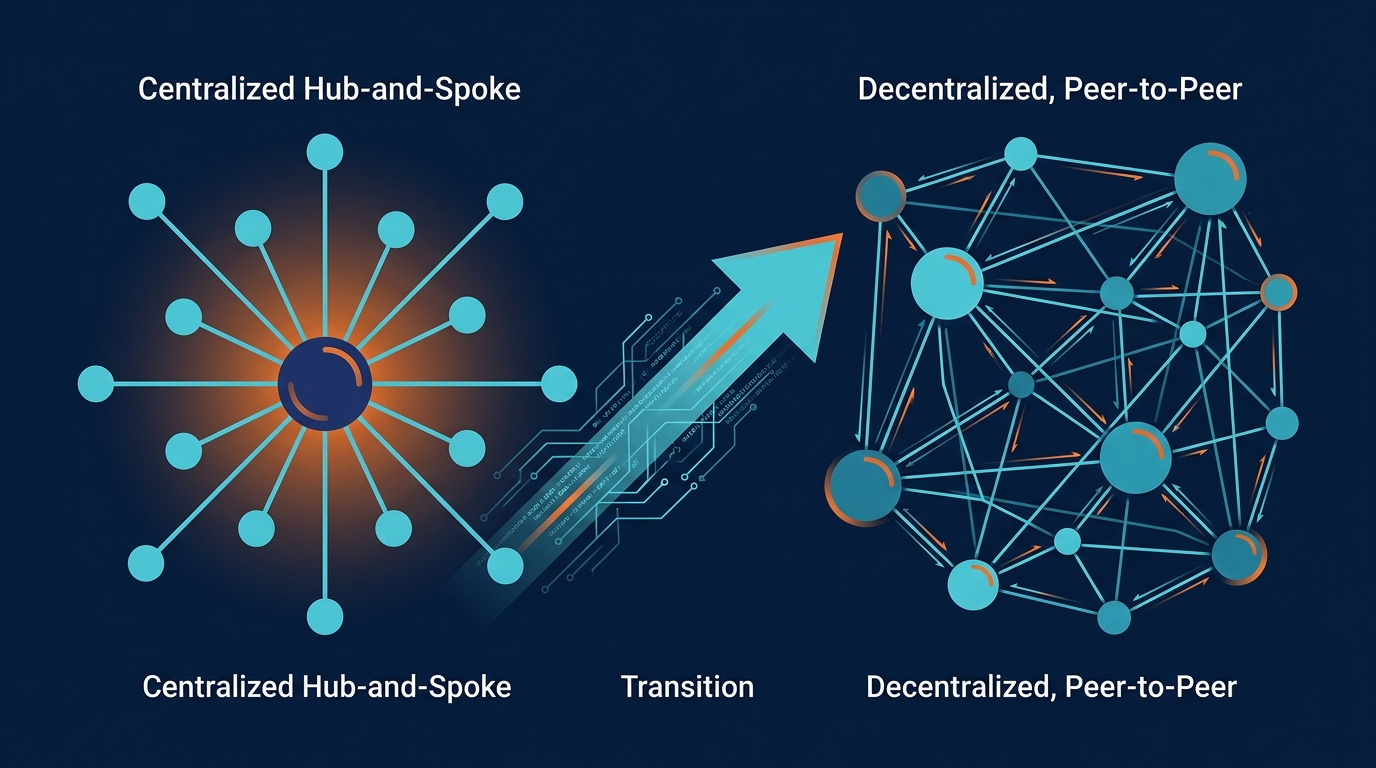
The Mechanics of the Information Router (And Why It Fails)
For nearly two decades, the standard blueprint for scaling an engineering organization relied on a familiar figure: the Engineering Manager (EM) acting as an information router. In this classic hub-and-spoke model, the manager sat at the intersection of product, business, and engineering, spending their days translating business requirements down to developers, aggregating status updates upward to executives, and manually coordinating dependencies across teams.
This model is no longer viable. The traditional information-routing engineering manager is a relic of an era characterized by low-trust organizational designs, manual tracking tools, and slow release cycles. Today, three converging forces have rendered this role obsolete: the widespread adoption of flatter team topologies, the rise of asynchronous, document-first cultures, and the introduction of AI-driven developer tooling that automates status aggregation, documentation, and basic coordination.
When information flows instantly and transparently across automated systems, an engineering leader whose primary value proposition is "knowing who is doing what" becomes a bottleneck. In my work analyzing and restructuring engineering organizations, I have observed that teams relying on manual information routers suffer from higher latency, decreased developer autonomy, and systemic misalignment. This analysis examines the structural decline of the information router, details the operational forces driving this shift, and outlines a practical framework for transitioning your engineering leadership toward a model of high-leverage, context-driven enablement.
To understand why the information router is declining, we must first analyze the mechanics of the role and the systemic failures it introduces. The router model assumes that developers should focus exclusively on writing code, while managers handle the cognitive load of alignment, prioritization, and communication. This separation of concerns is fundamentally flawed.
The Latency and Distortion of Human Relays
When information is routed through a human intermediary, it is subject to the same degradation seen in a game of telephone. A product requirement originates at the executive level, passes through a product manager, is filtered by an engineering manager, and is finally delivered to a software engineer. At each hop, nuance is lost, and assumptions are introduced.
Conversely, when status updates travel back up the chain, they are polished and sanitized. An engineer's technical concern about architectural debt is softened by the EM into a "minor delivery risk," which is then reported to the VP of Engineering as "on track with minor adjustments." This distortion masks systemic engineering friction until it manifests as a catastrophic delivery failure or an unexpected spike in attrition.
The Cognitive Cost of Context Switching
Information routing requires endless synchronous meetings: daily standups, syncs, status reviews, and cross-functional alignments. Because the EM is the sole conduit of information, they must constantly interrupt developers to gather updates or clarify requirements. This creates a high-frequency interruption cycle that destroys the deep focus required for complex engineering work.
I have calculated the organizational cost of these interruptions across multiple engineering teams. When an EM interrupts an engineer for a "quick status update," they are not just taking five minutes of that engineer's time; they are resetting the engineer's cognitive state, costing up to 23 minutes of recovery time before the engineer can resume deep-focus work. Multiply this across a team of eight engineers over a sprint, and the manual routing of status updates directly accounts for a 15% to 20% drop in engineering throughput.
The Creation of Learned Helplessness
When an engineering manager acts as the exclusive buffer between the team and the rest of the business, they inadvertently foster a culture of learned helplessness. Engineers stop thinking about the business outcome, the user experience, or the broader system architecture because they expect their manager to handle those dimensions. The team's operational horizon shrinks to the boundaries of their immediate Jira tickets. This lack of agency leads to disengagement, poor architectural decisions, and a failure to innovate.
The Catalysts of Decline: Flatter Topologies and Algorithmic Coordination
The decline of the information router is not merely a cultural shift; it is driven by structural changes in how software is built and how modern organizations are structured.
Flatter Team Topologies
Modern organizational design, heavily influenced by frameworks like Team Topologies, prioritizes "stream-aligned teams"—cross-functional units that own a single, continuous flow of work aligned to a business domain. These teams are designed to be highly autonomous, possessing all the skills necessary (product, design, frontend, backend, infrastructure) to deliver value from ideation to production without external handoffs.
In a stream-aligned team, the need for an external information router disappears. The team collaborates directly with their product partners and customers. Communication is peer-to-peer and continuous, rather than hierarchical and batched. If a team requires coordination with a platform or enabling team, they establish direct APIs or lightweight collaboration protocols, bypassing the traditional manager-to-manager negotiation loop.
Algorithmic and Asynchronous Coordination
The second major catalyst is the automation of the information layer. Historically, EMs spent hours compiling weekly status reports, updating project boards, and tracking down blockers. Today, modern developer platforms and AI-driven tools perform these tasks automatically and with far greater accuracy.
Version control systems, CI/CD pipelines, and project management tools are now deeply integrated. A developer's commit automatically updates a Jira ticket, triggers a build, deploys to a staging environment, and notifies downstream consumers via automated Slack or Teams integrations. AI agents can now analyze pull requests, generate release notes, flag architectural drift, and summarize engineering progress across repositories in real time.
When a Slack bot or an automated dashboard can provide an executive with an accurate, real-time view of delivery metrics, cycle times, and deployment frequencies, the manual status-reporting function of the EM is rendered entirely redundant.
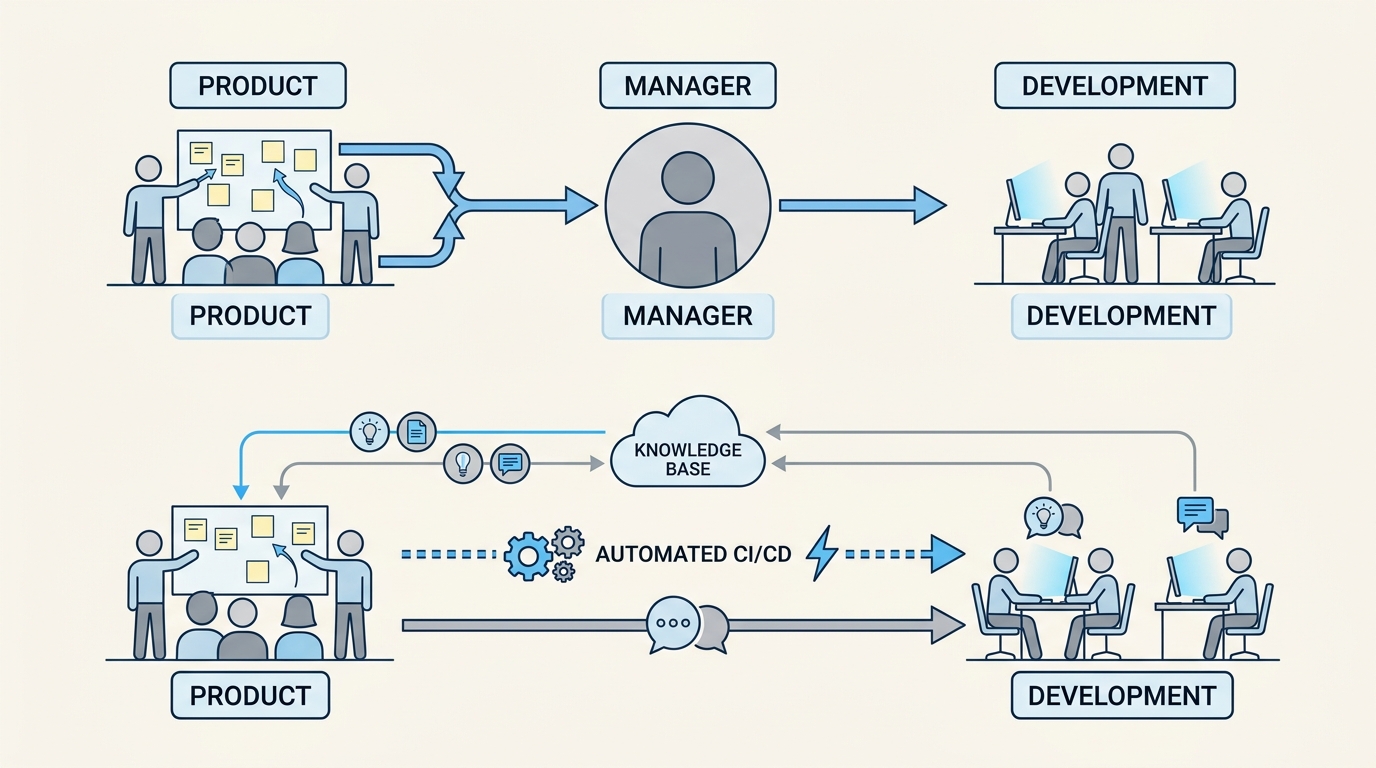
Architectural Shift: From Router to Context Provider
If engineering leaders are no longer needed to route information, what is their role? The answer lies in shifting from an information router to a context provider.
Instead of managing the flow of data, the modern engineering leader focuses on building the systems, culture, and context that enable engineers to make high-quality, autonomous decisions. This is a shift from operational control to strategic enablement.
Establishing High-Fidelity Context
As a context provider, your primary responsibility is to ensure that every engineer on your team deeply understands the "why" behind their work. This involves translating high-level business strategy, customer pain points, and market dynamics into a clear, accessible engineering context.
Instead of assigning tasks, you must define the boundaries of the problem space, establish the strategic constraints (e.g., cost, scale, time-to-market), and define what success looks like. When engineers possess high-fidelity context, they can make local architectural and product decisions that align with the organization's global goals, eliminating the need for constant managerial oversight.
Systemic Obstacle Removal
Traditional EMs unblock their teams by chasing down individuals on other teams to resolve dependencies. This is a reactive, short-term fix. A context-driven leader addresses blockers systemically.
If your team is constantly blocked by a slow security review process, you do not simply beg the security team to hurry up. Instead, you work with security leadership to build self-service automated security scanning into the CI/CD pipeline, shifting security left and eliminating the dependency entirely. You design systems, APIs, and organizational boundaries that minimize the need for human-to-human coordination in the first place.
Cultivating High-Agency Talent
In a flat, autonomous team, the caliber of your talent is your primary constraint. The modern engineering leader must transition from a task manager to a talent accelerator. This means focusing on coaching, mentoring, and career development.
Your goal is to build high-agency engineers who are comfortable navigating ambiguity, communicating directly with stakeholders, and taking extreme ownership of their systems. You achieve this not by micromanaging their daily tasks, but by providing constructive feedback, exposing them to business-level challenges, and holding them accountable to high standards of technical excellence.
Operationalizing the Transition: Frameworks and Metrics
To successfully transition your organization away from the information router model, you must implement concrete frameworks that institutionalize asynchronous communication, automate status tracking, and redefine how engineering leadership performance is measured.
The Asynchronous, Document-First Framework
To eliminate the meeting-heavy routing culture, you must establish a document-first operating model. Every major technical decision, product requirement, and architectural change must be initiated and debated asynchronously via written documents before any synchronous meeting is scheduled.
I recommend adopting a strict RFC (Request for Comments) process for technical designs and an ADR (Architecture Decision Record) framework for documenting architectural choices. This ensures that the context behind decisions is permanently captured, searchable, and accessible to anyone in the organization, bypassing the need for a human to explain the history of a system.
To make this concrete, here is a Python-based automation script that I have used to automate the collection of engineering context from GitHub pull requests. This script parses recent PRs, extracts key architectural changes, and generates a structured markdown report. This automates the context-gathering process that EMs historically performed manually through status meetings:
import os
import requests
from datetime import datetime, timedelta

def generate_engineering_context(repo_owner, repo_name, github_token, days_back=7):
    """
    Automates the aggregation of engineering context by parsing recent PRs.
    Eliminates manual status collection by extracting architectural changes directly from Git metadata.
    """
    headers = {
        "Authorization": f"token {github_token}",
        "Accept": "application/vnd.github.v3+json"
    }

    # Calculate the date threshold
    since_date = (datetime.now() - timedelta(days=days_back)).isoformat()
    url = f"https://api.github.com/repos/{repo_owner}/{repo_name}/pulls"
    params = {
        "state": "closed",
        "sort": "updated",
        "direction": "desc",
        "per_page": 100
    }

    response = requests.get(url, headers=headers, params=params)
    if response.status_code != 200:
        raise Exception(f"GitHub API error: {response.status_code} - {response.text}")

    pull_requests = response.json()
    context_report = []

    context_report.append(f"# Weekly Engineering Context Report: {repo_name.upper()}")
    context_report.append(f"Generated on: {datetime.now().strftime('%Y-%m-%d')} | Lookback: {days_back} days\n")
    context_report.append("## Key Architectural & System Changes\n")

    changes_found = False
    for pr in pull_requests:
        # Only process PRs merged within our lookback window
        if not pr.get("merged_at"):
            continue

        merged_at = datetime.strptime(pr["merged_at"], "%Y-%m-%dT%H:%M:%SZ")
        if merged_at < (datetime.now() - timedelta(days=days_back)):
            continue

        title = pr["title"]
        body = pr["body"] or ""
        author = pr["user"]["login"]
        pr_url = pr["html_url"]

        # Look for indicators of high-impact or architectural changes
        indicators = ["architectur", "breaking", "migration", "schema", "api", "performance"]
        is_significant = any(ind in title.lower() or ind in body.lower() for ind in indicators)

        if is_significant:
            changes_found = True
            context_report.append(f"### [{title}]({pr_url})")
            context_report.append(f"- **Author:** {author}")
            context_report.append(f"- **Merged:** {merged_at.strftime('%Y-%m-%d %H:%M')}")

            # Extract a brief summary of the change from the PR body
            summary_lines = [line.strip() for line in body.split('\n') if line.strip()][:3]
            summary = " ".join(summary_lines) if summary_lines else "No description provided."
            context_report.append(f"- **Context Summary:** {summary[:200]}...\n")

    if not changes_found:
        context_report.append("*No major architectural changes detected in this period.*\n")

    return "\n".join(context_report)

# Example usage (configured via environment variables)
if __name__ == "__main__":
    token = os.getenv("GITHUB_TOKEN", "mock_token_for_validation")
    owner = os.getenv("REPO_OWNER", "acme-corp")
    repo = os.getenv("REPO_NAME", "payment-gateway")

    try:
        # In production, this output is piped directly to an internal wiki or engineering portal
        report = generate_engineering_context(owner, repo, token)
        print(report[:1000]) # Print first 1000 characters for validation
    except Exception as e:
        print(f"Execution skipped or failed: {e}")
By deploying automation like the script above, you shift the burden of context aggregation from human labor to software. This frees your engineering leaders to focus on systemic improvements rather than administrative tracking.
Redefining Engineering Leadership Metrics
To successfully transition away from the information router model, you must change how you measure the success of your engineering managers. If you continue to evaluate them based on "delivery predictability" or "ticket throughput," they will naturally default to micromanagement and information routing to protect those metrics.
Instead, I recommend evaluating engineering leaders on metrics that reflect organizational health, systemic enablement, and talent leverage. The following checklist outlines the key operational shifts you must drive to transition your leadership team:
| Dimension | The Outdated Information Router | The Modern Context-Driven Catalyst |
|---|---|---|
| Primary Metric | Ticket velocity, sprint burndown, and schedule adherence. | Team cycle time, deployment frequency, and developer retention. |
| Communication Style | Synchronous, meeting-heavy, oral-first, and highly siloed. | Asynchronous, document-first, transparent, and public by default. |
| Problem Solving | Reactive; chasing down individuals to manually resolve dependencies. | Systemic; designing self-service platforms and clean team boundaries. |
| Technical Engagement | Assigning tasks, reviewing daily code, and dictating implementation. | Setting architectural guardrails, reviewing RFCs, and defining SLOs. |
| Talent Development | Task allocation based on current skills; limited career coaching. | Intentional stretch assignments, continuous feedback, and high-agency coaching. |
| Business Alignment | Translating product requirements into isolated Jira tasks. | Ensuring the team understands the business strategy, metrics, and customer pain points. |
Implementing the Transition: A Step-by-Step Guide
If you are currently leading an organization dominated by information routers, you cannot change the culture overnight. You must approach this transition systematically.
- Audit the Meeting Load: Begin by auditing your engineering managers' calendars. Any meeting that is purely dedicated to status reporting (e.g., "weekly syncs," "project status reviews") must be eliminated. Replace them with automated Slack updates, shared dashboards, or asynchronous status documents.
- Enforce Document-First RFCs: Mandate that no new major feature or architectural change can be developed without an RFC. The RFC must be shared publicly across the engineering organization, and feedback must be gathered asynchronously over a set period (e.g., 72 hours). This democratizes context and breaks down information silos.
- Train Managers in Systems Thinking: Most EMs act as routers because they do not know how to operate otherwise. Provide training on systems thinking, Team Topologies, and modern developer platform dynamics. Teach them how to identify systemic bottlenecks rather than treating individual symptoms.
- Empower Engineers to Speak Directly to the Business: Break the buffer. Invite engineers to product discovery sessions, customer interviews, and business reviews. Let them hear the customer's pain directly. When the engineer understands the customer, the manager no longer needs to translate the requirements.
Summary
The decline of the information router is not a threat to the engineering management profession; it is an evolution. By stripping away the administrative overhead of manual tracking, status reporting, and dependency negotiation, we free engineering leaders to do what they were always meant to do: build high-performing systems, cultivate exceptional talent, and align technical execution with business strategy.
As you look at your own engineering organization, ask yourself: If your managers stopped routing information tomorrow, would your teams continue to deliver value? If the answer is no, then your organization is built on a fragile foundation of human relays.
My recommendation is to begin dismantling this model immediately. Automate your status tracking, enforce an asynchronous, document-first culture, and challenge your engineering leaders to step out of the routing loop and into the role of strategic context providers. The result will be a faster, more resilient, and significantly higher-agency engineering organization.