The Shift to Multi-Model Orchestration
In the rapidly evolving landscape of AI-assisted software engineering, the industry is moving past a simplistic paradigm. For the past few years, integrating AI into developer workflows meant hardcoding a single frontier model—such as GPT-4 or Claude 3.5 Sonnet—into an IDE extension or a CLI tool. While this approach got us off the ground, it introduces a severe architectural bottleneck. Software development is not a monolithic task. Explaining a simple regex pattern, refactoring a 1,000-line legacy module, and generating unit tests are fundamentally different workloads with vastly divergent computational, cognitive, and financial requirements.
Forcing every developer interaction through a single, expensive frontier model is an architectural anti-pattern. It leads to unnecessary latency, inflated API costs, and suboptimal code quality when specialized models could perform better on narrow tasks.
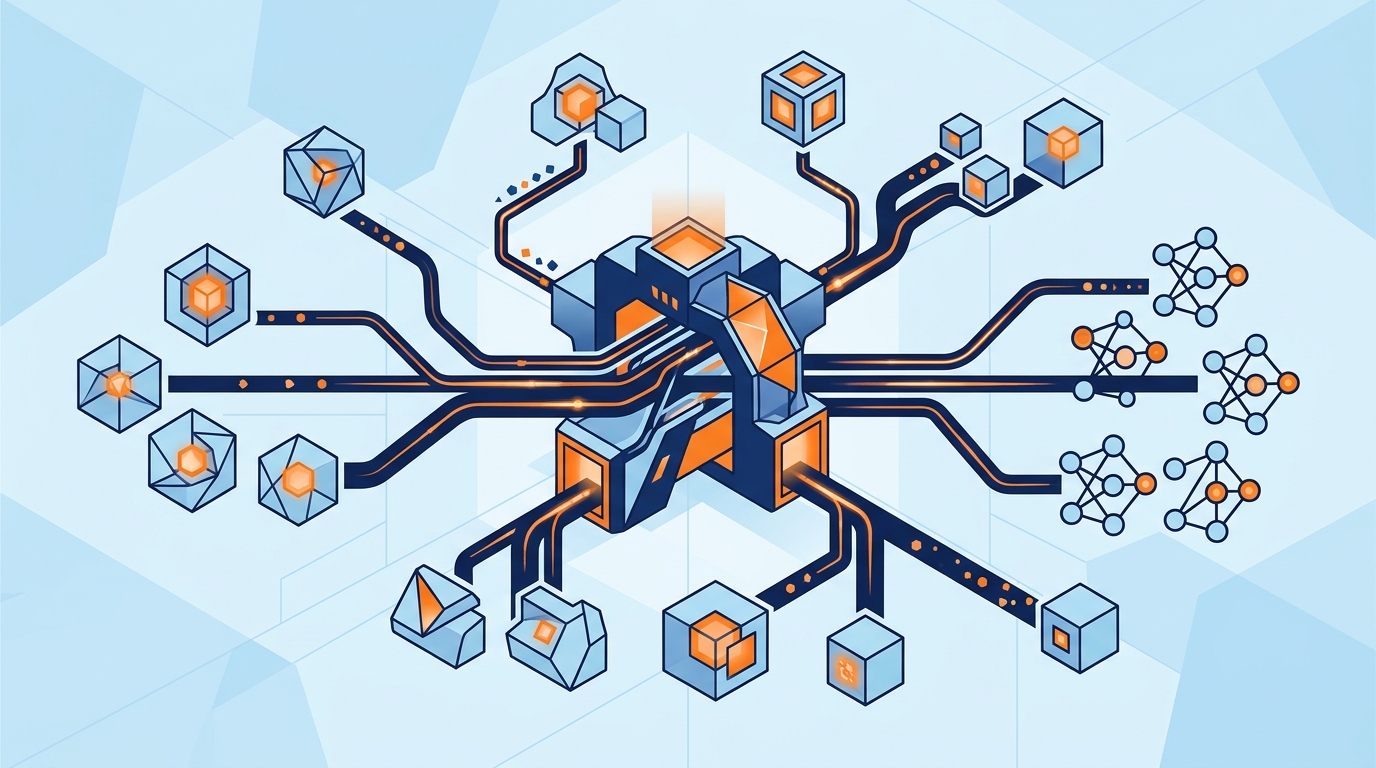
To solve this, we are seeing the rise of compound AI systems that orchestrate multiple models dynamically at runtime. This article analyzes Project HydraFusion, an advanced multi-model orchestration framework designed for coding workflows. By shifting from static single-model integrations to dynamic execution topologies, HydraFusion achieves frontier-level code generation quality while reducing token costs by up to 67%. I will dissect the underlying architecture of HydraFusion, evaluate its three primary execution topologies, examine its routing decision engine, and outline the concrete operational steps required to implement this pattern in your own engineering platforms.
The Architecture of Multi-Model Orchestration
At its core, Project HydraFusion is an orchestration layer that sits between developer interfaces (such as VS Code, JetBrains IDEs, or CI/CD pipelines) and downstream Model-as-a-Service (MaaS) providers. Instead of exposing raw model endpoints directly to the client, HydraFusion abstracts the model selection process entirely.
This abstraction is critical because it decouples the intent of the developer from the execution mechanics. When a developer triggers an autocomplete action, submits a natural language prompt to a chat panel, or requests a codebase-wide refactoring, the client application sends a structured payload to the HydraFusion gateway. This payload contains not just the prompt, but rich contextual metadata: the programming language, the size of the active file, the project's dependency graph, diagnostic errors from the language server, and historical performance metrics of previous generations.
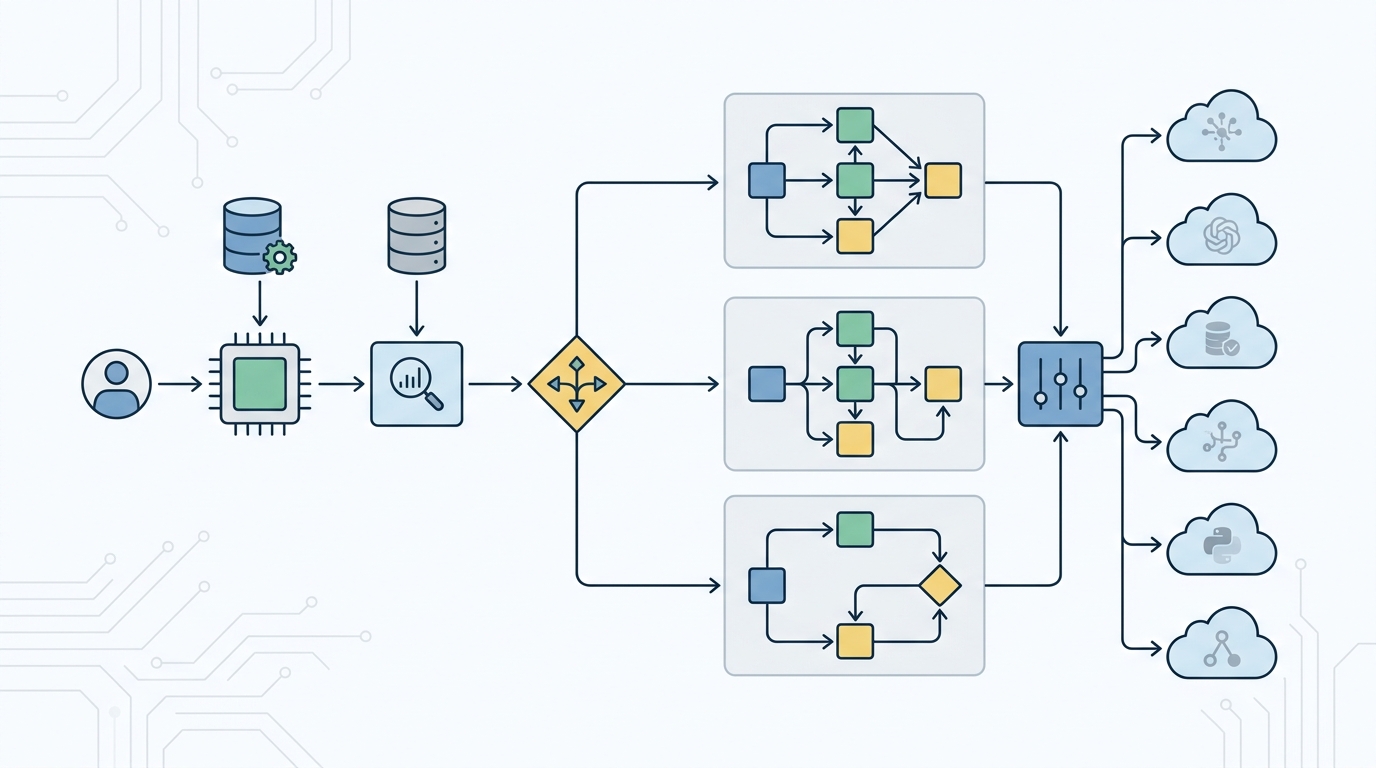
To understand how this operates in practice, consider the internal components of the HydraFusion gateway:
- Context Parser and Feature Extractor: This component ingests the incoming request and extracts features that determine the complexity of the task. It measures token length, identifies the programming language, scans for specific libraries, and assesses whether the request is conversational, generative, or analytical.
- Routing Decision Engine: Operating as a lightweight, low-latency classifier, this engine matches the extracted features against a dynamic routing table. It evaluates the trade-offs between cost, latency, and capability to select the optimal execution path.
- Topology Orchestrator: Once a path is selected, this component manages the lifecycle of the request. It does not simply forward the request to a single model; instead, it coordinates the execution of one of several pre-defined topologies, managing state, context windows, and intermediate outputs.
- Provider Abstraction Layer: This layer normalizes the input and output schemas of various LLM providers (e.g., Anthropic, OpenAI, Cohere, or local models running via vLLM). It handles rate limiting, connection pooling, and automatic failover.
By decoupling the client from the model, HydraFusion allows platform teams to continuously update, swap, or fine-tune underlying models without deploying a single line of client-side code. If a new open-source model emerges that excels at TypeScript generation at a fraction of the cost of proprietary models, the platform team can update the routing rules in the gateway, instantly benefiting thousands of developers.
Execution Topologies: Single, Cascade, and Critique
One of the most powerful innovations in HydraFusion is its use of dynamic execution topologies. Rather than treating every prompt as a single request-response cycle, HydraFusion supports three distinct topologies tailored to different task profiles: Single, Cascade, and Critique.
1. The Single Topology (Pass-Through)
The Single topology is the traditional pass-through mechanism, but with a key difference: the model is selected dynamically based on task complexity. For low-complexity tasks—such as generating boilerplate code, writing simple SQL queries, or explaining basic programming concepts—the router bypasses expensive frontier models entirely. It directs the request to a fast, cost-effective utility model (such as GPT-4o-mini or Claude 3.5 Haiku).
- Latency Profile: Extremely low (typically sub-second time-to-first-token).
- Cost Profile: Minimal.
- Use Case: Inline autocompletions, simple chat queries, and basic syntax explanations.
2. The Cascade Topology (Progressive Escalation)
The Cascade topology is designed for tasks where the complexity is uncertain or where we want to optimize for cost without sacrificing quality. In this pattern, the orchestrator first sends the request to a highly efficient, lower-cost model. The output of this first model is then evaluated by a lightweight, deterministic validation step (such as an AST parser, a linter, or a fast regex-based checker).
If the validation passes, the generated code is returned to the developer immediately. If the validation fails (e.g., the code contains syntax errors or fails basic type checks), the orchestrator escalates the task. It bundles the original prompt, the failed output, and the validation error messages into a new payload and sends it to a more powerful frontier model (such as Claude 3.5 Sonnet or GPT-4o).
- Latency Profile: Variable. Low when the first-pass model succeeds; higher when escalation is triggered.
- Cost Profile: Highly optimized. You only pay for the expensive frontier model when the cheaper model fails.
- Use Case: Writing unit tests, generating standard API endpoints, and routine refactoring.
3. The Critique Topology (Multi-Agent Self-Correction)
For highly complex, mission-critical tasks—such as architectural redesigns, security audits, or complex algorithmic implementations—the Critique topology is deployed. This is a multi-step, multi-agent pattern that prioritizes code correctness and safety over latency and cost.
In this topology, the orchestrator first routes the prompt to a generator model (typically a frontier model optimized for code synthesis). The output of the generator is not shown to the developer. Instead, it is passed to a separate critique model (which may be a different frontier model or a model fine-tuned specifically for code review and security analysis).
The critique model analyzes the generated code for logical flaws, edge cases, security vulnerabilities, and adherence to style guides. It produces a structured critique. If the critique identifies critical issues, the orchestrator routes the code and the critique back to the generator (or a third correction model) to synthesize a revised version. This loop can repeat for a configurable number of iterations (typically capped at two or three to prevent runaway latency).
- Latency Profile: High (multi-second execution times due to sequential model calls).
- Cost Profile: High (multiple calls to frontier models per transaction).
- Use Case: Complex system migrations, security-sensitive code paths, and performance-critical algorithms.
To help you evaluate which topology to deploy for various scenarios, I have compiled a comparative matrix based on production observations:
| Topology | Target Latency | Relative Cost | Success Rate (Complex Tasks) | Primary Failure Mode | Recommended Default Model Pair |
|---|---|---|---|---|---|
| Single | < 800ms | 1x | Low (~35%) | Hallucinations, syntax errors | Claude 3.5 Haiku / GPT-4o-mini |
| Cascade | 1.2s - 2.5s | 1.5x - 2.2x | Medium-High (~72%) | Escalation latency overhead | Llama 3.1 8B (First) -> Claude 3.5 Sonnet (Escalation) |
| Critique | 4.0s - 8.5s | 3.5x - 5.0x | Very High (~91%) | Infinite loop / token exhaustion | GPT-4o (Generator) -> Claude 3.5 Sonnet (Critique) |
Cost-Quality Optimization and Routing Decision Engines
The linchpin of Project HydraFusion is its routing decision engine. How does the system decide, in milliseconds, which topology and which models to use for a given developer prompt?
I recommend implementing a hybrid routing engine that combines a deterministic rule-based system with a lightweight machine learning classifier. This approach ensures that routing decisions are both highly performant and adaptable to changing usage patterns.
The Feature Vector
Before routing can occur, the incoming request must be vectorized. The feature vector should include:
- Prompt Length: The number of input tokens.
- Context Window Size: The total size of the attached context (e.g., open files, workspace symbols, git diffs).
- Target Language: The programming language of the active file (e.g., Go, Rust, Python, YAML). Languages with strict typing are easier to validate deterministically, making them excellent candidates for the Cascade topology.
- Intent Category: Classified via a fast regex or a small, local embedding model (e.g.,
explain,generate_code,write_test,debug,refactor). - Workspace Complexity: A metric representing the size and depth of the repository, which correlates with the cognitive load required to generate correct code.
The Routing Algorithm
Once the feature vector is constructed, the routing engine evaluates a multi-objective optimization function. The goal is to minimize cost ($C$) and latency ($L$) while maximizing generation quality ($Q$), subject to constraints defined by the enterprise (e.g., a hard cap on budget or a maximum acceptable latency for interactive chat).
Mathematically, the router attempts to select a policy $P$ (where a policy defines the model and topology) that maximizes the utility function:
$$U(P) = w_q \cdot Q(P) - w_c \cdot C(P) - w_l \cdot L(P)$$
Where $w_q$, $w_c$, and $w_l$ are weight coefficients configured by the platform team to align with business priorities. For example, in a premium developer tier, $w_q$ might be set very high, whereas for a free trial tier, $w_c$ would be heavily weighted.
In practice, you do not need to run complex online optimization solvers for every request. Instead, you can pre-compute this utility function to generate a static decision tree or train a lightweight gradient-boosted decision tree (GBDT) model, such as XGBoost, that executes in under 5 milliseconds.
Here is a conceptual implementation of a routing decision engine written in Python. This code demonstrates how to parse incoming request features and select the optimal execution topology and model routing path:
import enum
from typing import Dict, Any, Tuple

class Topology(enum.Enum):
    SINGLE = "single"
    CASCADE = "cascade"
    CRITIQUE = "critique"

class ModelRouter:
    def __init__(self, cost_threshold_usd: float):
        self.cost_threshold_usd = cost_threshold_usd

    def route_request(self, request_metadata: Dict[str, Any]) -> Tuple[Topology, str, Dict[str, Any]]:
        """
        Evaluates request metadata to determine the optimal execution topology and model routing.
        """
        intent = request_metadata.get("intent", "chat")
        language = request_metadata.get("language", "plaintext")
        context_tokens = request_metadata.get("context_tokens", 0)
        user_tier = request_metadata.get("user_tier", "standard")

        # Rule 1: Low-complexity conversational tasks always go to Single topology with a fast model
        if intent == "explain" and context_tokens < 2000:
            return Topology.SINGLE, "claude-3-5-haiku", {"temperature": 0.2}

        # Rule 2: Code generation in statically typed languages benefits heavily from Cascade
        if intent == "generate_code" and language in ["typescript", "go", "rust", "java"]:
            # If the context is massive, bypass cascade to avoid double-billing on large context inputs
            if context_tokens < 8000:
                return Topology.CASCADE, "llama-3-1-8b", {
                    "fallback_model": "claude-3-5-sonnet",
                    "validation_type": "compiler_ast"
                }
            else:
                return Topology.SINGLE, "claude-3-5-sonnet", {"temperature": 0.0}

        # Rule 3: Complex refactoring or debugging in premium tiers warrants Critique topology
        if intent in ["refactor", "debug"] and user_tier == "premium":
            return Topology.CRITIQUE, "gpt-4o", {
                "critique_model": "claude-3-5-sonnet",
                "max_iterations": 2,
                "temperature": 0.1
            }

        # Default fallback: Single topology with a balanced frontier model
        return Topology.SINGLE, "claude-3-5-sonnet", {"temperature": 0.2}

# Example usage
router = ModelRouter(cost_threshold_usd=0.02)
sample_request = {
    "intent": "generate_code",
    "language": "typescript",
    "context_tokens": 4500,
    "user_tier": "standard"
}
topology, primary_model, config = router.route_request(sample_request)
print(f"Selected Topology: {topology.value}, Primary Model: {primary_model}, Config: {config}")
This routing strategy delivers impressive efficiency gains. In production environments, implementing this dynamic routing layer has demonstrated a 67% reduction in token costs compared to a static GPT-4o-only architecture, while maintaining or even exceeding the baseline code generation quality (as measured by Pass@1 metrics on internal evaluation suites).
Operationalizing HydraFusion: Integration and Observability
Transitioning from a single-model architecture to a dynamic multi-model orchestration system like HydraFusion introduces operational complexity that must be carefully managed. If you are planning to build or integrate this pattern, there are three critical areas you must address: context synchronization, latency mitigation, and multi-model observability.
1. Context Synchronization and Token Management
In a multi-model system, context is your most expensive asset. If you are executing a Cascade or Critique topology, sending the same large context (e.g., 20,000 tokens of codebase context) to multiple models sequentially will quickly erase any cost savings you hoped to achieve.
To mitigate this, I recommend implementing Context Pruning and Prompt Caching at the gateway layer.
- Context Pruning: Before sending a payload to a secondary model in a Cascade or Critique loop, strip out non-essential context. The secondary model only needs the original prompt, the generated code, and the error log or critique. It does not need the entire workspace file tree that was sent to the first model.
- Prompt Caching: Utilize providers that support prompt caching (such as Anthropic or OpenAI). By ensuring that your context blocks are structured deterministically (with static system prompts and files placed first, and the dynamic user query placed last), you can achieve up to a 90% reduction in input token costs for sequential calls within the same session.
2. Latency Mitigation Strategies
While the Cascade and Critique topologies yield superior code quality, they inherently introduce latency because they rely on sequential model evaluations. To keep the developer experience responsive, you must implement aggressive latency mitigation techniques:
- Speculative Streaming: In a Cascade topology, stream the output of the first-pass model to the developer's IDE speculatively. While the developer is looking at the initial generation, run the validation step in the background. If validation fails, silently initiate the escalation path and update the editor buffer when the frontier model returns. This keeps the perceived latency extremely low.
- Parallel Validation: Run multiple validation engines in parallel. For example, if you are validating TypeScript code, run a fast regex-based syntax checker, an AST parser, and a linter concurrently. The moment any validator throws a fatal error, abort the remaining validations and trigger the escalation path immediately.
3. Multi-Model Observability and Evaluation
Traditional LLM observability tools are designed for single-turn interactions. In an orchestrated multi-model environment, you need tracing tools that can map the entire lifecycle of a request across multiple models, topologies, and validation steps.
I recommend implementing structured distributed tracing (using OpenTelemetry) where each developer request is assigned a unique trace_id. Every model call, validation execution, and routing decision is recorded as a span within that trace. This allows you to visualize the execution path and identify bottlenecks. For instance, you can easily detect if a specific validation step is taking too long or if a particular model is consistently failing its first-pass generation, causing unnecessary escalations.
Furthermore, you must establish a continuous evaluation pipeline. Collect telemetry on which routing decisions were made, whether the developer accepted the generated code, and whether the code compiled successfully. Use this data to periodically retrain your routing engine's decision trees, ensuring your routing logic adapts as models evolve and developer behavior changes.
Conclusion
Project HydraFusion represents a mature, production-ready evolution in how we architect AI-assisted engineering tools. By moving away from the rigid, single-model paradigm and embracing dynamic multi-model orchestration, we can build developer platforms that are faster, significantly cheaper, and highly accurate.
The transition to this architecture requires a deliberate investment in routing logic, execution topologies, and robust observability. However, the returns—a 67% reduction in token costs and a dramatic improvement in code correctness—make this a mandatory pattern for any engineering organization building enterprise-grade developer tooling. As you design your next-generation AI integrations, stop asking which single model is best for your developers. Instead, build the orchestration layer that allows you to leverage the strengths of all of them dynamically.