
The software development lifecycle (SDLC) is undergoing its most profound structural shift since the adoption of continuous integration and continuous deployment (CI/CD). We have rapidly moved past the era of simple AI autocomplete tools—the inline assistants that suggest the next line of code—and entered the era of autonomous software engineering agents. These agents do not merely suggest code; they ingest entire codebases, reason about system architecture, execute local test suites, self-correct based on compiler errors, and submit comprehensive pull requests.
This transition presents engineering leaders with a stark paradox. On one hand, the theoretical lead time for writing a feature or fixing a bug has collapsed from days to minutes. On the other hand, the cognitive load on human engineers has shifted from writing code to reviewing, validating, and orchestrating it. If your engineering organization continues to measure success using traditional SDLC telemetry, you are likely flying blind. An explosion of agent-generated pull requests can easily overwhelm your human code review pipelines, degrade system quality, and inflate your cloud compute costs without delivering real, metric-driven business value.
In my work analyzing engineering organizations, I have seen that the key to unlocking the ROI of agentic software engineering lies not in the raw volume of code generated, but in the systematic modernization of your SDLC telemetry and governance. I recommend designing frameworks that balance the unprecedented velocity of AI agents with rigorous, automated quality control. This analysis outlines how to adapt your telemetry, design automated guardrails, and build a balanced, hybrid human-agent engineering pipeline.
The Shift from Copilots to Autonomous Agents
To manage this transition, you must first understand the architectural difference between assistive AI (Copilots) and autonomous AI (Agents). Assistive AI is synchronous, stateless, and human-driven. The developer remains the primary execution engine, using the AI as an interactive reference tool. The human writes the code, runs the tests, and manages the git lifecycle.
In contrast, autonomous agents are asynchronous, stateful, and tool-using. An agent is given a goal in natural language—such as "Resolve issue #402: Fix memory leak in the connection pool"—and is granted access to a sandboxed environment containing the repository, a compiler, a test runner, and external documentation. The agent operates in an iterative loop: it analyzes the codebase, formulates a plan, modifies the files, runs the tests, inspects the errors, and refines its approach until the goal is met.
This shift introduces entirely new failure modes that traditional static analysis and testing pipelines are not equipped to handle:
- Infinite Loop Regressions: An agent can get trapped in an iterative loop, repeatedly modifying code, running tests, and failing in a way that consumes massive amounts of LLM tokens and CI/CD compute without making progress.
- Hallucinated Dependency Injection: Agents may attempt to resolve a complex programming challenge by importing external, non-existent, or malicious libraries, introducing severe supply-chain security risks.
- Architectural Drift: Because agents optimize for the immediate task at hand, they can easily introduce localized fixes that violate broader, unwritten architectural patterns or design principles of your system.
To mitigate these risks, you cannot rely on manual post-hoc reviews. You must embed agent-aware telemetry and guardrails directly into your version control and CI/CD systems.
Redefining SDLC Telemetry for Hybrid Engineering Teams
Traditional engineering metrics, such as the classic DORA (DevOps Research and Assessment) metrics, assume that human effort is the primary constraint. In a hybrid team where humans and agents work side-by-side, these metrics can become highly distorted. For example, your "Lead Time for Changes" might appear to drop dramatically because agents generate code instantly, but your "Change Failure Rate" and "Time to Restore Service" may spike if that code is merged without adequate validation.
To measure the true efficiency and quality of a hybrid engineering organization, I recommend tracking a new set of telemetry metrics designed specifically for the agent era. These metrics focus on the interaction between human reviewers and agentic contributors.
| Metric Name | Formula / Definition | Operational Target | What It Measures |
|---|---|---|---|
| Agent Acceptance Rate (AAR) | (Merged Agent PRs / Total Agent PRs Created) * 100 |
> 75% | The accuracy and alignment of the agent's output with your codebase standards. |
| Review Friction Index (RFI) | Human Review Time (hours) / Agent Execution Time (hours) |
< 1.5 | The bottleneck created by human validation. A high RFI indicates humans are drowning in code review. |
| Token-to-Feature Efficiency | Total LLM Token Cost / Number of Merged Features |
Trend downward over time | The financial efficiency of your agentic workflows relative to output. |
| Agent Regression Rate (ARR) | (Agent-introduced Bugs / Total Agent PRs Merged) * 100 |
< 2% | The long-term quality and stability of agent-generated contributions. |
By instrumenting your pipelines to capture these metrics, you can identify exactly where the friction lies. If your Agent Acceptance Rate is low, your agents lack sufficient context or are using the wrong models. If your Review Friction Index is extremely high, your human engineers are spending too much time parsing complex, agent-generated diffs, indicating a need for better automated pre-review filters.
Designing a Dual-Gate Governance Framework
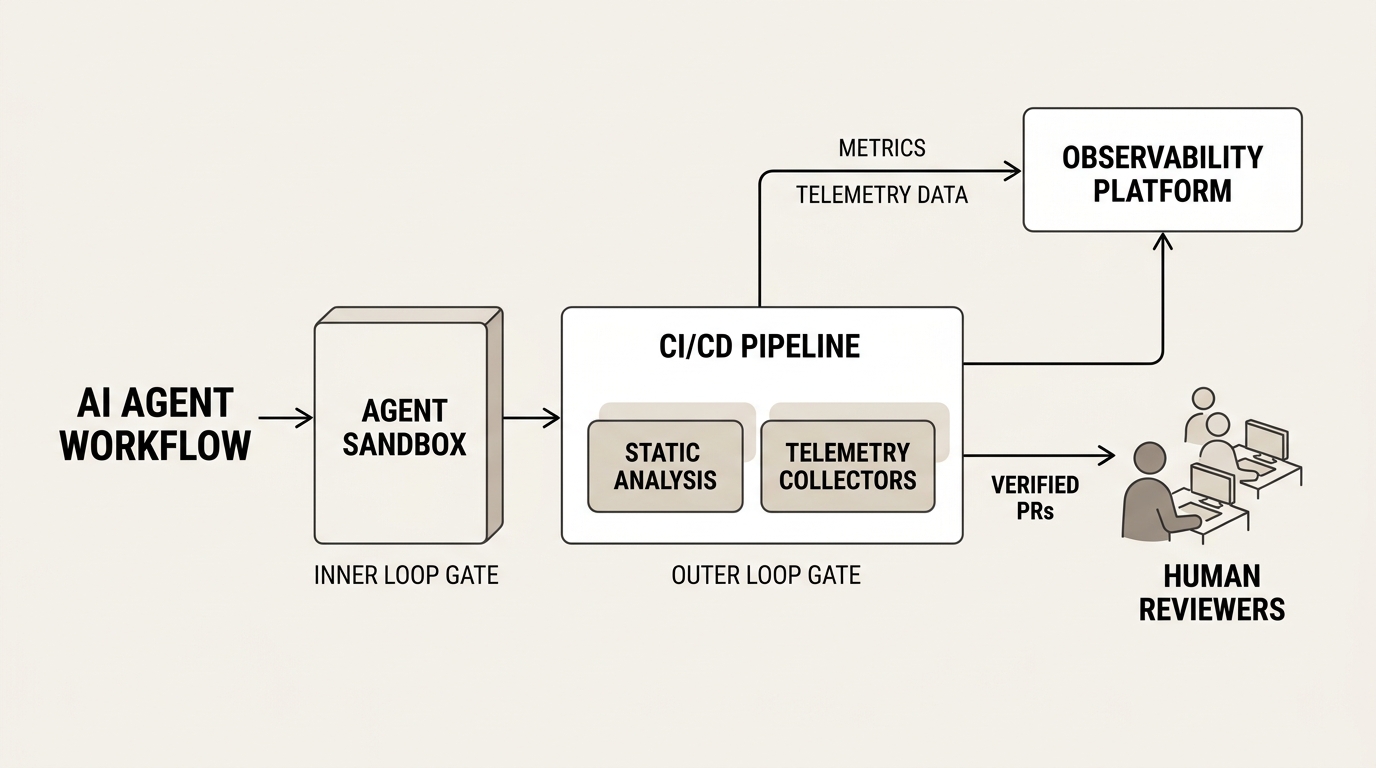
To safely scale agentic contributions, I recommend implementing a Dual-Gate Governance Framework. This framework splits quality control into two distinct phases: the Inner Loop Gate (which runs within the agent's sandboxed execution environment) and the Outer Loop Gate (which runs within your central CI/CD and version control systems).
1. The Inner Loop Gate: Sandboxed Validation
You must never allow an agent to commit code directly to a shared branch without isolated validation. The agent must operate within a secure, ephemeral container (such as a gVisor sandbox or a Firecracker microVM) where it can execute its code and run tests without risking your internal network or infrastructure.
The Inner Loop Gate must enforce:
- Strict Network Egress Policies: Prevent the agent from making arbitrary outbound internet calls, which protects against data exfiltration and unauthorized dependency downloads.
- Resource Quotas: Limit the CPU, memory, and execution time of the agent's sandbox to prevent run-away loops or denial-of-service scenarios on your build runners.
- Self-Correction Cycles: Allow the agent a finite number of test-and-correct iterations (e.g., a maximum of 5 attempts) before terminating the task and reporting a failure.
2. The Outer Loop Gate: Automated Policy-as-Code
Once the agent successfully passes its internal tests and submits a pull request, the Outer Loop Gate takes over. This gate is managed by your central CI/CD platform and enforces organizational policies before any human ever looks at the code.
This gate should run automated static application security testing (SAST), software composition analysis (SCA) to verify dependencies, and structural AST (Abstract Syntax Tree) diffing to ensure the agent has not introduced architectural anomalies. Crucially, the Outer Loop Gate must automatically tag the PR with metadata indicating which agent generated it, the token cost incurred, and the specific files modified.
Implementation: A Telemetry and Gatekeeping Architecture
To make this concrete, let us look at how you can implement an automated telemetry collector and gatekeeper within a modern CI/CD workflow. The following Python script demonstrates how to parse a pull request submitted by an AI agent, evaluate it against safety and quality rules, calculate key telemetry metrics, and output the data to your observability backend.
import os
import sys
import json
import subprocess

class AgentPRGatekeeper:
    def __init__(self, pr_metadata_path):
        with open(pr_metadata_path, 'r') as f:
            self.metadata = json.load(f)
        self.agent_id = self.metadata.get("agent_id")
        self.token_cost = self.metadata.get("token_cost", 0)
        self.execution_time_sec = self.metadata.get("execution_time_sec", 0)
        self.changed_files = self.metadata.get("changed_files", [])

    def verify_dependency_safety(self) -> bool:
        for file in self.changed_files:
            if "package.json" in file or "requirements.txt" in file:
                print(f"[INFO] Scanning dependencies in {file}...")
                # In a real pipeline, invoke tools like npm audit or pip-audit here
        return True

    def calculate_complexity_delta(self) -> float:
        try:
            # Simulate running a complexity analysis tool (e.g., Radon or Xenon)
            complexity_delta = 1.2
            return complexity_delta
        except Exception as e:
            print(f"[ERROR] Failed to calculate complexity: {e}")
            return 0.0

    def evaluate_gate(self) -> bool:
        print(f"--- Evaluating Gate for Agent: {self.agent_id} ---")

        if not self.verify_dependency_safety():
            print("[REJECT] Dependency safety check failed.")
            return False

        complexity_delta = self.calculate_complexity_delta()
        if complexity_delta > 5.0:
            print(f"[REJECT] Complexity delta too high ({complexity_delta}). Agent code is too convoluted.")
            return False

        MAX_TOKEN_BUDGET = 500000
        if self.token_cost > MAX_TOKEN_BUDGET:
            print(f"[REJECT] Token budget exceeded. Cost: {self.token_cost} tokens.")
            return False

        print("[PASS] All automated gates passed. Ready for human review.")
        return True

    def emit_telemetry(self):
        telemetry_payload = {
            "service.name": "sdlc-agent-gatekeeper",
            "metrics": {
                "agent.id": self.agent_id,
                "agent.execution_time_seconds": self.execution_time_sec,
                "agent.token_cost": self.token_cost,
                "agent.complexity_delta": self.calculate_complexity_delta(),
                "agent.files_changed_count": len(self.changed_files)
            }
        }
        print(f"[TELEMETRY] {json.dumps(telemetry_payload)}")

if __name__ == "__main__":
    if len(sys.argv) < 2:
        print("Usage: python gatekeeper.py <path_to_metadata.json>")
        sys.exit(1)

    gatekeeper = AgentPRGatekeeper(sys.argv[1])
    passed = gatekeeper.evaluate_gate()
    gatekeeper.emit_telemetry()

    if not passed:
        sys.exit(1)
    sys.exit(0)
This script serves as an automated gatekeeper. If an agent attempts to submit a pull request that exceeds your token budget, introduces complex and unmaintainable code, or fails dependency verification, the CI/CD pipeline immediately rejects the PR and alerts the agent platform to self-correct. This keeps low-quality code away from your human developers, preserving their cognitive bandwidth for high-value architectural reviews.
Actionable Next Steps
To prepare your engineering organization for the agent era, I recommend taking the following immediate actions:
- Audit your current CI/CD pipelines: Ensure you have the infrastructure to run agent-generated code in isolated, sandboxed environments with strict resource limits.
- Establish baseline telemetry: Start tracking the metrics outlined in this article, particularly your Review Friction Index and Agent Acceptance Rate, to locate bottlenecks in your human-agent collaboration loop.
- Implement automated policy-as-code gates: Deploy automated checks to block agent-generated pull requests that violate security, complexity, or budget thresholds before they reach human reviewers.
By taking these steps, you can confidently accelerate your software delivery velocity while maintaining absolute control over the quality, security, and stability of your production systems.