
Introduction
The economics of software development have fundamentally shifted. For decades, the primary constraint in software engineering was code production—the physical and cognitive speed at which human developers could translate requirements into syntax. Today, that constraint has vanished. With the rise of agentic coding assistants, multi-file code generation engines, and autonomous software agents, the rate of code production has scaled exponentially.
However, this massive influx of code has exposed a critical, systemic bottleneck: code comprehension and validation. While an AI agent can generate a 500-line pull request (PR) in under thirty seconds, a human engineer still requires thirty minutes to an hour of focused, high-context concentration to review it thoroughly. The result is a severe, industry-wide code review backlog that strains engineering organizations, degrades developer morale, and introduces subtle, systemic risks into production codebases.
In my work analyzing engineering workflows, I have observed that organizations attempting to process AI-generated PRs using traditional human-centric review pipelines quickly experience operational paralysis. The symptom is not just a longer queue of open PRs; it is a rapid decline in review quality, characterized by "rubber-stamping" (approving code without understanding it), an increase in regression rates, and a widening chasm between senior engineers who review code and junior developers or agents who generate it. To survive this shift, you must re-architect your engineering workflows. I will outline the precise technical and structural changes required to mitigate this backlog and safely govern agentic code generation at scale.
The Mechanics of the PR Deluge: The Bottleneck Shift
To understand why AI-generated PRs are breaking traditional workflows, we must examine the mathematical asymmetry of code generation versus code review. In a traditional team, a developer writes code over several hours or days, naturally limiting the volume of incoming PRs. The reviewer's cognitive load is roughly proportional to the author's development time.
When an AI agent enters the loop, this balance is destroyed. An agent can systematically identify a pattern across dozens of microservices, generate individual refactoring PRs for each, and submit them simultaneously. This creates a massive spike in cognitive load for human reviewers. The asymmetry is driven by three distinct factors:
- Context-Switching Penalties: A human reviewer must stop their own deep-work task, pull down the agent's branch, understand the intent of the changes, verify the architectural alignment, and trace the execution path. While the agent generated the code instantly, the human must reconstruct the mental model of the change from scratch.
- The Illusion of Correctness: AI-generated code is often syntactically flawless, idiomatic, and beautifully formatted. This makes it highly deceptive. It passes linters and basic syntax checks easily, yet it can contain deep logical flaws, subtle race conditions, or incorrect assumptions about state management that are invisible to a superficial glance.
- Lack of Historical Context: An AI agent lacks the institutional memory of why a specific "ugly" workaround was implemented in the codebase three years ago. When the agent refactors that section to make it more elegant, it often silently reintroduces the very bug the workaround was designed to prevent.
When your team is hit with dozens of these high-volume, highly polished PRs daily, a phenomenon I call "review fatigue" sets in. Senior engineers, who are typically the bottleneck for approvals, begin to skim code. They look at the clean formatting, see that the automated test suite passed, and click "Approve." This shifts the burden of quality assurance entirely onto your test suite and, ultimately, your production environment.
Re-architecting the CI/CD Pipeline for Agentic Code
To prevent your senior engineers from becoming full-time, exhausted code readers, you must treat AI-generated code as untrusted input. Just as you would not write a web application that accepts raw user input without sanitization, you must not allow your code repository to accept agentic PRs without automated, multi-layered validation.
I recommend implementing an automated triage and gating pipeline that runs prior to any human being notified of a PR. The goal of this pipeline is to filter out low-quality, broken, or high-risk changes, and to enrich the remaining PRs with semantic context that reduces human review time.
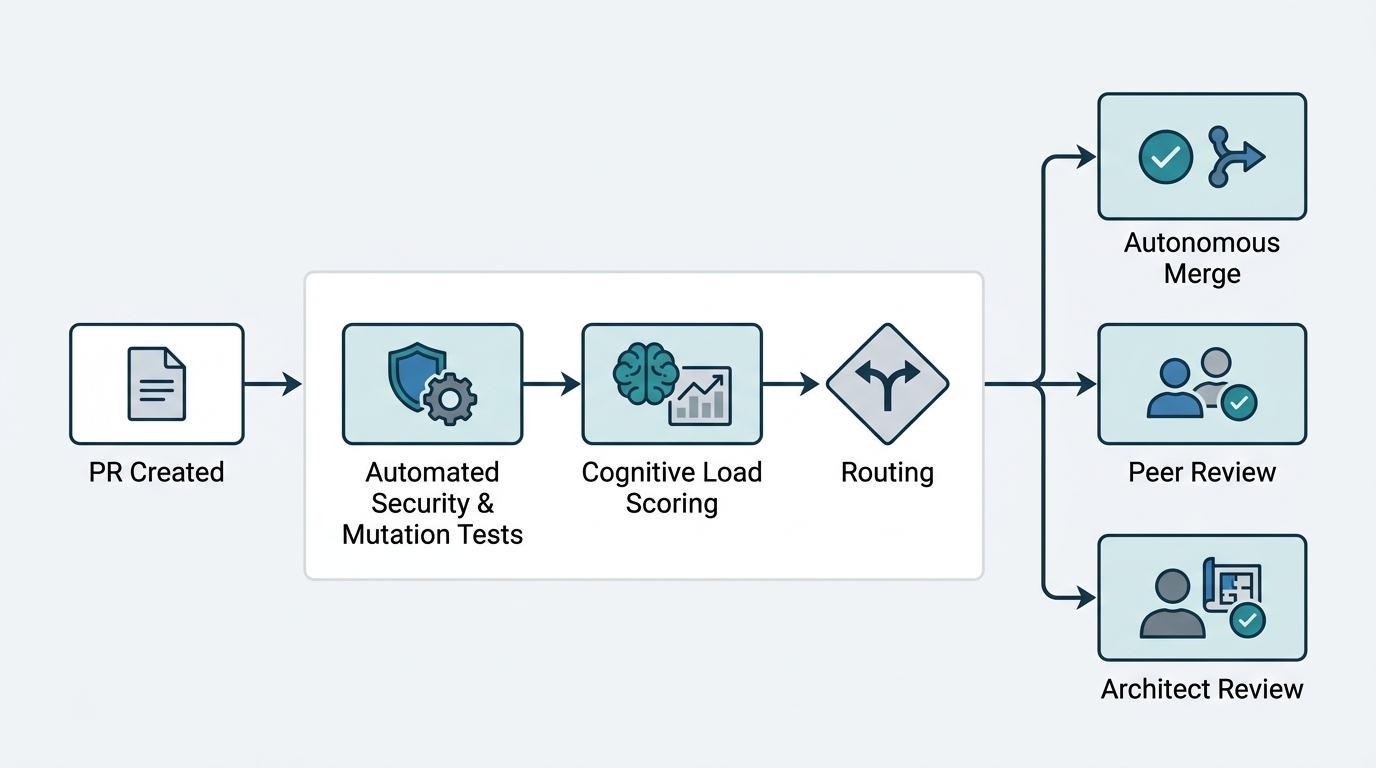
Here is a declarative example of how you can structure a validation workflow using a modern CI pipeline configuration. This workflow acts as an automated gatekeeper, calculating a "Cognitive Load Score" and running deep semantic analysis before assigning human reviewers:
name: Agentic PR Gatekeeper

on:
  pull_request:
    types: [opened, synchronize]

jobs:
  triage-and-validate:
    runs-on: ubuntu-latest
    steps:
      - name: Checkout Code
        uses: actions/checkout@v4
        with:
          fetch-depth: 0

      - name: Identify Author Type
        id: author-check
        run: |
          AUTHOR="${{ github.event.pull_request.user.login }}"
          # Check if the PR was generated by a known AI bot or agent service
          if [[ "$AUTHOR" =~ ^(copilot|coder-rabbit|swe-agent|pr-agent)\[bot\]$ ]]; then
            echo "is_agent=true" >> $GITHUB_OUTPUT
          else
            echo "is_agent=false" >> $GITHUB_OUTPUT
          fi

      - name: Run Static Application Security Testing (SAST)
        uses: securego/gosec@master
        with:
          args: ./...

      - name: Execute Mutation Testing
        run: |
          # Run mutation testing to verify the depth and quality of the test suite changes
          echo "Running mutation analysis to ensure AI-generated tests are not superficial..."
          # go-mutesting ./...

      - name: Calculate Cognitive Load Score
        id: cognitive-load
        run: |
          # Calculate churn, complexity delta, and test-to-code ratio
          CHANGED_FILES=$(git diff --name-only origin/main...HEAD | wc -l)
          COMPLEXITY_DELTA=$(git diff origin/main...HEAD | grep -E '^\+[[:space:]]*(if|for|while|switch|catch)' | wc -l)

          # If complexity delta or file count is high, flag for senior review
          if [ "$CHANGED_FILES" -gt 10 ] || [ "$COMPLEXITY_DELTA" -gt 5 ]; then
            echo "score=HIGH" >> $GITHUB_OUTPUT
          else
            echo "score=LOW" >> $GITHUB_OUTPUT
          fi

      - name: Apply Labels and Assignees
        uses: actions/github-script@v7
        with:
          script: |
            const isAgent = "${{ steps.author-check.outputs.is_agent }}" === "true";
            const loadScore = "${{ steps.cognitive-load.outputs.score }}";

            if (isAgent) {
              github.rest.issues.addLabels({
                owner: context.repo.owner,
                repo: context.repo.repo,
                issue_number: context.issue.number,
                labels: ['agent-generated', `cognitive-load:${loadScore}`]
              });
            }

            if (loadScore === 'HIGH') {
              // Route to senior architect rotation
              github.rest.issues.addAssignees({
                owner: context.repo.owner,
                repo: context.repo.repo,
                issue_number: context.issue.number,
                assignees: ['senior-architect-reviewer']
              });
            } else {
              // Route to standard peer review or auto-merge if coverage is 100%
              github.rest.issues.addLabels({
                owner: context.repo.owner,
                repo: context.repo.repo,
                issue_number: context.issue.number,
                labels: ['candidate-for-auto-merge']
              });
            }
By implementing this type of automated gating, you ensure that human reviewers are only alerted when a PR has passed security scans, has proven test coverage (not just high line coverage, but meaningful mutation-tested assertions), and has been classified by its cognitive impact. This prevents the immediate backlog of broken or trivial PRs from hitting human queues.
Tiered Code Review and Cognitive Load Scoring
To scale your engineering organization without hiring an unsustainable number of senior engineers, you must abandon the flat "two-approvals-required" policy for all PRs. Instead, I advocate for a Tiered Code Review Framework based on a calculated Cognitive Load Score (CLS).
The CLS should be computed programmatically based on the blast radius of the change, the criticality of the modified subsystem, the test coverage delta, and whether the author is an AI agent. Based on this score, the PR is routed through one of three tiers:
| Review Tier | Criteria | Required Approvals | Automated Verification Requirements |
|---|---|---|---|
| Tier 1: Autonomous Merge | Low CLS (<3), non-critical paths (e.g., internal documentation, simple UI copy, CSS, localized bug fixes with high test coverage). | Zero human approvals. | 100% pass rate on unit/integration tests; linting and security scans pass; regression tests pass. |
| Tier 2: Peer Review | Medium CLS (3-7), standard feature development, minor refactoring, API additions. | One human peer reviewer. | All Tier 1 checks + automated API schema validation (e.g., OpenAPI/Protobuf compliance check). |
| Tier 3: Multi-Expert Architecture Review | High CLS (>7), changes to core state machine, database migrations, security-sensitive paths, or high-volume agentic refactoring. | Two senior engineers or software architects. | All Tier 2 checks + manual architectural review + verification of performance/load testing in a staging environment. |
This tiered approach directly addresses the bottleneck by offloading low-risk, agent-generated code to automated merging. If an AI agent updates a dependency version and all integration tests pass, there is rarely a compelling reason for a human to spend ten minutes reviewing the package lockfile. Conversely, if an agent attempts to rewrite a database transaction block, the system flags it as Tier 3, alerting the exact domain experts required to prevent a production outage.
To make this work, you must define clear, machine-readable boundaries for your systems. Subsystems must be explicitly tagged with their criticality. For example, a payment processing module or an authentication service should always force a Tier 3 classification, regardless of how small the agent's PR is. You can enforce this using code ownership files (CODEOWNERS) coupled with automated branch protection rules.
Shifting from Line-by-Line Review to Architectural Guardrails
When reviewing AI-generated code, human reviewers must shift their focus. Historically, code review was used to catch syntax errors, formatting inconsistencies, and minor logic bugs. These are precisely the things that automated linters, compilers, and LLM-based pre-reviewers are excellent at catching today.
If your senior engineers are still leaving comments like "use camelCase here" or "you missed a null check on line 42," you are wasting their expensive cognitive capacity. I advise training your teams to review code at a higher level of abstraction: the architectural boundary.
When a human opens a Tier 2 or Tier 3 PR generated by an AI agent, they should ask three fundamental questions:
- Does this change violate our architectural boundaries? For example, did the agent bypass a service layer to query the database directly from a controller? Did it introduce an unwanted circular dependency between modules?
- Is the state transition safe? Agents are notorious for writing stateless code that fails to account for concurrent state transitions, race conditions, or distributed system failures. Reviewers must trace how the code handles network partitions, database deadlocks, and eventual consistency.
- Are the security and compliance guardrails intact? Did the agent introduce a SQL injection vulnerability by dynamically constructing a query? Did it log personally identifiable information (PII) to standard output?
To support this shift, you must invest in compile-time and build-time architectural assertions. Tools like ArchUnit (for Java/Kotlin), NetArchTest (for .NET), or custom static analysis rules in Go and Rust allow you to write unit tests that assert architectural rules. For instance, you can write a test that fails if any class in the controller package imports a class from the repository package directly.
By codifying your architectural rules into the test suite itself, you offload the enforcement of design patterns to the CI pipeline. This allows your human reviewers to focus on the deep, qualitative aspects of software design that AI agents cannot yet comprehend: long-term maintainability, alignment with business strategy, and the human developer experience of working within that codebase.
Conclusion
The code review backlog is not a temporary operational hiccup; it is a structural crisis born of an imbalance between exponential code generation and linear human comprehension. Continuing to apply traditional, manual code review processes to an agentic development workflow will inevitably lead to organizational burnout, delayed releases, and unstable software.
To mitigate this strain, you must act decisively. First, implement automated triage pipelines that treat AI-generated code with high skepticism, filtering out low-quality PRs before they reach a human. Second, adopt a Tiered Code Review Framework driven by Cognitive Load Scoring, allowing low-risk changes to merge autonomously. Finally, elevate the role of your human reviewers from line-by-line proofreaders to architectural guardians, using automated tools to enforce structural boundaries.
Your immediate next step is to analyze your current PR cycle times. Identify what percentage of your open PRs are generated or heavily assisted by AI, and measure the average time they spend waiting for human review. Use this data to justify the engineering investment required to build automated gating and tiered routing. The organizations that thrive in the era of agentic software will not be those whose developers write the fastest, but those whose systems can validate and integrate code the most efficiently.