

The Systemic Vulnerability of Centralized Management Planes
For any engineering leader, systems administrator, or security practitioner, Remote Monitoring and Management (RMM) platforms represent the ultimate double-edged sword. They serve as the operational nervous system of modern IT infrastructure, possessing deep, unrestricted administrative access to thousands of downstream endpoints. This centralized power makes them the most prized targets for sophisticated threat actors. When an RMM platform suffers a critical vulnerability, the traditional security perimeter ceases to exist, and the trust relationships that hold the infrastructure together are weaponized against the organization.
This reality has been starkly demonstrated by the disclosure of CVE-2026-18577, a critical vulnerability in N-able N-central. This vulnerability allows remote, unauthenticated attackers to bypass authentication mechanisms entirely and achieve "God-Mode" administrative access over the RMM server. What makes this situation particularly alarming is that CVE-2026-18577 represents a direct bypass of a previous security patch. It highlights a recurring and dangerous pattern in software security: the incomplete remediation of structural flaws.
In my analysis of enterprise software security, patch bypasses are among the most frustrating yet common failure modes. They occur when a vendor mitigates a specific exploit payload rather than fixing the underlying architectural vulnerability. For organizations relying on N-central to manage their clients' or internal infrastructures, this flaw represents an existential risk. Active exploitation has been observed in the wild, meaning that if your N-central instance is exposed to the public internet and unpatched, you must assume compromise and initiate immediate incident response.
In this article, I will dissect the technical mechanics of CVE-2026-18577, explain how the authentication bypass operates under the hood, analyze the downstream blast radius of an RMM compromise, and provide a concrete, actionable playbook for detection, mitigation, and long-term architectural hardening.
The Architecture of the Vulnerability: How the Bypass Works
To understand how CVE-2026-18577 bypasses previous security controls, we must first examine how N-central handles authentication and authorization at the web server and application layer. N-central relies on a multi-tiered architecture where an external-facing reverse proxy or web server routes incoming HTTP traffic to backend Java-based servlet containers and application services.
Authentication is typically enforced by a chain of security filters. These filters inspect incoming requests, validate session tokens, verify API keys, and determine whether the requesting entity has the appropriate privileges to access the requested resource. The root cause of CVE-2026-18577 lies in a classic normalization mismatch and logical flaw within this servlet filter chain.
In many enterprise web applications, security filters are configured to protect specific URL patterns (e.g., /api/v1/admin/* or /config/*). If a request matches these patterns, the filter intercepts it and demands valid credentials. However, if an attacker can craft a request that the front-end reverse proxy interprets as pointing to an unprotected, public endpoint, but the backend application server decodes as pointing to a protected, administrative endpoint, the security filter can be bypassed entirely.
This is often achieved through path traversal sequences, URL encoding discrepancies, or parameter pollution. In the case of N-central, the initial patch attempted to sanitize incoming URIs by blocking specific characters or patterns associated with path traversal (such as .. or certain hex-encoded equivalents). However, the remediation failed to account for the complex ways in which the backend application parses and normalizes nested URI paths and matrix parameters.
By manipulating the request URI—specifically by appending semi-colons (matrix parameters), double URL-encoding specific control characters, or exploiting differences in how the web server and the servlet engine handle path normalization—an unauthenticated attacker can trick the security filter into thinking the request is destined for a public asset (like a static image or a public login page). Once the request passes the security filter unchallenged, the backend application container strips the obfuscating characters and routes the request to high-privilege administrative APIs.
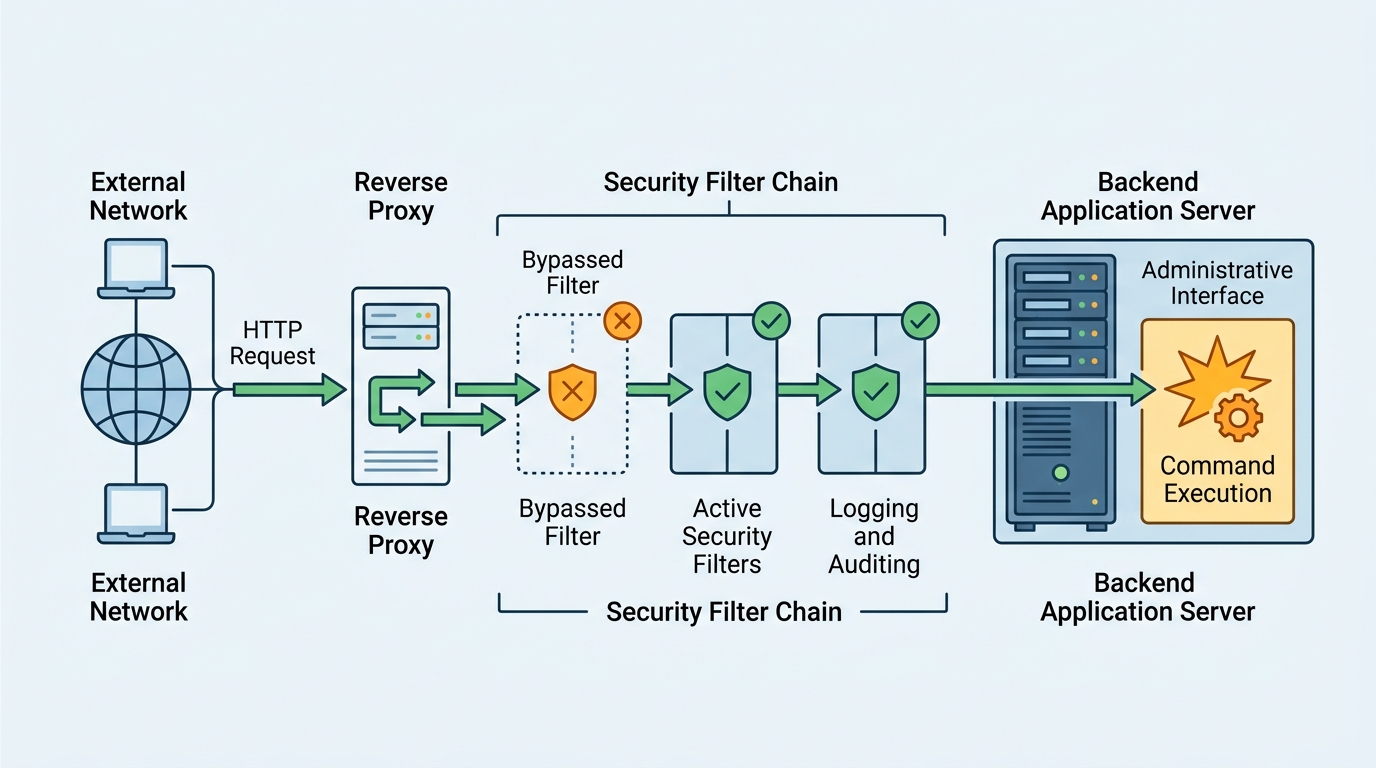
This architectural breakdown results in the application executing administrative commands under the context of an unauthenticated session, effectively granting the attacker full administrative control over the N-central console without ever presenting valid credentials. This is the definition of "God-Mode."
The Downstream Blast Radius of RMM Compromise
When an attacker gains administrative access to an RMM server, they do not merely compromise a single web application; they inherit the trust relationships established between that server and every single managed endpoint. In N-central, this trust is maintained via the N-central Agent, a privileged service running on downstream servers and workstations.
The N-central Agent communicates back to the central server via secure channels, polling for tasks, software updates, and configuration changes. Because the agent must perform administrative tasks (such as installing software, patching operating systems, and running scripts), it runs with local SYSTEM privileges on Windows or root privileges on Linux and macOS.
Once an attacker exploits CVE-2026-18577 and gains administrative access to the N-central console, they can leverage these built-in operational features to orchestrate a massive, automated supply-chain attack. I categorize the primary attack vectors within a compromised RMM into three distinct phases:
- Immediate Script Execution (The Push): Attackers can use the N-central "Automation Manager" or scripting engine to push malicious PowerShell, Bash, or Python scripts to thousands of endpoints simultaneously. Because these scripts execute within the context of the local agent (
SYSTEM/root), they bypass standard user-access controls and can immediately disable local security tools, harvest credentials, or deploy ransomware. - Software Deployment Abuse: The software distribution feature can be subverted to distribute malicious payloads disguised as legitimate software updates or utilities. This allows the attacker to establish secondary persistence mechanisms across the entire fleet, ensuring continued access even if the N-central server is subsequently isolated or rebuilt.
- Lateral Movement and Domain Dominance: By leveraging the RMM's access to domain controllers and critical infrastructure servers, attackers can dump active directory databases, hijack domain administrator sessions, and achieve complete domain dominance within minutes of the initial RMM compromise.
The speed at which an attacker can transition from exploiting the N-central web console to executing code on downstream endpoints is measured in seconds. This compressed timeline leaves traditional security operations centers (SOCs) with virtually no time to react manually. Therefore, prevention and automated detection are your only viable lines of defense.
Detection, Verification, and Forensic Analysis
If you are running an on-premises or self-hosted instance of N-central, you must immediately audit your logs for signs of exploitation. Because CVE-2026-18577 is actively exploited, a lack of obvious system failure does not equal safety; sophisticated actors will attempt to blend their activities with legitimate administrative traffic.
To detect potential exploitation, you must analyze both web server access logs and N-central application logs. Look for anomalous HTTP requests that exhibit path normalization manipulation or target administrative endpoints from unexpected IP addresses.
I have developed the following Python script to assist security teams in parsing N-central access logs. This script scans for common indicators of path normalization bypasses, unusual HTTP status codes on administrative paths, and requests containing suspicious character sequences (such as matrix parameters or double-encoded slashes) targeting the API directories.
import re
import sys
from pathlib import Path

# Define common patterns used in path normalization and authentication bypass exploits
SUSPICIOUS_PATTERNS = [
    re.compile(r"\.\./"),                  # Standard path traversal
    re.compile(r"%2[eE]%2[eE]"),          # Double-encoded dots
    re.compile(r";"),                      # Matrix parameters / semicolon insertion
    re.compile(r"/api/.*//"),              # Double slashes in API paths
    re.compile(r"%00"),                    # Null byte injection
    re.compile(r"/dms/internal/"),         # Access to internal DMS endpoints
    re.compile(r"/jaxrs/")                 # Direct JAX-RS endpoint access attempts
]

def analyze_log_line(line):
    # Example log format: 192.168.1.100 - - [03/Aug/2026:14:32:10 +0000] "POST /api/v1/admin;jsessionid=... HTTP/1.1" 200 4502
    match = re.search(r'"([A-Z]+)\s+([^\s"]+)\s+HTTP/[0-9.]+"\s+(\d+)', line)
    if not match:
        return None

    method, path, status_code = match.groups()

    for pattern in SUSPICIOUS_PATTERNS:
        if pattern.search(path):
            return {
                "method": method,
                "path": path,
                "status": status_code,
                "reason": f"Matched pattern: {pattern.pattern}"
            }

    # Flag unauthenticated POST/PUT requests to administrative endpoints that returned 200 OK
    if status_code == "200" and method in ["POST", "PUT"] and "/api/" in path:
        if "login" not in path.lower() and "public" not in path.lower():
            return {
                "method": method,
                "path": path,
                "status": status_code,
                "reason": "Successful state-changing request to API without obvious login path"
            }

    return None

def main(log_file_path):
    path = Path(log_file_path)
    if not path.exists():
        print(f"[-] File not found: {log_file_path}")
        sys.exit(1)

    print(f"[*] Analyzing {log_file_path} for CVE-2026-18577 exploit indicators...")
    match_count = 0

    with open(path, "r", encoding="utf-8", errors="ignore") as f:
        for line_num, line in enumerate(f, 1):
            result = analyze_log_line(line)
            if result:
                print(f"[ALERT] Line {line_num}: {result['method']} {result['path']} -> Status {result['status']} ({result['reason']})")
                match_count += 1

    print(f"[*] Analysis complete. Found {match_count} suspicious entries.")

if __name__ == "__main__":
    if len(sys.argv) < 2:
        print("Usage: python analyze_logs.py <path_to_access_log>")
        sys.exit(1)
    main(sys.argv[1])
Beyond log analysis, you must perform a thorough review of administrative actions within the N-central console. Specifically, audit the following:
- User Creation Audit: Review the N-central user directory for any newly created administrative accounts, especially those created outside of standard change-management windows.
- Script Execution History: Inspect the "Scheduled Tasks" and "Script/Software Repository" for any unfamiliar scripts, executable files, or modified automation policies.
- Active Sessions: Terminate all active sessions and inspect the source IP addresses of currently logged-in administrators. Look for sessions originating from residential proxies, VPN providers, or unexpected geographical locations.
Mitigation and Remediation Playbook
If you host your own N-central instance, you must treat this vulnerability with the highest level of urgency. The following checklist outlines the immediate, intermediate, and long-term actions required to secure your environment against CVE-2026-18577.
| Phase | Action Item | Description | Target Timeline |
|---|---|---|---|
| Immediate | Apply Vendor Patches | Upgrade N-central to the latest patched version specified by N-able immediately. Do not delay. | Within 2 hours |
| Immediate | Network Isolation | If patching cannot be performed immediately, restrict access to the N-central web interface (ports 443/80) to trusted IP addresses or behind a client VPN. | Within 2 hours |
| Immediate | Terminate Active Sessions | Force-expire all active user sessions and API tokens within the N-central console to disrupt any active attacker persistence. | Within 4 hours |
| Intermediate | Credential Rotation | Rotate all administrative credentials, service account passwords, and API keys stored within or used by N-central. | Within 24 hours |
| Intermediate | Endpoint EDR Audit | Run full-system EDR/MDR scans across all downstream endpoints managed by N-central to detect any post-exploitation payloads. | Within 24 hours |
| Strategic | Implement Zero Trust Access | Transition the N-central administrative interface entirely off the public internet, requiring MFA-protected VPN or Zero Trust Network Access (ZTNA). | Within 7 days |
Step 1: Immediate Patching
Your first and most critical action is to apply the official security update provided by N-able. Because this vulnerability is a patch bypass, relying on previous workarounds or web application firewall (WAF) rules is highly risky. WAFs are notoriously bad at handling complex URI normalization bypasses because attackers can continuously find new ways to encode payloads that bypass the WAF's regex patterns but are still decoded by the backend application.
Step 2: Restrict Network Exposure
I cannot overemphasize this: your RMM administration portal should never be directly accessible from the public internet. If you must expose it for agent communication, you should configure your firewalls or reverse proxies to only allow traffic to the specific ports and endpoints required for agent-to-server communication (typically specific agent check-in URLs), while completely blocking external access to the /admin, /config, and /api paths.
Ideally, the administrative interface should only be accessible via a secure Zero Trust Network Access (ZTNA) gateway, a trusted management VPN, or dedicated administrative bastions. By restricting access to authenticated corporate identities before they can even reach the N-central login page, you eliminate the threat of unauthenticated remote exploits entirely.
Step 3: Post-Compromise Assessment
If your N-central server was exposed to the internet without the patch during the active exploitation window, you must operate under the assumption of compromise. Applying the patch after an attacker has already exploited the vulnerability and established secondary persistence (such as creating new administrative accounts or deploying backdoor agents) will not remove the threat.
In this scenario, you must initiate a comprehensive forensic investigation. This includes analyzing host-level artifacts on the N-central server itself, reviewing database transaction logs for unauthorized modifications, and closely monitoring downstream endpoints for anomalous processes, unauthorized registry modifications, or unexpected network connections originating from the RMM agent process.
Conclusion
CVE-2026-18577 serves as a stark reminder of the systemic risks inherent in centralized management platforms. When an RMM platform is vulnerable, the security of your entire managed fleet is compromised. The fact that this vulnerability is an authentication bypass targeting a previous patch underscores the critical importance of defense-in-depth.
You cannot rely solely on software vendors to write flawless code. As security and engineering leaders, my recommendation is to design your operational architectures with the assumption that any single component—including your RMM—can and will be compromised.
By enforcing strict network segmentation, isolating administrative consoles behind Zero Trust gateways, continuously auditing log data for anomalous activity, and maintaining robust endpoint detection and response (EDR) capabilities, you can significantly reduce your attack surface. Do not wait for the next patch bypass to secure your infrastructure. Take the necessary steps today to isolate your management planes, rotate your secrets, and verify the integrity of your managed endpoints.