
Introduction
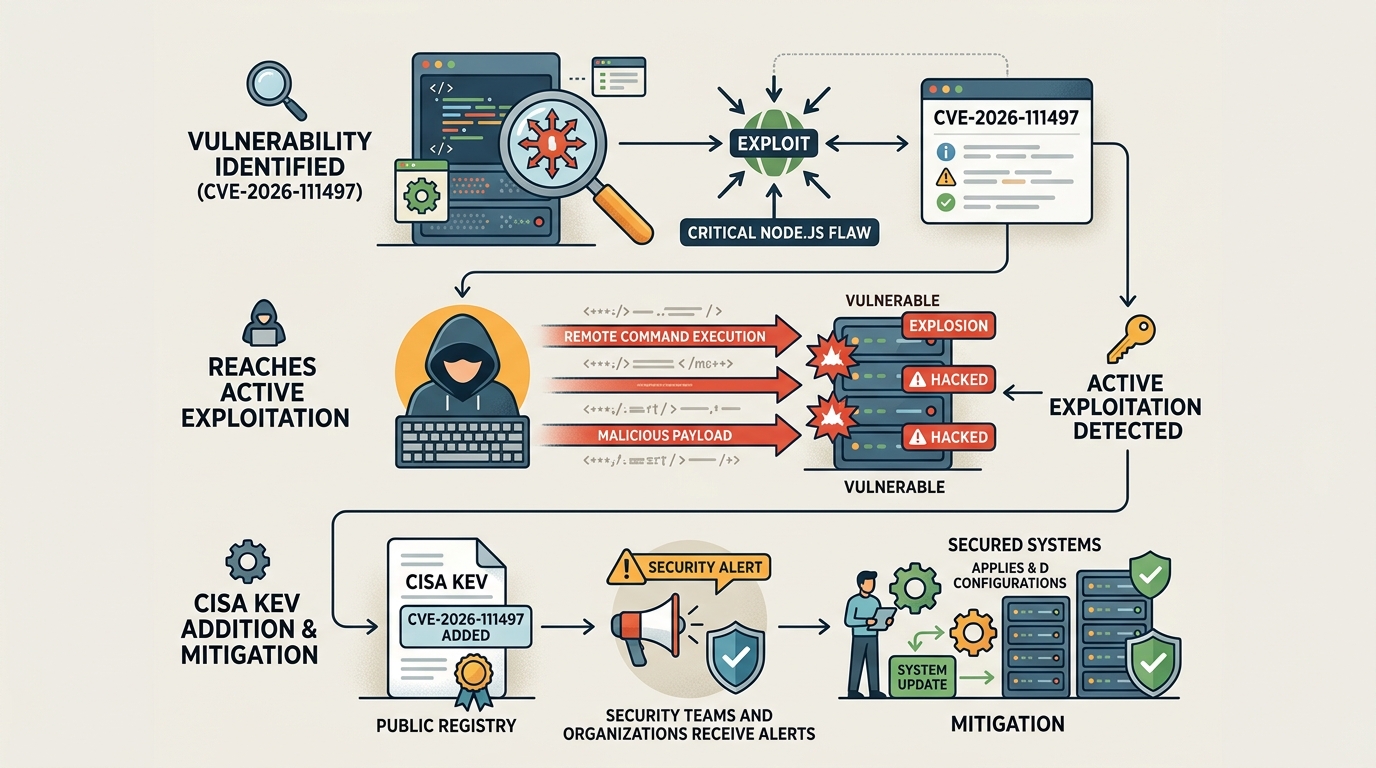
The security landscape shifted significantly with CISA adding CVE-2026-111497—dubbed "Node2Shell"—to its Known Exploited Vulnerabilities (KEV) catalog. Node2Shell is a critical remote code execution (RCE) flaw residing in Node.js runtime environments, specifically within the underlying native bindings handling Brotli decompression routines. When an application accepts untrusted, Brotli-compressed payloads and processes them using affected Node.js zlib APIs, an attacker can trigger an off-by-one heap overflow. Under realistic memory layouts, this overflow yields arbitrary code execution within the context of the running Node.js process.
Active exploitation in the wild underscores that this is not merely a theoretical edge case. The vulnerability bypasses standard input sanitization layers because the payload payload corruption occurs down in the C++ layer of the decompression engine before JavaScript execution even begins. In this article, I will analyze the technical root cause of Node2Shell, explain the mechanism of exploitation, detail immediate mitigations for production environments, and provide a long-term strategy for dependency and native module governance.
Technical Root Cause: Native Heap Overflow in Decompression Routines
To understand Node2Shell, I must first break down how Node.js interfaces with native C/C++ libraries for performance-critical operations like stream compression. Node.js leverages its native zlib wrapper module, which binds directly to C libraries responsible for handling Brotli compression (libbrotli).
When a Node.js web application—such as an Express, Fastify, or NestJS service—uses the native zlib.createBrotliDecompress() or zlib.brotliDecompress() methods, memory allocation for the uncompressed output buffer is negotiated across the V8/C++ boundary. The flaw manifests when processing specially crafted Brotli stream headers containing invalid or extreme dictionary context flags combined with fragmented meta-blocks.
+-----------------------------------------------------------------------+
|                         Incoming HTTP Request                         |
|               Header: Content-Encoding: br (Brotli)                   |
+----------------------------------+------------------------------------+
                                   |
                                   v
+-----------------------------------------------------------------------+
|                     Node.js Express / Fastify Middleware              |
|               Passes raw stream to zlib.brotliDecompress()             |
+----------------------------------+------------------------------------+
                                   |
                                   v
+-----------------------------------------------------------------------+
|                    V8 Native C++ Binding Layer                        |
|           Allocates native Node::Buffer on libuv Threadpool          |
+----------------------------------+------------------------------------+
                                   |
                                   v
+-----------------------------------------------------------------------+
|                   Native Decompression Engine (libbrotli)              |
|     1. Flawed state machine miscalculates dynamic context length     |
|     2. Off-by-one heap overflow overwrites adjacent chunk header       |
|     3. Corrupts V8 ArrayBuffer backing store pointer                  |
|     4. Achieve arbitrary memory read/write -> Remote Code Execution   |
+-----------------------------------------------------------------------+
The vulnerability stems from an integer truncation during buffer size calculation within the internal state machine of the native binding. Specifically, when sliding window parameters are dynamically re-allocated during a multi-chunk stream read, the native wrapper miscalculates the required allocation size by a small offset. When the actual uncompressed byte sequence is written to the heap allocation, it writes past the buffer boundary.
In standard C/C++ applications, an off-by-one heap write might result in a simple segmentation fault (SIGSEGV) and crash the process. However, within the V8 JavaScript engine runtime, heap allocations for Node::Buffer objects sit adjacent to internal V8 metadata objects, including ArrayBuffer backing stores and internal object pointers. By overwriting the adjacent memory chunk's boundary headers or corrupting an adjacent V8 internal pointer, a sophisticated threat actor can convert this off-by-one heap overwrite into an arbitrary memory read/write primitive, ultimately redirecting process execution flow to shellcode or executing system commands via native library hooks.
Exploitation Vector and Real-World Attack Scenarios
The primary attack vector for Node2Shell centers on HTTP request handling services, API gateways, and microservices that accept compressed request bodies. Because Brotli (br) is a standard compression algorithm widely used across modern web infrastructures, many API frameworks automatically decompress incoming requests if the Content-Encoding: br header is present.
An attacker sends a single HTTP POST or PUT payload containing a maliciously structured Brotli byte stream. The vulnerability triggers during stream processing before any authentication middleware or business logic in JavaScript evaluates the request body. This ordering renders application-level defense mechanisms—such as JWT verification, input validation schemas (Zod, Joi), or Web Application Firewall (WAF) rule sets inspecting application JSON—completely ineffective.
Consider the operational impact across three common architecture patterns:
- API Gateways and Ingress Controllers: Node.js-based API gateways that automatically parse incoming request bodies suffer immediate exposure. An unauthenticated attacker can target the public endpoint, achieve RCE on the ingress controller, and pivot into internal microservice networks.
- Microservices Handling File Uploads or Data Streams: Applications accepting compressed bulk data uploads (e.g., log aggregators, metrics collectors, or document processors) processing Brotli archives natively trigger the vulnerability on file parsing.
- Server-Side Rendering (SSR) Frameworks: SSR applications built on Next.js, Nuxt, or Remix that accept compressed state payloads or handle edge proxying can be exploited to compromise the host operating system or steal environmental variables containing backend database credentials and secret keys.
Because the exploit executes within the memory space of the Node.js process, it inherits all OS privileges assigned to that process. If the container or system runs as root or an over-privileged service account, the attacker gains full control of the underlying host or container cluster.
Immediate Detection and Tactical Mitigation Strategies
Because CVE-2026-111497 is actively exploited, relying solely on standard patching cadence is insufficient. I recommend executing a two-phase response: immediate tactical mitigation followed by structural remediation.
1. Identify Exposed Workloads
First, audit all running Node.js runtimes across your environments. Focus on detecting Node.js application instances running affected release lines. Execute a rapid inventory check across your container registries and active pods. You can identify exposed services by querying runtime environment variables or package manifests.
2. Emergency Mitigation via Middleware and WAFs
If immediate runtime upgrades cannot be deployed across all production environments within hours, implement immediate request-filtering rules at your load balancer, API gateway, or WAF tier:
- Disable Brotli Ingress Parsing: Force client requests to use standard
gzipor uncompressed payloads by stripping or rejecting theContent-Encoding: brheader at the ingress proxy level (e.g., NGINX, Cloudflare, AWS ALB) before the traffic hits the Node.js application tier. - Block Suspicious Stream Signatures: Configure deep packet inspection on WAFs to detect invalid Brotli metadata window parameters. However, I caution against relying solely on WAF signature matching, as obfuscation techniques can bypass static string patterns.
3. Application-Level Workaround
If you must accept Brotli compression and cannot upgrade the runtime immediately, implement strict limits on stream parsing or temporarily route Brotli decompression off the Node.js main thread and native binding to isolated execution environments. Below is an example of an Express/Node.js middleware strategy that explicitly validates and restricts incoming encoding headers to prevent vulnerable native methods from processing untrusted input:
// Emergency Node2Shell (CVE-2026-111497) Ingress Mitigation Middleware // Apply this middleware at the top of your route processing chain.
const zlib = require('zlib');
function preventNode2ShellExploitation(req, res, next) { const contentEncoding = req.headers['content-encoding'];
if (contentEncoding && contentEncoding.includes('br')) {
// Audit log high-risk decompression attempts
console.warn([SECURITY WARNING] Intercepted payload using Brotli encoding from IP: ${req.ip});
// Option A: Reject Brotli payloads outright until runtime is patched
return res.status(415).json({
  error: 'Unsupported Media Type',
  message: 'Brotli encoding is temporarily disabled for maintenance. Please re-encode using gzip or plain JSON.'
});
}
next(); }
module.exports = preventNode2ShellExploitation;