

Introduction\n\nIn high-velocity enterprise engineering organizations, the boundaries of the traditional codebase are constantly shifting. Engineering leaders rely heavily on outside collaborators—contractors, vendor partners, specialized consultants, and cross-functional advisors—to accelerate delivery. However, managing outside collaborator access and maintaining repository hygiene at scale quickly becomes a significant operational tax and a major security vulnerability.\n\nLeft unmanaged, enterprise repositories suffer from permission drift, stale access privileges, dangling personal access tokens (PATs), orphaned branches, and an accumulation of dead repositories. Security governance models built around manual quarterly audits or ticket-driven access requests fail because they are reactive and inherently prone to human error. When an outside contractor's contract ends, or when a temporary integration project concludes, revoking access often relies on manual offboarding checklists that are easily overlooked.\n\nTo solve this, enterprise platform teams must move away from manual gatekeeping toward event-driven, automated access lifecycle management and automated repository hygiene. In this article, I will detail an architectural framework and practical implementation blueprint for automating outside collaborator access and maintaining an evergreen GitHub enterprise organization without burdening platform operators or compromising security controls.\n\n## The Anatomy of Permission Drift and Operational Decay\n\nTo build an effective automation framework, I first analyze where traditional identity and repository governance models break down in enterprise environments. Permission drift in GitHub organizations typically stems from three core structural issues:\n\n1. Direct Assignment over Identity Provider (IdP) Mapping: Enterprise users are frequently assigned direct permissions on individual repositories rather than inheriting access through IdP-synced teams. When an outside collaborator is invited directly to a repository, their access lives outside the centralized SCIM (System for Cross-domain Identity Management) lifecycle.\n2. Temporal Mismatch: Outside access is almost always inherently temporary, yet repository permissions are, by default, permanent until explicitly revoked. Without an explicit Time-To-Live (TTL) attached to the permission grant, access persists indefinitely.\n3. Decentralized Repository Creation: As teams spin up repositories for spikes, proof-of-concepts, or short-term vendor engagements, these assets are often left unmonitored. Over time, these repositories retain sensitive code, active webhooks, and elevated access permissions long after the underlying initiative has been abandoned.\n\n\n +----------------------------------+\n | Enterprise IdP (e.g., Okta) |\n +----------------+-----------------+\n |\n SCIM Provisioning\n v\n +----------------------------------+\n | GitHub Enterprise Org |\n +----------------+-----------------+\n |\n +-----------------------+-----------------------+\n | |\n v v\n+-------------------------+ +-------------------------+\n| IdP-Managed Teams | | Outside Collaborators |\n| (Standard Employees) | | (Direct Grants / TTL) |\n+------------+------------+ +------------+------------+\n | |\n | Inherited | Ephemeral\n v v\n+-------------------------------------------------------------------------+\n| Target Repositories |\n| |\n| [ Active Codebase ] [ Stale Proof-of-Concept ] [ Archived Repo ] |\n+-------------------------------------------------------------------------+\n\n\nThe security risk of this decay is substantial. Attackers targeting enterprise supply chains frequently target dormant accounts or stale access tokens associated with third-party vendors. Furthermore, dangling repositories with unpatched dependencies or exposed test secrets increase the organization's attack surface. \n\nFrom an administrative standpoint, handling manual requests to add, modify, or extend collaborator access consumes disproportionate platform engineering bandwidth. A scalable solution requires treating access and repository lifecycle management as code, enforced by automated policies and scheduled control loops.\n\n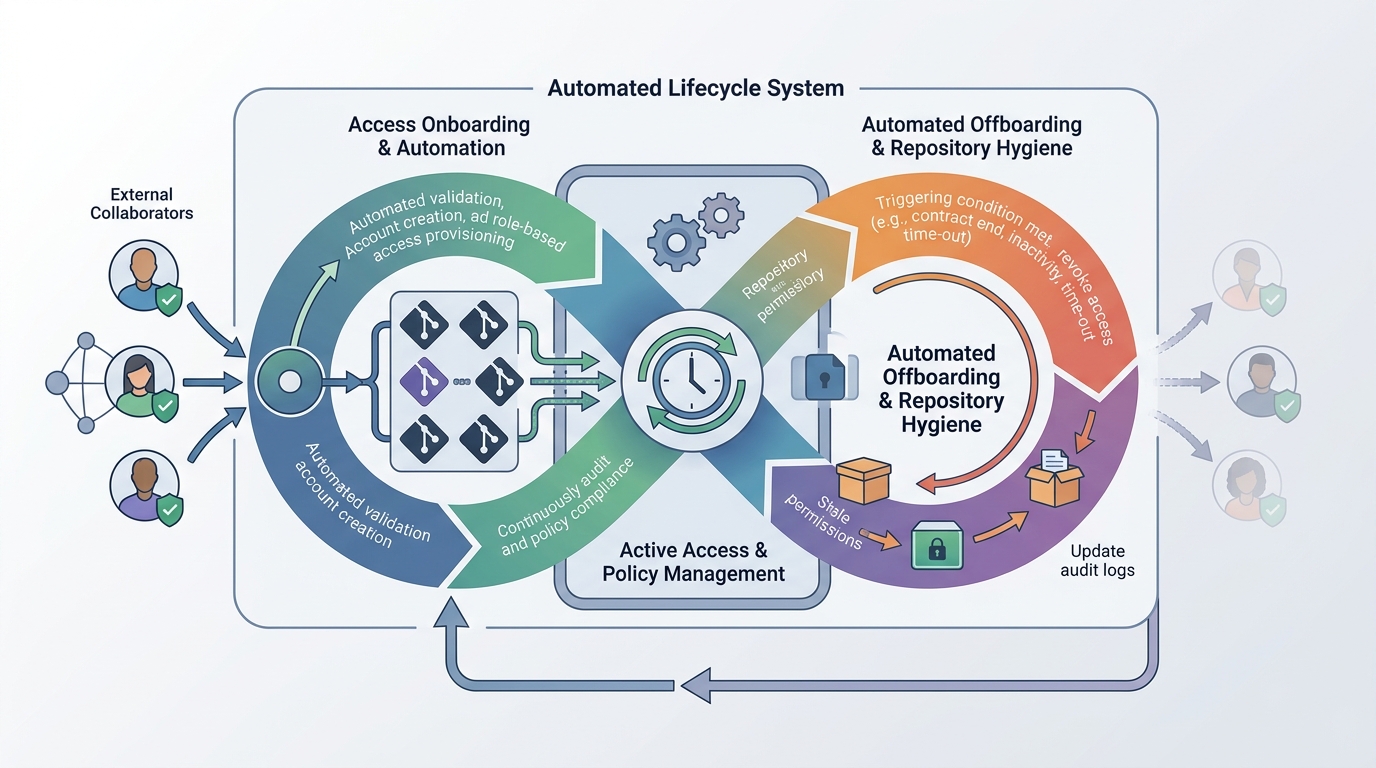 \n\n## Architectural Framework for Ephemeral Access Management\n\nTo mitigate permission drift, I recommend implementing an event-driven, TTL-based access model for all outside collaborators. Instead of granting static permissions, access should be granted dynamically with a fixed expiration date, backed by a persistent metadata store and audited via automated control loops.\n\n### 1. Identity Provisioning and Federation\nAll outside collaborators must authenticate through the enterprise IdP using Single Sign-On (SSO) and Time-based One-Time Passwords (TOTP) or hardware keys, even if they do not hold full enterprise employee status. Through SCIM, the collaborator's lifecycle is bound to the identity provider. When a contractor is deactivated in the IdP, SCIM immediately revokes their GitHub organization membership.\n\nHowever, SCIM alone does not manage granular repository-level permissions for outside collaborators who should not belong to broad IdP teams. For repository-level access, I implement an explicit Access Request & Entitlement Workflow.\n\n### 2. The TTL Access Engine\nWhen an outside collaborator requires access to a specific repository, the request is routed through a self-service portal or ChatOps interface (e.g., Slack/Teams integrated with a platform API). The request must specify:\n- Target Repository\n- Permission Level (
read, triage, write, maintain)\n- Business Justification and Internal Sponsor\n- Duration / Expiration Date (maximum allowable window, e.g., 30, 60, or 90 days)\n\nUpon approval by the internal repository owner, an automated worker executes the access grant using the GitHub REST API or GraphQL API, and simultaneously writes an entitlement record to a secure, centralized state store (such as a DynamoDB table or PostgreSQL database).\n\nThe state store tracks metadata that GitHub's native user model does not natively enforce as a single primitive:\n- collaborator_handle\n- repository_id\n- permission_level\n- sponsor_email\n- granted_at\n- expires_at\n- status (active, warned, expired, revoked)\n\n### 3. Automated Lifecycle Enforcement Loop\nA scheduled execution engine (e.g., AWS Lambda triggered via EventBridge, or a dedicated GitHub Action workflow running on a cron schedule) executes daily to audit active outside collaborators against the state store.\n\nThe enforcement loop runs the following algorithm:\n1. Query State Store: Fetch all active records where expires_at is within the notification window (e.g., current_date + 7 days).\n2. Send Soft Warnings: Issue automated notifications (via email or ChatOps) to the internal sponsor and collaborator, offering a one-click re-certification path if access needs extension.\n3. Identify Expired Access: Fetch all active records where expires_at <= current_date or where the internal sponsor failed to re-certify access.\n4. Execute Revocation: Call the GitHub API to remove the collaborator from the repository:\n DELETE /repos/{owner}/{repo}/collaborators/{username}\n5. Audit Logging: Emit a structured JSON log to the SIEM (e.g., Datadog, Splunk) detailing the revocation event for compliance tracking.\n\n## Automating Ephemeral Access Enforcement\n\nThe following Python automation script demonstrates how to implement the core enforcement loop using requests to interact with the GitHub REST API. This script queries an entitlement store (represented here as a list of dictionary payloads for demonstration), checks for expired grants, removes the outside collaborator from the repository, and audits the action.\n\nimport os
import datetime import logging import requests
Configure structured logging for SIEM integration
logging.basicConfig( level=logging.INFO, format='{