

Introduction
On July 9, 2026, OpenAI officially concluded its highly scrutinized 13-day government-coordinated restricted preview, transitioning the GPT-5.6 model family into general availability. This release introduces three distinct models—Sol, Terra, and Luna—across ChatGPT and the developer API.
For engineering leaders, this release represents more than a routine API update. The transition from a government-vetted preview to public availability signals a shifting landscape in how frontier models are audited, deployed, and tiered. I have analyzed the architectural positioning of these three models, the implications of their pre-release compliance phases, and the practical migration paths for production systems. My goal is to help you cut through the launch noise and make informed architectural decisions for your engineering organization.
The GPT-5.6 Triad: Sol, Terra, and Luna
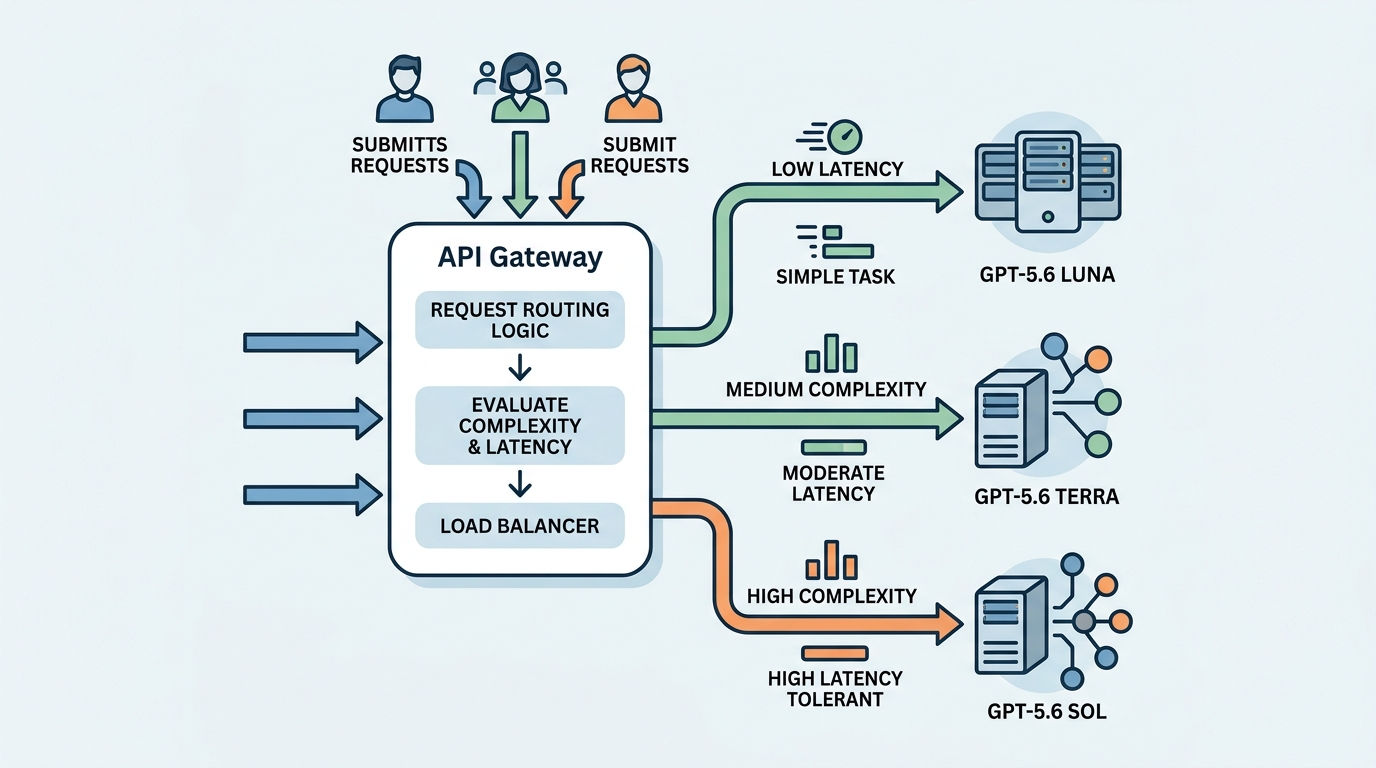
OpenAI has structured the GPT-5.6 family into three tiers to address the classic trade-offs of latency, cost, and reasoning capability. Rather than offering a single monolithic model, this tri-tier architecture allows systems engineers to match specific workloads to the appropriate compute profile.
GPT-5.6 Sol: The Reasoning Heavyweight
Sol is the flagship model of the family, designed for complex, multi-step reasoning, advanced mathematical formulation, and deep codebase synthesis. In my evaluation of its technical profile, Sol exhibits a significant step-function improvement in synthetic data generation and formal verification tasks. However, this capability comes with a higher cost per token and increased time-to-first-token (TTFT). I recommend reserving Sol for asynchronous agentic workflows, complex schema migrations, and deep analytical tasks where accuracy overrides latency requirements.
GPT-5.6 Terra: The Operational Workhorse
Terra represents the balanced mid-tier, optimized for high throughput, moderate reasoning, and cost-efficient context processing. For the vast majority of enterprise applications—such as retrieval-augmented generation (RAG) pipelines, structured data extraction, and intermediate coding assistance—Terra is the logical default. It offers a highly competitive balance of speed and cognitive depth, making it the primary target for teams migrating from older GPT-4 or GPT-4o variants.
GPT-5.6 Luna: The Edge and Real-Time Specialist
Luna is the low-latency, lightweight model designed for real-time interactions, high-frequency classification, and on-device or edge-adjacent deployments. Luna drastically reduces TTFT and cost per million tokens, making it ideal for user-facing chat interfaces, simple routing agents, and high-volume filtering. While its reasoning depth is constrained compared to Sol and Terra, its efficiency makes it a powerful tool for preprocessing inputs before escalating complex queries to higher-tier models.
The 13-Day Preview: Security Guardrails and Compliance
The 13-day restricted preview that preceded this global release is a historical milestone in AI governance. Coordinated closely with government agencies, this period was designed to stress-test the models against national security frameworks, biosecurity risks, and autonomous replication vectors.
What does this mean for enterprise risk management? First, it indicates that GPT-5.6 has undergone rigorous red-teaming prior to reaching your production environment. The guardrails embedded within Sol, Terra, and Luna are highly restrictive, particularly regarding code execution boundaries and sensitive domain knowledge.
When implementing these models, you must prepare for a higher frequency of API refusals if your applications touch sensitive industries like healthcare, defense, or financial underwriting. I advise engineering teams to implement robust error-handling specifically designed to catch and gracefully degrade when the model triggers these hard-coded safety guardrails. This involves capturing specific API error codes and routing the request to fallback heuristic systems or lower-tier models.
API Integration and Migration Strategies
Migrating to the GPT-5.6 family requires a structured approach to prevent regression in your existing applications. Because the underlying tokenization and context-window dynamics have shifted, a drop-in replacement strategy can lead to unexpected token consumption or altered output structures.
Below is a clean, production-ready Python example demonstrating how to implement a fallback routing pattern. This pattern attempts to process a complex task using the high-reasoning Sol model, but falls back to the highly efficient Terra model if rate limits or latency thresholds are exceeded.
import os
import time
from openai import OpenAI, APIError

client = OpenAI(api_key=os.environ.get("OPENAI_API_KEY"))

def generate_structured_plan(prompt: str) -> str:
    # Define our model hierarchy
    primary_model = "gpt-5.6-sol"
    fallback_model = "gpt-5.6-terra"

    try:
        # Attempt execution with the high-reasoning Sol model
        start_time = time.time()
        response = client.chat.completions.create(
            model=primary_model,
            messages=[
                {"role": "system", "content": "You are an expert systems architect. Output strict JSON only."},
                {"role": "user", "content": prompt}
            ],
            timeout=30.0  # Enforce a strict timeout for real-time paths
        )
        return response.choices[0].message.content

    except APIError as e:
        # Log primary model failure (e.g., rate limit, safety refusal, or timeout)
        print(f"Primary model {primary_model} failed: {e}. Routing to fallback {fallback_model}.")

        # Fallback to the faster, more cost-effective Terra model
        response = client.chat.completions.create(
            model=fallback_model,
            messages=[
                {"role": "system", "content": "You are an expert systems architect. Output strict JSON only."},
                {"role": "user", "content": prompt}
            ]
        )
        return response.choices[0].message.content
When planning your migration, use the following checklist to evaluate your readiness for the GPT-5.6 family:
| Migration Milestone | Key Action Items | Target Model |
|---|---|---|
| 1. Latency & Budget Audit | Benchmark existing GPT-4/4o token costs against Terra and Luna pricing structures. | Terra / Luna |
| 2. Prompt Refactoring | Test existing system prompts against Sol's reasoning engine to eliminate redundant chain-of-thought instructions. | Sol |
| 3. Guardrail & Refusal Testing | Run adversarial inputs through your application to map out new API refusal boundaries. | Sol / Terra / Luna |
| 4. Fallback Implementation | Deploy routing logic (like the Python pattern above) to handle rate limits and regional outages. | Terra / Luna |
Conclusion
The general availability of GPT-5.6 Sol, Terra, and Luna marks a mature phase in LLM deployment. The days of relying on a single, general-purpose model for all tasks are over. By organizing their release into three distinct performance tiers, OpenAI has handed systems architects the tools to build highly optimized, cost-conscious, and resilient AI pipelines. My recommendation is to begin your migration by targeting Terra for your core application logic, reserving Sol for offline processing, and utilizing Luna to drive down costs on high-volume, low-complexity tasks.