The Mechanics of CVE-2026-55255
On July 7, 2026, the Cybersecurity and Infrastructure Security Agency (CISA) added CVE-2026-55255 to its Known Exploited Vulnerabilities (KEV) Catalog. This vulnerability is an Insecure Direct Object Reference (IDOR) authorization bypass within Langflow, a widely adopted open-source visual framework used to build multi-agent AI applications and Retrieval-Augmented Generation (RAG) pipelines.
Active exploitation in the wild indicates that threat actors are specifically targeting AI orchestration layers. In my analysis of modern AI infrastructure security, orchestrators like Langflow represent a highly attractive target because they act as the "central nervous system" of AI integrations. They hold direct connections to vector databases, proprietary data lakes, and external LLM APIs—often storing high-value API keys and database credentials.
I want to break down the mechanics of this IDOR vulnerability, explain why compromising an AI orchestrator is uniquely dangerous, and provide a concrete roadmap to secure your AI deployment pipelines.
An Insecure Direct Object Reference (IDOR) occurs when an application provides direct access to objects based on user-supplied input without performing adequate authorization checks. In the context of Langflow, users design "flows"—visual graphs representing components, prompts, models, and tools.
Each flow is assigned an identifier (such as a UUID). When a user requests, updates, or deletes a flow, the backend API endpoint handles these actions via HTTP requests (e.g., GET /api/v1/flows/{flow_id}). CVE-2026-55255 stems from a failure in the application's backend routing and middleware layer to validate whether the authenticated user making the request actually owns or has permission to access the specified {flow_id}.
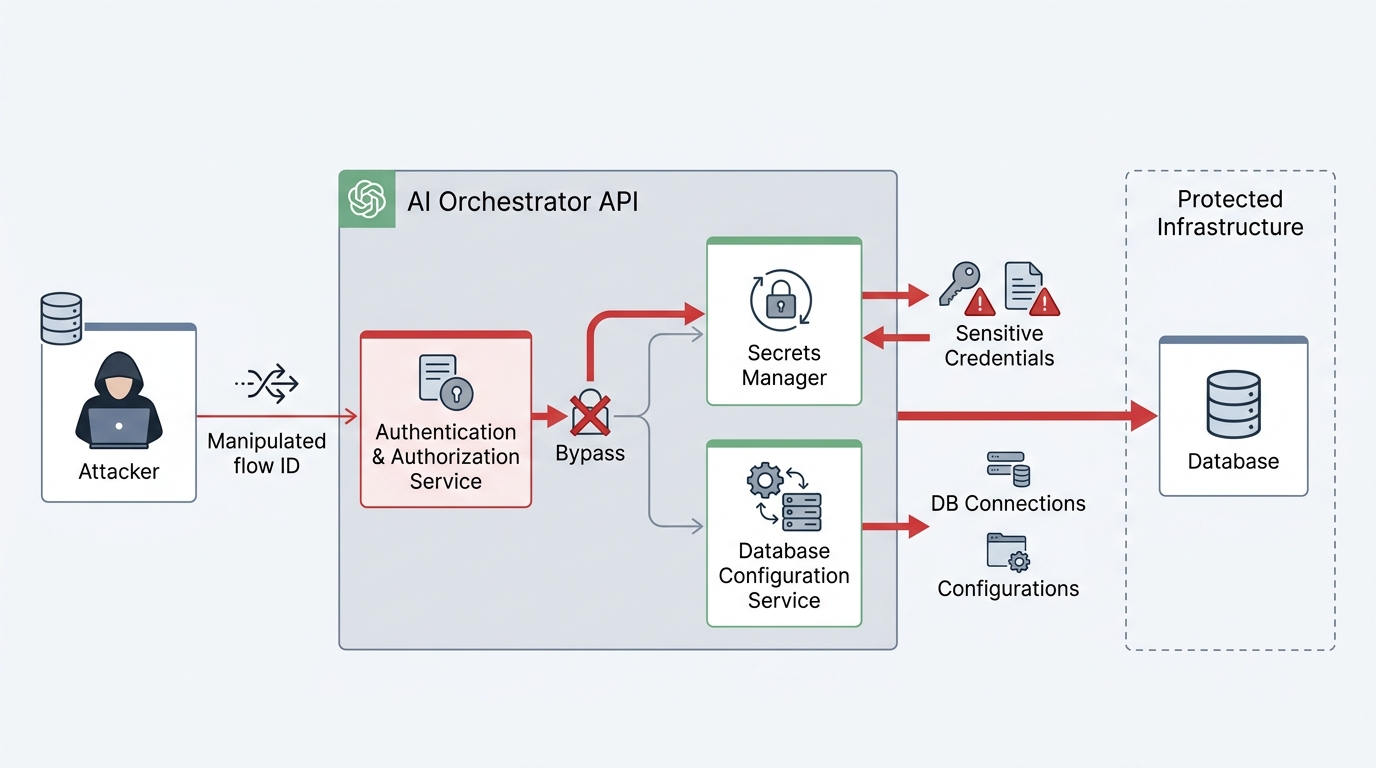
If you deploy an unpatched version of Langflow exposed to a network, an attacker with basic authenticated access—or in some configurations, unauthenticated access depending on the deployment's specific multi-tenant setup—can systematically enumerate or guess flow IDs. By sending crafted HTTP requests directly to the API, the attacker can bypass UI-level restrictions to read, modify, or delete arbitrary flows belonging to other users or system accounts.
The High Stakes of AI Orchestrator Compromise
The impact of an IDOR in a traditional web application is severe, but in an AI orchestrator, it is catastrophic. I categorize the primary risks of this vulnerability into three distinct vectors:
- Credential Harvesting: To function, Langflow components must authenticate to external services. Flows frequently contain hardcoded or session-bound credentials for OpenAI, Anthropic, Hugging Face, Pinecone, Postgres, and enterprise Slack or Jira integrations. An attacker reading your flow configurations can extract these API keys and connection strings instantly.
- Data Exfiltration and Poisoning: By modifying an existing flow, an attacker can alter the system prompt of an active agent or redirect RAG query routes. They can inject malicious instructions (prompt injection) to exfiltrate sensitive user queries to an attacker-controlled endpoint or feed poisoned data back to your users.
- Remote Code Execution (RCE) via Tooling: Many AI orchestrators allow agents to execute Python code or bash commands locally to solve complex math or data processing tasks. If an attacker modifies a flow to include a custom Python tool with arbitrary code execution capabilities, they can pivot from the Langflow container to your broader cloud environment.
Immediate Remediation and Verification Steps
If you run Langflow in your development, staging, or production environments, I recommend treating this as an active incident response scenario. Your first step must be upgrading to a patched version that enforces robust server-side authorization checks on all flow-related endpoints.
To prevent IDOR vulnerabilities in your own custom API wrappers or integrations built around Langflow, you must implement strict ownership validation. Below is a conceptual Python example using FastAPI and SQLAlchemy that demonstrates how to properly validate object ownership before returning or modifying a resource, preventing IDOR patterns:
from fastapi import FastAPI, Depends, HTTPException, status
from sqlalchemy.orm import Session
import uuid

app = FastAPI()

# Conceptual dependency to get the current authenticated user
def get_current_user_id() -> str:
    # In production, extract and decode JWT/session token
    return "user_12345"

# Conceptual database session helper
def get_db():
    db = "mock_db_session"
    yield db

# SECURE PATTERN: Enforce strict ownership validation on the backend
@app.get("/api/v1/flows/{flow_id}", status_code=status.HTTP_200_OK)
def get_flow_secure(
    flow_id: uuid.UUID,
    current_user_id: str = Depends(get_current_user_id),
    db: Session = Depends(get_db)
):
    # Simulate a database query lookup
    # In a real system, query: db.query(Flow).filter(Flow.id == flow_id).first()
    mock_flow = {
        "id": flow_id,
        "owner_id": "user_67890", # Owned by a different user
        "data": "sensitive_api_keys_and_prompts"
    }

    if not mock_flow:
        raise HTTPException(
            status_code=status.HTTP_404_NOT_FOUND,
            detail="Flow not found"
        )

    # Strict authorization check: Validate owner matches the requester
    if mock_flow["owner_id"] != current_user_id:
        raise HTTPException(
            status_code=status.HTTP_403_FORBIDDEN,
            detail="You do not have permission to access this resource"
        )

    return mock_flow
Hardening AI Infrastructure Against Orchestration Risks
Patching CVE-2026-55255 is a necessary immediate fix, but relying solely on reactive patching is a failing long-term strategy. You must isolate your AI orchestration layer from direct exposure and limit the blast radius of potential compromises.
I advise implementing the following architectural controls to protect your AI orchestration environments:
| Control Category | Actionable Security Practice | Implementation Detail |
|---|---|---|
| Network Isolation | Private VPC Deployment | Never expose Langflow or similar UIs directly to the public internet. Restrict access via a client VPN, Zero Trust Network Access (ZTNA), or an identity-aware proxy (IAP). |
| Credential Management | External Secret Managers | Avoid hardcoding API keys in flow configurations. Use environment variables or integrate Langflow with external secret managers (e.g., AWS Secrets Manager, HashiCorp Vault) that rotate keys automatically. |
| Least Privilege Execution | Container Sandboxing | Run your Langflow containers with a read-only root filesystem and non-root users. If flows require code execution capabilities, run those execution environments in isolated, ephemeral sandboxes. |
| Egress Filtering | Restrict Outbound Traffic | Configure strict egress firewall rules on your container network. Limit outbound connections only to verified LLM provider endpoints and internal databases to prevent exfiltration of harvested credentials. |
I recommend auditing your software bill of materials (SBOM) today to identify all deployments of Langflow. Update them immediately to the latest patched release, restrict network access to these dashboards, and ensure that your API keys are managed externally rather than stored in plaintext within your visual flow configurations.