

The Operational Shock of 622 CVEs
Deploying a patch rollup of this scale is not a routine maintenance task; it is a high-risk system event. When a single vendor updates hundreds of libraries, binaries, and kernel-level components simultaneously, the probability of regression rises exponentially.
In my experience, the primary bottleneck in patch management is not the installation of the update itself, but the validation phase. Engineering teams must weigh two competing risks:
- The Exposure Window: Every day a patch is delayed, the organization remains vulnerable to active exploitation of newly disclosed vulnerabilities.
- System Instability: Rushing a massive, unvalidated patch rollup into production can cause cascading failures, break API compatibility, or corrupt persistent state.
With 622 CVEs spanning across Windows kernels, virtualization layers, developer tools, and cloud-hybrid connectors, pinpointing which systems are truly vulnerable becomes an overwhelming task. If your team relies on manual verification, a backlog of this size will inevitably lead to analysis paralysis, leaving your infrastructure exposed for weeks while QA teams struggle to validate every affected dependency.
The Metadata Crisis: Navigating the New Security Update Guide
By removing individual CVE listings from the main Security Update Guide interface, Microsoft has disrupted traditional vulnerability management workflows. Historically, a security analyst could search a CVE identifier, read the specific mitigation steps, assess the CVSS vector, and determine if a compensating control (such as a firewall rule or registry change) could buy the engineering team more time.
Without this granular visibility in the central web UI, teams are left with a monolithic "patch everything" mandate. This approach is highly inefficient for complex enterprise environments where legacy systems cannot be restarted or updated without extensive planning.
To bypass this limitation, you must pivot to programmatic data extraction. While the web interface has been stripped of individual CVE listings, the underlying Microsoft Security Update API (MSRC API) still provides structured JSON payloads that contain the necessary metadata. By querying this API directly, you can reconstruct the mapping between CVEs, KB articles, and product families.
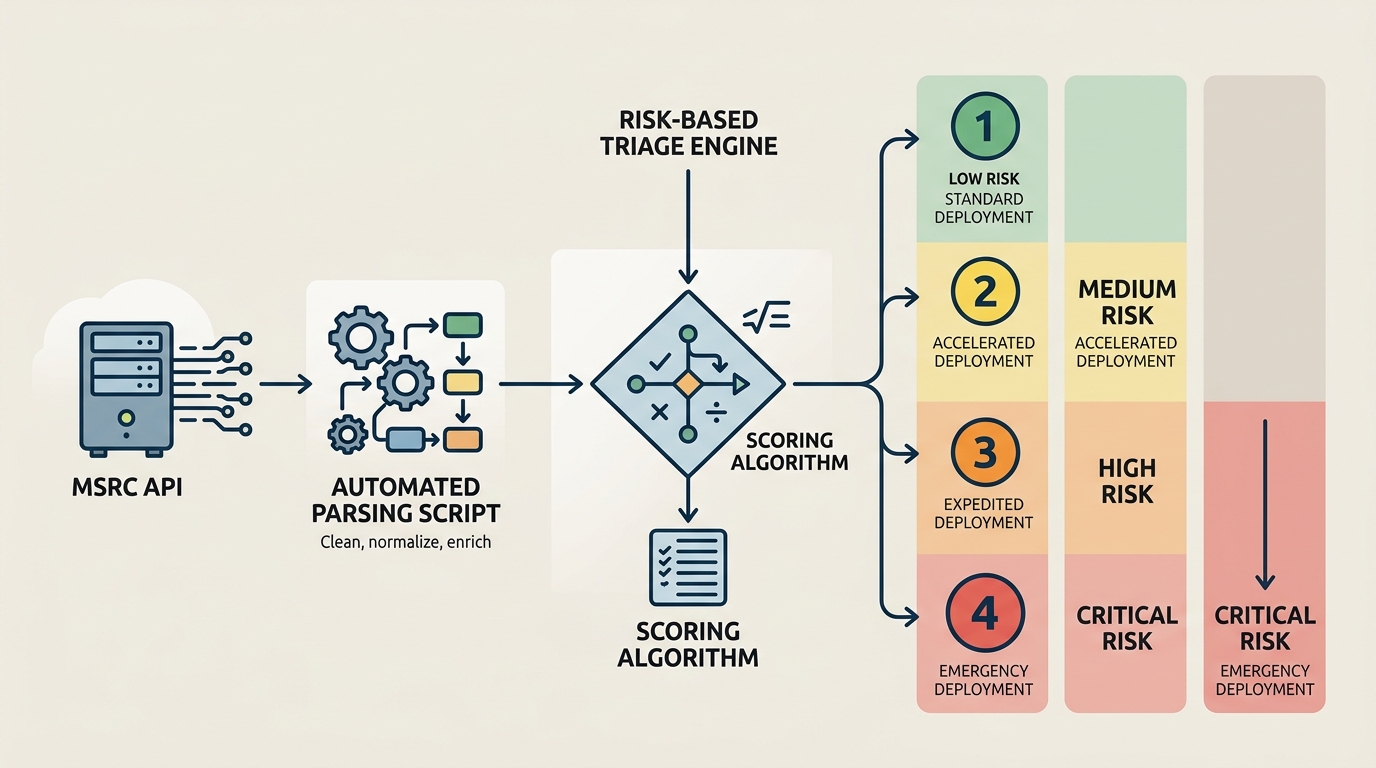
Here is a practical Python script I recommend to programmatically query the MSRC API and extract the raw vulnerability data for a given month. This script bypasses the web UI limitations and outputs a structured CSV for your triage tools:
import requests
import csv
import sys

API_URL = "https://api.msrc.microsoft.com/cvrf/v2.0/updates('2026-Jul')"
HEADERS = {"Accept": "application/json"}

def fetch_and_export_patches(output_file):
    try:
        response = requests.get(API_URL, headers=HEADERS)
        response.raise_for_status()
        data = response.json()

        with open(output_file, mode='w', newline='', encoding='utf-8') as file:
            writer = csv.writer(file)
            writer.writerow(["CVE_ID", "Title", "Severity", "CVSS_Score", "Fixed_Product"])

            vulnerabilities = data.get("Vulnerability", [])
            for vuln in vulnerabilities:
                cve_id = vuln.get("CVE", "N/A")
                title = vuln.get("Title", {}).get("Value", "N/A")

                cvss_sets = vuln.get("CVSSScoreSets", {}).get("ScoreSet", [])
                cvss_score = cvss_sets[0].get("BaseScore", "N/A") if cvss_sets else "N/A"

                threats = vuln.get("Threats", [])
                severity = "N/A"
                for threat in threats:
                    if threat.get("Type") == 3:
                        severity = threat.get("Description", {}).get("Value", "N/A")

                writer.writerow([cve_id, title, severity, cvss_score, "Microsoft Rollup"])

        print(f"Successfully exported patch metadata to {output_file}")
    except Exception as e:
        print(f"Error retrieving patch metadata: {e}", file=sys.stderr)

if __name__ == "__main__":
    fetch_and_export_patches("july_2026_patches.csv")
A Practical Triage Framework for High-Volume Rollups
When confronted with hundreds of vulnerabilities and limited documentation, you cannot treat every patch with equal urgency. I recommend implementing a risk-based triage framework that categorizes assets based on exposure and business criticality, rather than relying solely on the vendor's severity rating.
This table outlines the triage matrix I use to prioritize patch deployment when metadata is obscured:
| Tier | Asset Classification | Exposure Profile | Action Required |
|---|---|---|---|
| Tier 1 | Edge devices, public APIs, DMZ servers | Directly exposed to the internet | Patch within 48 hours; bypass full QA if active exploits are reported. |
| Tier 2 | Internal active directory, identity providers, database servers | Internal network, high privilege access | Patch within 7 days; require synthetic staging validation. |
| Tier 3 | Internal microservices, worker nodes, staging environments | Segregated networks, non-privileged | Patch within 14 days; run through standard CI/CD deployment pipelines. |
| Tier 4 | Legacy air-gapped systems, offline archives | No network access, physical isolation | Defer patching; apply compensating controls (disable unused services, restrict local access). |
By applying this matrix, you filter out the noise of the 622-CVE payload. Instead of attempting to validate all updates across your entire fleet, your engineering resources focus on the high-risk zones where an exploit would cause immediate, catastrophic damage.
Conclusion
Microsoft's July 2026 Patch Tuesday is a turning point for enterprise systems administration. The sheer volume of 622 CVEs, combined with the reduction of granular metadata in the primary Security Update Guide, means that traditional, manual patch management is no longer viable.
To maintain security posture without breaking operational stability, I advise you to take three immediate actions. First, transition your vulnerability management tools to consume raw data directly from the MSRC API rather than relying on manual portal searches. Second, implement a tiered asset triage framework to focus validation efforts where they matter most. Finally, invest in automated canary deployments for your infrastructure, allowing you to catch regressions on a small subset of servers before rolling out massive updates across your entire production environment.