

Introduction
Securing secrets at rest within a Kubernetes cluster has historically been a complex operational challenge. By default, Kubernetes stores all resource data, including sensitive Secret objects, in etcd as unencrypted plaintext. To mitigate this risk, platform engineers have long relied on envelope encryption, a technique where data-encryption keys (DEKs) are encrypted using a key-encryption key (KEK) managed by an external Key Management Service (KMS).
On July 10, 2026, HashiCorp announced the public beta of its Vault Kubernetes Key Management v2 Plugin (vault-kube-kms). This release represents a significant architectural leap forward for enterprise platform teams. By natively aligning with the Kubernetes KMS v2 API, this new plugin addresses the performance bottlenecks, key rotation limitations, and operational fragility that characterized the older KMS v1 integrations. In this article, I will analyze the mechanics of this new plugin, evaluate its architectural improvements, and provide a practical guide on how to prepare your infrastructure for its adoption.
The Architecture of KMS v2 Envelope Encryption
To understand why the new vault-kube-kms plugin is a critical update, we must first examine the architectural differences between Kubernetes KMS v1 and KMS v2. Under the older KMS v1 specification, the Kubernetes API server performed a synchronous gRPC call to the KMS plugin for every single write operation of a secret. The plugin, in turn, had to call HashiCorp Vault to encrypt the data. This model introduced severe latency overhead, made the API server highly vulnerable to external network fluctuations, and offered no clean mechanism for rotating keys without restarting the API server.
KMS v2 fundamentally changes this interaction model. Instead of requesting a new encryption operation from Vault for every secret, the API server uses a local key-encryption key (KEK) hierarchy. The KMS v2 plugin generates a local data-encryption key (DEK), encrypts it using the KEK stored in Vault, and caches it. The API server can then perform fast, local encryption of secrets using the cached DEK, only communicating with Vault when the cache expires or when a key rotation event occurs.
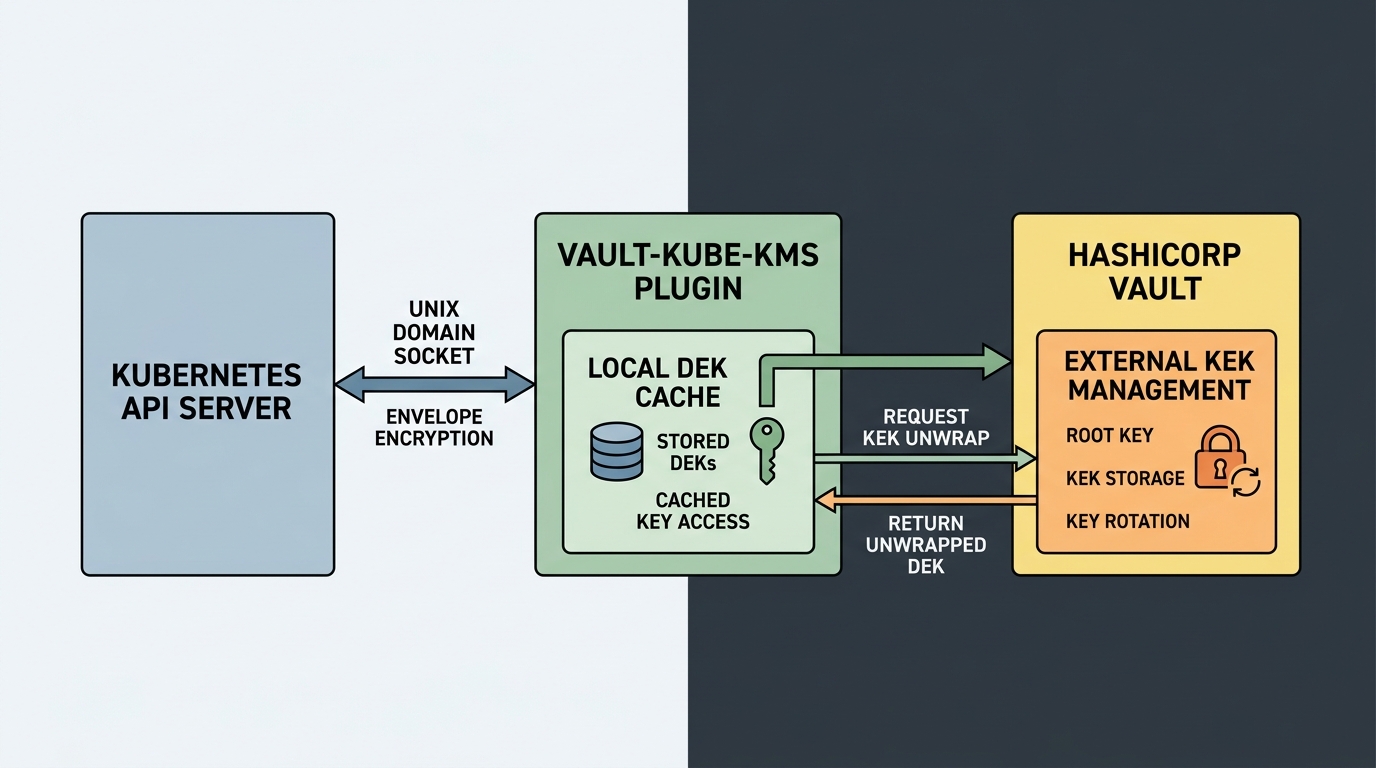
This architecture dramatically reduces the round-trip latency to Vault. Furthermore, KMS v2 introduces a structured status API that allows the Kubernetes API server to perform active health checks on the plugin, ensuring that encryption status is known before write operations are attempted.
Deployment and Configuration Mechanics
Implementing the vault-kube-kms plugin requires configuring both the plugin daemon and the Kubernetes API server. The plugin runs as a sidecar or a daemon on the control plane nodes, exposing a gRPC service over a local Unix domain socket. The Kubernetes API server is then configured to communicate with this socket.
Below is an example configuration for the Kubernetes API server's EncryptionConfiguration file, updated to leverage the KMS v2 provider with the Vault plugin:
apiVersion: apiserver.config.k8s.io/v1
kind: EncryptionConfiguration
resources:
  - resources:
      - secrets
    providers:
      - kms:
          apiVersion: v2
          name: vault-kms-provider
          endpoint: unix:///var/run/kms-plugin/vault-kms.sock
          timeout: 3s
When deploying this in your clusters, I recommend ensuring that the Unix domain socket directory (e.g., /var/run/kms-plugin/) is mounted as a shared hostPath volume between the vault-kube-kms container and the kube-apiserver pod. This ensures low-latency, secure communication isolated to the local host namespace.
Operational Advantages: Performance, Rotation, and Observability
In my analysis of the vault-kube-kms plugin, three operational advantages stand out as compelling reasons to plan a migration from legacy KMS v1 integrations:
1. High-Performance Secret Processing
By caching DEKs locally, the KMS v2 plugin eliminates the synchronous network hop to Vault for every secret write. This is particularly beneficial for large-scale GitOps pipelines or microservice architectures where deployments, config maps, and secrets are updated frequently. The reduction in API server latency directly translates to faster deployment times and less strain on your Vault cluster.
2. Seamless, Zero-Downtime Key Rotation
Under KMS v1, rotating the master key in Vault required a tedious manual process, often involving rolling restarts of the entire control plane to force the API server to pick up the new key. With KMS v2, the vault-kube-kms plugin supports dynamic key rotation. When you rotate the KEK in Vault, the plugin detects the new key version, automatically re-encrypts the local DEKs, and begins encrypting new secrets with the new key version. Existing secrets remain readable because the plugin can decrypt older DEKs using historical key versions still stored in Vault.
3. Standardized Health and Status Checks
KMS v1 plugins were notoriously difficult to monitor; the API server had no standardized way to verify if the plugin was healthy other than attempting an encryption operation. KMS v2 introduces a dedicated Status gRPC call. The vault-kube-kms plugin implements this to report its connection status to Vault, the validity of its authentication token, and the state of the encryption keys, allowing platform teams to build robust alerting around secret encryption health.
| Feature | KMS v1 (Legacy) | KMS v2 (vault-kube-kms) |
|---|---|---|
| Network Latency | High (synchronous call per secret) | Low (cached DEKs, asynchronous KEK calls) |
| Key Rotation | Requires API server restarts | Automated, dynamic re-encryption |
| Health Monitoring | Basic ping / none | Standardized Status API with detailed state |
| Vault Load | Proportional to secret write volume | Proportional to key rotation frequency |
Trade-offs, Limitations, and Production Considerations
While the public beta of vault-kube-kms is a major milestone, engineering leaders must weigh several trade-offs before deploying it to production environments.
First, because this is a public beta, I advise against running it in mission-critical production clusters immediately. Use this beta period to validate performance in staging environments, specifically testing how your control plane behaves during a simulated Vault outage.
Second, the dependency on Vault availability remains a critical path. Although the KMS v2 caching layer reduces the frequency of calls to Vault, a cold start of the API server or a plugin restart during a Vault outage will prevent the API server from decrypting secrets. You must ensure your Vault deployment is highly available, ideally utilizing raft-based storage across multiple availability zones.
Finally, access control to the Unix domain socket must be strictly guarded. Anyone with write access to the socket file can perform decryption operations. Ensure your host-level security policies (SELinux, AppArmor, or standard Linux permissions) restrict access to the socket directory solely to the kube-apiserver and the KMS plugin system users.
Conclusion
The release of the Vault Kubernetes Key Management v2 Plugin in public beta is a highly welcome advancement for cloud-native security. By moving to the KMS v2 standard, HashiCorp has resolved the primary performance and operational pain points of etcd envelope encryption.
If you are currently running KMS v1 integrations or relying on unencrypted etcd storage, my recommendation is clear: begin testing vault-kube-kms in your development and staging environments today. Use this beta period to update your Infrastructure-as-Code (IaC) templates, establish monitoring dashboards around the new KMS v2 status metrics, and prepare your teams for a smoother, more secure secret management workflow.