

The Edge as a Primary Attack Vector
In modern platform engineering, the API gateway is no longer just a routing mechanism; it is the primary security boundary for your entire microservices architecture. When CISA issues cybersecurity advisories or major platform providers update their development frameworks, the underlying message for engineering leaders is clear: passive defense is obsolete. Zero-day vulnerabilities targeting edge infrastructure and API gateways are rising in both frequency and sophistication.
As a technology editor and former systems architect, I have watched organizations struggle to balance rapid feature delivery with rigorous security posture management. When a critical vulnerability is disclosed, the window of exposure is often measured in hours, yet typical enterprise patching cycles take days or weeks. I want to share a pragmatic, hands-on strategy to harden your API gateways, automate your vulnerability response pipelines, and establish a resilient zero-trust architecture at the edge.
Vulnerability Vectors in API Gateways
API gateways are highly attractive targets because they sit at the intersection of public networks and internal trusted zones. A compromise here grants an attacker lateral access to your entire backend ecosystem. The vulnerabilities we see today typically fall into three categories:
- Request Smuggling and Parsing Discrepancies: Differences in how an edge proxy and a backend microservice interpret HTTP headers (such as
Transfer-EncodingandContent-Length) can allow attackers to smuggle malicious requests past security controls. - Insecure Deserialization and Remote Code Execution (RCE): Gateway plugins, custom filters, or underlying runtimes (such as Lua, JavaScript, or Java) may insecurely deserialize untrusted input, leading to immediate system compromise.
- Broken Object Level Authorization (BOLA): Even if the gateway is patched, a failure to validate user permissions at the edge can expose internal microservices to unauthorized data access.
To mitigate these risks, you must treat your gateway configuration as code, subject to the same rigorous static analysis and peer review as your application logic.
Implementing Zero-Trust at the Gateway Layer
To limit the blast radius of a gateway compromise, you must implement strict zero-trust principles. Do not assume that traffic passing through the gateway is safe. Every downstream microservice must verify the identity and authorization of incoming requests.
I recommend enforcing Mutual TLS (mTLS) between the gateway and your internal services, alongside cryptographically signed tokens (such as JWTs) for user authorization. If an attacker bypasses the gateway's routing logic, they still cannot access backend services without valid, short-lived credentials.
Here is an example of an Envoy proxy configuration snippet designed to mitigate request smuggling and enforce strict downstream TLS settings:
static_resources:
  listeners:
  - name: secure_ingress
    address:
      socket_address:
        address: 0.0.0.0
        port_value: 443
    filter_chains:
    - filters:
      - name: envoy.filters.network.http_connection_manager
        typed_config:
          "@type": type.googleapis.com/envoy.extensions.filters.network.http_connection_manager.v3.HttpConnectionManager
          stat_prefix: ingress_http
          # Enforce strict HTTP/1.1 parsing to prevent request smuggling
          http_protocol_options:
            accept_http_10: false
            default_host_for_http_10: false
          common_http_protocol_options:
            headers_with_underscores_action: REJECT_VALUE
          route_config:
            name: local_route
            virtual_hosts:
            - name: api_service
              domains: ["api.yourdomain.com"]
              routes:
              - match:
                  prefix: "/"
                route:
                  cluster: backend_service
                  timeout: 15s
This configuration actively rejects malformed headers containing underscores—a common vector for header injection—and strictly enforces HTTP/1.1 standards to prevent request smuggling attacks.
Automating Patching Pipelines and Vulnerability Response
When CISA publishes an active exploitation advisory, your response time is your primary metric of success. I advise against manual patching or ad-hoc server configurations. Instead, build a fully automated, immutable infrastructure pipeline.
Your API gateway instances should be treated as ephemeral. When a security patch is released:
- Automate Image Rebuilds: Trigger an automated CI/CD pipeline to rebuild your gateway base images using the latest patched dependencies.
- Canary Deployments: Deploy the new gateway version to a small subset of traffic (e.g., 5%) and monitor error rates, latency, and security logs for anomalies.
- Automated Rollback: If the canary deployment exhibits degradation, automatically roll back to the previous stable state and alert the on-call engineering team.
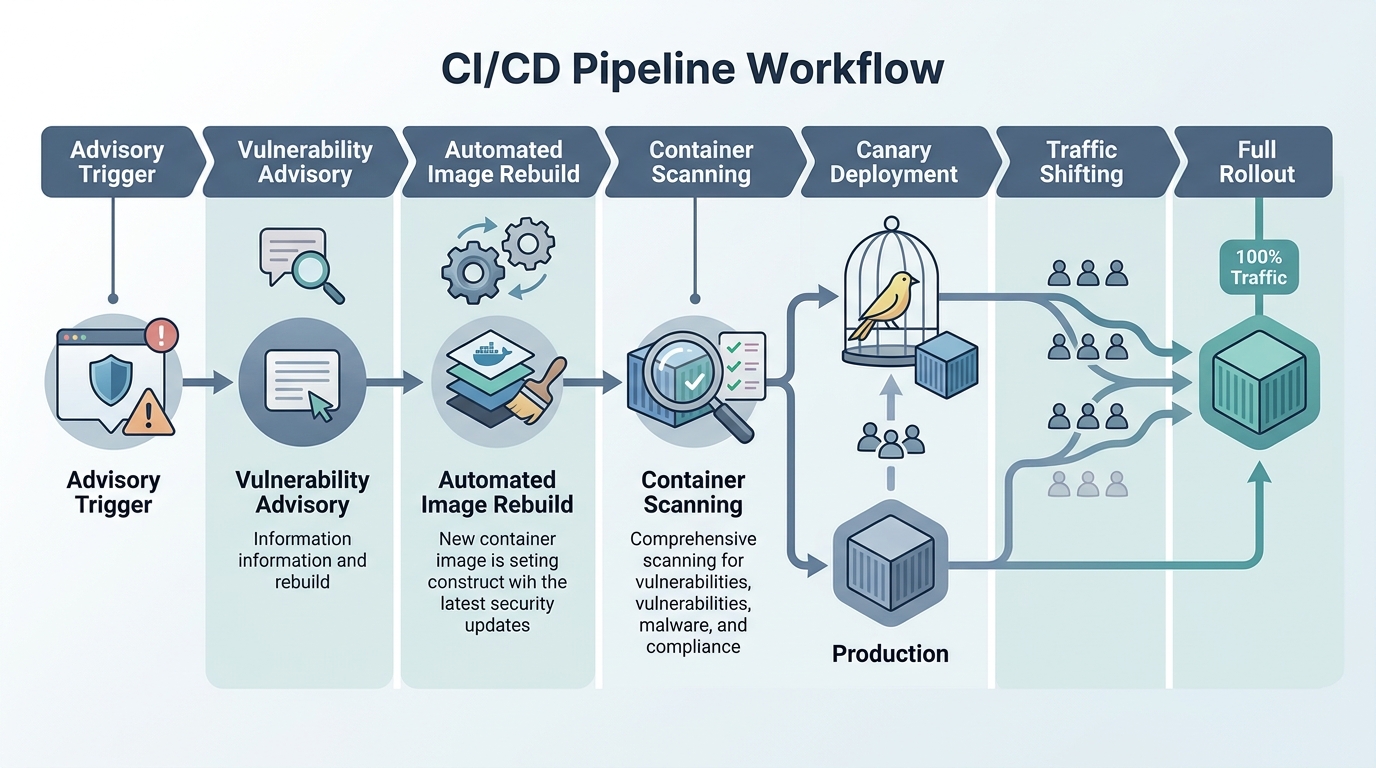
By decoupling the patching process from manual operator intervention, you can reduce your Mean Time to Remediate (MTTR) from days to minutes.
Hardening the Software Supply Chain
Securing the gateway is useless if the dependencies running inside it are compromised. Modern gateways rely heavily on third-party plugins, custom modules, and shared libraries. To secure this supply chain, I recommend implementing the following checklist:
| Practice | Objective | Implementation Action |
|---|---|---|
| Software Bill of Materials (SBOM) | Full visibility into dependencies | Generate an SBOM for every gateway build using tools like Syft or CycloneDX. |
| Vulnerability Scanning | Identify known CVEs early | Integrate container scanning (e.g., Trivy, Grype) directly into your CI/CD pull request checks. |
| Dependency Pinning | Prevent unexpected code updates | Pin all base images, libraries, and plugins to specific, cryptographic SHA-256 hashes rather than mutable tags like latest. |
| Least Privilege Execution | Limit runtime exploit capabilities | Run gateway containers as non-root users and disable write access to the root filesystem. |
Next Steps for Engineering Leaders
Securing your API gateway is an ongoing, dynamic process that requires a shift from reactive patching to proactive, automated defense. By treating gateway configurations as code, enforcing zero-trust boundaries, and automating your deployment pipelines, you can successfully insulate your organization from emerging zero-day threats. Your next action should be to audit your current gateway's HTTP parsing configurations and verify that your vulnerability response pipeline can deploy a patch within hours, not weeks.