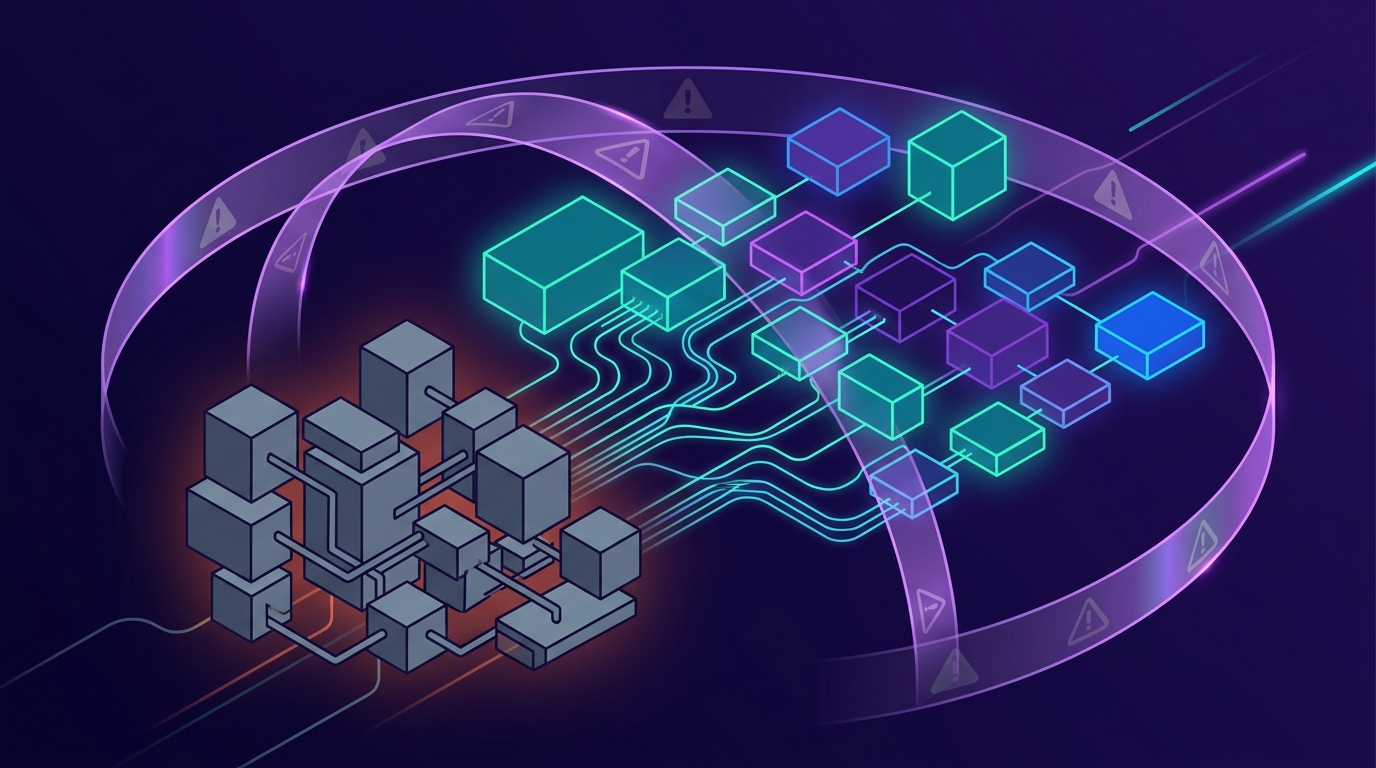
The Architectural Shift: Why Move from Zig to Rust?
To evaluate the technical reality behind Bun's rapid pivot, I must first analyze why the runtime was built in Zig, and why the team ultimately chose to pivot to Rust.
Zig is an imperative, low-level systems programming language designed as a robust alternative to C. It eschews hidden control flow, features manual memory allocation with explicit allocators, and relies heavily on comptime (compile-time code execution) rather than a traditional macro system. This design allowed Bun to achieve ultra-fast startup times and minimal overhead by tightly controlling memory layouts and system calls.
However, Zig is still a pre-1.0 language. Its ecosystem, tooling, and compiler stability are in constant flux. For a rapidly growing project like Bun, this created several friction points:
- Tooling and Package Management: Rust’s Cargo ecosystem is mature, offering a vast array of production-tested libraries (crates) for networking, parsing, and concurrency. Zig’s package management, while improving, is still nascent.
- Memory Safety and Concurrency: Zig relies on the developer to manage memory correctly. While its explicit allocator model is excellent for performance tuning, it does not offer the compile-time safety guarantees of Rust’s borrow checker. As Bun scaled its contributor base, maintaining memory safety in a highly concurrent environment became increasingly difficult.
- Developer Velocity and Hiring: The pool of experienced Rust developers is orders of magnitude larger than that of Zig developers. Transitioning to Rust lowers the barrier to entry for open-source contributors and enterprise hires alike.
While these factors justify a transition to Rust over a standard engineering lifecycle, attempting to execute this shift overnight via automated LLM translation bypasses critical safety and design phases.
The Mechanics and Risks of the 11-Day AI-Driven Migration
The core of the controversy lies in the methodology: using LLMs to rapidly translate Zig source files into Rust. In theory, LLMs are excellent at pattern matching and syntax translation. In practice, systems programming languages cannot be translated line-for-line without introducing subtle, catastrophic bugs.
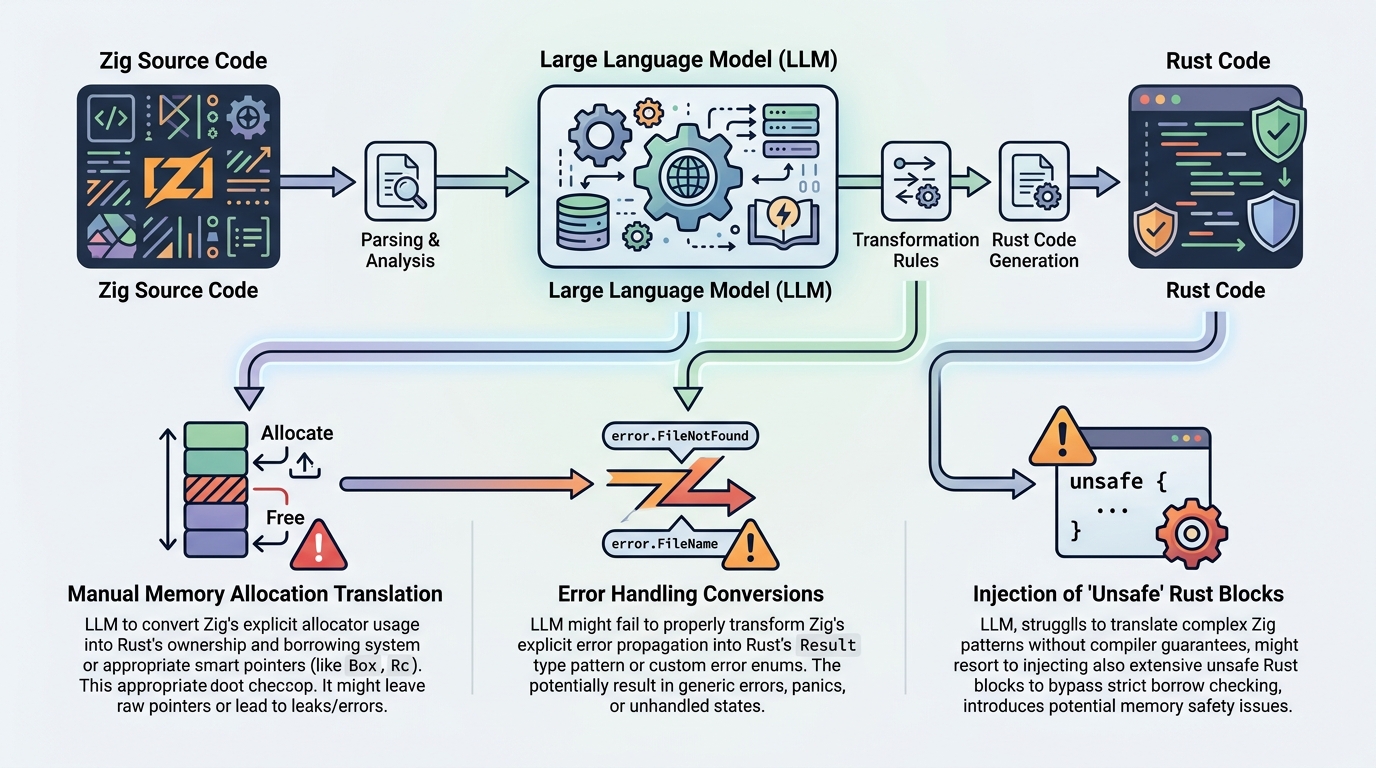
When translating between Zig and Rust, an LLM faces several fundamental paradigm mismatches:
1. Manual Allocation vs. Ownership and Lifetimes
In Zig, memory allocation is explicit. Functions accept an Allocator parameter, and the developer manually manages the lifecycle of the allocated memory. Rust, conversely, enforces memory safety at compile time using ownership, moves, and lifetimes. An LLM translating Zig to Rust often defaults to wrapping everything in raw pointers (*mut T), using unsafe blocks, or overusing reference counting (Rc and Arc). This defeats the primary safety benefits of migrating to Rust in the first place.
2. Error Handling
Zig uses error union types (e.g., anyerror!T) and the try keyword to propagate errors. Rust uses the Result<T, E> enum and the ? operator. While they look superficially similar, Rust’s error handling is deeply integrated with its trait system (std::error::Error). LLM translations frequently struggle to map custom Zig error sets to idiomatic Rust error enums, resulting in unmaintainable, nested match statements or excessive panics.
3. Compile-Time Metaprogramming
Zig’s comptime allows arbitrary code execution at compile time to generate types and optimize paths. Rust achieves metaprogramming through declarative and procedural macros. Translating complex comptime logic into Rust macros is incredibly difficult for an LLM, often leading to bloated, non-idiomatic code that is difficult to debug.
Here is a conceptual example of how a simple Zig memory-bound function translates poorly when processed naively by an LLM compared to an idiomatic Rust rewrite:
// Naive LLM Translation (Anti-pattern: preserving Zig's raw allocation style)
fn naive_translate(allocator: *mut std::ffi::c_void, size: usize) -> *mut u8 {
    unsafe {
        // The LLM mimics Zig's manual allocator passing, resulting in unsafe Rust
        let layout = std::alloc::Layout::from_size_align(size, 8).unwrap();
        std::alloc::alloc(layout)
    }
}

// Idiomatic Rust (What a human architect would design)
fn idiomatic_rewrite(size: usize) -> Vec<u8> {
    // Leverage Rust's safe, RAII-managed standard library types
    vec![0u8; size]
}
The Fallout: Technical Debt, Correctness, and Community Reaction
The immediate fallout of the "11-day migration" was a wave of concern from systems engineers and the creators of the languages involved. Andrew Kelley, the creator of Zig, noted a sense of relief when Bun announced the shift, acknowledging that Bun's aggressive, rapid-fire release cycle was often at odds with Zig's current state of development. However, the broader systems community quickly identified the structural debt left in the wake of the rapid rewrite.
When you rush a codebase translation using AI, you do not write idiomatic code; you write "transpiled" code. The resulting Rust codebase was plagued by:
- Abuse of
unsafe: To bypass the borrow checker and match Zig's pointer-heavy architecture, the AI-generated code relied heavily onunsafeblocks, nullifying Rust's primary safety guarantees. - Performance Regression: Zig's performance comes from precise control over memory layout and allocation strategies. Naive Rust translations often introduce unnecessary allocations, cloning, and indirection, degrading the very performance that made Bun famous.
- Maintenance Bottlenecks: While the code compiled, it was highly unidiomatic. Human maintainers struggled to read, debug, and extend the AI-generated Rust files because they lacked clean abstractions and idiomatic patterns.
This experiment demonstrated that while AI can accelerate the writing of code, it cannot accelerate the understanding of system boundaries and invariants. The time saved during the 11-day translation phase was quickly consumed by the subsequent weeks of debugging, profiling, and refactoring required to make the code production-ready.
Operational Lessons for Engineering Leaders
If you are considering an LLM-assisted migration or refactoring project, I recommend establishing strict guardrails to avoid the pitfalls experienced by the Bun team.
| Migration Phase | AI Role | Human Verification Required | Key Metric |
|---|---|---|---|
| 1. Architecture Mapping | Generates interface definitions and trait boundaries. | Architect reviews memory layouts, ownership boundaries, and API ergonomics. | Design Review Approval |
| 2. Code Translation | Translates isolated, pure functions (e.g., parsers, math utilities). | Developers rewrite stateful, concurrent, or I/O-bound modules manually. | Compiler warning/error count |
| 3. Safety & Idiom Audit | Analyzes code for patterns that can be refactored to remove unsafe. |
Security engineers audit all unsafe blocks and raw pointer usages. |
Percentage of unsafe code |
| 4. Validation & Profiling | Generates unit and integration tests based on original behavior. | Performance engineers run differential benchmarks against the original codebase. | Latency and memory delta |
My primary recommendation is to never use LLMs to translate state management or concurrency models across paradigm boundaries. Use AI strictly as a local assistant for translating stateless, well-defined utility functions. The high-level architecture, ownership boundaries, and concurrency strategies must remain firmly in the hands of human systems architects.
Conclusion
Bun's 11-day migration from Zig to Rust is a landmark case study in the limits of AI-driven systems engineering. It proved that while LLMs can generate syntactically valid code at an unprecedented scale, they cannot automatically resolve deep architectural mismatches between languages with fundamentally different safety models.
As engineering leaders, we must resist the temptation of the "quick rewrite." Codebase migrations are not merely exercises in syntax translation; they are deep redesigns of system invariants, memory lifecycles, and performance characteristics. True engineering velocity is not measured by how fast we can generate lines of code, but by how long that code remains safe, maintainable, and performant in production.