

On July 17, 2026, Moonshot AI announced Kimi K3, a flagship model boasting 2.8 trillion parameters, with a commitment to release its open weights by July 27, 2026. This move pushes open-weights architecture into a scale previously reserved exclusively for closed-source, proprietary APIs.
While the headline parameter count is staggering, my goal is to look past the marketing noise. For hands-on practitioners, a 2.8-trillion parameter model introduces massive architectural, infrastructure, and operational challenges. I want to analyze what Kimi K3 means for your infrastructure roadmap, how you can realistically prepare to serve a model of this scale, and the strategic trade-offs of adopting open-weights models at the multi-trillion parameter level.
Architectural Scale and the Infrastructure Reality
At 2.8 trillion parameters, running a dense model is economically and physically impractical for almost all enterprise environments. To make this scale viable, Kimi K3 leverages a Mixture of Experts (MoE) architecture. In an MoE setup, while the total parameter count is 2.8T, only a fraction of those parameters (the active parameters) are activated per token during inference.
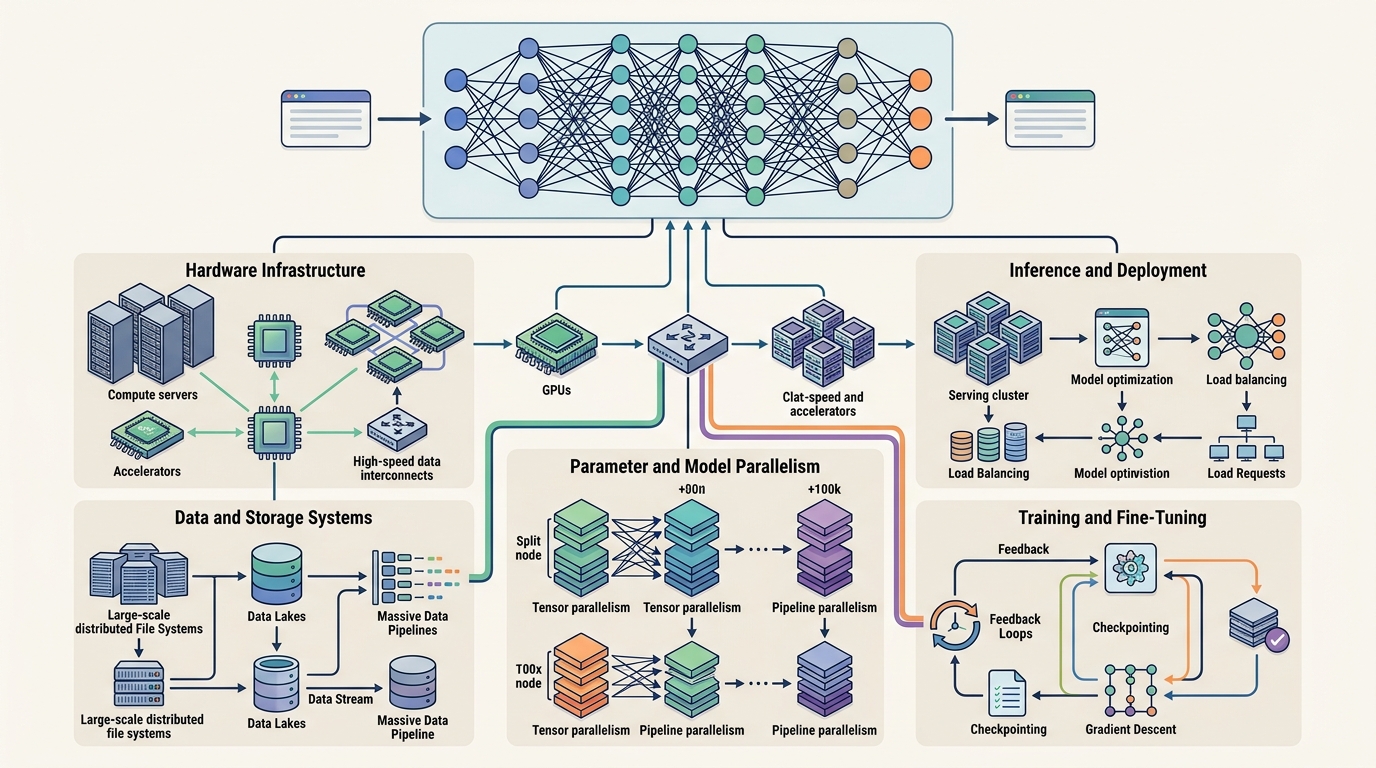
However, even with an MoE architecture that limits active compute per token, the entire 2.8T weight set must still reside in high-bandwidth memory (HBM) to avoid catastrophic latency bottlenecks during routing. Let us break down the raw memory math. At FP16 precision, a 2.8T model requires approximately 5.6 terabytes of VRAM just to load the weights, excluding the KV cache required for serving concurrent requests. Even at FP8 precision, the baseline memory requirement is 2.8 TB.
To put this into perspective, a standard HGX H100 node with 8x 80GB GPUs provides 640 GB of VRAM. To host Kimi K3 in FP8 without offloading, you would require an interconnected cluster of at least 5 to 6 HGX H100 nodes (40 to 48 GPUs) just for a single model instance. If you plan to use next-generation NVIDIA H200 (141GB VRAM) or B200 (192GB VRAM) systems, the node footprint decreases, but the network interconnect (InfiniBand or RoCE) remains critical to handle the massive inter-node communication overhead during expert routing.
Operationalizing 2.8T: Quantization and Serving Strategies
To make Kimi K3 accessible to enterprise deployments, aggressive quantization is not optional; it is a prerequisite. Moving from FP16 to FP8 or FP4 is the only viable path to reduce the hardware footprint to a manageable level.
Based on my analysis of similar MoE architectures, quantization introduces non-trivial challenges in routing stability. In MoE models, the gating network that routes tokens to specific experts is highly sensitive to precision loss. Quantizing the routing layers can lead to suboptimal expert selection, which degrades model accuracy far more than standard dense model quantization. Therefore, I recommend keeping the routing layers and critical attention blocks at FP16 or FP8, while quantizing the large expert feed-forward networks (FFNs) to INT4 or FP4.
Below is a conceptual configuration illustrating how you might configure a distributed inference engine, such as vLLM or TensorRT-LLM, to load a massive MoE model like Kimi K3 across multiple tensor-parallel and pipeline-parallel domains using FP8 quantization:
# Conceptual configuration for distributed MoE inference serving
from vllm import LLM, SamplingParams

def initialize_kimi_k3_service():
    # Configure tensor and pipeline parallelism for a 2.8T MoE model
    # Assuming a deployment across 4 nodes with 8x H200 (141GB) each (32 GPUs total)
    llm = LLM(
        model="moonshot-ai/kimi-k3",
        tensor_parallel_size=8,      # Intra-node tensor parallelism
        pipeline_parallel_size=4,    # Inter-node pipeline parallelism
        quantization="fp8",          # Utilize FP8 for expert weights
        trust_remote_code=True,
        max_model_len=32768,         # Set context window based on memory budget
        gpu_memory_utilization=0.90, # Reserve 10% for KV cache and system overhead
        enforce_eager=False          # Use CUDA graphs where possible for speed
    )
    return llm

if __name__ == "__main__":
    model = initialize_kimi_k3_service()
    print("Kimi K3 initialized successfully across distributed topology.")
To help you plan your infrastructure procurement, I have compiled an estimation of the minimum hardware configurations required to serve Kimi K3 across different quantization levels:
| Quantization Level | Estimated Weight Memory | Minimum GPU Node Requirement (8x 80GB H100) | Minimum GPU Node Requirement (8x 141GB H200) | Operational Complexity |
|---|---|---|---|---|
| FP16 (Unquantized) | ~5.6 TB | 10 Nodes (80 GPUs) | 6 Nodes (48 GPUs) | Extremely High (Complex inter-node routing) |
| FP8 (Recommended) | ~2.8 TB | 5 Nodes (40 GPUs) | 3 Nodes (24 GPUs) | High (Standard tensor/pipeline parallelism) |
| INT4 / FP4 | ~1.4 TB | 3 Nodes (24 GPUs) | 2 Nodes (16 GPUs) | Moderate (Requires specialized quantization kernels) |
The Strategic Shift in Open-Weights Ecosystems
Historically, enterprises chose closed-source APIs because the performance gap between open and closed models was vast. The release of Kimi K3 represents a structural shift. When a 2.8-trillion parameter model is open-weights, the raw capability gap narrows significantly.
However, you must weigh the strategic trade-offs of hosting Kimi K3 internally versus consuming frontier models via managed APIs:
- Data Sovereignty and Compliance: For industries with strict regulatory boundaries (finance, healthcare, defense), hosting a 2.8T model within your own virtual private cloud (VPC) or on-premise data center eliminates data leakage risks. This is the primary driver for adopting open weights at this scale.
- Total Cost of Ownership (TCO): Running a dedicated 32-GPU cluster 24/7 is incredibly expensive. If your query volume is low or highly variable, paying a managed API provider per token is far more cost-effective. Internal hosting only becomes economically viable when you have high, sustained throughput that fully utilizes the provisioned hardware.
- Customization and Fine-Tuning: With open weights, you can perform Parameter-Efficient Fine-Tuning (PEFT) or LoRA to specialize Kimi K3 on proprietary domain knowledge. Fine-tuning a 2.8T MoE model, however, requires specialized distributed training frameworks (like Megatron-LM) and substantial engineering expertise.
Conclusion
Moonshot AI’s Kimi K3 proves open-weights models can compete at the absolute frontier of AI scale. Yet, the sheer size of a 2.8-trillion parameter model means that deployment is not a trivial task. It demands rigorous planning around memory allocation, high-speed network interconnects, and aggressive quantization strategies.
My recommendation for engineering leaders is to approach Kimi K3 with a clear-eyed assessment of your infrastructure budget. Do not rush to host this model in-house unless your data security requirements mandate it or your token volume justifies the massive capital expenditure of dedicated GPU clusters. Start by evaluating quantized FP8 or INT4 versions in a test environment, measure the latency and accuracy trade-offs, and ensure your distributed serving stack is fully optimized before committing to production migration.