
Introduction
Engineering leaders today face a compounding security challenge: mitigating immediate, active exploits on edge infrastructure while simultaneously modernizing identity systems to prevent credential-based attacks. Recent advisories from the Cybersecurity and Infrastructure Security Agency (CISA) highlight a persistent trend of threat actors targeting edge gateways, firewalls, and virtual private networks (VPNs). Concurrently, updates from Google’s developer ecosystems emphasize the accelerating transition toward phishing-resistant authentication standards like Passkeys (WebAuthn).
I find that treating these two domains—infrastructure security and identity modernization—as separate initiatives is a tactical mistake. Edge vulnerabilities often serve as the initial access point, but compromised credentials are what allow lateral movement and long-term persistence. To build a resilient architecture, we must secure our network boundaries with zero-trust principles while systematically eliminating shared secrets at the application layer.
This article provides an operational guide to triaging edge vulnerabilities under active exploitation and implementing a robust, phishing-resistant authentication flow using WebAuthn.
Triaging Edge Gateway Vulnerabilities
When CISA issues an active exploitation advisory for an edge device—such as a reverse proxy, SSL-VPN gateway, or firewall—your incident response time is measured in hours, not weeks. These devices sit outside your traditional security perimeter, making them highly visible targets.
The Failure of Traditional Patch Management
I have observed that relying solely on standard maintenance windows for edge devices introduces unacceptable windows of exposure. When a zero-day vulnerability is actively exploited in the wild, patching must be treated as an emergency configuration change. However, patching can sometimes introduce regressions or configuration drift that disrupts business continuity.
To balance security and availability, I recommend a tiered mitigation strategy:
- Immediate Network Isolation: If a patch is unavailable, restrict management interfaces to trusted, source-IP-restricted administrative subnets. Disable any non-essential public-facing services (e.g., user portals on VPN gateways).
- Payload Inspection and Signature Matching: Deploy temporary Web Application Firewall (WAF) rules or Intrusion Prevention System (IPS) signatures to detect and block known exploit payloads targeting the vulnerability.
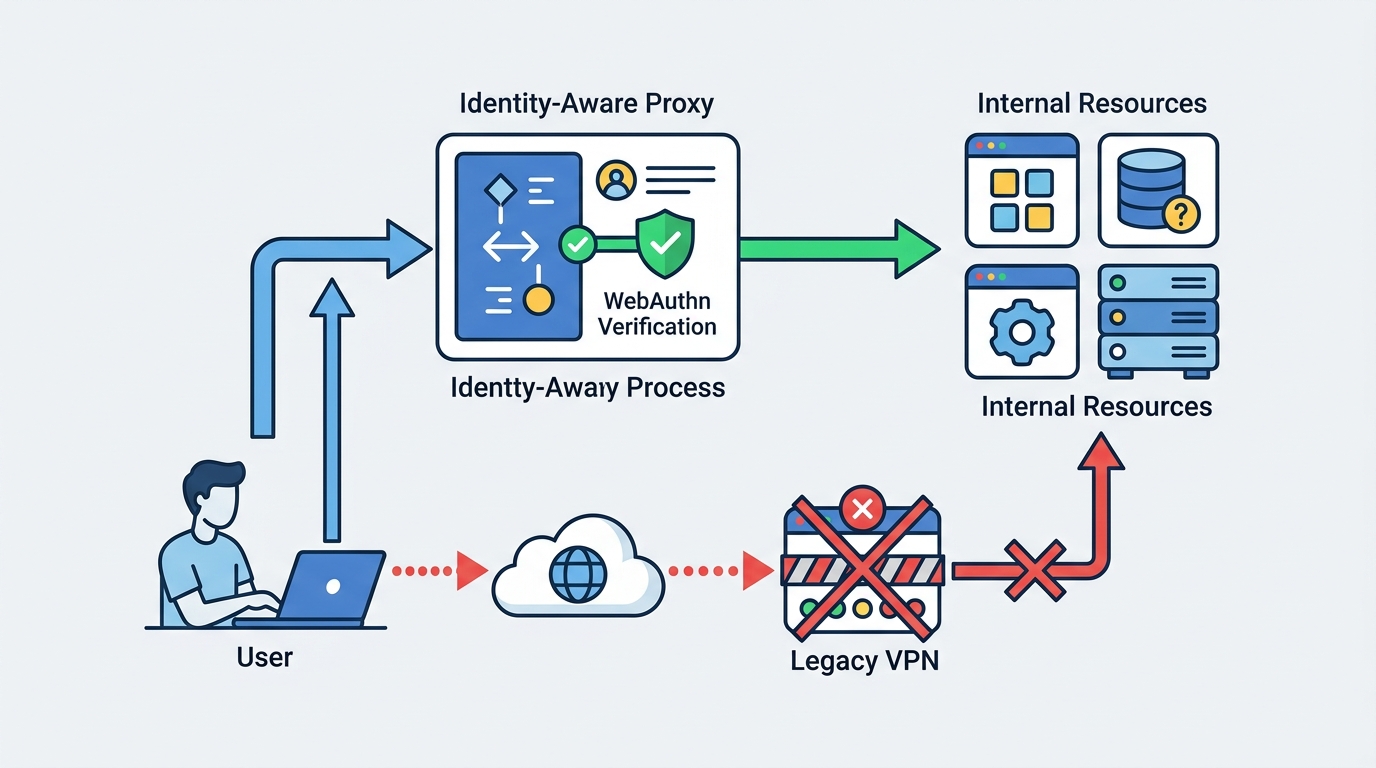
- Transition to Zero-Trust Network Access (ZTNA): Replace legacy inbound VPNs with an identity-aware proxy (IAP). An IAP evaluates identity, device posture, and context before granting access to internal resources, rendering edge vulnerabilities less exploitable because the gateway itself is not exposed directly to the public internet.
Implementing Phishing-Resistant Auth with WebAuthn
While securing the network layer prevents unauthorized access to infrastructure, securing user sessions requires eliminating the weakest link: reusable passwords and SMS-based multi-factor authentication (MFA). Google's developer updates consistently advocate for Passkeys, which leverage the WebAuthn standard to provide cryptographic, phishing-resistant authentication.
WebAuthn relies on public-key cryptography. During registration, the user's device (the authenticator) generates a unique public-private key pair. The private key remains securely stored on the device's hardware (such as a Secure Enclave), while the public key is sent to your application server.
The Registration Ceremony
To implement this, your backend must generate a unique, cryptographically secure challenge to prevent replay attacks. Here is a concise example of how to handle the credential creation options in a Node.js backend environment:
import crypto from 'crypto';

function generateRegistrationOptions(user) {
  return {
    challenge: crypto.randomBytes(32).toString('base64url'),
    rp: {
      name: "Your Enterprise Portal",
      id: "portal.example.com"
    },
    user: {
      id: Buffer.from(user.id).toString('base64url'),
      name: user.email,
      displayName: user.fullName
    },
    pubKeyCredParams: [
      { alg: -7, type: "public-key" }, // ES256
      { alg: -257, type: "public-key" } // RS256
    ],
    timeout: 60000,
    authenticatorSelection: {
      authenticatorAttachment: "platform",
      userVerification: "required",
      residentKey: "required"
    }
  };
}
Key Implementation Trade-offs
When deploying WebAuthn, you must make explicit architectural decisions regarding authenticator types:
- Platform Authenticators (Passkeys): Built into the user's device (e.g., Touch ID, Face ID, Windows Hello). They offer low friction and high adoption rates. However, they rely on the underlying operating system's cloud synchronization mechanism (e.g., iCloud Keychain or Google Password Manager) to sync keys across a user's devices.
- Roaming Authenticators: Physical security keys (e.g., YubiKeys). These do not sync and require physical possession. I recommend mandating roaming authenticators for high-privilege accounts (such as system administrators and database operators) while allowing platform authenticators for general staff to minimize friction.
A Unified Security Architecture
To achieve true operational resilience, you must bind your network security controls to your identity provider. If an edge gateway is compromised, a robust identity layer acts as a secondary containment boundary.
| Security Layer | Legacy Approach | Modern Resilient Approach |
|---|---|---|
| Network Boundary | Public-facing SSL-VPN with open ports | Identity-Aware Proxy (IAP) with zero public listening ports |
| User Identity | Passwords + SMS/TOTP MFA | Passwordless Passkeys (WebAuthn) with device-bound keys |
| Device Trust | Any device with valid credentials | Managed devices with verified MDM certificates and active endpoint protection |
| Access Control | Static, role-based network segments | Dynamic, context-aware authorization policies evaluated per request |
By combining these modern approaches, you ensure that even if an attacker discovers a zero-day vulnerability in your external boundary, they cannot easily pivot. They would still need to bypass a phishing-resistant authentication challenge and present a trusted device posture to gain access to any internal resource.
Conclusion
Securing modern technology operations requires moving away from reactive patching cycles and legacy perimeter models. When CISA issues an advisory, use it as an opportunity to evaluate whether that vulnerable asset should exist on the public internet at all. Simultaneously, leverage the mature WebAuthn ecosystem championed by Google and other major platform vendors to eliminate shared credentials.
My recommendation for your next engineering cycle is to audit your public-facing edge infrastructure, identify any legacy VPNs, and draft a migration plan to transition your highest-privilege users to hardware-bound Passkeys.