

The Gateway as the Hardened Trust Boundary
In modern distributed architectures, the API gateway is no longer just a routing mechanism; it is your primary trust boundary. As security advisories from agencies like CISA continue to highlight sophisticated edge-device exploits and zero-day vulnerabilities, engineering leaders must treat the API gateway as a critical security enforcement point.
When I analyze the intersection of infrastructure hardening guidelines and modern API design, a clear gap emerges. Infrastructure teams often focus on network-level perimeter defenses, while application teams focus on payload validation and business logic. The API gateway must bridge this gap. Relying solely on internal network isolation is a dangerous anti-pattern. If an attacker bypasses your perimeter or exploits a vulnerability in a public-facing service, an unhardened gateway will route malicious payloads deep into your private network.
To protect downstream microservices from external exposure, I recommend enforcing strict protocol validation at the gateway level. This means rejecting malformed HTTP requests, non-compliant headers, and unexpected HTTP methods before they reach your internal routing table.
Furthermore, rate limiting and traffic shaping must be applied globally and per client identity. Simple volumetric rate limiting is insufficient. I advise implementing token-bucket or leaky-bucket algorithms that differentiate between unauthenticated public endpoints and authenticated high-throughput internal service-to-service communication.
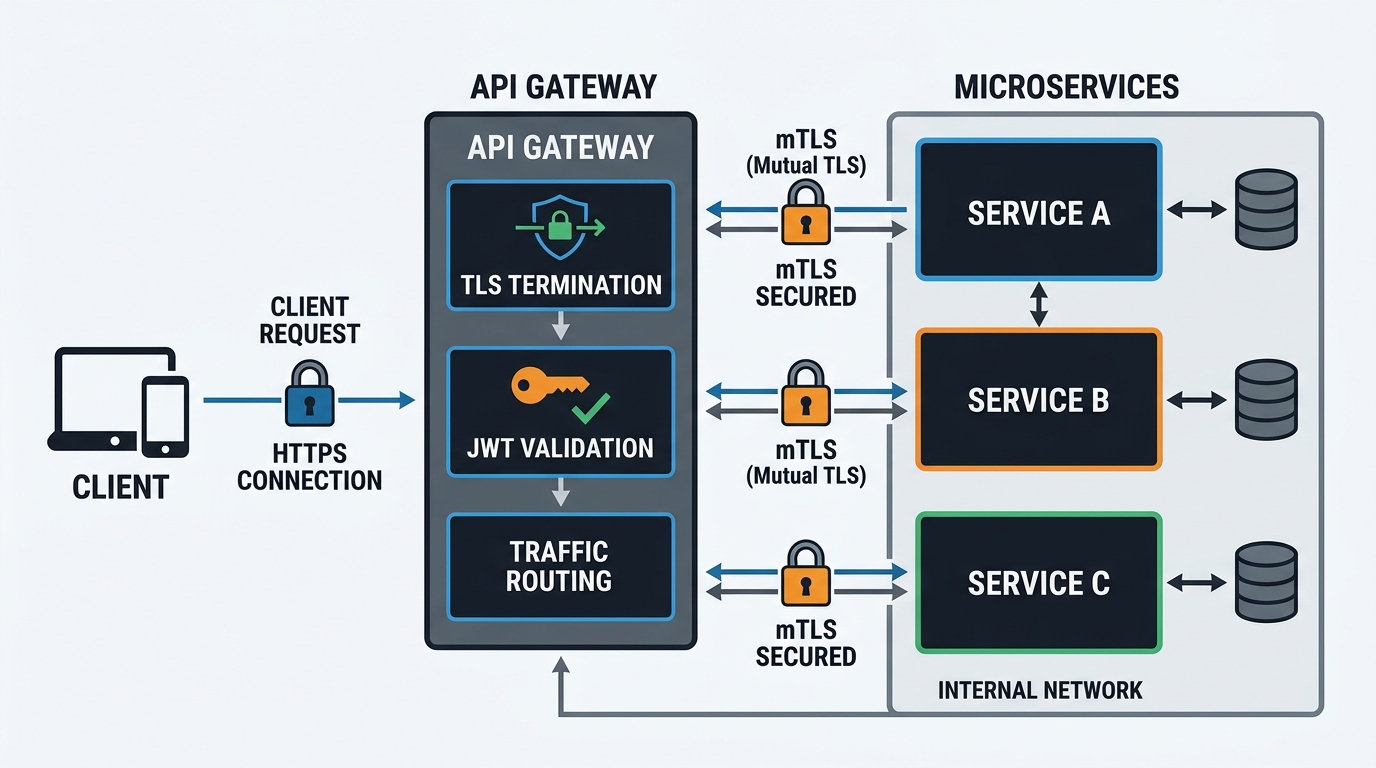
Finally, you must decouple public-facing API contracts from internal microservice topologies. Revealing internal path structures, technology stacks (via headers like X-Powered-By), or detailed stack traces in error responses provides attackers with a roadmap of your system. Your gateway should sanitize all outbound headers and transform generic system failures into standardized, safe error contracts.
Implementing Zero-Trust at the API Layer
Transitioning to a zero-trust architecture requires validating every request, every time, regardless of its origin. Within your API gateway, this is achieved by combining mutual TLS (mTLS) for transport-layer security with robust token-based authorization for application-layer security.
I recommend offloading TLS termination to your gateway or a dedicated load balancer, but you must not let the traffic flow unencrypted from there. Implement mTLS from the gateway to your internal microservices. This prevents lateral movement within your cluster if a single container is compromised.
For authentication, the gateway should validate incoming JSON Web Tokens (JWTs) or OAuth2 access tokens at the edge. This validation must include:
- Cryptographic Signature Verification: Fetching public keys via a secure, cached JSON Web Key Set (JWKS) endpoint.
- Expiration and Replay Checks: Rejecting expired tokens and maintaining a short-lived revocation list for compromised tokens.
- Scope and Claim Verification: Ensuring the token contains the necessary scopes for the requested path before forwarding the request downstream.
Here is an Envoy proxy configuration snippet demonstrating how to enforce JWT validation and claim extraction at the gateway level:
http_filters:
  - name: envoy.filters.http.jwt_authn
    typed_config:
      "@type": type.googleapis.com/envoy.extensions.filters.http.jwt_authn.v3.JwtAuthentication
      providers:
        identity_provider:
          issuer: https://auth.internal.enterprise.com
          audiences:
          - api.enterprise.com
          remote_jwks:
            http_uri:
              uri: https://auth.internal.enterprise.com/.well-known/jwks.json
              cluster: jwks_cluster
              timeout: 1s
            cache_duration: 300s
      rules:
        - match:
            prefix: /api/v1/secure
          requires:
            provider_name: identity_provider
By executing this validation at the edge, you shield downstream microservices from processing unauthorized requests, saving compute resources and reducing the attack surface of your internal applications.
Managing Vulnerability and Dependency Drift
Hardening your configuration is only half the battle. Software vulnerability management is a continuous operational challenge. As CISA frequently warns, unpatched vulnerabilities in edge software are among the most common vectors for initial enterprise access.
To mitigate this risk, you must treat your API gateway configuration and runtime as immutable infrastructure. Do not make manual, ad-hoc changes to gateway configurations in production. Instead, manage your gateway configurations via a declarative GitOps workflow.
I recommend establishing a strict, automated pipeline for dependency updates and vulnerability scanning. This involves three key practices:
| Practice | Implementation Action | Expected Outcome |
|---|---|---|
| Software Bill of Materials (SBOM) | Generate an SBOM for every gateway container build using tools like Syft or Trivy. | Complete visibility into transitively imported libraries and runtime dependencies. |
| Automated Patching | Configure automated pull requests (e.g., via Renovate or Dependabot) to bump gateway base images weekly. | Reduced exposure window to known CVEs in underlying operating system libraries. |
| Canary Deployments | Route a small percentage of production traffic (e.g., 1-5%) to newly patched gateway instances. | Early detection of regression bugs or routing anomalies without impacting the entire user base. |
Furthermore, you must design your system to handle gateway failures gracefully. If your gateway experiences an outage or a sudden performance degradation due to a surge in traffic, downstream services should degrade gracefully rather than cascading into a total system failure. Implement circuit breakers and fallback responses directly at the gateway to preserve system availability.
Actionable Next Steps
To put these concepts into practice immediately, I recommend taking three concrete actions:
- Audit your current API gateway configurations to ensure that public-facing error messages do not leak internal system details or stack traces.
- Implement edge-level JWT validation to offload cryptographic verification overhead from your internal microservices.
- Integrate automated container scanning and SBOM generation into your API gateway deployment pipeline to catch library vulnerabilities before they reach production.