

Introduction
As engineering leaders, we are constantly caught in a structural tension: the security team demands immediate mitigation of the latest vulnerabilities, while the development team must maintain feature velocity. When agencies like the Cybersecurity and Infrastructure Security Agency (CISA) release urgent cybersecurity advisories, the traditional response is to trigger an ad-hoc fire drill. Developers are pulled from their sprints to patch dependencies, often without clear context on whether the vulnerability is actually exploitable in their specific runtime environment.
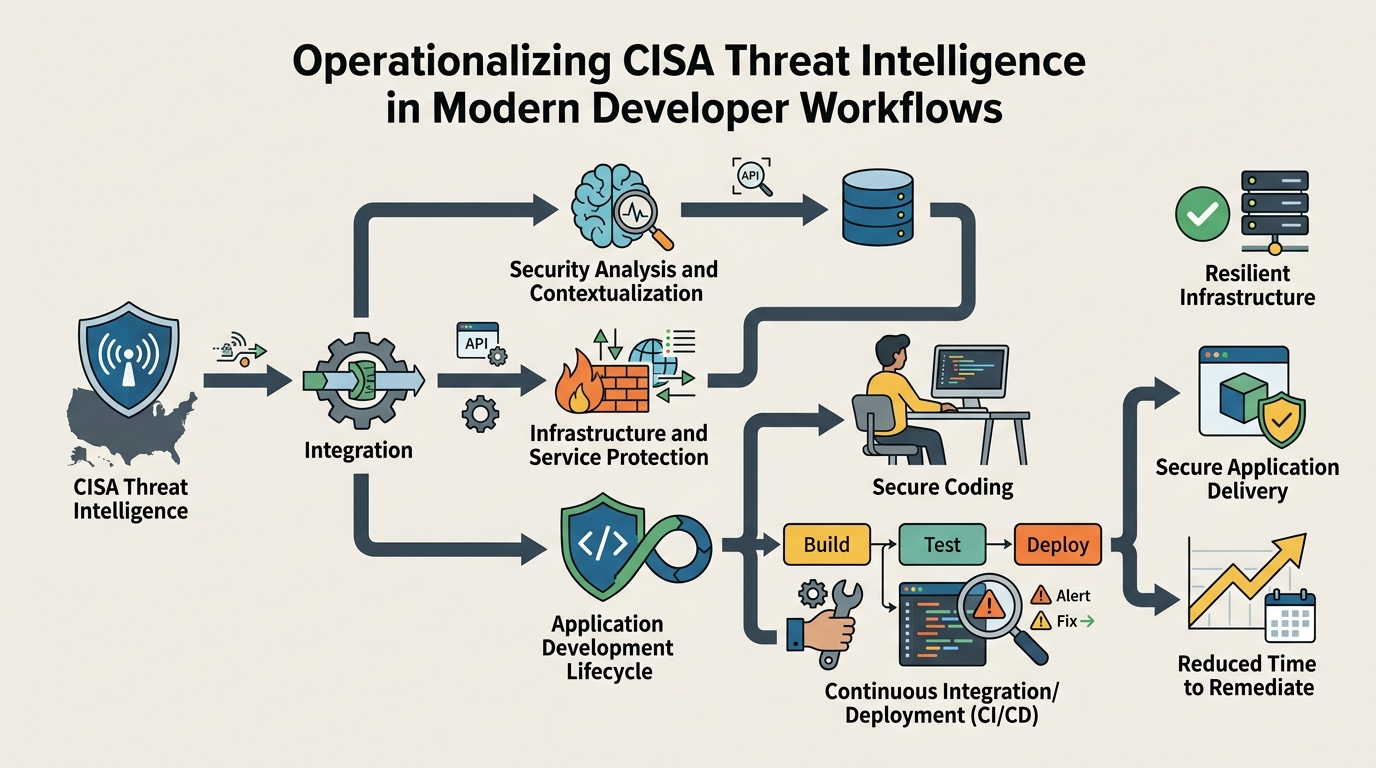
This reactive model is broken. To build resilient systems, we must bridge the gap between upstream threat intelligence and modern developer workflows. By integrating automated vulnerability prioritization—such as CISA’s Known Exploited Vulnerabilities (KEV) catalog—directly into our continuous integration and continuous deployment (CI/CD) pipelines, we can transition from chaotic firefighting to structured, secure-by-design engineering. Here is how I approach operationalizing threat intelligence to protect our systems without stalling developer momentum.
The Anatomy of Modern Threat Prioritization
Not all vulnerabilities are created equal. A Common Vulnerabilities and Exposures (CVE) identifier with a Common Vulnerability Scoring System (CVSS) score of 9.8 might seem like an immediate priority. However, if that vulnerability exists in an unreachable code path or requires a configuration that your system does not use, the actual risk to your organization is near zero.
Conversely, a CVSS 7.5 vulnerability that is actively being exploited in the wild by threat actors poses an immediate, existential threat. This is where CISA’s KEV catalog becomes invaluable. It filters out the noise of theoretical vulnerabilities and focuses exclusively on those with documented, active exploitation.
To operationalize this, I recommend moving away from generic vulnerability scanning reports that overwhelm developers with hundreds of low-context alerts. Instead, your security tooling should cross-reference your Software Bill of Materials (SBOM) with active threat feeds. If a dependency appears in your codebase and is listed in the KEV catalog, it must bypass the standard sprint planning cycle and trigger an automated escalation.
Implementing Secure-by-Design Defaults
While prioritizing active exploits keeps us safe today, it does not solve the systemic issue of recurring vulnerability classes. The long-term solution requires adopting "secure-by-design" principles, a philosophy championed by both CISA and major engineering organizations like Google.
Secure-by-design means eliminating entire classes of vulnerabilities at the compiler or framework level, rather than relying on developers to write flawless code. For example, memory safety vulnerabilities (such as buffer overflows and use-after-free bugs) have historically made up the majority of critical exploits. Transitioning new service development to memory-safe languages like Rust or Go, or utilizing memory-safe APIs in managed environments, systematically eliminates these risks.
When designing APIs and microservices, I enforce the following architectural boundaries to limit the blast radius of any single compromise:
- Strict Input Validation at the Gateway: Never allow unvalidated payloads to reach downstream internal services.
- Least-Privilege Service Identities: Use short-lived, cryptographic identities (such as SPIFFE/SPIRE or cloud-native IAM roles) rather than long-lived API keys.
- Network Microsegmentation: Ensure that a compromise in a public-facing web service does not allow lateral movement to database segments.
Practical Automation: Filtering SBOMs Against the KEV Catalog
To make this actionable, we can automate the intersection of our internal dependency tracking with CISA's real-time vulnerability data. Below is a practical Python script that demonstrates how to parse a standardized CycloneDX SBOM (in JSON format) and cross-reference its vulnerabilities against CISA's KEV API.
This script can be integrated into your CI/CD pull request checks to automatically fail builds or flag high-priority security reviews if an actively exploited vulnerability is introduced.
import json
import sys
import urllib.request

CISA_KEV_URL = "https://www.cisa.gov/sites/default/files/feeds/known_exploited_vulnerabilities.json"

def fetch_cisa_kev():
    """Fetches the latest Known Exploited Vulnerabilities catalog from CISA."""
    try:
        with urllib.request.urlopen(CISA_KEV_URL) as response:
            data = json.loads(response.read().decode())
            # Extract CVE IDs into a set for O(1) lookup
            return {vuln["cveID"] for vuln in data.get("vulnerabilities", [])}
    except Exception as e:
        print(f"Error fetching CISA KEV catalog: {e}", file=sys.stderr)
        sys.exit(1)

def parse_sbom_cves(sbom_path):
    """Extracts CVE identifiers from a CycloneDX JSON SBOM."""
    cves = set()
    try:
        with open(sbom_path, "r") as f:
            sbom = json.load(f)
            # Iterate through vulnerabilities if present in the SBOM
            for vuln in sbom.get("vulnerabilities", []):
                id_str = vuln.get("id", "")
                if id_str.startswith("CVE-"):
                    cves.add(id_str)
    except FileNotFoundError:
        print(f"SBOM file not found: {sbom_path}", file=sys.stderr)
        sys.exit(1)
    return cves

def main(sbom_path):
    print("Fetching active threat intelligence from CISA...")
    kev_set = fetch_cisa_kev()

    print(f"Parsing SBOM: {sbom_path}...")
    sbom_cves = parse_sbom_cves(sbom_path)

    # Find the intersection of active exploits and our SBOM
    active_exploits = sbom_cves.intersection(kev_set)

    if active_exploits:
        print("\n[!] CRITICAL SECURITY ALERT: Active exploits detected in your dependencies!")
        for cve in active_exploits:
            print(f"  - {cve} is listed in CISA's Known Exploited Vulnerabilities catalog.")
        # Exit with non-zero code to fail CI/CD pipeline
        sys.exit(1)
    else:
        print("\n[+] No actively exploited vulnerabilities found in SBOM.")
        sys.exit(0)

if __name__ == "__main__":
    # Example usage: python check_kev.py sbom.json
    if len(sys.argv) < 2:
        print("Usage: python check_kev.py <path_to_cyclonedx_sbom.json>")
        sys.exit(1)
    main(sys.argv[1])
Operationalizing the Vulnerability Lifecycle
To scale this approach across multiple engineering teams, you need a clear operational framework. I use a simple triage matrix to determine how my teams respond to security alerts. This prevents alert fatigue and ensures that engineering capacity is directed where it matters most.
| Vulnerability Status | In CISA KEV Catalog? | Action Required | SLA for Remediation |
|---|---|---|---|
| Critical / High | Yes | Out-of-band hotfix; immediate deployment | Under 24 hours |
| Critical / High | No | Prioritize in the next sprint planning session | 14 Days |
| Medium / Low | Yes | Assess reachability; patch in current sprint | 7 Days |
| Medium / Low | No | Standard dependency update cycle | Next Scheduled Release |
By establishing these clear SLAs, you remove the subjectivity from vulnerability management. Developers know exactly what is expected of them, and security teams have a predictable, measurable standard for risk reduction.
Conclusion
Securing modern software systems is not about achieving zero vulnerabilities; it is about managing risk intelligently. By integrating authoritative threat intelligence like CISA's advisories directly into our development lifecycles, we can filter out the noise and focus on the threats that present actual, immediate risk.
My recommendation for engineering leaders is to start small: automate your SBOM generation, cross-reference it with the KEV catalog, and establish clear, non-negotiable SLAs for actively exploited vulnerabilities. Over time, pair this reactive discipline with secure-by-design architectural defaults to systematically eliminate entire classes of bugs before they ever reach production.