

Introduction
As engineering leaders, we are constantly balancing the velocity of feature delivery against the hardening of our production systems. The recent batch of cybersecurity advisories from CISA, alongside updated engineering guidelines from major platform providers like Google, highlights a persistent reality: the perimeter is no longer a static wall. It is a dynamic, software-defined boundary governed by API contracts, access tokens, and containerized microservices.
When a zero-day vulnerability is disclosed or an active exploitation campaign is identified, your response time is determined by decisions made months prior during the architectural design phase. In my experience, organizations that rely solely on reactive patching find themselves in a perpetual state of fire-fighting. Conversely, teams that build defense-in-depth directly into their API gateways and deployment pipelines can mitigate entire classes of vulnerabilities before a patch is even compiled.
I want to analyze how to translate these high-level security advisories into concrete architectural patterns, focusing specifically on API gateway hardening, input validation, and automated policy enforcement.
Hardening the API Gateway as the First Line of Defense
The API gateway is the ingress point for almost all modern application traffic. It is also the primary target for attackers seeking to exploit deserialization flaws, broken object-level authorization (BOLA), or injection vulnerabilities. When CISA issues an advisory regarding a remote code execution (RCE) vulnerability in an upstream dependency, your gateway is your immediate mitigation lever.
I recommend implementing strict schema validation at the gateway tier. Rather than passing arbitrary JSON payloads directly to downstream microservices, your gateway should validate incoming requests against a pre-defined OpenAPI or gRPC specification. If a request contains unexpected fields, malformed types, or excessive payload sizes, the gateway must drop it immediately with a 400 Bad Request status.
This approach neutralizes many zero-day exploits that rely on sending unexpected payloads to trigger edge cases in downstream parsers. Here is an example of how I configure a declarative request validation policy in an API gateway configuration (such as Envoy or Kong) using an OpenAPI schema filter:
apiVersion: gateway.envoyproxy.io/v1alpha1
kind: SecurityPolicy
metadata:
  name: api-ingress-validation
  namespace: production
spec:
  targetRef:
    group: gateway.envoyproxy.io
    kind: HTTPRoute
    name: core-api-route
  requestValidation:
    openApiSpec:
      local:
        filename: /etc/gateway/specs/core-api-v1.yaml
    rejectOnFailure: true
    logViolations: true
By enforcing this configuration, you ensure that downstream services—which may be running older, vulnerable runtimes—never receive the malformed payloads that trigger memory corruption or injection flaws.
Implementing Zero-Trust Network Architecture (ZTNA) Internally
Securing the ingress point is only half the battle. If an attacker bypasses the gateway or exploits a vulnerability in a public-facing service, you must prevent lateral movement. This is where zero-trust network architecture (ZTNA) transitions from a buzzword into a technical necessity.
In my architectural reviews, I look for two primary controls: mutual TLS (mTLS) with cryptographic identity verification, and fine-grained authorization policies.
- Cryptographic Identity (SPIFFE/SPIRE): Do not rely on IP addresses or network namespaces for trust. Every microservice should be issued a short-lived, cryptographically verifiable identity document (SVID). This ensures that Service A can only communicate with Service B if explicitly authorized by a central policy.
- Least-Privilege Authorization: Just because Service A is allowed to establish a TLS connection to Service B does not mean it should have unrestricted access to all HTTP methods. I advocate for enforcing path-level and method-level restrictions at the sidecar proxy level.
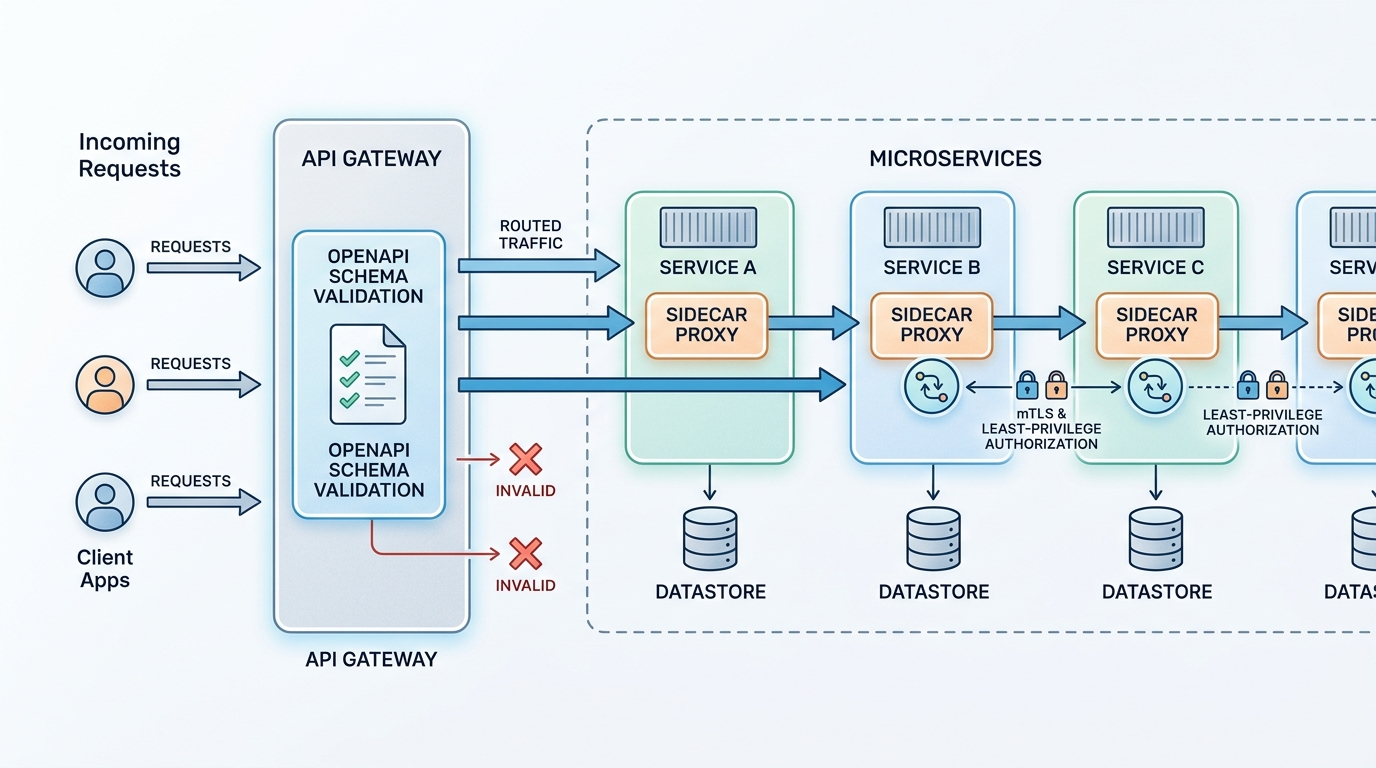
This architecture ensures that even if an RCE vulnerability is successfully executed within the container of Service A, the attacker cannot pivot to the database or sensitive internal APIs, as the sidecar proxy will block unauthorized outbound requests.
Operationalizing Vulnerability Management and Automated Patching
When a high-severity advisory is published, your security operations team needs an automated, repeatable way to assess exposure. Manual inventory checks are too slow and prone to human error.
I recommend establishing a continuous Software Bill of Materials (SBOM) pipeline. Every time a container image is built, your CI/CD pipeline must generate a cycloneDX or SPDX-compliant SBOM and sign it using a tool like Cosign. This artifact is then stored alongside the container image in your registry.
When a new vulnerability is disclosed, you can query your container registry or runtime environment for the specific package version across your entire fleet in seconds.
Here is a practical checklist I use to evaluate an organization's readiness to respond to urgent security advisories:
| Capability | Target Metric | Implementation Tooling |
|---|---|---|
| Vulnerability Discovery | < 1 hour from advisory publication to impact analysis | Trivy, Grype, Dependency-Track |
| Image Provenance | 100% of production images cryptographically signed | Cosign, Kyverno, Sigstore |
| Patch Deployment | < 4 hours for critical CVEs via automated canary | ArgoCD, Flux, GitHub Actions |
| Runtime Blocking | Immediate virtual patching via WAF/Gateway policy | Cloudflare WAF, Envoy WAF filters |
Conclusion
Securing modern technology operations is not about preventing every single vulnerability from entering your codebase; it is about building a resilient architecture that minimizes the blast radius when a vulnerability is inevitably found. By enforcing strict schema validation at your API gateway, implementing zero-trust microservice communication, and maintaining an automated, queryable inventory of your software supply chain, you shift your security posture from reactive firefighting to proactive mitigation.
As a next step, I recommend auditing your current API gateway configurations. Identify your top three public-facing endpoints and implement strict OpenAPI schema validation on them this week. This single action will eliminate a significant portion of your attack surface.
If you want to learn more, you can check out this article: https://ixuvo.com/blog/securing-boundary-zero-day-api-gateways