

The Edge as a Single Point of Failure
As an engineering leader, I have watched the API gateway evolve from a simple reverse proxy into the most critical security boundary in modern infrastructure. It is no longer just a traffic router; it is the primary gatekeeper for your entire microservices topology. Yet, many organizations treat gateway security as a secondary configuration task rather than a core architectural discipline.
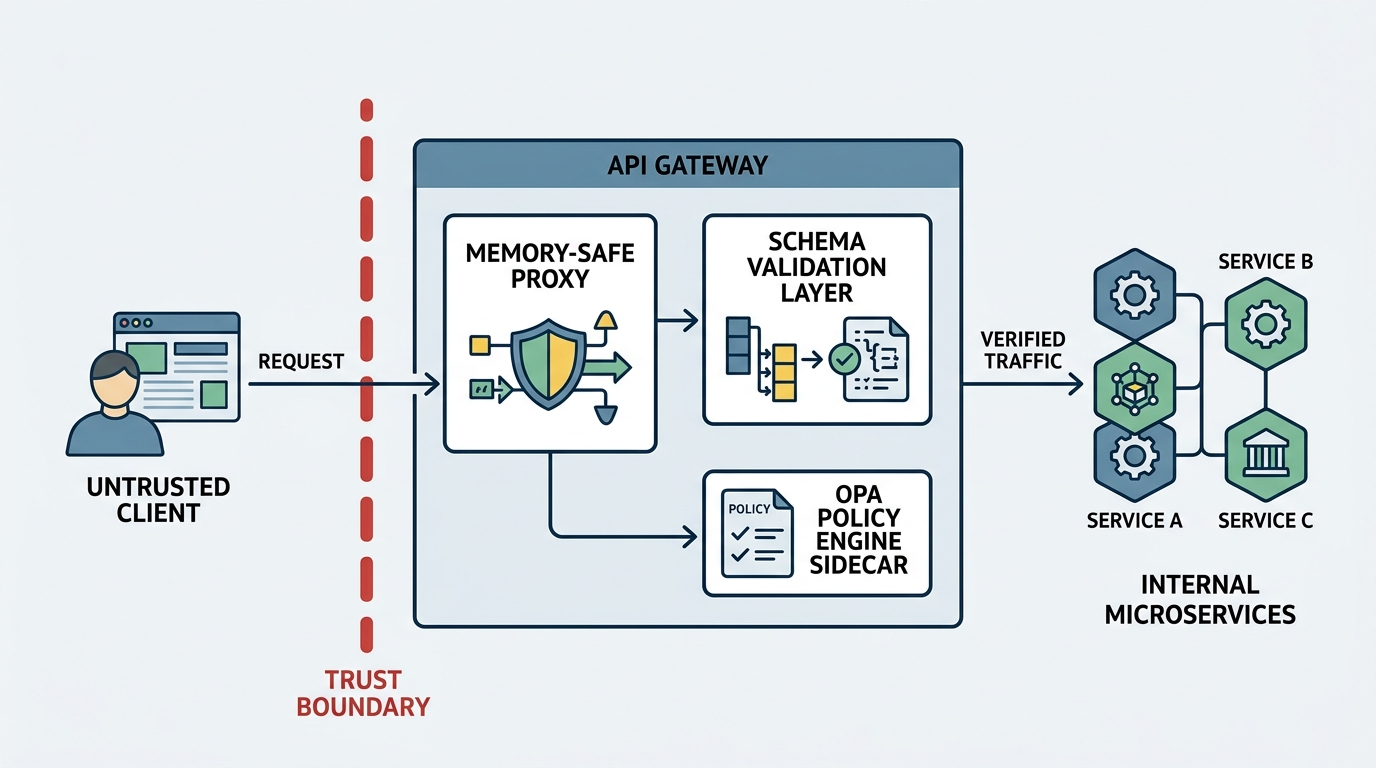
Recent advisories from the Cybersecurity and Infrastructure Security Agency (CISA) and continuous updates from major cloud providers underscore a critical shift: we must design our edge systems to be secure by default. In my analysis of edge failures, relying on reactive patching is a losing strategy. Instead, I advocate for a three-pronged hardening strategy: migrating to memory-safe proxy runtimes, enforcing zero-trust input validation at the ingress point, and automating policy-as-code to eliminate vulnerability classes before they reach downstream services.
1. The Shift to Memory-Safe Edge Proxies
For decades, high-performance edge proxies were written in C or C++ to maximize throughput and minimize latency. However, this performance came at a massive cost: memory safety vulnerabilities like buffer overflows, use-after-free errors, and memory leaks. CISA has repeatedly emphasized that memory safety issues constitute a significant portion of exploited zero-days in edge appliances.
When I evaluate edge infrastructure, I prioritize runtimes built on memory-safe languages such as Go or Rust, or proxies that isolate untrusted code. For example, while Envoy is written in C++, its extensibility model has shifted toward WebAssembly (Wasm) runtimes. This allows you to write custom filters in Rust or Go that run in a sandboxed environment, preventing a bug in a custom plugin from compromising the entire proxy process.
If you are building high-throughput microservices, the trade-offs between pure performance and memory safety are clear. The minor CPU overhead of garbage collection in Go or the compilation complexity of Rust is a negligible price to pay compared to the catastrophic blast radius of a remote code execution (RCE) vulnerability at your ingress point.
2. Implementing Zero-Trust Input Validation
An API gateway should act as a strict schema validator. A common mistake I see is trusting downstream microservices to handle input sanitization. This is a direct violation of zero-trust principles. If an attacker bypasses your gateway or exploits a Server-Side Request Forgery (SSRF) vulnerability internally, unvalidated inputs can exploit downstream systems.
I advocate for enforcing strict OpenAPI or gRPC schema validation directly at the gateway layer. Every incoming request must match an explicit, allow-listed schema definition. If a request contains unexpected query parameters, malformed JSON bodies, or headers that violate your schema, the gateway must reject it immediately with a 400 Bad Request before it consumes downstream compute resources.
To implement this without degrading performance, you should leverage declarative configuration patterns. Below is an example of an Open Policy Agent (OPA) Rego policy that I use to enforce strict header and authorization checks at the gateway level before routing traffic to internal services:
package envoy.authz

default allow = false

token = t {
    auth_header := input.attributes.request.http.headers.authorization
    startswith(auth_header, "Bearer ")
    t := substring(auth_header, count("Bearer "), -1)
}

allow {
    [valid, header, payload] := io.jwt.decode_verify(token, {
        "cert": opa.runtime()["env"]["JWT_PUBLIC_KEY"],
        "aud": "https://api.yourdomain.com"
    })
    valid

    input.attributes.request.http.method == "GET"
    re_match("^/v1/users/[a-zA-Z0-9_-]+$", input.attributes.request.http.path)

    payload.sub == user_id_from_path(input.attributes.request.http.path)
}

user_id_from_path(path) = id {
    parts := split(path, "/")
    id := parts[3]
}
By offloading this authorization logic to an engine like OPA running adjacent to your gateway (for instance, as a sidecar), you decouple security policy from your application code. This ensures that even if a developer forgets to implement authorization checks in a new microservice, the gateway acts as a fail-safe.
3. Automating Vulnerability Management and Policy as Code
Securing your gateway is not a one-time configuration; it is a continuous lifecycle. As new vulnerabilities are discovered, your deployment pipelines must automatically detect and mitigate them. I recommend treating your gateway configurations, rate-limiting rules, and routing tables as code (GitOps).
To ensure your edge remains resilient, I recommend integrating the following checks directly into your CI/CD pipelines:
| Pipeline Stage | Security Control | Technical Implementation |
|---|---|---|
| Static Analysis | Configuration Linting | Scan gateway YAML/JSON configurations for over-permissive routing, missing TLS settings, or disabled rate limiting using tools like Kubeval or Conftest. |
| Dependency Scanning | Software Bill of Materials (SBOM) | Generate and scan SBOMs for your gateway container images to detect CVEs in underlying libraries (e.g., OpenSSL, glibc) before deployment. |
| Dynamic Testing | Fuzzing & DAST | Run automated dynamic application security testing (DAST) against a staging instance of your gateway to identify unexpected crash behaviors or memory leaks. |
| Runtime Monitoring | Anomaly Detection | Monitor gateway metrics for sudden spikes in 4xx/5xx errors, high latency, or unusual payload sizes, which often indicate active exploitation attempts. |
By enforcing these gates, you prevent misconfigured routing rules or vulnerable gateway binaries from ever reaching production. This aligns directly with CISA's guidance on reducing systemic risk through automated, repeatable verification processes.
Next Steps for Engineering Leaders
My recommendation for your next sprint is to audit your current gateway configuration. Identify where input validation is occurring, verify whether your gateway runtime is susceptible to memory-safety exploits, and begin planning the transition to a declarative, policy-as-code model. The resilience of your entire downstream architecture depends on the strength of your edge.