

The Shift to Active Knowledge Retrieval
Retrieval-Augmented Generation (RAG) is undergoing a structural paradigm shift within enterprise software architectures. In early deployments, RAG functioned as a linear, static process: systems fetched document chunks from a vector database based on semantic similarity and appended them directly to the large language model (LLM) prompt. While this naive approach helped reduce hallucinations for basic informational queries, it lacks the flexibility required for multi-step reasoning, real-time decision-making, and interactions with heterogeneous enterprise systems.
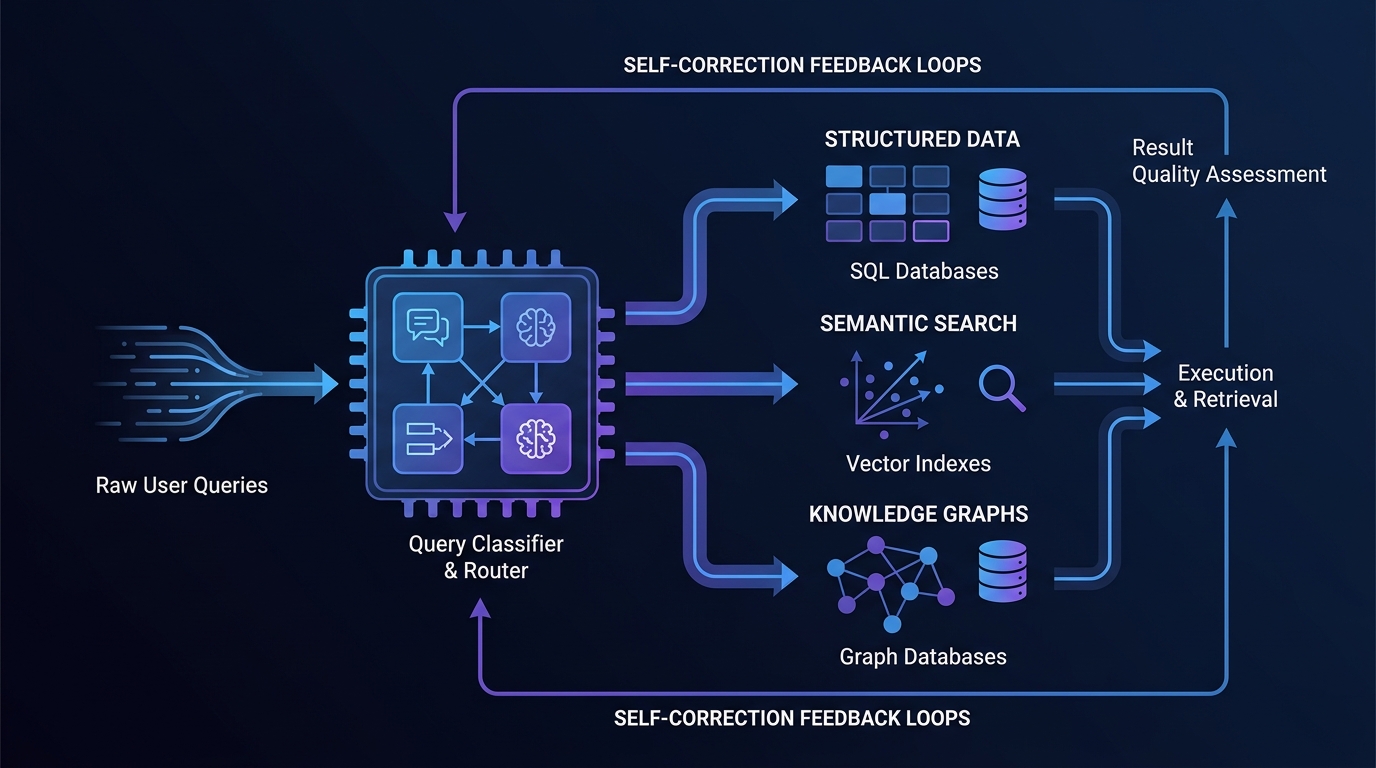
As organizations shift from isolated chat applications to autonomous, goal-oriented agentic systems, retrieval is transitioning from a passive utility to an active orchestration tool. Today, modern agentic systems construct workflows where retrieval is treated as a programmatic action. The system decides when to look up information, evaluates the quality of retrieved data, reformulates search parameters dynamically, and merges multiple disparate sources to resolve complex, open-ended tasks.
Dynamic Tool Use and Agentic Execution Loops
Within modern agentic frameworks, retrieval has evolved into an active decision-making layer. Instead of executing retrieval as a pre-processing step, the model itself serves as a controller. As industry analyses highlight, RAG has moved up the stack to form an active component of the reasoning loop, allowing systems to autonomously inspect state, parse user intent, and run targeted lookup tools.
This shift enables architectures to deploy iterative execution loops. Documentation on advanced agent behaviors from LightOn highlights how agents can query a system, detect informational gaps in the output, rewrite the query, and fetch additional context recursively until the objective is met. Such loops make it possible to parse vast databases without overwhelming the model's working memory.
Optimizing for Latency, Context Windows, and Operational Costs
The continuous expansion of LLM context windows has led some teams to question whether complex retrieval pipelines are still necessary. However, relying solely on massive context windows introduces severe architectural and financial penalties. Feeding entire file directories or high-volume databases directly into prompts results in linear cost escalation, since pricing scales with input token volume.
Analyzing current RAG implementations underscores that processing large context windows introduces prohibitive latency overhead, making real-time applications impractical for standard business requirements. Furthermore, models often suffer from decreased attention accuracy (known as the "lost in the middle" phenomenon) when digesting massive, unstructured context dumps.
To counter these challenges, targeted retrieval acts as a critical optimization filter. Technical deep dives published by AI with Aish demonstrate that precise context selection remains the main defense against runaway inference costs. By routing only the most relevant context blocks to the model, developers maintain low-latency response times and predictable token utilization rates.
Implementing Hybrid Storage and Fine-Tuning Pipelines
Building dependable agentic systems requires moving beyond basic vector database configurations. Modern enterprise architectures use hybrid storage strategies, combining dense vector search for semantic relationships with sparse keyword-based search (such as BM25) for specific identifiers like product codes, serial numbers, or legal citations. This dual approach ensures comprehensive retrieval across different data profiles.
In tandem with hybrid indexing, developments tracked in recent RAG updates indicate that organizations are increasingly utilizing domain-specific fine-tuning for embedding models and cross-encoders. Cross-encoders evaluate the exact relevance of retrieved information chunks, filter out noise, and pass only high-scoring data to the synthesis stage. These filtering stages ensure that the agent operates with clean, high-density facts, resulting in reliable outputs that minimize hallucinatory behaviors.