

The Evolution of Agentic Execution
The deployment of Large Language Models (LLMs) has transitioned from passive search assistants to active autonomous agents. These agentic workflows use dynamic tool-calling loops to query databases, trigger background transactions, and interface with third-party software. Consequently, the traditional security model—predicated on predictable human execution paths—collapses. In these architectures, the API layer is no longer just a backend interface; it is the primary execution surface for autonomous entities.
Securing agentic integrations demands a transition from static authorization keys and basic rate limiting to real-time, context-aware API defense. Because autonomous agents operate with high degrees of operational freedom, development and security teams must design APIs under zero-trust assumptions. Failing to establish this defensive boundary exposes enterprises to cascading execution failures, silent privilege escalations, and massive data leaks.
Structural Differences in Agentic Workflows
Traditional application programming relies on deterministic paths where every API interaction is predictable and hardcoded. Security teams write rules, define input sanitization models, and monitor predictable execution signatures to block anomalies.
Agentic AI disrupts this design. When an LLM utilizes tool-calling capabilities, it reads developer-provided OpenAPI specifications or JSON-RPC schemas to dynamically construct API payloads, sequence multiple endpoint calls, and execute transactions based on its reasoning engine and user prompts.
Because the model’s execution path is non-deterministic, security teams cannot rely on static threat signatures. If an agent is targeted by indirect prompt injection, it can be manipulated into executing unauthorized tools or fetching administrative resources. As explored in analyses on API security best practices for AI agents, securing these systems requires isolating the agent’s execution privileges from the underlying human user's context, maintaining clear boundaries between identities.
Critical Security Pillars for Agentic APIs
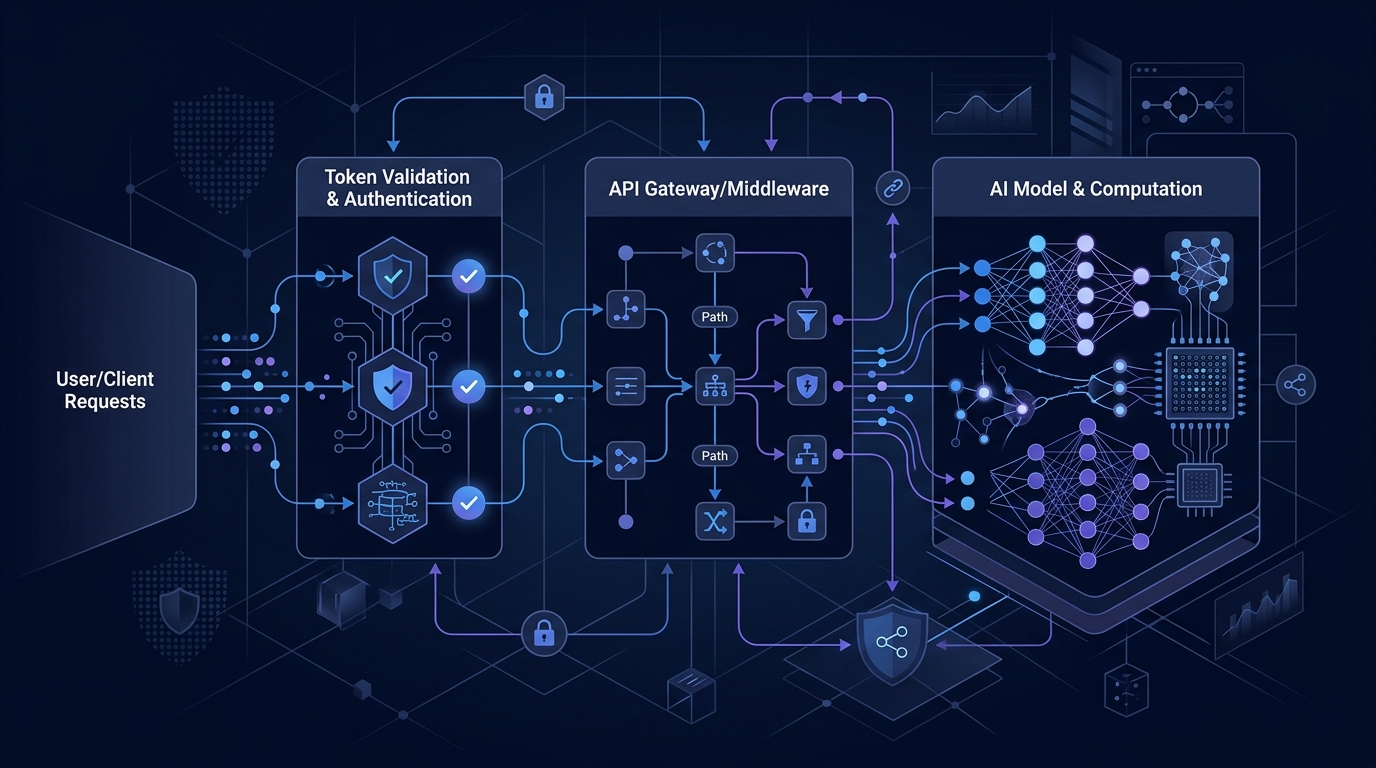
To secure autonomous agentic workflows, software architects and DevSecOps teams must establish a defense-in-depth architecture across three core engineering vectors.
1. Fine-Grained Delegated Authorization and Scope Management
Issuing a single, all-powerful API key to the LLM agent is a classic architectural error. This over-privileging pattern means a compromise in the agentic boundary grants full access to core systems. Developers must implement delegated authorization, ideally using OAuth 2.0 with minimal privilege profiles.
- Token Exchange and On-Behalf-Of Flows: Agents must not operate with independent, static credentials. Implement Token Exchange patterns to issue short-lived, scoped access tokens that inherit the intersection of the agent’s capabilities and the user's explicit permissions.
- Context-Bound Scopes: Restrict tokens to read-only scopes by default. If the agent needs to invoke state-changing endpoints (like database modifications or outbound mail transfers), require dynamic scope elevation or strict human-in-the-loop (HITL) manual confirmations.
- Ephemeral Validity Windows: Reduce token lifetime to the minimum duration necessary to complete the dynamic execution loop, mitigating the risk of intercepted tokens.
2. Payload Validation and Mitigation of Indirect Prompt Injection
Indirect prompt injection is a major threat vector for autonomous LLMs. This occurs when an agent processes raw external data containing hidden instructions. For instance, if an agent retrieves an email containing a malicious command, the LLM may interpret that data as a system instruction, forcing it to construct unauthorized API requests to delete user data or exfiltrate databases.
To secure the API layer against these attacks, implement strict boundary validation:
- Uncompromised Input Sanitization: Treat all LLM-constructed API parameters as untrusted inputs. Apply hard JSON-schema validation at the API gateway before executing any payload. Ensure parameters conform strictly to data types, regex patterns, and string lengths.
- Data Exfiltration Filters: Monitor and inspect outgoing API responses. Implement egress data-loss prevention (DLP) engines within the gateway to redact personally identifiable information (PII) or secrets before they are passed back to the model's context window.
- Domain Whitelisting: Restrict outbound network requests to predefined external domains. This prevents an injected prompt from forcing the agent to exfiltrate enterprise records to an attacker's server.