
Introduction
The software engineering landscape is experiencing a fundamental shift driven by autonomous AI coding agents. While these tools accelerate code generation velocity, traditional CI/CD pipelines are ill-equipped to handle the non-deterministic nature and massive volume of AI commits. Transitioning from experimental pilots to enterprise-grade operations requires a new class of DevOps infrastructure built specifically to manage, validate, and monitor agentic outputs. Recent industry developments illustrate how new pipeline tooling addresses these operational bottlenecks.
The Friction in Agentic Software Delivery
Traditional software pipelines assume a deterministic, human-driven workflow of writing tests, implementing features, and running static checks. AI coding agents disrupt this model by generating vast volumes of code within seconds, which introduces specific operational risks:
- Hallucinated Dependencies: Agents may include outdated or secure-vulnerable external libraries.
- Context Drift: Lacking architectural context, agents can introduce runtime regressions.
- High Commit Frequency: The sheer volume of pull requests easily overwhelms human reviewers.
To mitigate these issues, the industry is shifting toward automated, sandboxed validation layers that verify code integrity before standard tests run.
Next-Gen CI/CD: Orchestrating the Prompt-to-Production Pipeline
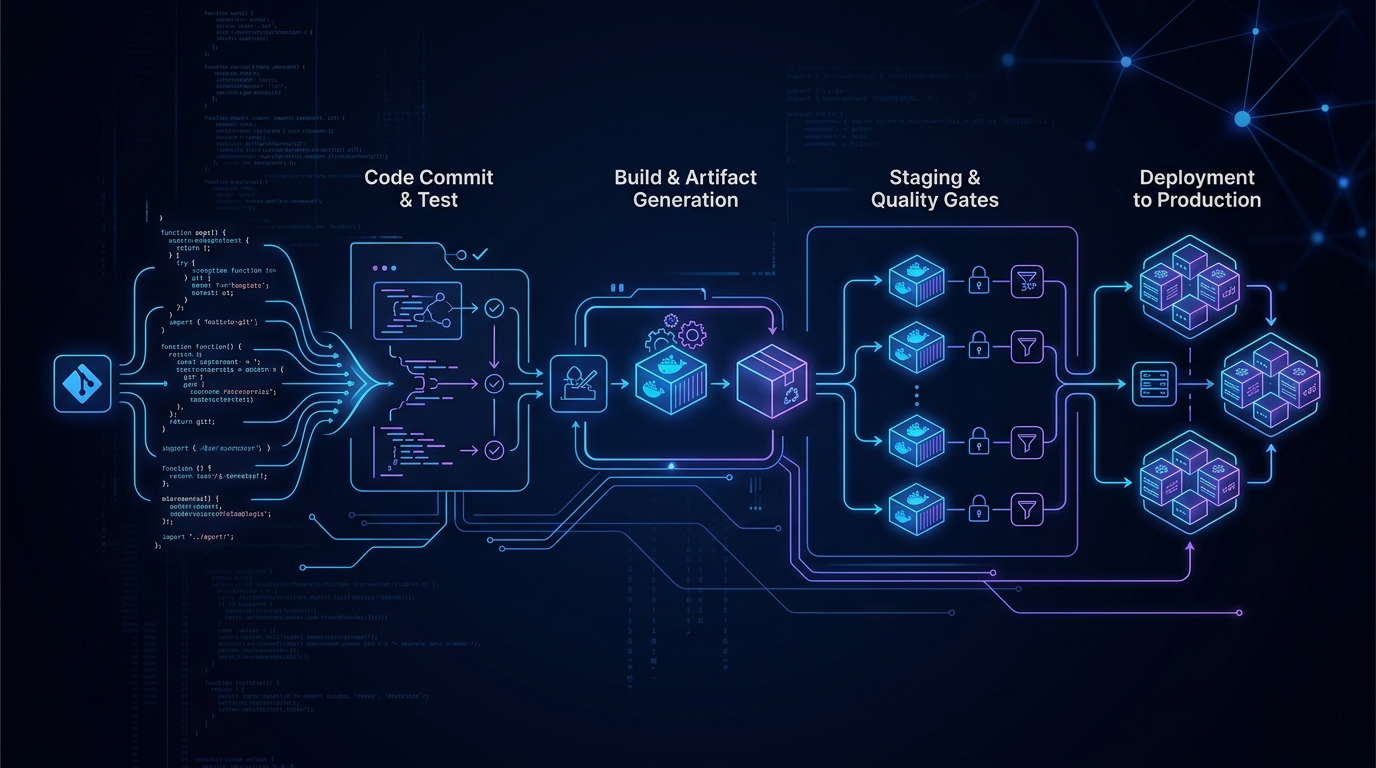
Modern software delivery requires specialized infrastructure. According to an analysis by InfoQ on Next-Gen CI/CD for AI-Generated Code, pipelines are evolving from static scripts into dynamic, interactive orchestration platforms that communicate execution errors back to the generating agent.
Key capabilities of prompt-to-production pipelines include:
- Isolated Ephemeral Sandboxes: Running agent-proposed changes in secure, containerized environments to verify compile-time and system runtime compatibility.
- Structured Semantic Feedback: Translating build failures into structured JSON payloads optimized for LLM consumption, enabling real-time self-correction.
- Dynamic Policy Engines: Evaluating compliance, credential leaks, and code quality automatically to block flawed commits early.
Enterprise Infrastructure and Self-Healing Deployments
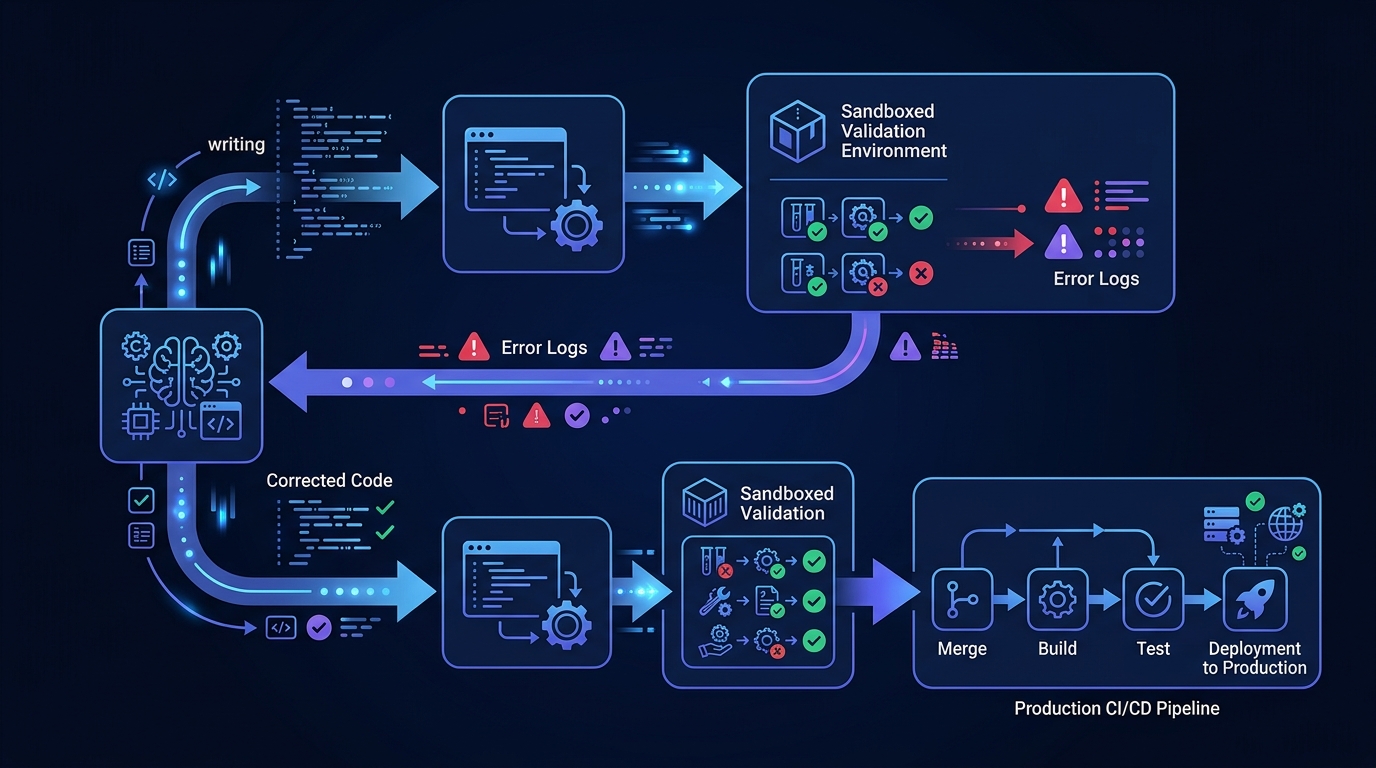
These validation capabilities are moving from theory into core platform features. As detailed in the GitHub Engineering Blog on Agentic Software Development, advanced DevOps integrations are optimized to automate execution loops. By pairing autonomous agents with native runtime environments, systems can execute self-healing protocols without human intervention.
When a pipeline failure occurs, the CI environment captures system logs, identifies the failed assertions, and feeds this state back to the agent controller. The agent analyzes the error, generates an adjusted diff, and pushes an updated commit. This loop continues until the codebase passes all operational gates. Consequently, human developers transition from tedious syntax debugging to strategic system validation.
Architectural Impacts on DevSecOps
Integrating AI coding agents changes the security calculus of DevSecOps. Security testing, including SAST and SCA, must execute programmatically in real-time during the integration loop to prevent prompt-injection risks or insecure library dependencies.
Access control is also critical. Pipelines must enforce the principle of least privilege, ensuring autonomous agents access only the repositories and deployment targets required for their specific tasks. This safeguards critical systems against compromised agents or configuration leaks during build cycles.
Conclusion
The full business value of AI coding agents is unlocked only when their output can be reliably deployed. Streamlining prompt-to-production workflows requires isolating test environments, automating semantic feedback loops, and employing self-healing CI pipelines. These advancements allow enterprises to deploy agentic code with high speed and robust security, shifting the developer bottleneck from writing code to system-level architectural design.