

The Operational Reality of Production Agents
For the past several years, engineering teams have struggled to transition AI agents from local developer sandboxes into reliable production systems. While building a prototype agent using basic orchestration frameworks is relatively straightforward, deploying that agent to operate autonomously within an enterprise environment is an entirely different challenge. The moment an agent is granted the agency to write code, call APIs, read databases, and make decisions on behalf of users, it introduces unprecedented security, reliability, and governance risks.
Traditional application infrastructure is designed for deterministic software. It assumes predictable execution paths, static access controls, and clear request-response lifecycles. AI agents, by their very nature, violate these assumptions. They are non-deterministic, stateful, long-running, and highly unpredictable. When we attempt to run these agents on standard serverless runtimes or container platforms, we quickly run into severe limitations: execution timeouts, lack of persistent state, complex human-in-the-loop (HITL) integration bottlenecks, and the massive security risk of executing model-generated code on internal networks.
To address this critical operational gap, OpenAI has introduced Presence, an enterprise-grade platform specifically engineered to deploy, run, and govern production AI agents at scale. In my analysis, Presence represents a fundamental paradigm shift in how we manage AI workloads. It moves the industry away from treating LLMs as stateless APIs and toward treating agents as managed, stateful, and highly secure processes.
In this article, I will analyze the technical architecture of OpenAI Presence, evaluate its sandboxing and governance mechanisms, examine how it handles state durability and human-in-the-loop workflows, and provide concrete implementation guidance for engineering leaders looking to operationalize agentic architectures.
The Architecture of Stateful, Sandboxed Agent Runtimes
To understand why a platform like Presence is necessary, we must first look at the architectural limitations of traditional compute runtimes when applied to agentic workflows. If you deploy an agent on a standard serverless function, the agent is bound by strict execution limits (often 15 minutes or less). However, an agent tasked with analyzing a repository, writing tests, and deploying a patch might need to run for hours, pausing repeatedly to wait for asynchronous compilation steps or human approvals.
Furthermore, agents require a secure environment to execute tools. If an agent decides to write and run a Python script to parse a CSV file, running that script directly on your application server exposes your entire infrastructure to remote code execution (RCE) vulnerabilities.
Presence solves these challenges by decoupling the agent's reasoning engine (the LLM) from its execution environment. It introduces a managed, stateful runtime that orchestrates three primary components: the agent controller, the secure execution sandbox, and the integration backend (such as Appwrite or custom enterprise databases).
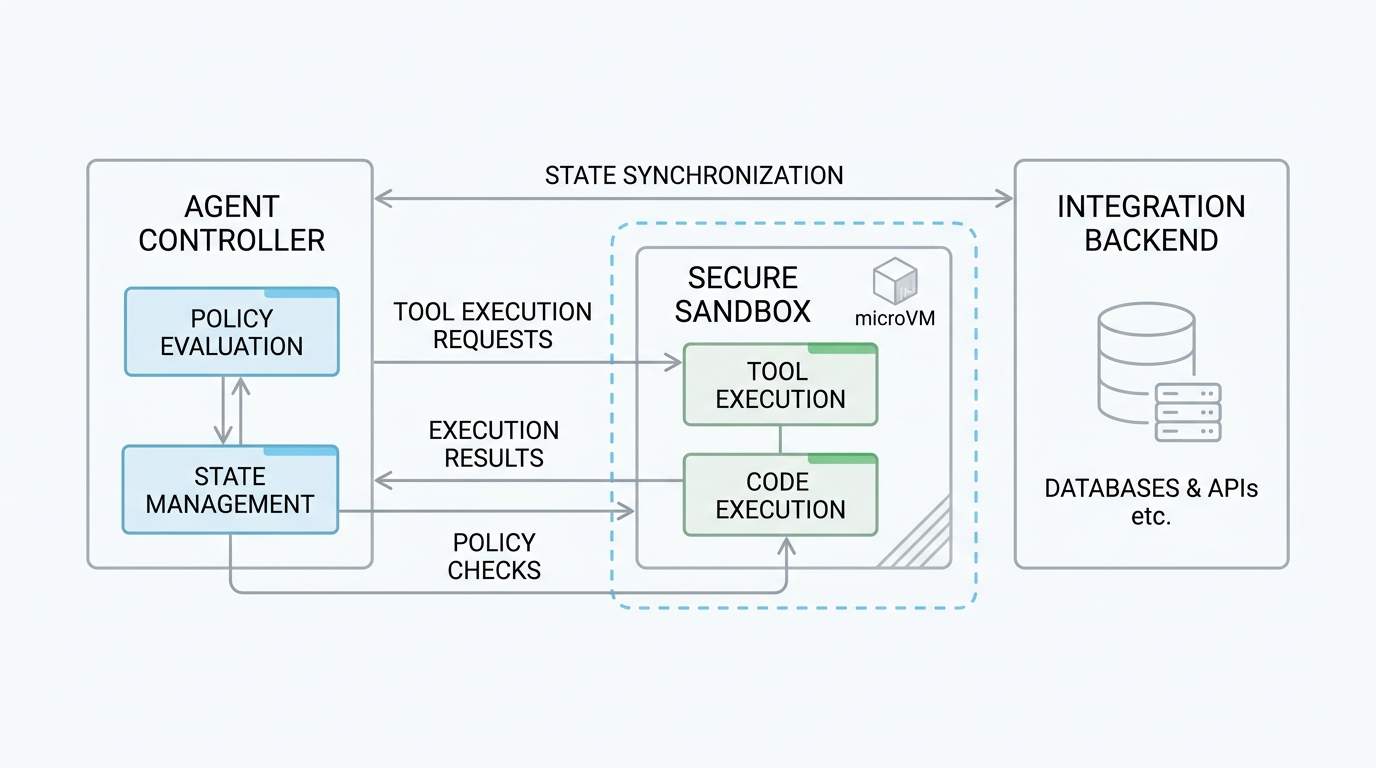
At the core of this architecture is the secure execution sandbox. Presence utilizes lightweight, highly isolated micro-virtual machines (microVMs) to execute agent-generated code and tool calls. These microVMs are ephemeral, provisioned in milliseconds, and strictly isolated at the hypervisor level. When an agent requests a tool execution—such as running a terminal command or executing a script—the Presence controller schedules that task inside the isolated microVM. The network interface of this sandbox is locked down by default; it can only communicate with pre-approved external APIs and designated internal endpoints through a secure proxy.
This runtime model relies heavily on integration backends to maintain state and manage external resources. For example, by integrating with Appwrite, Presence agents can leverage secure, out-of-the-box databases, file storage, and user authentication systems. Instead of building custom state-synchronization layers, the agent can read and write session data directly to a managed Appwrite database, using Appwrite's granular access control lists (ACLs) to ensure the agent never accesses data outside its authorized scope.
This architecture shifts the developer's responsibility. Instead of writing complex infrastructure code to manage container lifecycles, network isolation, and state persistence for every agent, you define the agent's capabilities, tools, and boundaries, leaving the low-level orchestration to the Presence runtime.
Defining and Enforcing Agent Governance Policies
One of the most significant risks of deploying autonomous agents is the potential for "agent drift" or unintended actions. An agent designed to optimize database queries could theoretically decide to drop a table if it believes that is the fastest way to reduce read latency. To prevent such catastrophic failures, we must implement deterministic guardrails around non-deterministic systems.
Presence addresses this through a robust Policy-as-Code engine. Rather than hardcoding safety checks into your application logic, Presence allows you to define declarative policies that govern the agent's behavior in real time. These policies are evaluated by the Presence controller before any tool execution or external API call is allowed to proceed.
An effective policy framework must govern three distinct vectors:
- Tool Permissions: Which tools can the agent access, and what parameters are valid?
- Financial and Operational Budgets: What is the maximum token consumption, execution step count, or monetary cost allowed for a single run?
- Network and Data Boundaries: Which domains can the agent query, and what data classification levels is it allowed to read or write?
Below is an example of a declarative policy configuration for a database maintenance agent deployed on Presence. This configuration defines strict tool boundaries, enforces rate limits, and requires explicit human approval for any destructive operations.
version: "presence/v1alpha1"
metadata:
  name: "db-optimization-agent"
  environment: "production"
spec:
  runtime:
    timeout_seconds: 3600
    max_steps: 50
  budgets:
    max_cost_usd: 5.00
    rate_limits:
      max_tool_calls_per_minute: 10
  security_boundary:
    network:
      allowed_domains:
        - "api.github.com"
        - "*.appwrite.org"
      blocked_domains:
        - "*"
    data_access:
      max_classification_level: "confidential"
  tools:
    - name: "read_query_logs"
      policy: "allow"
    - name: "create_index"
      policy: "allow"
    - name: "drop_index"
      policy: "require_approval"
      approval_rules:
        approver_group: "database-reliability-engineers"
        auto_reject_on_timeout: true
        timeout_seconds: 900
When the agent attempts to execute the drop_index tool, the Presence controller intercepts the request, pauses the agent's execution state, and dispatches an approval request to the specified engineering group. The agent remains in a suspended state, preserving its entire call stack and memory, until a human explicitly approves or denies the action. If the request is approved, execution resumes seamlessly; if denied, an error is returned to the agent's context, allowing it to plan an alternative path.
I recommend treating these policy files as core software assets. They should live in your version control systems, undergo peer review, and be deployed via your CI/CD pipelines. This ensures that changes to an agent's permissions are fully audited and traceable.
State Durability and the Human-in-the-Loop (HITL) Protocol
In traditional web applications, requests are stateless and short-lived. If a network connection drops or a server crashes, the client simply retries the request. With autonomous agents, however, a single task can involve dozens of sequential reasoning steps, tool executions, and external API queries over several hours. If an agent fails at step 38 due to a transient network error, restarting the agent from step one is incredibly costly, slow, and disruptive.
To achieve production reliability, agents require state durability. Presence implements this by continuously checkpointing the agent's execution state. This state includes not only the conversational history (the prompt context) but also the exact state of the agent's variables, the history of tool executions, and the current step in its execution plan.
This checkpointing mechanism is critical for managing the Human-in-the-Loop (HITL) protocol. There are many scenarios where an agent cannot—and should not—proceed without human intervention. This includes not only high-risk actions like deleting data or executing financial transactions, but also situations where the agent encounters ambiguity and requires clarification.
When an agent hits a checkpoint that requires human input, the Presence platform executes a structured transition:
- State Serialization: The controller serializes the entire runtime state of the agent and writes it to persistent storage (such as an encrypted document store or an integrated Appwrite database).
- Execution Suspension: The active compute resources allocated to the agent are released, ensuring you do not pay for idle compute while waiting for a human response.
- Notification Dispatch: Presence triggers a webhook or dispatches an event to an external notification system (e.g., Slack, PagerDuty, or an internal portal).
- State Hydration and Resumption: Once the human provides the necessary input or approval, Presence provisions a new runtime container, hydrates the serialized state back into memory, appends the human's input to the agent's context, and resumes execution from the exact point of suspension.
This model completely changes how we design user interfaces for AI. Instead of building complex, custom state machines to pause and resume LLM loops, you can rely on Presence to handle the underlying state serialization and resumption mechanics. This allows you to focus on building clean, intuitive frontends that display the agent's current reasoning chain and provide clear interfaces for human intervention.
Observability, Tracing, and Debugging Non-Deterministic Loops
Debugging a deterministic application is straightforward: you look at the stack trace, identify the failing line of code, and fix the logic. Debugging an autonomous agent is vastly more complex. An agent might fail not because of a syntax error or an unhandled exception, but because it fell into an infinite loop of unproductive tool calls, misinterpreted a tool's output, or suffered from "hallucination drift" over a long conversation.
Traditional Application Performance Monitoring (APM) tools are blind to these failure modes. They can tell you that an API call took 500ms, but they cannot tell you why the agent decided to make that call, what its internal reasoning was, or how its prompt context evolved over time.
Presence addresses this by providing deep, structured observability tailored specifically for agentic workflows. Every step of an agent's execution is recorded as a structured trace. This trace captures:
- The Thought (Chain of Thought): The internal reasoning generated by the model before deciding on an action.
- The Action: The specific tool call, including the exact arguments passed.
- The Observation: The raw output returned by the tool or environment.
- The Context Delta: How the system prompt and conversation history changed as a result of that step.
To help you evaluate your current monitoring capabilities and plan your transition to agentic observability, I have compiled a comparison of traditional APM metrics versus the specific telemetry required for production agents running on Presence:
| Telemetry Category | Traditional APM Metric | Agentic Observability Metric (Presence) |
|---|---|---|
| Performance | Response Latency (p95/p99), CPU/Memory utilization. | Time-to-First-Token (TTFT), step execution latency, tool execution overhead. |
| Error Tracking | HTTP 5xx rates, unhandled exceptions, stack traces. | Loop detection (repeated identical tool calls), tool parameter validation failures, alignment drift. |
| Cost Control | Cloud infrastructure spend, database read/write costs. | Token consumption metrics (input, output, cached), dynamic cost-per-run tracking. |
| Security & Audit | IAM role access logs, network firewall logs. | Policy evaluation decisions, tool execution authorization logs, data classification access logs. |
| State & Progress | Session state size, database transaction logs. | Execution step count, state checkpoint size, human-in-the-loop wait times. |
When debugging a failed agent run in Presence, you do not just look at a log file. You replay the execution step-by-step. You can see exactly where the agent's reasoning diverged from the expected path.
Furthermore, Presence allows for "interactive debugging." If an agent is stuck in a loop or failing to complete a task, you can pause the live execution, modify the agent's system prompt or policy on the fly, inject a corrective instruction directly into its memory, and resume the execution. This ability to hot-patch running agents dramatically reduces the cycle time for resolving production incidents.
Conclusion
Deploying autonomous AI agents into production environments is one of the most complex engineering challenges of this decade. It requires us to rethink our approach to compute runtimes, security boundaries, state management, and observability.
OpenAI Presence provides a highly cohesive, enterprise-grade platform that directly addresses these challenges. By decoupling reasoning from execution, enforcing declarative policies, ensuring state durability, and providing deep, agent-specific observability, Presence enables engineering teams to deploy agents with the same level of confidence, security, and control that we expect from traditional software systems.
As you plan your agentic roadmap, I recommend taking three immediate actions:
- Audit your current agent prototypes: Identify where they run, how they access tools, and what security risks they present to your internal networks.
- Define your governance boundaries: Begin drafting declarative policies for your agents, establishing clear limits on budgets, tool access, and human-approval thresholds.
- Evaluate your integration architecture: Ensure your backend systems, whether built on platforms like Appwrite or custom enterprise databases, are prepared to handle stateful, long-running agent interactions with robust access controls.
The era of toy agents running in terminal windows is over. Platforms like Presence provide the production-grade foundation required to build truly autonomous, reliable, and secure agentic systems at enterprise scale.