
The GenAI Bottleneck: Why Enterprise Pilots Stall
Approximately 52% of enterprise AI initiatives stall during the pilot phase. In my evaluation of failed AI initiatives, this high mortality rate is not due to a lack of creative use cases or capable models. Rather, it is a direct consequence of operational fragmentation, unsustainable infrastructure costs, and the absence of standardized delivery pipelines. When transitioning from a local notebook or single-user prototype to a multi-tenant, production-grade system, three distinct friction points emerge.
Cognitive Overload on Data Science Teams
Data scientists are trained to design algorithms, curate datasets, and fine-tune models. However, in the absence of a structured platform, they are routinely tasked with configuring Kubernetes clusters, setting up ingress controllers, managing IAM policies, and writing complex Helm charts. Expecting data science teams to double as full-stack platform and infrastructure engineers is a recipe for inefficiency. I have observed that this cognitive load results in slow development cycles and fragile deployments that are difficult to maintain.
Resource Fragmentation and GPU Underutilization
GPUs are the lifeblood of GenAI, yet they are also one of the most expensive and scarce resources in the modern data center. Without a centralized platform to orchestrate and share compute resources, individual teams spin up dedicated GPU instances for isolated projects. This leads to a highly fragmented environment where some GPUs sit idle for days during data preparation phases, while other teams are blocked waiting for compute capacity. The financial waste associated with unmanaged, siloed GPU allocation is a primary driver of executive-level project cancellations.
The "Day-2" Operational Vacuum
Building a prototype that answers queries using Retrieval-Augmented Generation (RAG) is relatively straightforward. Operating that same system at scale under strict SLAs is an entirely different challenge. When a GenAI application moves to production, it must confront real-world operational requirements: continuous monitoring for model drift and hallucination, real-time cost tracking, automated scaling based on traffic, and strict compliance with data privacy regulations. When these "day-2" requirements are treated as an afterthought, applications quickly become unstable, insecure, and economically unviable.
The Platform Engineering Blueprint for Generative AI
To resolve these bottlenecks, GenAI assets must be treated not as isolated experiments, but as standard software components integrated into an enterprise-wide developer platform. Platform engineering provides the structured framework necessary to abstract away infrastructure complexity, allowing data scientists to focus on delivering business value while platform teams maintain operational control.
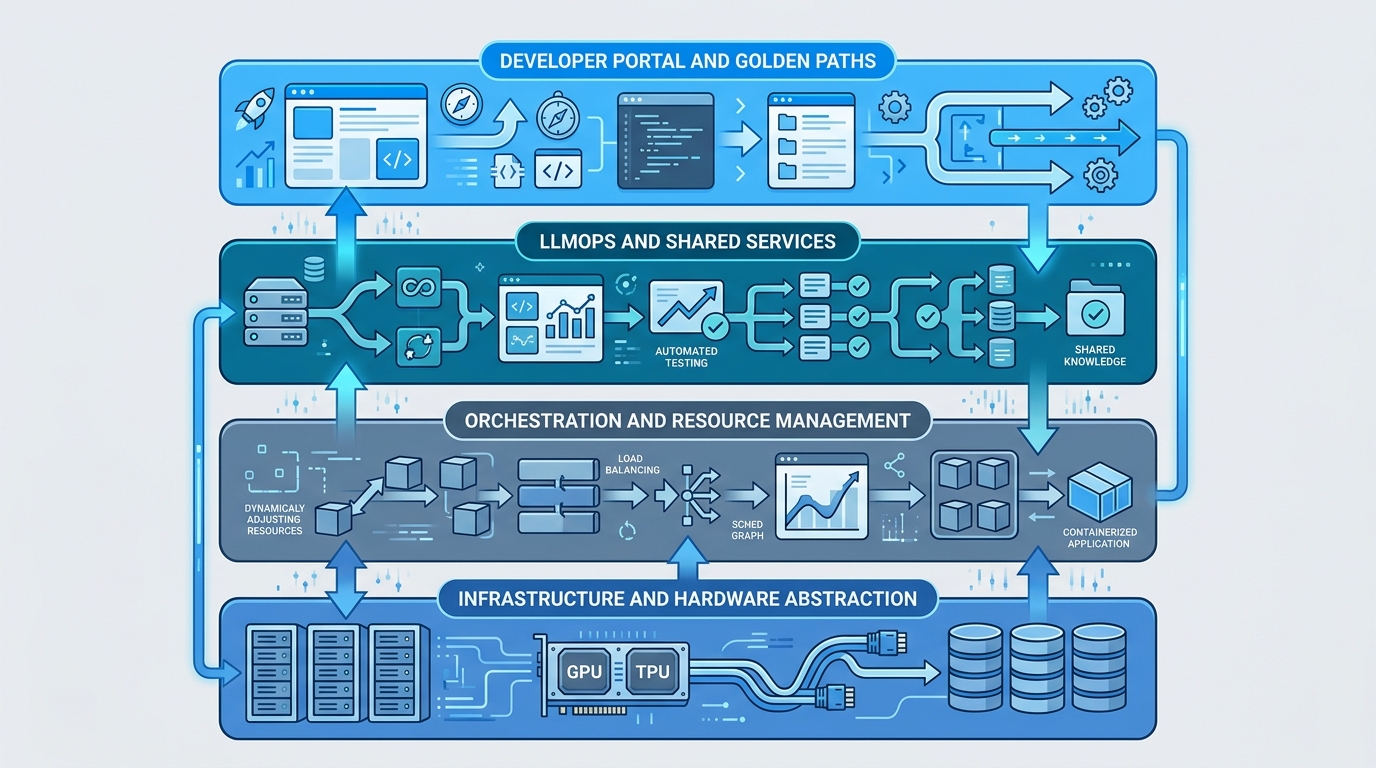
I recommend structuring your GenAI platform around four core layers, as illustrated in the architecture diagram above:
- Infrastructure and Hardware Abstraction Layer: This layer aggregates heterogeneous compute resources—including on-premises bare metal, private clouds, and public cloud instances—into a single, elastic pool. It abstracts the underlying hardware (CPUs, GPUs, and specialized TPUs/ASICs) using container orchestration platforms like Red Hat OpenShift or Kubernetes.
- Orchestration and Resource Management Layer: This layer is responsible for scheduling workloads, managing multi-tenancy, and dynamically allocating GPU resources. It ensures that training, fine-tuning, and inference workloads are prioritized and executed efficiently without resource starvation.
- LLMOps and Shared Services Layer: Just as DevOps standardizes the software development lifecycle, LLMOps standardizes the machine learning lifecycle. This layer provides centralized services for model registries, vector databases, prompt engineering environments, and data pipelines.
- Developer Portal and "Golden Paths": The topmost layer is the interface through which developers and data scientists consume platform services. By utilizing internal developer portals (such as Backstage), platform teams can offer self-service templates—or "golden paths"—that allow users to spin up a fully configured RAG application or fine-tuning pipeline with a single click.
By decoupling the application logic from the underlying infrastructure, this four-layer blueprint significantly reduces cognitive load. A data scientist no longer needs to know how to configure a GPU-enabled Kubernetes node; they simply request a workspace through the developer portal, and the platform handles the provisioning, security, and networking automatically.
Standardizing the AI Infrastructure Stack: From Silos to Shared Services
Implementing a platform engineering framework for GenAI requires a fundamental shift in how we provision and manage infrastructure. The goal is to transition from siloed, project-specific stacks to a shared, multi-tenant infrastructure model. This transition requires careful planning across compute, storage, and networking.
Dynamic GPU Partitioning and Sharing
To maximize GPU utilization, your platform must support dynamic resource allocation. I advise against assigning physical GPUs exclusively to individual developers or projects. Instead, leverage technologies like NVIDIA Multi-Instance GPU (MIG) or fractional GPU scheduling within your container platform. MIG allows a single physical GPU to be partitioned into multiple isolated instances, each with its own dedicated memory and compute cores. This is ideal for running multiple low-latency inference workloads or lightweight development environments on a single physical card, dramatically lowering the cost of entry for new projects.
High-Performance Data Pipelines
GenAI workloads, particularly those involving fine-tuning or RAG, are highly data-intensive. The platform must provide standardized, high-throughput storage classes that can feed data to GPUs without causing I/O bottlenecks. I recommend integrating object storage solutions that support S3-compatible APIs directly into the platform's shared services layer. This ensures that data scientists have immediate, programmatic access to training datasets, document corpora, and model checkpoints without needing to manually configure storage mounts.
Declarative Infrastructure as Code (IaC)
To maintain consistency across development, staging, and production environments, all infrastructure components must be defined declaratively. The following YAML manifest demonstrates how a platform team can define a standardized, GPU-enabled notebook environment using a custom resource definition (CRD) within a Kubernetes-based platform. This manifest ensures that the data scientist receives a pre-configured environment with the exact GPU, memory, and storage allocations defined by corporate policy:
apiVersion: kubeflow.org/v1
kind: Notebook
metadata:
  name: genai-workspace-standard
  namespace: data-science-prod
spec:
  template:
    spec:
      containers:
      - name: ml-workspace
        image: registry.enterprise.io/ml-platform/jupyter-pytorch:v2.4.0
        resources:
          limits:
            cpu: "4"
            memory: 16Gi
            nvidia.com/gpu: "1"
          requests:
            cpu: "2"
            memory: 8Gi
            nvidia.com/gpu: "1"
        volumeMounts:
        - name: workspace-data
          mountPath: /home/jovyan/workspace
      volumes:
      - name: workspace-data
        persistentVolumeClaim:
          claimName: shared-dataset-pvc
This declarative approach eliminates configuration drift and allows the platform team to update the underlying container images, security patches, and resource limits globally without disrupting the end-user's workflow.
Operationalizing LLMOps: Guardrails, Pipelines, and Resource Allocation
Once the infrastructure is standardized, the next challenge is operationalizing the day-2 lifecycle of GenAI applications. This is the domain of LLMOps. To scale safely, the platform must enforce organizational guardrails and automate the deployment pipeline.
Automated Model Promotion Pipelines
Just as we do not allow developers to deploy raw code directly to production without passing through a CI/CD pipeline, we must not allow models or prompts to be deployed without validation. A robust LLMOps platform must establish automated pipelines for model promotion. When a model is fine-tuned, it should automatically undergo evaluation for accuracy, bias, and safety. Only after passing these automated gates should the model be registered in the enterprise model registry and promoted to the production inference server.
Centralized Guardrail and Policy Enforcement
GenAI applications introduce unique risks, such as prompt injection attacks, data exfiltration, and the generation of inappropriate content. Rather than relying on individual application developers to implement security measures, the platform should enforce guardrails centrally at the API gateway or service mesh level. By routing all model traffic through a centralized LLM gateway, the platform team can enforce global rate limiting, log queries for auditability, scrub personally identifiable information (PII) before it reaches external APIs, and inject system prompts that restrict the model's behavior.
To help engineering leaders evaluate their current operational readiness, I have compiled a checklist of critical capabilities that a production-ready GenAI platform must support:
| Capability Category | Operational Requirement | Technical Implementation | Priority |
|---|---|---|---|
| Resource Management | Dynamic GPU allocation and fractional sharing | NVIDIA MIG / Kubernetes GPU scheduling | High |
| Security & Compliance | PII scrubbing and data anonymization | Centralized LLM Gateway / RegEx filters | High |
| Model Management | Version-controlled model registry | MLflow / Hugging Face Enterprise Hub | Medium |
| Observability | Real-time latency, token usage, and cost tracking | Prometheus / Grafana with custom exporters | High |
| Data Integration | Automated ingestion pipelines for RAG | Apache Kafka / Vector Database connectors | Medium |
| Governance | Audit logging of all prompt-response pairs | Centralized logging (Elasticsearch / Splunk) | High |
Strategic Next Steps for Engineering Leadership
Transitioning from fragmented GenAI experimentation to a centralized platform engineering model is an organizational journey that requires deliberate planning. Based on my experience advising engineering organizations, I recommend taking the following immediate actions:
1. Establish a Dedicated Platform Engineering Team
Do not expect your existing DevOps or infrastructure teams to absorb GenAI workloads without dedicated focus. Establish a cross-functional platform engineering team that includes infrastructure engineers, software developers, and machine learning engineers. This team's primary customer is your internal data science and application development community. Their sole mission should be to build, maintain, and optimize the developer platform and its associated golden paths.
2. Conduct an Inventory and Audit of Existing AI Initiatives
Before building the platform, you must understand what your developers are currently doing. Conduct a comprehensive audit of all active GenAI pilots, tools, and third-party API integrations across the organization. Identify the common patterns, data sources, and infrastructure requirements. This inventory will define the initial requirements for your platform's shared services and golden path templates.
3. Define and Implement Your First "Golden Path"
Avoid the temptation to build a massive, all-encompassing platform before delivering value. Instead, apply an agile, iterative approach. Identify a single, high-value use case—such as an internal document search tool using RAG—and build the first "golden path" template specifically for it. This template should include pre-configured infrastructure, a vector database instance, a validated LLM, and basic monitoring. Use this initial release to gather feedback from developers, refine your platform processes, and demonstrate immediate ROI to executive stakeholders.