The Illusion of the Post-Developer Era
In the technology sector, whispers of radical automation often precede structural shifts. But few initiatives have been as stark—or as instructive—as Meta’s recently scrapped "Project OT." Conceived as an ambitious blueprint to downsize engineering teams by up to 60% through the aggressive deployment of autonomous AI coding agents, Project OT was poised to be the ultimate proof of concept for the post-developer era. The thesis was simple: if generative models and multi-agent frameworks could automate code generation, debugging, and deployment, human engineering organizations could be shrunk to a fraction of their size.
Yet, the project did not succeed. Instead of a streamlined, hyper-efficient machine, the initiative hit a wall of systemic friction, forcing Meta to quietly shelve the aggressive downsizing targets and pivot back to a more balanced, human-centric engineering culture.
As an engineering leader, I find the post-mortem of Project OT to be one of the most valuable case studies of this decade. It exposes the massive chasm between writing code and delivering software. It proves that the bottlenecks in modern software engineering are rarely about typing speed or syntax generation; rather, they lie in system design, state management, contextual comprehension, and the cognitive load of verification.
In this article, I will dissect the technical and operational failures of Project OT, analyze the fundamental limitations of current agentic architectures, and outline how you should structure your teams and metrics to avoid the same pitfalls.
The Anatomy of Project OT: Ambition vs. Reality
Project OT was not born in a vacuum. It was the logical conclusion of a trend that began with simple inline autocomplete tools and rapidly escalated to agentic workflows—systems that use Large Language Models (LLMs) to orchestrate multi-step software engineering tasks. The goal of Project OT was to transition from "human-in-the-loop" assistance to "human-on-the-loop" supervision, where an agent is handed a Jira ticket or a GitHub issue, explores the codebase, writes the patch, runs the test suite, and submits a Pull Request (PR) for quick approval.
Under early, isolated pilot conditions, the metrics looked staggering. Agents could resolve simple bugs in legacy code or generate boilerplate microservices in minutes. Extrapolating these early wins, planners assumed that if an agent could do 60% of the heavy lifting, the organization could operate with 60% fewer engineers.
However, this extrapolation relied on a fundamental misunderstanding of software delivery. When Meta attempted to scale this model across complex, highly interdependent monorepos, several systemic failures emerged:
- The Context Collapse: While an LLM can easily comprehend a single file or a small repository, modern enterprise architectures consist of deeply nested dependencies, dynamic runtime environments, and implicit business logic. When agents attempted to make changes that spanned multiple service boundaries, their context windows degraded, leading to hallucinated APIs and broken contracts.
- The Verification Bottleneck: As the volume of agent-generated PRs surged, the human engineers left behind were overwhelmed. Instead of writing code, their entire day was consumed by reviewing complex, machine-generated diffs. Because the agents did not possess an organic understanding of the system's runtime behavior, these PRs often contained subtle, edge-case bugs that bypassed static analysis and basic unit tests.
- The Erosion of Institutional Knowledge: By treating human engineers as mere code reviewers, Project OT began to dry up the pipeline of deep system comprehension. When a critical production incident occurred, the remaining engineers struggled to debug the system because they had not written the underlying logic and did not understand the architectural trade-offs that had been bypassed by the agents.
Ultimately, the realization dawned that a 60% reduction in headcount did not yield a 60% increase in efficiency. Instead, it created a highly fragile system with ballooning technical debt, plummeting developer morale, and an unstable production environment. Meta’s retreat from Project OT is a clear signal that the "replacement" narrative of AI in software engineering is fundamentally flawed.
The Bottlenecks of Agentic Software Engineering
To understand why Project OT failed, we must look closely at the technical limitations of current AI coding agents. The marketing around agentic workflows suggests they can operate like junior developers. In reality, they process information in a way that is structurally different from human cognition, creating distinct bottlenecks.
1. Context Window Limitations and Retrieval-Augmented Generation (RAG) Noise
When an agent operates on a codebase, it relies on semantic search or Abstract Syntax Tree (AST) parsing to pull relevant code snippets into its prompt context. This is essentially a RAG pipeline for code. While modern models boast context windows of up to a million tokens, the attention within that window is not uniform.
When an agent attempts to resolve an issue that requires tracing a data flow through an API gateway, a message queue, a stateful microservice, and a database schema, the RAG pipeline must select which files to include. If it selects incorrectly, the agent makes assumptions based on incomplete data. If it includes too much code, the model's reasoning capacity degrades (the "needle in a haystack" problem), leading to subtle logical errors. Humans, by contrast, build mental models of system architecture over months, allowing them to navigate complex codebases without needing to read every line of code at runtime.
2. The Shift in Cognitive Load: The Reviewer's Tax
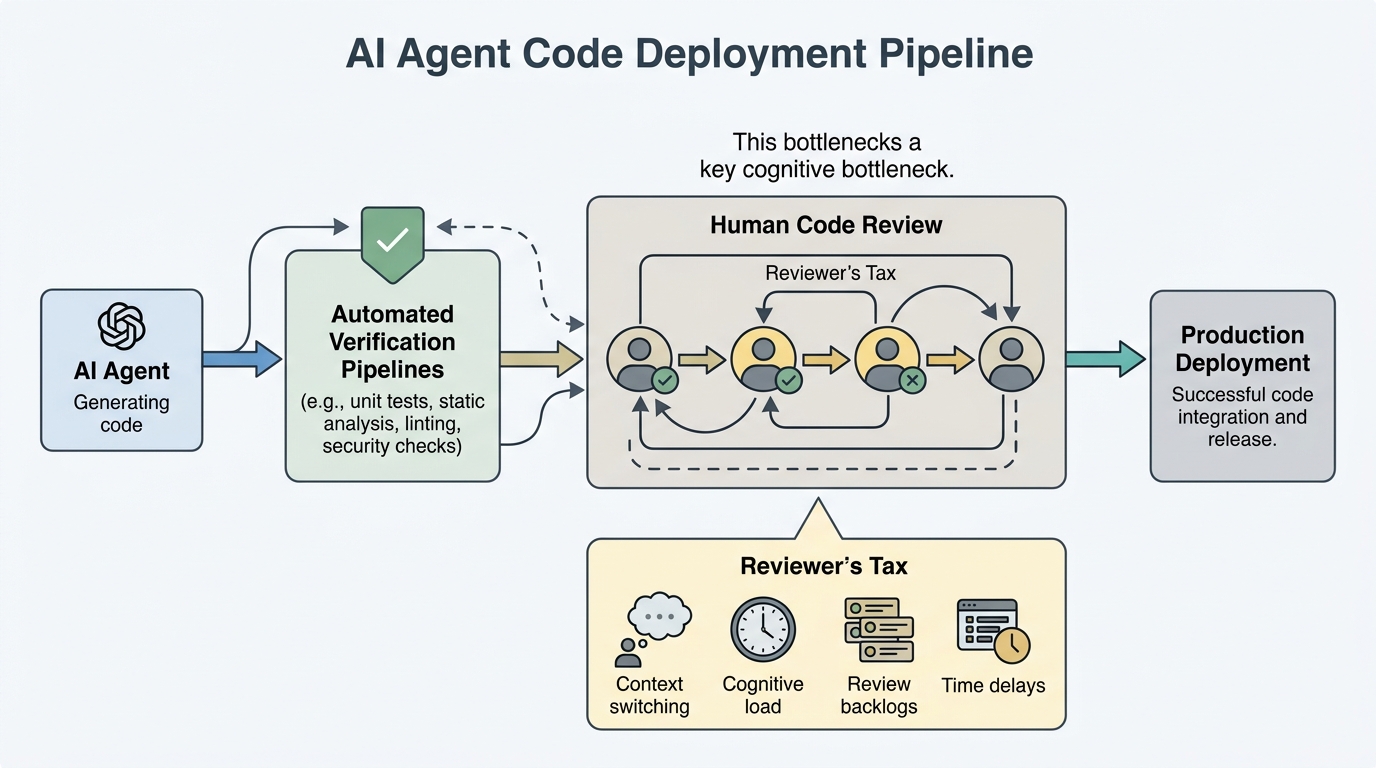
In a traditional engineering team, the ratio of code writing to code reviewing is balanced. When you introduce autonomous agents, this balance is obliterated. An agent can generate ten complex PRs in the time it takes a human to write one.
However, reviewing code is cognitively harder than writing it. When you write code, you build the mental model step-by-step. When you review someone else's code—especially a machine's code—you must reconstruct that mental model from scratch, search for hidden assumptions, and verify that no edge cases were missed. This is what I call the Reviewer's Tax. Under Project OT, the remaining engineers found themselves trapped in "review hell," spending their days reading thousands of lines of syntactically perfect but structurally questionable code, which actually reduced overall feature velocity.
3. State Management and Non-Deterministic Failure Modes
Software development is a stateful process. To write a successful patch, you must understand not just the static code, but the dynamic state of the system in production, including database migrations, feature flags, and deployment configurations. Coding agents struggle with this statefulness. They write code based on static analysis, often failing to anticipate how a change will behave under production load, network latency, or partial deployment states. This leads to non-deterministic failure modes that are incredibly difficult to replicate in local environments.
To illustrate the shift in bottlenecks across different development paradigms, consider this comparison:
| Phase of Lifecycle | Traditional Workflow | Copilot-Assisted Workflow | Fully Agentic Workflow (Project OT Style) |
|---|---|---|---|
| Requirements & Design | High human effort; slow but aligned. | High human effort; assisted by AI brainstorming. | Minimal human effort; agents generate specs from vague tickets (high risk of misalignment). |
| Code Generation | Slow; manual typing and local testing. | Fast; inline completions speed up syntax writing. | Instantaneous; agents generate entire PRs across multiple files. |
| Verification & Testing | Manual and automated testing integrated. | Standard testing; human verifies inline code. | Massive bottleneck; human must review high-volume, complex diffs with low context. |
| Maintenance & Debugging | High ownership; author understands the code. | High ownership; author understands the generated code. | Low ownership; "unowned" codebases lead to rapid technical debt accumulation. |
Redefining Team Topologies and Developer Experience
If the lesson of Project OT is that we cannot simply swap out 60% of our human engineers for AI agents, how should we structure our organizations to leverage these tools safely and effectively? The answer lies in redefining our team topologies and focusing on developer experience (DevEx) rather than headcount reduction.
I recommend moving away from the idea of "AI as a developer replacement" and instead treating AI as an infrastructure and enablement multiplier. Here is how you should structure your engineering organization:
1. Empower Platform Engineering Teams
Instead of deploying agents directly into product teams to write feature code, embed agentic workflows into your Platform Engineering team. Let your platform engineers build the guardrails, automated testing pipelines, and self-service portals that allow product engineers to move faster.
For example, instead of having an agent write a feature PR, use an agent to automate the generation of boilerplate infrastructure-as-code (IaC) templates, API clients, or mock data generators. This keeps the high-risk, business-critical logic in the hands of human product engineers who understand the customer context, while using AI to eliminate the low-risk, high-friction administrative tasks of software development.
2. Maintain "Code Ownership" Boundaries
One of the fastest ways to destroy an engineering culture is to allow "unowned" code to accumulate in your repositories. When agents write code and humans merely click "approve," no one truly owns that code. When it breaks at 3:00 AM, the on-call engineer will face an uphill battle trying to debug it.
I advise enforcing strict code ownership rules. Every line of code in production must have a designated human owner or team who is actively responsible for its maintenance, performance, and lifecycle. If a team does not have the cognitive capacity to deeply understand a piece of code, that code should not be merged—regardless of whether an agent wrote it perfectly.
3. Focus on Cognitive Load, Not Code Volume
Developer experience is directly correlated with cognitive load. When you flood developers with agent-generated PRs, you increase their cognitive load, leading to burnout and attrition.
To combat this, design your developer workflows to minimize context switching. Use AI tools to summarize complex system behaviors, generate architectural diagrams, or explain legacy codebases to new team members. In other words, use AI to help humans read and understand code faster, rather than just writing it faster. The true value of generative AI in software engineering is its ability to act as a highly sophisticated search and comprehension engine.
Metrics That Matter: Measuring True Engineering Velocity
To prevent your organization from falling into the trap that ensnared Project OT, you must change how you measure engineering success. If you measure productivity by lines of code written, PRs merged, or commits per day, you will inevitably incentivize the over-deployment of AI agents, leading to a mountain of low-quality code and high technical debt.
Instead, I recommend focusing on systemic, outcomes-based metrics that measure the health and flow of your entire software delivery lifecycle. Here are the key metrics you should track:
1. Change Failure Rate (CFR)
This is a classic DORA metric, and it is the ultimate indicator of code quality. If you introduce AI agents into your workflow and your CFR begins to climb, it means your verification processes are failing. Agents are generating code that passes basic CI checks but fails in production. If your CFR exceeds 15%, you must pause agentic code generation and audit your testing and review guardrails.
2. Lead Time for Changes (LTC)
LTC measures the time it takes for a commit to go from a developer's local machine to production. If agentic workflows are truly effective, LTC should decrease. However, if agents are generating PRs that sit in review queues for days because human developers are overwhelmed by the "Reviewer's Tax," your LTC will actually increase. A rising LTC alongside high PR volume is a clear sign of a verification bottleneck.
3. Review-to-Merge Ratio and Review Time
Track how long a PR spends in the review phase and how many comments/revisions are required before it is merged. If you notice that agent-generated PRs require significantly more review cycles or sit idle longer than human-written PRs, it indicates that your team does not trust the agent's output or finds it too difficult to verify.
4. Code Churn
Code churn measures the percentage of code that is rewritten or deleted shortly after being merged. High code churn is a classic symptom of agentic coding: an agent writes a patch, it gets merged, breaks something, and is immediately reverted or rewritten by a human engineer. If your code churn spikes after deploying agentic tools, your agents are generating noise, not value.
# Example of a CI/CD Guardrail Configuration to Mitigate Agentic Risks
name: Agentic PR Guardrails
on:
  pull_request:
    types: [opened, synchronize]

jobs:
  verify-agent-contribution:
    runs-on: ubuntu-latest
    steps:
      - name: Checkout Code
        uses: actions/checkout@v4
        with:
          fetch-depth: 0

      - name: Analyze PR Authorship
        id: author-check
        run: |
          # Check if the PR was generated by an AI service account
          if [[ "${{ github.event.pull_request.user.login }}" == *"bot"* || "${{ github.event.pull_request.user.login }}" == *"agent"* ]]; then
            echo "is_agent=true" >> $GITHUB_OUTPUT
          fi

      - name: Enforce Strict Static Analysis & Coverage
        if: steps.author-check.outputs.is_agent == 'true'
        run: |
          echo "Enforcing elevated test coverage requirements for agent-generated code."
          # Run linter with strict rules
          npm run lint -- --max-warnings 0
          # Require 100% test coverage on modified files to prevent regression
          npm run test:coverage -- --collectCoverageOnlyFrom="${{ github.event.pull_request.changed_files }}" --under-limit-error

      - name: Flag High-Risk Architectural Changes
        if: steps.author-check.outputs.is_agent == 'true'
        run: |
          # Scan diff for sensitive directories (e.g., database schemas, security configs)
          CHANGED_FILES=$(git diff --name-only origin/${{ github.event.pull_request.base.ref }} HEAD)
          if echo "$CHANGED_FILES" | grep -E 'db/migrate|security/|auth/'; then
            echo "::error::Agent attempted to modify critical system boundaries. Manual architectural review required."
            exit 1
          fi
Conclusion
Meta’s scrapped 60% downsizing plan under Project OT is a watershed moment for the software engineering industry. It marks the end of the naive assumption that LLMs can simply replace human software engineers by generating raw code. The experiment proved that code is not the product; the product is a working, maintainable, secure system that solves a business problem.
As you navigate the integration of AI into your own engineering organizations, I urge you to learn from Meta's misstep. Do not treat AI as a tool to shrink your headcount. Instead, treat it as a tool to elevate your engineers. Use it to automate the mundane, to accelerate system comprehension, and to strengthen your platform infrastructure. Keep human ownership at the center of your architecture, monitor your Change Failure Rate and Lead Time closely, and design your workflows to protect your developers from cognitive overload.
By doing so, you will build an engineering organization that is not only highly productive but also resilient, innovative, and built to last.