

The Paradigm Shift in Enterprise Attack Surfaces
The integration of autonomous artificial intelligence agents and dynamic execution layers into enterprise software has fundamentally altered the modern corporate attack surface. When an organization deploys an AI platform capable of generating and executing code on the fly, it effectively introduces an internal multi-tenant execution environment within its perimeter. The security of this architecture relies entirely on the absolute integrity of the boundary separating untrusted, AI-generated code from the underlying host operating system. When this boundary fails, the consequences are immediate: remote code execution (RCE) with the privileges of the orchestration service.
I observe that security teams frequently treat AI platforms as standard web applications, focusing their defense-in-depth strategies on traditional web vulnerabilities like SQL injection or Cross-Site Scripting (XSS). However, the deployment of LLM-driven code interpreters introduces a fundamentally different threat model. In this paradigm, the application is designed to execute arbitrary code by design. The primary security control is no longer input sanitization alone, but robust, low-level virtualization and process isolation.
In this analysis, I examine the structural mechanics of sandbox escape vulnerabilities within enterprise AI platforms, using the architectural patterns of CVE-2026-6875 as a reference model. I will dissect how these boundaries are bypassed, evaluate the operational trade-offs of various isolation technologies, and provide a concrete blueprint for hardening your runtime infrastructure. My objective is to move beyond superficial patching advice and equip engineering leaders with the technical depth required to design resilient execution environments.
Architectural Analysis of AI Execution Layers
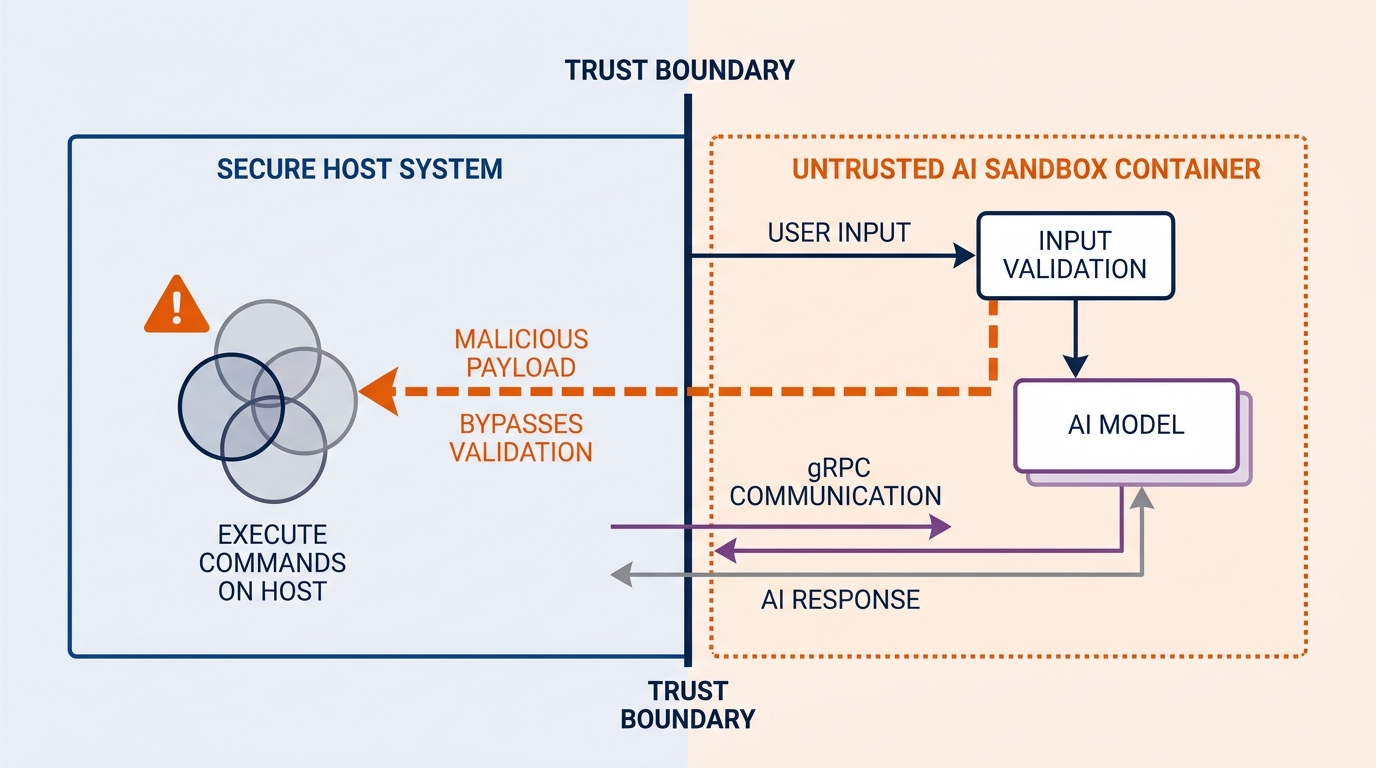
To understand how a sandbox escape occurs, one must first analyze the typical architecture of an enterprise AI execution engine. These systems generally consist of three primary components: the orchestration layer, the communication bridge, and the isolated guest runtime.
The Orchestration Layer
This component runs on the host system, often with high privileges. It interfaces with the broader enterprise application, manages user sessions, and coordinates with the LLM. When the LLM determines that a task requires code execution (such as data analysis, mathematical computation, or file parsing), the orchestration layer receives the generated code block and prepares the execution environment.
The Communication Bridge
Because the host must pass code into the sandbox and retrieve the execution output, a communication channel must exist. This is typically implemented via Unix domain sockets, local loopback TCP connections, or shared memory segments. A daemon running inside the sandbox listens on this channel, receives the code, executes it via a local interpreter (such as Python or Node.js), and returns the stdout, stderr, and generated files.
The Isolated Guest Runtime
This is the sandbox itself. In many standard deployments, this is a lightweight container managed by runc, Docker, or containerd. The isolation relies on standard Linux kernel features: namespaces (to isolate processes, network interfaces, mount points, and IPC), control groups (cgroups, to limit CPU, memory, and I/O), and seccomp filters (to restrict available system calls).
I must emphasize that this architecture contains an inherent structural tension. The AI agent requires access to libraries, packages, and sometimes external APIs to perform useful work. However, every capability granted to the guest runtime increases the available attack surface. If the guest runtime shares the host operating system's kernel—as is the case with standard containerization—any vulnerability in the kernel's system call interface or any misconfiguration in the orchestration layer can be leveraged to escape the container.
Deconstructing the Escape Mechanics
My analysis of sandbox escapes reveals that failures rarely occur within the isolated guest runtime itself. Instead, the breakdown typically occurs at the interface between the host and the guest, or through the exploitation of shared kernel resources. I have categorized the primary escape vectors into four distinct operational patterns.
1. Kernel Interface Exploitation and Shared Syscalls
When standard containers are used for sandboxing, the guest processes execute directly on the host kernel. If an attacker can execute arbitrary code inside the guest, they can interact directly with the host kernel via system calls. If a local privilege escalation (LPE) vulnerability exists in the host kernel (for example, in memory management or network namespaces), the attacker can exploit it from within the container to gain root privileges on the host, subsequently breaking out of the container namespaces.
2. Orchestration Agent Command Injection
This is a common vulnerability pattern in custom-built AI platforms. The orchestration layer on the host often uses command-line utilities to manage the lifecycle of the sandbox (e.g., spawning containers via docker run or executing commands inside them via docker exec). If the orchestration layer fails to properly sanitize parameters passed to these commands—such as environment variables, volume mount paths, or container names—an attacker can inject shell metacharacters. This results in command execution on the host system, completely bypassing the sandbox.
3. Socket and IPC Hijacking
To monitor container health or manage files, developers sometimes mount the host's container runtime socket (such as /var/run/docker.sock) inside the sandbox. This is an architectural anti-pattern of the highest severity. If an attacker gains code execution inside a sandbox with access to this socket, they can issue API commands to the host's container daemon to spawn a new container. This new container can be configured with host namespaces, host network access, and the host's root directory mounted as a volume, yielding immediate and total control over the host system.
4. Path Traversal and Shared Volume Manipulation
To facilitate file input and output, the host must share a directory with the sandbox. This is typically achieved via bind mounts. If the host-side application processes files written to this shared directory without rigorous validation, several vulnerabilities can emerge. For example, if the guest runtime creates a symbolic link pointing to a sensitive host file (such as /etc/shadow or /root/.ssh/authorized_keys) within the shared directory, and the host application reads or writes to that link without verifying that it resolves within the allowed boundary, the host will inadvertently read or overwrite its own system files.
Operational Trade-offs of Isolation Technologies
When designing a remediation strategy, engineering leaders must choose an isolation technology that balances security, performance, and operational complexity. I have evaluated the three primary paradigms currently used in production environments.
Standard Containers (runc / Docker / Kubernetes)
- Mechanism: OS-level virtualization sharing the host kernel, isolated via namespaces and cgroups.
- Security Posture: Low. The shared kernel design means any kernel vulnerability can lead to a complete host compromise. It is highly susceptible to configuration drift and misconfigurations.
- Performance: Excellent. Near-zero virtualization overhead; sub-second startup times.
- Operational Complexity: Low. Standard tooling and deep ecosystem integration.
User-Space Kernels (gVisor)
- Mechanism: A runc-compatible container runtime that intercepts system calls from the guest application and filters them through a user-space kernel (written in Go) before passing a limited subset to the host kernel.
- Security Posture: Medium-High. It drastically reduces the host kernel attack surface by blocking direct system calls. Even if a guest process attempts to exploit a kernel vulnerability, the system call is intercepted and handled safely in user space.
- Performance: Moderate. The system call interception introduces latency, which can impact I/O-heavy or system-call-intensive workloads.
- Operational Complexity: Moderate. It integrates with existing container orchestrators like Kubernetes but requires specific runtime class configurations.
- My Recommendation: I recommend gVisor as an excellent compromise for organizations with existing Kubernetes infrastructure that cannot easily transition to hardware virtualization.
MicroVMs (AWS Firecracker / Kata Containers)
- Mechanism: Hardware-assisted virtualization using the Linux Kernel-based Virtual Machine (KVM) hypervisor to launch extremely lightweight, minimalist virtual machines with their own dedicated kernels.
- Security Posture: High. The boundary is enforced at the hardware level. A sandbox escape requires exploiting the hypervisor itself, which is a significantly smaller and more secure interface than the Linux kernel system call interface.
- Performance: High. Startup times are measured in milliseconds (typically under 100ms), and memory overhead is minimal compared to traditional virtual machines.
- Operational Complexity: High. Requires bare-metal instances or nested virtualization support in cloud environments. It also requires specialized orchestration tooling.
- My Recommendation: For dedicated AI execution engines handling highly untrusted code, I consider microVMs to be the gold standard. The security benefits far outweigh the initial setup complexity.
Implementation: A Secure Execution Wrapper
To illustrate the practical application of these hardening principles, I have designed a robust Python execution wrapper. This implementation demonstrates how to enforce strict resource constraints, drop privileges, and isolate execution using standard Linux system controls before running untrusted code.
I must emphasize that while this wrapper significantly hardens standard process execution, it should be deployed inside an isolated container or microVM to achieve true defense-in-depth.
import os
import sys
import pwd
import grp
import resource
import subprocess
import tempfile
import shutil
from pathlib import Path

def enforce_sandbox_limits(uid: int, gid: int, max_cpu_seconds: int = 5, max_memory_bytes: int = 128 * 1024 * 1024):
    """
    Configures process limits and drops privileges to an unprivileged user.
    This function must run in the child process before executing untrusted code.
    """
    # 1. Establish strict resource limits (cgroups equivalent at process level)
    # Limit CPU time to prevent infinite loops and denial of service
    resource.setrlimit(resource.RLIMIT_CPU, (max_cpu_seconds, max_cpu_seconds))
    # Limit virtual memory allocation to prevent memory exhaustion
    resource.setrlimit(resource.RLIMIT_AS, (max_memory_bytes, max_memory_bytes))
    # Limit file creation size to prevent disk filling
    resource.setrlimit(resource.RLIMIT_FSIZE, (1024 * 1024, 1024 * 1024))  # 1 MB
    # Limit number of processes to prevent fork bombs
    resource.setrlimit(resource.RLIMIT_NPROC, (20, 20))
    # Disable core dumps to prevent sensitive data leakage
    resource.setrlimit(resource.RLIMIT_CORE, (0, 0))

# 2. Drop privileges to the designated unprivileged user
    try:
        os.setgroups([])  # Clear supplementary groups
        os.setgid(gid)
        os.setuid(uid)
        # Ensure we cannot regain root privileges
        os.environ["USER"] = pwd.getpwuid(uid).pw_name
        os.environ["HOME"] = pwd.getpwuid(uid).pw_dir
    except Exception as e:
        sys.stderr.write(f"[FATAL] Failed to drop privileges: {str(e)}\n")
        sys.exit(1)

def execute_untrusted_code(code_payload: str, sandbox_user: str = "sandbox_worker") -> dict:
    """
    Executes untrusted Python code within a restricted, temporary directory
    under an unprivileged system account with strict resource constraints.
    """
    # Resolve the unprivileged user credentials
    try:
        user_info = pwd.getpwnam(sandbox_user)
        uid = user_info.pw_uid
        gid = user_info.pw_gid
    except KeyError:
        return {
            "success": False,
            "error": f"System user '{sandbox_user}' does not exist. Aborting for safety."
        }

# Create an isolated temporary directory for execution
    temp_dir = tempfile.mkdtemp(prefix="ai_sandbox_")
    temp_path = Path(temp_dir)
    script_path = temp_path / "payload.py"

try:
        # Write the payload to the temporary directory
        script_path.write_text(code_payload, encoding="utf-8")

        # Adjust ownership of the directory and file to the unprivileged user
        os.chown(temp_dir, uid, gid)
        os.chown(str(script_path), uid, gid)

        # Restrict permissions: only the owner can read/write/execute
        os.chmod(temp_dir, 0o700)
        os.chmod(str(script_path), 0o500)  # Read and execute only for the worker

# Execute the untrusted script in a isolated subprocess
        process = subprocess.run(
            [sys.executable, str(script_path)],
            preexec_fn=lambda: enforce_sandbox_limits(uid, gid),
            capture_output=True,
            text=True,
            timeout=10,  # Hard wall-clock timeout
            cwd=temp_dir
        )

return {
            "success": True,
            "return_code": process.returncode,
            "stdout": process.stdout,
            "stderr": process.stderr
        }

except subprocess.TimeoutExpired as e:
        return {
            "success": False,
            "error": f"Execution exceeded maximum wall-clock time limit of {e.timeout} seconds.",
            "stdout": e.stdout.decode() if e.stdout else "",
            "stderr": e.stderr.decode() if e.stderr else ""
        }
    except Exception as e:
        return {
            "success": False,
            "error": f"Internal execution failure: {str(e)}"
        }
    finally:
        # Securely clean up the execution directory
        try:
            shutil.rmtree(temp_dir)
        except Exception as cleanup_error:
            sys.stderr.write(f"[ERROR] Failed to clean up sandbox directory {temp_dir}: {str(cleanup_error)}\n")
Immediate Incident Response and Remediation Playbook
If you are running enterprise AI platforms that execute dynamic code, you must assume that your systems are targeted. I recommend executing the following response protocol immediately to identify potential compromises and secure your infrastructure.
Step 1: Asset Discovery and Mapping
You must identify every instance of the AI execution engine within your environment. This includes production servers, development environments, staging environments, and any local testing instances. Attackers frequently target unmonitored staging environments to establish an initial foothold, then pivot laterally into production networks.
Step 2: Log Analysis and Threat Hunting
Do not rely solely on automated alerts. I recommend performing a manual, structured audit of your system and application logs, looking back at least 90 days. Focus your investigation on the following indicators:
- Process Creation Logs: Audit your host operating system logs (such as auditd or Sysmon) for anomalous processes spawned by the AI service user. Look specifically for shells (
/bin/sh,/bin/bash,/bin/zsh), network utilities (curl,wget,nc,socat), or compiler tools (gcc,make). - Network Flow Logs: Analyze outbound connection records from your AI worker nodes. Any connection initiated by an AI worker to an external IP address—especially those not explicitly whitelisted—must be treated as highly suspicious. Pay close attention to connections targeting cloud metadata services (e.g.,
169.254.169.254). - File Integrity Monitoring: Check for modifications to critical system files, SSH configuration directories (
~/.ssh/), cron jobs, or systemd service files on the host operating system running the AI platform.
Step 3: Network Segmentation and Virtual Patching
If an official patch cannot be applied immediately due to operational constraints, you must implement strict network segmentation. Isolate the AI execution hosts. Block all outbound internet access from these hosts, and restrict inbound traffic to authenticated, internal corporate networks. If the AI engine requires external data, route those requests through a secure, validating proxy server on the host.
Long-Term Hardening Framework
To move beyond reactive patching and build a truly resilient AI infrastructure, engineering teams must adopt a zero-trust model for code execution. I have compiled a structured checklist of critical controls that you should audit and implement immediately.
| Control Domain | Security Requirement | Implementation Verification |
|---|---|---|
| Process Isolation | AI execution runtimes must run under dedicated, non-root, unprivileged system accounts. | Verify that the UID of the running process inside the container is not 0. |
| Resource Constraints | Hard limits must be enforced on CPU, memory, process count, and disk write sizes. | Verify cgroup configurations and process limits (ulimit) on the host. |
| Network Isolation | Outbound network access from the sandbox to internal networks and cloud metadata APIs must be blocked. | Attempt to curl 169.254.169.254 or an internal IP from within the sandbox; it must fail. |
| Filesystem Security | The root filesystem of the sandbox must be mounted as read-only. | Attempt to write to /usr, /bin, or /etc from within the sandbox; it must fail. |
| Boundary Validation | All data passed between the host and the sandbox must be strictly validated against a schema. | Ensure that the communication bridge does not accept raw shell commands or unvalidated file paths. |
| Ephemeral Lifecycles | Sandbox environments must be destroyed and recreated after every execution task. | Verify that no state or files persist between separate execution requests. |
Conclusion
The emergence of sandbox escape vulnerabilities in enterprise AI platforms is a predictable consequence of the rapid integration of dynamic execution layers. When we design systems that allow models to write and execute code, we must abandon the assumption that the code is benign. We must design our architectures with the fundamental assumption that the sandbox will be compromised.
By transitioning from shared-kernel container isolation to hardware-level microVM virtualization, enforcing strict system call filtering, dropping process privileges, and implementing zero-trust network policies, you can ensure that a sandbox escape remains an isolated event rather than an enterprise-wide catastrophe. Security must not be treated as a feature to be added later; it must be the architectural foundation upon which your AI infrastructure is built.