

The Memory Safety Imperative: Deconstructing the Attack Surface
For decades, the software engineering industry has operated on a reactive treadmill: discover a vulnerability, triage its severity, issue a patch, and rush deployment before exploitation occurs. This cycle is structurally unsustainable. Telemetry from major operating system vendors and the Cybersecurity and Infrastructure Security Agency (CISA) confirms that approximately 70% of all serious security vulnerabilities in large-scale, low-level codebases are attributable to memory safety violations.
When I analyze the root causes of our industry's most severe systemic failures, they rarely stem from a lack of developer diligence. Instead, they are the predictable consequence of using programming languages that require manual memory management. In complex, multi-threaded systems, expecting human engineers to flawlessly track pointer lifetimes, allocation boundaries, and concurrent access patterns across millions of lines of code is a design flaw in itself.
To build resilient systems, we must transition from a posture of mitigation to one of structural elimination. This means adopting "Secure-by-Design" principles where entire classes of vulnerabilities are rendered impossible by the compiler and runtime architecture. I will outline the pragmatic engineering strategies, architectural patterns, and operational trade-offs involved in transitioning enterprise systems to memory-safe architectures without halting business-critical feature delivery.
To systematically eliminate memory safety vulnerabilities, we must first understand how they manifest at the hardware and operating system boundary. Memory safety violations generally fall into two categories: spatial and temporal.
Spatial Memory Violations
Spatial violations occur when a program accesses memory outside its allocated boundary. The classic buffer overflow is the archetypal spatial violation. Consider a scenario where a network packet parser allocates a fixed-size buffer on the stack or heap:
- Buffer Overflows and Over-reads: If the parser does not rigorously validate the input length against the allocated buffer size, an attacker can write past the buffer boundary. This overwrites adjacent memory, which may contain control flow data such as function return addresses on the stack or function pointers on the heap. Conversely, a buffer over-read allows an attacker to read adjacent memory containing sensitive cryptographic keys or session tokens.
- Out-of-Bounds Indexing: This occurs when an application accesses an array using an index that exceeds the array's bounds. In languages like C and C++, the runtime does not perform bounds checking by default for performance reasons, leading to undefined behavior or arbitrary memory access.
Temporal Memory Violations
Temporal violations occur when a program accesses memory that was once valid but has since been deallocated or repurposed. These are often more difficult to debug and exploit than spatial violations, but they are highly prized by exploit writers.
- Use-After-Free (UAF): This occurs when a pointer continues to reference a memory address after that memory has been freed. If the memory allocator subsequently reassigns that address to a different object, the stale pointer can be used to read or overwrite the new object's data, potentially hijacking virtual table (vtable) pointers to redirect execution flow.
- Double Free: If an application attempts to free the same memory allocation twice, it can corrupt the internal state of the memory allocator (such as its free lists or bins). An attacker can exploit this corruption to force the allocator to return an arbitrary memory address on a subsequent allocation request.
The Allocator and Kernel Boundary
Modern operating systems use virtual memory to isolate processes from one another. However, within a single process, the memory allocator (e.g., glibc malloc, jemalloc, or mimalloc) manages the heap. When memory safety violations occur, they corrupt this allocator state or the process's private address space.
Because the kernel trusts the user-space process to manage its own memory correctly within its virtual address space, a memory corruption vulnerability inside a privileged process (such as a system daemon, network service, or browser engine) can be leveraged to execute arbitrary code with the privileges of that process. This is why memory safety is not just a software quality issue; it is the primary vector for local privilege escalation and remote code execution.
Architectural Strategies for Incremental Migration
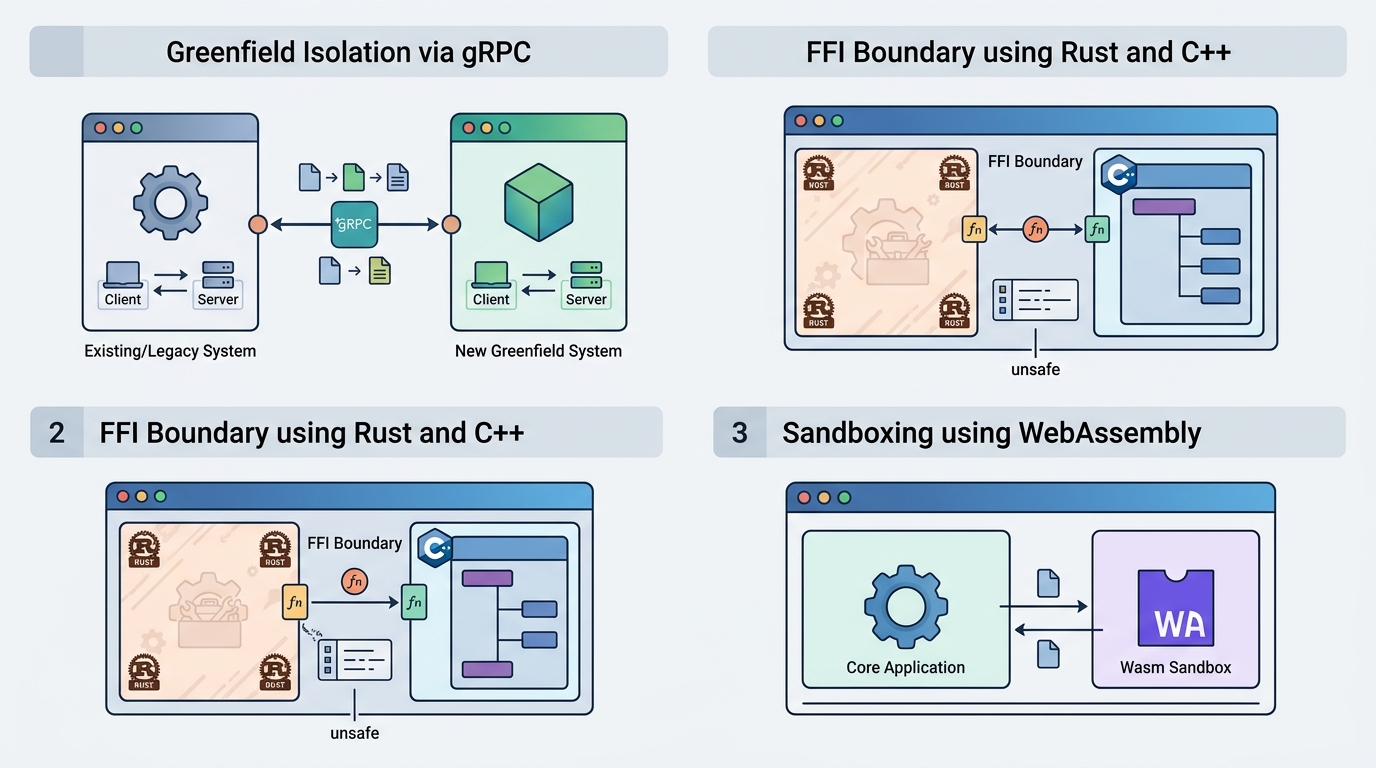
Replacing a mature, multi-million-line C or C++ codebase with a memory-safe language like Rust or Go overnight is an economic and operational impossibility. As engineering leaders, we must design migration strategies that deliver incremental security value while maintaining system stability and developer velocity. I recommend three primary architectural patterns for integrating memory-safe components into legacy systems.
1. The Greenfield Isolation Pattern
For new features, services, or major subsystem rewrites, I advocate for the Greenfield Isolation pattern. Instead of adding new code to the legacy codebase, write the new component in a memory-safe language and run it as an independent, sandboxed process or microservice.
Communication between the legacy system and the new memory-safe service should occur over a well-defined, secure IPC (Inter-Process Communication) boundary or network protocol. Using protocol buffers (Protobuf) over gRPC or Unix domain sockets provides a strongly-typed, serialized interface that minimizes the parsing attack surface. By isolating the new component, you ensure that even if the legacy system is compromised, the memory-safe service remains protected behind operating-system-level access controls (such as SELinux profiles, namespaces, or cgroups).
2. The Foreign Function Interface (FFI) Boundary Pattern
When network-based isolation introduces unacceptable latency or operational complexity, you must integrate memory-safe code directly into the same process address space. This is achieved using a Foreign Function Interface (FFI).
In this pattern, you rewrite high-risk components (such as cryptographic libraries, image decoders, or network parsers) in Rust and expose them to the legacy C/C++ application via a C-compatible ABI (Application Binary Interface). Conversely, you can write a Rust wrapper around a legacy C++ library to safely expose its functionality to a modern Rust application.
However, the FFI boundary itself is a critical trust boundary. Because C does not understand Rust's safety invariants (such as ownership and lifetimes), any data passing across the FFI must be treated with extreme care. To mitigate this risk, I recommend using automated binding generators like cxx or bindgen rather than writing manual, unsafe FFI bindings. The cxx library, for example, enforces safety invariants at compile time by generating C++ and Rust code that validates object ownership across the boundary.
3. The Sandboxing and Privilege Separation Pattern
If a legacy C/C++ component cannot be rewritten or wrapped, you must isolate it to limit the blast radius of a potential exploit. This is the core philosophy behind modern web browser architectures, and it applies equally to enterprise systems.
Using technologies like WebAssembly (Wasm) runtimes (e.g., Wasmtime) or lightweight container sandboxes (e.g., gVisor), you can run untrusted, memory-unsafe legacy code in a highly restricted execution environment. WebAssembly compiles C/C++ code into a sandboxed bytecode format with its own isolated linear memory space. The host application can safely call into the Wasm module, knowing that any memory corruption inside the module cannot escape to corrupt the host process's memory space.
Tooling, Compiler-Enforced Guarantees, and Runtime Trade-offs
When choosing a memory-safe language to replace legacy code, you must evaluate the technical trade-offs between compiler-enforced static safety and runtime-managed dynamic safety. The two primary paths are represented by Rust and Go.
Rust: Compile-Time Safety and Zero-Cost Abstractions
Rust achieves memory safety without a garbage collector through its ownership model, which is enforced entirely at compile time by the "borrow checker." The core rules of Rust's ownership model are:
- Each value in Rust has an owner.
- There can only be one owner at a time.
- When the owner goes out of scope, the value is dropped (deallocated).
To allow data sharing, Rust introduces references, which are governed by strict borrowing rules: you may have either one mutable reference or any number of immutable references, but never both simultaneously. This compile-time analysis completely eliminates data races, use-after-free conditions, and double frees at zero runtime cost.
However, the trade-off is a steep learning curve and significantly longer compilation times. Developers must learn to structure their data flows to satisfy the borrow checker, which can be challenging when dealing with complex graph structures or highly concurrent architectures.
Go: Runtime Safety and Garbage Collection
Go takes a different approach, prioritizing developer productivity and rapid compilation. It achieves memory safety by managing memory allocation and deallocation automatically at runtime using a garbage collector (GC).
Go eliminates manual memory management, null pointer dereferences (by initializing variables to safe zero values), and out-of-bounds indexing (by performing runtime bounds checks on slices and arrays). This makes Go highly accessible and productive for general-purpose application development.
However, the trade-off is runtime overhead. Go's garbage collector must periodically scan the heap to identify and reclaim unused memory. Although modern Go runtimes have optimized GC pauses to sub-millisecond levels, the GC still consumes CPU cycles and introduces latency jitter (tail latency), making it less suitable for hard real-time systems, low-level kernel development, or resource-constrained embedded environments. Furthermore, Go's runtime memory footprint is significantly larger than Rust's or C++'s.
Bridging the Gap Safely: A Concrete FFI Example
To illustrate how we can safely bridge the gap between legacy C++ and memory-safe Rust without exposing our application to undefined behavior, let us look at a concrete implementation using the cxx library. This library ensures that the C++ and Rust compilers agree on the layouts of shared data structures, preventing the common memory alignment and layout errors that plague manual FFI implementations.
// Rust side: src/main.rs
#[cxx::bridge]
mod ffi {
    // Shared structs whose fields are visible to both languages.
    struct NetworkPacket {
        source_ip: String,
        payload: Vec<u8>,
    }

    // Foreign types and signatures allocated in C++ but usable in Rust.
    unsafe extern "C++" {
        include!("path/to/legacy_parser.h");

        type PacketParser;

        fn new_parser() -> UniquePtr<PacketParser>;
        fn parse_raw_bytes(self: &PacketParser, data: &[u8]) -> Result<NetworkPacket>;
    }
}

fn main() {
    // Safely instantiate the legacy C++ parser
    let parser = ffi::new_parser();

    let raw_data: [u8; 8] = [0x7F, 0x00, 0x00, 0x01, 0x0A, 0x0B, 0x0C, 0x0D];

    // The FFI call is safe; cxx handles bounds checking and lifetime tracking
    match parser.parse_raw_bytes(&raw_data) {
        Ok(packet) => println!("Successfully parsed packet from {}", packet.source_ip),
        Err(e) => eprintln!("Failed to parse packet safely: {}", e),
    }
}
This pattern allows you to keep your core parsing engine in highly optimized C++ if necessary, but wrap it in a strict, compiler-validated interface that prevents memory corruption from propagating into your main application logic.
Operationalizing Secure-by-Design Principles
Transitioning to a memory-safe architecture is as much an operational and cultural challenge as it is a technical one. To successfully operationalize these principles across an engineering organization, I recommend establishing a structured framework that guides teams through the migration process.
1. Establish a "Memory Safety Budget"
Just as site reliability engineering (SRE) uses error budgets to balance velocity and reliability, security teams should establish a Memory Safety Budget for legacy codebases.
Track the frequency and severity of memory-related bugs discovered in your legacy systems. If a specific component or service repeatedly exceeds its memory safety budget (e.g., more than two memory safety vulnerabilities discovered in a quarter), trigger a mandatory architectural review. The outcome of this review should be a funded mandate to either rewrite the component in a memory-safe language, isolate it using sandboxing, or wrap it behind a secure FFI boundary.
2. Implement Compiler-Assisted Hardening
While you are planning and executing your migration to memory-safe languages, you must harden your existing C/C++ codebases using modern compiler flags and runtime sanitizers. These tools do not eliminate vulnerabilities, but they make exploitation significantly more difficult and aid in early detection.
| Hardening Technique | Compiler Flags / Tooling | Mechanism | Runtime Overhead |
|---|---|---|---|
| AddressSanitizer (ASan) | -fsanitize=address |
Instruments memory accesses to detect use-after-free, buffer overflows, and memory leaks during testing. | 1.5x - 2.5x slowdown; high memory overhead (not for production). |
| Control Flow Integrity (CFI) | -fsanitize=cfi |
Restricts execution paths to valid call targets, preventing attackers from hijacking control flow. | Minimal (< 1% - 2% performance impact); suitable for production. |
| Stack Smashing Protection | -fstack-protector-strong |
Inserts a guard value (canary) before the stack return address; detects stack buffer overflows before function return. | Negligible; standard industry practice for production. |
| Position Independent Executables | -fPIE -pie |
Enables Address Space Layout Randomization (ASLR), making it difficult for attackers to predict memory locations. | Negligible on modern 64-bit architectures; standard practice. |
3. Integrate Continuous Fuzzing into the CI/CD Pipeline
Static analysis tools are often insufficient for detecting complex, state-dependent memory safety bugs. Therefore, I recommend integrating continuous fuzz testing (fuzzing) into your deployment pipelines for all legacy and FFI components.
Fuzzing engines (such as libFuzzer or AFL++) generate millions of semi-random inputs and feed them to your application while monitoring for crashes or sanitizer alerts. By running fuzzers continuously in your CI/CD pipeline, you can discover edge-case memory corruption bugs before code is merged into your main branch. For Rust codebases, tools like cargo-fuzz make it incredibly simple to write and run fuzz targets as part of your standard development workflow.
Conclusion
The transition to memory-safe architectures is not a luxury; it is a strategic necessity for any organization operating critical digital infrastructure. By moving away from the reactive cycle of patching memory safety vulnerabilities and adopting a proactive, Secure-by-Design posture, we can build systems that are inherently resilient to entire classes of cyber threats.
As engineering leaders, our path forward is clear. We must stop writing new, un-sandboxed code in memory-unsafe languages. We must systematically assess our legacy codebases, identify high-risk components, and apply pragmatic migration patterns—whether through greenfield isolation, secure FFI boundaries, or sandboxing. This transition will take time, but by making deliberate, incremental architectural choices today, we secure our systems for the future.