

The High-Stakes Tug-of-War in Engineering Operations
Engineering leaders are caught in a continuous operational conflict. On one side, urgent security advisories—such as those issued by the Cybersecurity and Infrastructure Security Agency (CISA)—demand immediate, disruptive patching to secure the perimeter. On the other side, the rapid evolution of developer ecosystems—exemplified by Google’s continuous updates to APIs, SDKs, and platform standards—demands that codebases be modernized to avoid technical debt and maintain developer velocity.
I have spent years managing this delicate balance. Treating every security advisory as an existential crisis paralyzes feature delivery, just as ignoring platform deprecations eventually leads to catastrophic system failures when legacy APIs are turned off. To survive and thrive in this landscape, you must establish a highly structured, dual-track operations engine. This engine must systematically ingest threat intelligence, prioritize vulnerabilities based on real-world exploitability, and seamlessly integrate platform modernization into your standard engineering sprints.
In this briefing, I analyze the latest operational directives from CISA and developer platform updates from Google. I share my framework for triaging critical vulnerabilities, modernizing developer API lifecycles, and structuring teams to handle both unplanned security incidents and planned architectural evolution without burning out engineers.
Triaging Critical Vulnerabilities: A Systematic Approach to CISA Advisories
When CISA releases a cybersecurity advisory or updates its Known Exploited Vulnerabilities (KEV) catalog, the typical reaction in many engineering organizations is panic. Security teams fire off urgent tickets, developers drop active sprints, and emergency patches are rushed to production. I believe this reactive posture is fundamentally broken. It introduces operational risk, degrades code quality, and destroys developer morale.
To move from a reactive state to a proactive, controlled state, I recommend implementing a risk-based triage matrix that combines three distinct data points: the Common Vulnerability Scoring System (CVSS) score, the Exploit Prediction Scoring System (EPSS) score, and CISA’s KEV designation.
While CVSS measures the theoretical severity of a vulnerability based on its technical characteristics (such as attack vector and impact), it does not tell you if anyone is actually exploiting it in the wild. This is where EPSS and CISA’s KEV catalog become invaluable. EPSS uses machine learning to estimate the probability that a vulnerability will be exploited within the next 30 days. CISA’s KEV catalog is even more definitive: it lists vulnerabilities that have documented, active exploitation in the wild.
My operational rule of thumb is simple: if a vulnerability is listed in the CISA KEV catalog and exists within your internet-facing attack surface, it bypasses standard sprint planning and must be mitigated within 24 to 48 hours. However, if a vulnerability has a high CVSS score but a near-zero EPSS score and is buried deep within an internal, segmented network, it should be scheduled for remediation in the next regular maintenance window.
To systematically handle these threats, I structure my vulnerability response lifecycle into four distinct phases:
- Discovery and Mapping: You cannot protect what you do not know you have. You must maintain an accurate, automated Software Bill of Materials (SBOM) and an up-to-date asset inventory. When an advisory is published, your security tooling should instantly query your asset database to identify affected systems, libraries, and dependencies.
- Contextual Risk Assessment: Once an asset is identified as vulnerable, you must evaluate its context. Is the system exposed to the public internet? Does it handle personally identifiable information (PII) or critical business logic? What mitigations—such as Web Application Firewalls (WAFs), network segmentation, or IAM restrictions—are already in place?
- Mitigation vs. Patching: Patching is the ideal long-term solution, but it is not always immediately feasible. In high-availability environments, deploying a patch might require extensive regression testing. In these scenarios, I look for immediate, low-risk mitigations. This might involve disabling a vulnerable feature flag, updating a WAF rule to block specific exploit payloads, or restricting network access to the affected service via security groups.
- Verification and Post-Mortem: After the patch or mitigation is deployed, you must verify its effectiveness. Run targeted vulnerability scans to confirm the flaw is resolved. Finally, conduct a brief blameless post-mortem to understand why the vulnerability existed, how your detection mechanisms performed, and how you can accelerate your response time in the future.
Modernizing Developer Workflows and API Integration Lifecycles
While CISA advisories focus on securing your existing perimeter, updates from major platform providers like Google remind us that our software ecosystems are constantly shifting beneath our feet. Google’s developer platform updates frequently introduce new API versions, deprecate legacy SDKs, and mandate stricter security and performance standards.
Ignoring these platform updates is a form of technical debt that compounds over time. When a major cloud provider or API publisher deprecates an endpoint, they are not just cleaning up their codebase; they are often removing legacy protocols that are inefficient, insecure, or incompatible with modern architecture. If you delay migration until the absolute deadline, you force your team into a rushed, high-risk migration that is prone to regression bugs.
I treat API and SDK lifecycles as a core engineering capability. To manage this effectively, you must establish a formal deprecation tracking process. I recommend assigning ownership of external integrations to specific engineering teams. If a team owns the integration with Google Cloud or Google Workspace APIs, they are responsible for monitoring deprecation notices, assessing the impact on your systems, and scheduling the migration work.
Modernizing your API integrations is not just about changing endpoint URLs; it is an opportunity to adopt modern architectural patterns that improve system resilience, security, and performance. For example, when migrating from legacy Google APIs to modern REST or gRPC endpoints, you should design your client implementations to be robust against transient network failures, rate limiting, and authentication changes.
To illustrate this, I have designed a highly resilient API client pattern in Go. This pattern demonstrates how to implement modern best practices: handling OAuth2/OIDC token exchange, enforcing strict timeouts using contexts, implementing exponential backoff with jitter for retries, and utilizing a circuit breaker to prevent cascading failures when the upstream service is degraded.
package main

import (
	"context"
	"fmt"
	"math/rand"
	"net/http"
	"time"
)

// APIClient wraps a standard HTTP client with resilience patterns.
type APIClient struct {
	client      *http.Client
	maxRetries  int
	baseBackoff time.Duration
}

// NewAPIClient initializes the client with sensible defaults.
func NewAPIClient(timeout time.Duration) *APIClient {
	return &APIClient{
		client: &http.Client{
			Timeout: timeout,
		},
		maxRetries:  3,
		baseBackoff: 100 * time.Millisecond,
	}
}

// ExecuteRequest performs an HTTP request with exponential backoff and context awareness.
func (c *APIClient) ExecuteRequest(ctx context.Context, req *http.Request) (*http.Response, error) {
	var resp *http.Response
	var err error

	for attempt := 0; attempt <= c.maxRetries; attempt++ {
		if err := ctx.Err(); err != nil {
			return nil, fmt.Errorf("request cancelled before execution: %w", err)
		}

		attemptReq := req.Clone(ctx)
		resp, err = c.client.Do(attemptReq)

		if err == nil && resp.StatusCode < 500 {
			return resp, nil
		}

		if resp != nil {
			resp.Body.Close()
		}

		if attempt == c.maxRetries {
			break
		}

		backoff := c.calculateJitter(attempt)
		select {
		case <-ctx.Done():
			return nil, ctx.Err()
		case <-time.After(backoff):
		}
	}

	if err != nil {
		return nil, fmt.Errorf("request failed after %d retries: %w", c.maxRetries, err)
	}
	return nil, fmt.Errorf("request failed with server error status: %d", resp.StatusCode)
}

func (c *APIClient) calculateJitter(attempt int) time.Duration {
	temp := float64(c.baseBackoff) * (1 << uint(attempt))
	jitter := rand.Float64() * temp
	return time.Duration(jitter)
}

func main() {
	ctx, cancel := context.WithTimeout(context.Background(), 5*time.Second)
	defer cancel()

	client := NewAPIClient(2 * time.Second)
	req, _ := http.NewRequestWithContext(ctx, "GET", "https://api.example.com/v1/resource", nil)
	req.Header.Set("Authorization", "Bearer mock-oauth2-token")

	resp, err := client.ExecuteRequest(ctx, req)
	if err != nil {
		fmt.Printf("API Execution Failed: %v\n", err)
		return
	}
	defer resp.Body.Close()
	fmt.Printf("API Execution Succeeded: Status %d\n", resp.StatusCode)
}
When you migrate to modern APIs, you should also adopt modern authentication standards. Legacy API keys should be systematically replaced with short-lived OAuth2 tokens or OpenID Connect (OIDC) identity federation. If you are running workloads in cloud environments like Google Cloud, you should leverage Workload Identity to eliminate hardcoded secrets entirely. This aligns your developer platform modernization directly with your security goals, turning a compliance chore into an architectural upgrade.
The Architecture of a Dual-Track Operations Engine
To successfully manage both CISA-driven security patches and Google-driven developer platform updates, you must build what I call a "Dual-Track Operations Engine." This is an organizational and technical framework designed to ingest, categorize, and route incoming operational requirements without disrupting your core product roadmap.
In many organizations, security and platform engineering operate in silos. The security team throws vulnerability reports over the wall, while the platform team struggles to keep up with API deprecations, and product teams ignore both to focus on feature delivery. I have found that the only way to break these silos is to create a unified triage and routing pipeline.
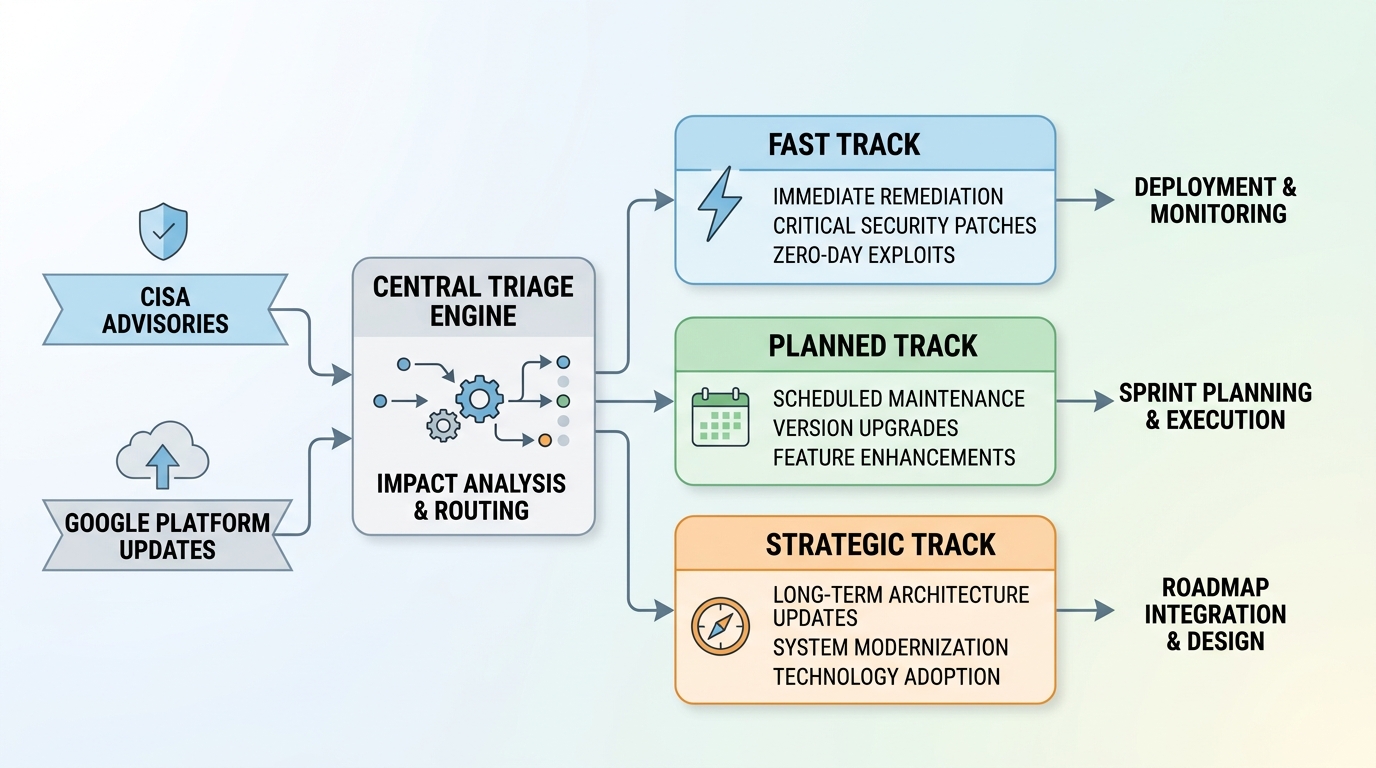
This pipeline acts as a central clearinghouse for all operational inputs. When a new CISA advisory or developer platform update is received, it is ingested into a central triage engine. This engine evaluates the input based on two primary dimensions: urgency (how quickly must this be addressed to prevent exploitation or system failure) and impact (how deeply does this affect our architecture and developer velocity).
Based on this evaluation, the work is routed into one of three execution tracks:
- The Fast Track (Emergency Mitigation): Reserved for active exploits (such as CISA KEV listings) that threaten internet-facing production systems. This track bypasses standard sprint planning. It is executed by a designated on-call rotation or emergency response team, ensuring that the rest of the engineering organization remains focused on their committed work.
- The Planned Track (Sprint Integration): Reserved for high-priority but non-emergency tasks, such as standard security patching, non-critical vulnerability remediation, and upcoming API migrations. These tasks are converted into structured user stories, estimated by the engineering teams, and pulled into regular bi-weekly sprints. I recommend allocating a fixed capacity (typically 15% to 20%) of every sprint specifically for this operational maintenance.
- The Strategic Track (Architectural Roadmap): Reserved for major platform modernizations, such as migrating from a legacy monolith to a microservices architecture, adopting a new container orchestration platform, or rewriting core integration layers. These projects are treated as major initiatives and are scheduled on the quarterly or annual engineering roadmap, complete with dedicated resources and clear business milestones.
By routing operational work through this structured pipeline, you eliminate the chaos of constant context switching. Your product developers can focus on delivering customer value, your security team can rest assured that critical vulnerabilities are mitigated within SLAs, and your platform engineers can systematically modernize your infrastructure.
Operationalizing the Playbook: Governance, Metrics, and Tooling
Establishing the architecture of a dual-track operations engine is a crucial first step, but maintaining its momentum requires rigorous governance, clear metrics, and the right tooling. Without these, teams will naturally drift back into reactive fire-fighting or allow technical debt to accumulate.
To keep both tracks aligned, I recommend establishing a weekly Operations and Security Review (OSR). This is a highly focused, 30-minute meeting attended by engineering leads, the security director, and platform product managers. The agenda is strictly limited to reviewing the operational dashboard, tracking progress on active migrations, and resolving any resource conflicts between security mitigations and platform modernization.
To measure the health and efficiency of your operations engine, you must track a balanced set of metrics. I focus on four key performance indicators (KPIs) that provide a holistic view of your security posture and developer velocity:
| Metric | Definition | Target SLA | Why It Matters |
|---|---|---|---|
| Mean Time to Remediate (MTTR) | The average time from the publication of a CISA KEV vulnerability to its successful mitigation or patch deployment in production. | < 48 Hours (Critical) / < 14 Days (High) | Measures your ability to rapidly respond to active, real-world threats. |
| Vulnerability Density | The number of open vulnerabilities per thousand lines of code (KLOC) across your active repositories. | < 0.5 open vulnerabilities per KLOC | Indicates the overall cleanliness of your codebase and the effectiveness of your static analysis tools. |
| API Migration Velocity | The percentage of internal systems successfully migrated to modern API standards before the official deprecation date. | 100% migration completed 30 days prior to deprecation | Prevents emergency migrations and ensures system stability when legacy endpoints are shut down. |
| Planned vs. Unplanned Work Ratio | The ratio of engineering hours spent on planned sprint tasks versus unplanned emergency patching and firefighting. | > 80% Planned / < 20% Unplanned | Measures the stability of your operations. A high unplanned ratio indicates a failing triage and mitigation strategy. |
To achieve these metrics, you must equip your teams with automated tooling that integrates directly into their existing workflows. Do not force developers to log into separate security consoles or platform dashboards. Instead, bring the data to them.
Integrate Software Composition Analysis (SCA) and Static Application Security Testing (SAST) tools directly into your CI/CD pipelines. When a developer opens a pull request, the pipeline should automatically scan for vulnerable dependencies and deprecated APIs. If a critical vulnerability or deprecated method is detected, the build should fail, and the developer should be provided with actionable remediation guidance directly within their pull request interface.
Furthermore, leverage automated dependency management tools to automatically generate pull requests for minor and patch-level updates of your external libraries. This keeps your dependencies fresh and significantly reduces the size and risk of security patches when critical vulnerabilities are announced.
Conclusion
Managing modern engineering operations is not about choosing between security and innovation. It is about building a resilient, disciplined organization that can do both simultaneously. By systematically triaging CISA advisories using real-world exploitability data, proactively managing Google-driven developer platform lifecycles, and routing this work through a structured dual-track operations engine, you protect your perimeter while accelerating your developer velocity.
I encourage you to take three immediate actions this week to begin operationalizing this playbook:
- Audit Your Ingestion Pipeline: Review how your organization currently receives and processes security advisories and platform deprecation notices. Eliminate manual email chains and establish a single, automated intake queue.
- Implement Sprint Capacity Allocation: Meet with your product management counterparts and agree on a permanent, non-negotiable allocation of sprint capacity (I recommend starting at 15%) dedicated solely to security maintenance and platform modernization.
- Deploy the Resilient Client Pattern: Review your critical external API integrations. Ensure they implement the core resilience patterns—timeouts, exponential backoff with jitter, and circuit breaking—demonstrated in the Go implementation above.
By taking these steps, you will transform your engineering team from a reactive firefighting squad into a proactive, highly efficient delivery engine capable of navigating any security threat or platform shift with confidence.