
The Structural Tension of Modern Framework Adoption
As an engineering leader, I find myself caught in a structural pincer movement. On one side, the relentless pace of application development demands that we rapidly adopt the latest framework features, APIs, and dependencies to maintain velocity. On the other side, authoritative bodies like the Cybersecurity and Infrastructure Security Agency (CISA) are shifting the burden of security directly onto our shoulders through "Secure-by-Design" mandates.
This tension is not merely academic. When we integrate new developer APIs or update our core frameworks, we often inherit complex dependency trees and implicit trust assumptions. If we treat framework adoption and security compliance as separate workstreams, we inevitably introduce systemic vulnerabilities that static analysis tools catch too late—or miss entirely.
I believe the only sustainable path forward is to unify these forces. We must treat framework updates not just as functional upgrades, but as critical security integration events. In this analysis, I will outline the structural risks of modern framework adoption, define a practical pipeline for secure-by-design integration, and provide a roadmap for engineering leaders to enforce systemic security without stalling development velocity.
The Illusion of Framework-Level Security
Many engineering teams operate under the assumption that modern, well-maintained frameworks are inherently secure. While it is true that major ecosystems build in robust defenses against classic vulnerabilities like SQL injection or Cross-Site Scripting (XSS), they also introduce new vectors.
When you adopt a new framework API or library, you are not just importing code; you are importing its entire lifecycle, its maintainers' security practices, and its dependency graph. This creates several distinct failure modes:
- Implicit Trust in Transitive Dependencies: A single top-level framework update can silently pull in dozens of deeply nested third-party packages. If one of those packages is compromised or poorly maintained, your application inherits that risk.
- Misconfigured Defaults: Frameworks prioritize developer onboarding and ease of use. Consequently, default configurations are frequently optimized for local development rather than hardened production environments.
- API Misuse: Even if an API is secure when used correctly, complex or poorly documented interfaces lead to implementation errors by developers who are rushing to meet deadlines.
To mitigate these risks, we must move away from reactive patching and instead build a system that assumes every external dependency and framework update is potentially hostile until verified.
Implementing a Secure-by-Design Pipeline
To operationalize secure-by-design principles during rapid framework adoption, we must embed validation directly into our continuous integration (CI) workflows. We cannot rely on manual reviews or quarterly audits to catch dependency drift.
I recommend establishing a strict, automated pipeline that evaluates every framework update and dependency change against a set of cryptographically verified baselines before code merges into main branches.
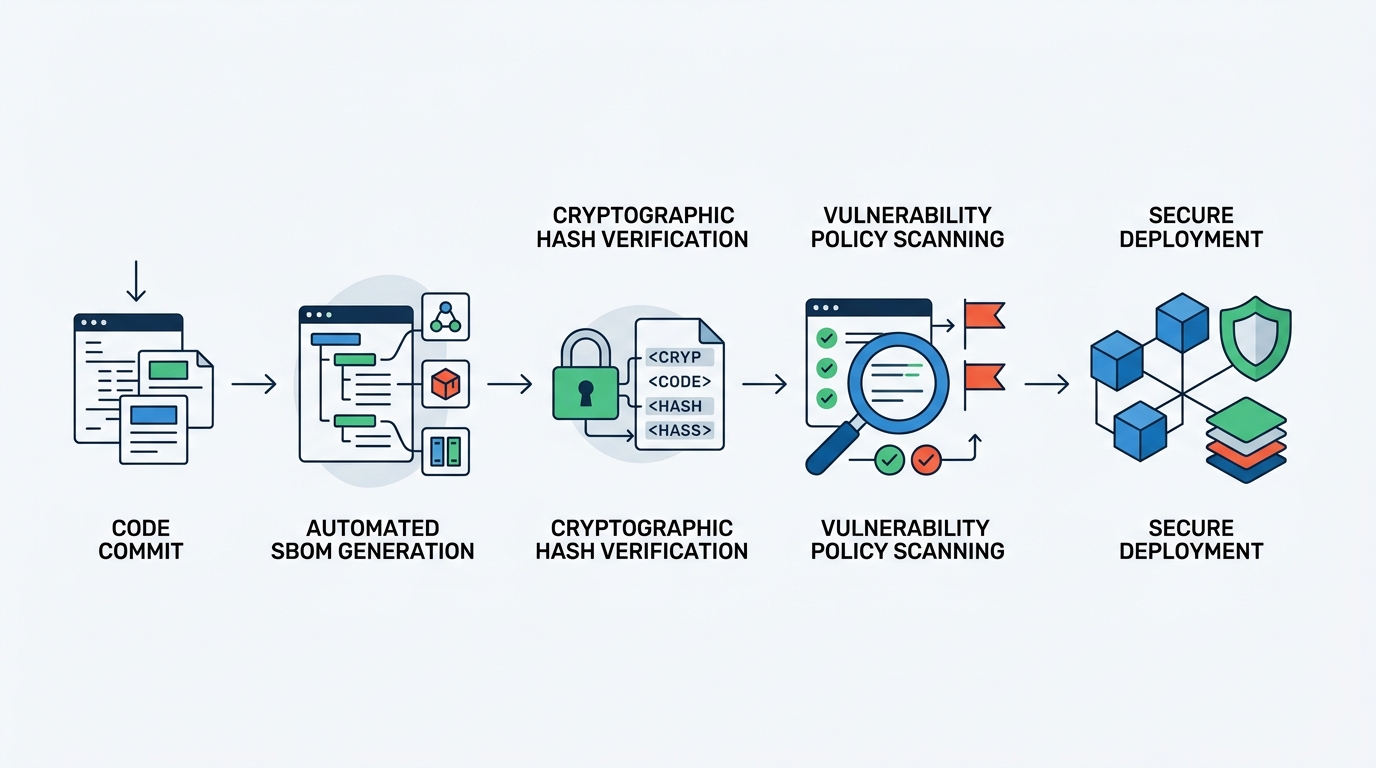
This pipeline relies on three core pillars:
- Software Bill of Materials (SBOM) Generation: Every build must generate a comprehensive, machine-readable inventory of all components, libraries, and modules. This allows us to instantly query our entire fleet when a new zero-day vulnerability is announced.
- Cryptographic Pinning and Verification: We must pin dependencies to exact cryptographic hashes (shasums) rather than loose semantic version ranges. This prevents malicious package updates from slipping into our builds during automated deployments.
- Automated Policy Enforcement: Build pipelines should automatically fail if a dependency violates pre-defined organizational policies, such as containing known high-severity CVEs or utilizing restrictive licenses.
Threat Modeling the Dependency Lifecycle
Before you allow your team to adopt a new framework or major API, I recommend conducting a targeted threat modeling exercise. This does not need to be a bureaucratic roadblock; it can be integrated into your existing design review process.
Here is a practical checklist I use to evaluate the security posture of a new technology or major framework update:
| Evaluation Vector | Key Technical Questions | Risk Mitigation Action |
|---|---|---|
| Provenance & Governance | Who maintains the project? Is there a clear security disclosure policy? | Prefer projects backed by established foundations or organizations with dedicated security teams. |
| Attack Surface | Does the framework open new network ports, require elevated privileges, or perform dynamic code execution? | Restrict runtime permissions using container security policies and AppArmor/SELinux profiles. |
| Update Velocity | How quickly are security patches released and backported to older versions? | Establish an SLA for upgrading frameworks within 14 days of a critical patch release. |
| Default Hardening | Are secure defaults (e.g., strict Content Security Policies, secure cookies) enabled out of the box? | Write custom linting rules or infrastructure-as-code (IaC) policies to enforce secure configurations. |
Concrete Actions for Engineering Leaders
To successfully bridge the gap between development velocity and secure-by-design principles, you must take immediate, structural actions within your organization.
First, shift the ownership of dependency management. It should not belong solely to a centralized security team that operates outside the daily development loop. Instead, empower your tech leads and software architects to own the security posture of their specific service boundaries. Provide them with the automated tools and telemetry needed to make informed decisions.
Second, allocate dedicated capacity for technical debt and platform upgrades. If your team is running at 100% capacity on product features, they will inevitably cut corners on framework upgrades and security configurations. I recommend dedicating at least 15% of every sprint cycle to platform maintenance, dependency updates, and security hardening.
Finally, standardize your internal developer platforms (IDPs). Reduce cognitive load on your engineers by providing pre-configured, hardened templates for new services. If a developer can spin up a new microservice that already includes secure defaults, automated SBOM generation, and pinned dependencies, they will naturally follow the path of least resistance—which also happens to be the most secure path.
Achieving a secure-by-design state while maintaining rapid development velocity is not a tooling problem; it is an architectural and cultural challenge. By implementing automated dependency verification pipelines, conducting lightweight threat modeling, and shifting security ownership to engineering teams, we can safely adopt the latest framework innovations without exposing our organizations to systemic risk. Our goal must be to make the secure path the easiest path for our developers.